


Most customer service training programs are built for call centers and banks. They'll teach your agents active listening and conflict de-escalation. What they won't teach is how to look up a late shipment in Shopify, process a return in under two minutes, or explain why a discount code isn't working.
That's a problem. Because 90% of the tickets your ecommerce customer service team handles fall into a handful of categories: order tracking, returns, exchanges, and billing questions. If your training doesn't cover those, your agents are winging it. And according to Zendesk's CX Trends Report, 61% of customers will switch to a competitor after just one poor service experience.
This guide covers eight training methods designed specifically for ecommerce teams. Not generic communication tips. Actual methods tied to the tickets your agents see every day, with clear steps and measurable outcomes.
Hear what AI support calls sound like for your store. Just paste your Shopify URL and get sample calls in under 20 seconds, no email required. Listen to demo calls for my store.
Why generic customer service training fails ecommerce teams
Here's the thing: traditional customer service training was designed for industries where the product is complex and the interaction is long. Think insurance claims, banking disputes, or technical support for software.
Ecommerce is different. Your agents handle high volumes of short, repetitive interactions. A customer calls about a late package. Another wants to exchange a size. A third is asking why they got charged twice. These aren't complex problems. They're workflow problems.
Generic training teaches agents how to be empathetic. That matters. But empathy without platform knowledge means your agent says "I completely understand your frustration" while having no idea how to actually look up the order.
The numbers back this up. According to Accenture, structured training delivers a 353% ROI, but only when it's relevant to what agents actually do. And the cost of getting it wrong is high: 70% of first-year customer service attrition happens in the first 90 days. When new hires feel unprepared, they leave.
The fix isn't more training. It's better training, built around the ecommerce customer service best practices your team needs to handle real tickets.
8 ecommerce customer service training methods that work
These methods are ordered roughly by when you'd use them. Start with sandbox training in week one. Build up to QA reviews and secret shoppers once agents are handling live tickets.
1. Sandbox order processing
Before your agents touch a real customer, give them a sandbox. Set up a Shopify development store (or a staging environment in whatever platform you use) and have new hires process at least 50 test orders.
That means placing orders, tracking shipments, initiating returns, processing refunds, handling exchanges, and applying discount codes. Every order status they'll see in the real world, they should see in the sandbox first.
Why does this work? Muscle memory. When a customer calls asking where their package is, you don't want your agent scrolling through menus for the first time. You want them to pull up the order in seconds.
How to implement it:
- Set up a test store: Clone your live store's product catalog and settings into a development environment
- Create a task checklist: 50 orders covering every scenario (cancel, partial refund, exchange, address change)
- Set a time target: Agents should complete the full checklist in 2-3 days
- Grade on speed and accuracy: Track how long each task takes and whether the result is correct
This is your first filter. If someone can't navigate your Shopify customer service app after 50 test orders, they need more time before going live.
2. Top-10 ticket scenario drills
Pull up your help desk data and identify your ten most common ticket types. For most ecommerce stores, the list looks something like this:
- Where is my order? (WISMO calls)
- I want to return this item
- I received the wrong product
- My discount code isn't working
- I was charged twice
- I want to cancel my subscription
- The item arrived damaged
- Can I change my shipping address?
- What's your return policy?
- When will this product be back in stock?
Build a one-page playbook for each scenario. Include the exact steps to resolve it, the tools to use, the information to collect, and the customer service scripts for common responses.
Then run timed drills. Present a scenario. The agent resolves it. You measure time and accuracy. Do this daily during onboarding and weekly after that.
Why it works: These ten scenarios cover roughly 90% of your ticket volume. If your agents nail these, they can handle almost anything.
3. Channel-specific training
Phone, chat, and email are three different skills. Don't assume someone who's great on chat can handle a phone call. Train each channel separately.
Phone training:
- Speaking pace: Slow down. Most agents talk too fast when nervous.
- Hold etiquette: Always explain why you're putting someone on hold and give a time estimate.
- Transfer protocols: Warm transfers only. Never cold-transfer a frustrated customer.
- Active listening: Repeat back what the customer said before jumping to a solution.
If you're running ecommerce phone support, phone training is non-negotiable. It's also the hardest channel to master, which is why many stores train it last.
Chat training:
- Typing speed: Target 60+ WPM. Slow typing kills the chat experience.
- Multitasking: Agents should handle 2-3 chats simultaneously without dropping quality.
- Tone in text: No ALL CAPS. Use exclamation marks sparingly. Read everything aloud before sending.
- Canned responses: Teach agents when to use templates and when to personalize.
Email training:
- Structure: Greeting, acknowledgment of issue, resolution/next steps, sign-off. Every time.
- Clarity: One email should resolve the issue. If the customer has to email back asking "what do I do next?", the training failed.
- Templates: Build email templates for your top scenarios but teach agents to customize them.
The customer service response time benchmarks differ by channel too. Phone satisfaction sits at 91% (the highest of any channel), while email first-response should be under 4 hours for top performers.
4. Product knowledge bootcamp
Your agents can't help customers if they don't know the products. This sounds obvious, but most ecommerce teams skip formal product training and expect agents to "pick it up as they go."
How to run a product knowledge bootcamp:
- Create cheat sheets: For your top 20 SKUs, build a one-page reference with dimensions, materials, common questions, and competitor comparisons
- Weekly "sell me this" sessions: Pick a random product. The agent explains it to the group without notes. The group asks tough questions.
- Quiz format: Monthly quizzes covering new arrivals, restocks, and product changes
- Update cadence: Cheat sheets must be updated every time the catalog changes. Outdated training is worse than no training.
This is especially critical for stores in niches like supplements, skincare, or health and wellness where customers ask detailed ingredient or usage questions.
5. Shadowing and buddy system
Pair every new hire with an experienced agent for their first one to two weeks. This is consistently rated the most effective training method by support teams. Two weeks of shadowing beats a month of classroom instruction.
The progression:
- Days 1-3: Observe. New hire listens to calls, watches chat sessions, reads email threads. No interaction with customers yet.
- Days 4-7: Co-handle. New hire drafts responses. The buddy reviews before sending. New hire takes calls with the buddy listening in.
- Days 8-14: Solo with backup. New hire handles tickets independently. The buddy is available for questions but not hovering.
The key is real context. Simulated scenarios only get you so far. Shadowing shows new hires the shortcuts, workarounds, and judgment calls that you can't put in a training manual. It's also where they learn your team structure and escalation paths.
6. QA scorecard reviews
Once agents are live, you need a system to keep improving. Build a QA scorecard and use it consistently.
Scorecard criteria:
- Greeting: Did the agent greet the customer by name?
- Problem identification: Did they correctly identify the issue on the first try?
- Resolution: Was the problem resolved? Was the resolution correct?
- Tone and empathy: Did the agent match the customer's emotional state?
- Follow-up: Did the agent confirm the customer was satisfied before closing?
Review 5-10 tickets per agent per week. Use real tickets (both good and bad) as coaching material. This connects directly to your call center quality assurance process.
The critical rule: Tie scores to coaching, not punishment. If agents feel like QA is about catching mistakes, they'll game the system instead of improving. Frame it as development. Share top-scoring tickets with the whole team as examples.
7. AI handoff training
This is the skill gap most ecommerce teams haven't addressed yet. If you're using any form of AI customer service automation, your agents need to know how to pick up where the AI left off.
Here's what that looks like in practice. A customer calls your store. An AI voice agent answers, looks up their order, and tries to resolve the issue. But the customer's situation is complex, so the AI transfers the call to a human agent.
Your agent now needs to:
- Read the AI conversation summary: Know what was already discussed so the customer doesn't repeat themselves
- Pick up smoothly: "I see you've been asking about order #4521. Let me take a closer look at that for you."
- Understand why the AI escalated: Was it a policy exception? A frustrated customer? A technical limitation?
This is new territory. Traditional call center training never covered it. But with 80% of businesses planning to adopt AI-driven voice technology by 2026, it's becoming essential.
Additional AI training topics:
- QA reviews of AI responses: Agents should periodically review what the AI said to customers and flag inaccuracies
- New metrics: Understanding AI resolution rate, handoff rate, and escalation reasons
- Knowing the boundaries: What can the AI handle vs. what should always go to a human?
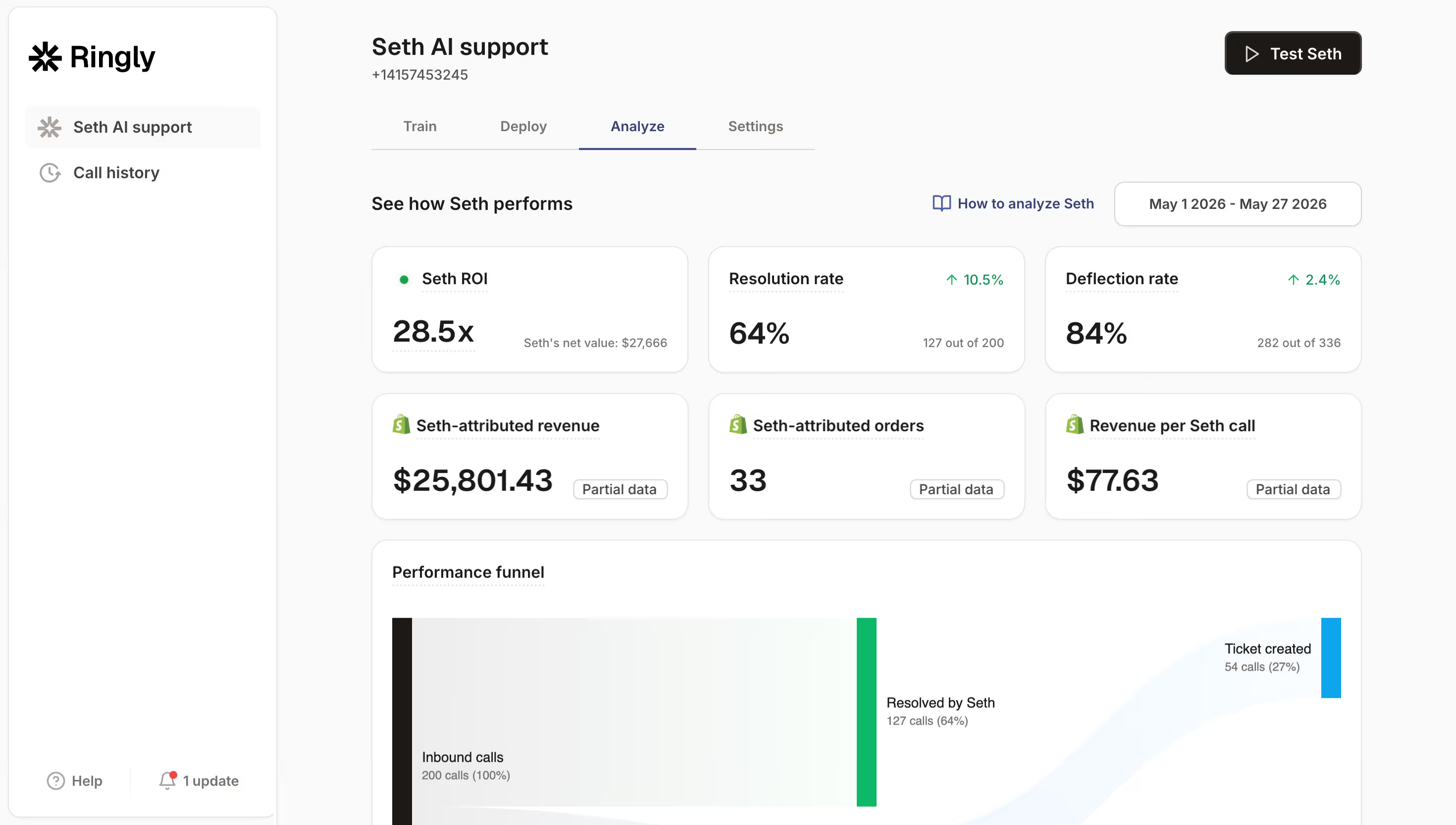
If you're using Ringly.io for AI phone support, Seth handles about 73% of calls without human help. That means your agents handle the remaining 27%, which are the harder, more nuanced conversations. Training for that specific role matters.
See how AI phone support works for your store. Setup takes three minutes, and you can hear sample calls before committing.
8. Secret shopper and call monitoring
You wouldn't run a restaurant without tasting the food. Don't run a support team without testing the experience.
Secret shopper program:
- Run mystery calls, chats, and emails once a month
- Use realistic scenarios from your top-10 ticket list
- Score the interaction using the same QA scorecard your team already knows
- Debrief as a group (anonymized). Focus on patterns, not individuals.
Ongoing call monitoring:
- Record a random sample of calls weekly
- Listen for both strengths and gaps
- Identify coaching moments (not gotcha moments)
- Track trends over time: are response times improving? Are certain issues stumping agents?
The combination of secret shoppers and monitoring gives you a complete picture. Scorecards tell you how agents perform when they know they're being reviewed. Secret shoppers tell you how they perform when they don't.
Building an ecommerce customer service training timeline
Here's a realistic onboarding timeline. Most agents hit basic proficiency by week three or four. Full productivity takes about 90 days.

| Week | Focus | Activities |
|---|---|---|
| Week 1 | Foundation | Sandbox order processing, product knowledge bootcamp, tool setup, shadowing (observe) |
| Week 2 | Practice | Scenario drills, channel-specific training, shadowing (co-handle), first live tickets with buddy |
| Week 3-4 | Go live | Solo tickets with QA reviews, AI handoff training, secret shopper baseline test |
| Day 60 | Check-in | Review KPIs vs. team average, identify weak areas, targeted coaching |
| Day 90 | Benchmark | Full proficiency assessment, graduate to independent agent, ongoing QA schedule |
The timeline isn't rigid. Some people ramp faster. But having a structure prevents the all-too-common approach of throwing new hires on the phones after two days of reading a wiki.
If you're comparing hiring vs. AI for your support team, factor in ramp time. An AI agent handles calls from day one. A human agent takes 90 days to reach full speed.
Try Ringly.io free for 14 days and see how AI handles your routine calls while your team focuses on the conversations that actually need a human touch.
How to measure if your ecommerce customer service training is working
Training without measurement is just hope. Track these customer service KPIs to know if your program is actually moving the needle.
| Metric | What it measures | Target benchmark |
|---|---|---|
| CSAT | Customer satisfaction | 85%+ |
| First contact resolution (FCR) | Issues resolved on first touch | 80%+ |
| Average handle time (AHT) | Efficiency per interaction | Varies by channel |
| Ramp time | Speed to full productivity | Under 90 days |
| Escalation rate | Agent confidence | Lower = better trained |
| NPS | Customer loyalty | 50+ |
How to use these numbers:
- Baseline first: Measure all KPIs before changing your training. You need a before-and-after comparison.
- Track by cohort: Compare agents hired in January vs. March. Did the updated training improve their ramp time?
- Watch for lag indicators: CSAT and NPS might take 30-60 days to reflect training changes. Don't panic if they don't move immediately.
According to the Freshworks 2025 Benchmark Report, the average ecommerce CSAT sits at 82%. If your trained agents are hitting 85%+, your program is working. If they're below 80%, something in the training isn't sticking. Check your ecommerce customer support statistics benchmarks for more context.
Common ecommerce customer service training mistakes
These are the patterns we see most often when outsourced customer service teams and in-house teams alike get training wrong.
- One-and-done training: Running a single onboarding session and never revisiting it. Training should be ongoing. Monthly refreshers, quarterly updates, continuous QA reviews.
- Ignoring channel differences: Assuming a good chat agent is automatically a good phone agent. They're different skills. Train them separately.
- Stale product knowledge: Your catalog changes every season. If your training materials don't change with it, agents are giving customers wrong information.
- Skipping AI training: Your team is probably already using AI tools in some form. If agents don't know how to work alongside AI (reading AI summaries, handling escalations, reviewing AI accuracy), you're leaving efficiency on the table.
- Measuring speed over quality: Average handle time matters, but not at the expense of resolution quality. An agent who spends 8 minutes solving a problem completely is better than one who spends 3 minutes and generates a callback.
Frequently asked questions
How long does it take to train an ecommerce customer service agent?
Most agents reach basic proficiency in 2-4 weeks and full productivity in about 90 days. The timeline depends on your product complexity, the channels you support, and the quality of your training program. Structured onboarding with sandbox training and shadowing consistently produces faster ramp times.
What are the most important skills for ecommerce customer service?
Platform proficiency (navigating Shopify, your helpdesk, and order management tools), product knowledge, and channel-specific communication skills. Empathy and active listening matter too, but they're useless without the technical skills to actually resolve issues.
How much does customer service training cost?
US companies spent an average of $874 per learner in 2025, according to Training Industry data. Small companies tend to spend more per person ($1,091) because they can't spread costs across large teams. In-house training using the methods in this guide costs significantly less than formal programs.
Should I train phone support separately from chat and email?
Yes. Phone requires speaking pace control, hold etiquette, and active listening skills that don't apply to chat. Chat requires fast typing and multitasking. Email requires clear written structure. Train each channel as its own skill, then cross-train once agents are proficient in one.
How do I train agents to work with AI customer service tools?
Focus on three areas: reading AI conversation summaries so customers don't repeat themselves, understanding why the AI escalated (policy exception, frustrated customer, technical limit), and periodically reviewing AI responses for accuracy. This is a new training category that most teams are still figuring out.
What's the ROI of customer service training?
An Accenture study found that structured training delivers a 353% ROI. Companies also see 82% higher new-hire retention and 42% faster ticket resolution. The key is relevance: training that covers your actual ticket types delivers far more value than generic customer service courses.
How often should customer service training be updated?
At minimum, update training materials every time your product catalog changes, your tools change, or your processes change. Run monthly refresher sessions and quarterly full reviews. If your AI customer service setup evolves, update the AI handoff training immediately.
The bottom line
Ecommerce customer service training has to be ecommerce-specific. Generic communication courses won't prepare your agents for the tickets they'll actually handle.
The eight methods in this guide give you a framework that starts on day one (sandbox training) and continues indefinitely (QA reviews, secret shoppers, ongoing coaching). They cover the skills that matter: platform knowledge, scenario handling, channel-specific communication, and working alongside AI.
The role is changing. AI handles routine calls. Humans handle the exceptions. Training your team for that reality, not for a world where every call goes to a person, is how you build a support operation that actually scales.
Ready to see what AI phone support can do for your store? Start your free 14-day trial of Ringly.io. Seth starts answering calls in three minutes, and your human agents can focus on the conversations that really need them.