
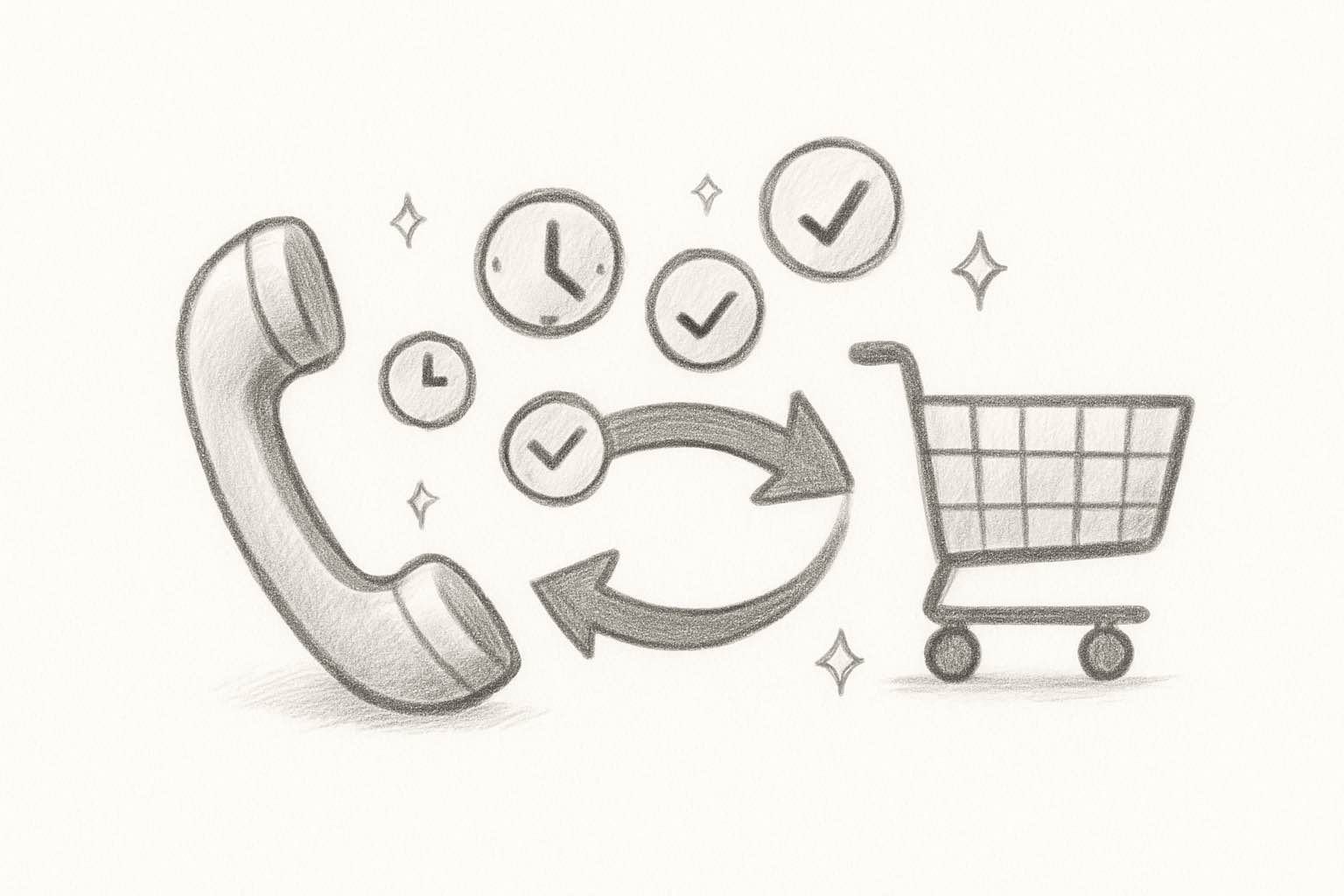
Your customer calls. Nobody picks up. They hang up and buy from someone else.
This happens thousands of times a day across ecommerce. And it's not because store owners don't care about customer callback software for ecommerce. It's because most callback tools were built for enterprise call centers, not online stores doing $50K/month with a two-person team. The result? Missed calls turn into missed revenue, abandoned carts stay abandoned, and phone support becomes a channel you avoid instead of use.
This guide covers seven callback tools that actually work for ecommerce businesses, from simple Shopify widgets to AI phone agents that handle calls without any human involvement. We tested each one, compared pricing, and called out what works (and what doesn't) so you can pick the right one for your store.
Hear what AI support calls sound like for your store. Just paste your Shopify URL and get sample calls in under 20 seconds, no email required. Listen to demo calls for my store.
Why ecommerce stores need customer callback software
Here's the thing: 75% of customers prefer getting a callback over waiting on hold. But for ecommerce, the stakes are even higher than traditional support.
When someone calls your store, they're usually ready to buy. They have a question about sizing, want to know when their order ships, or need help with a return. If nobody answers, they don't leave a voicemail. They leave your site. According to research from FoneSwift, phone callbacks recover 10-18% of abandoned carts compared to just 3-5% for email.
The math gets interesting fast. Say your store sees 2,000 abandoned carts per month with a $95 average order value. That's $190,000 in potential revenue sitting on the table. Even recovering 10% of those through callbacks puts $19,000 back in your pocket monthly.
But there's a catch. Most ecommerce teams are small. You can't staff a call center for 10-15 calls a day. And the calls that do come in are unpredictable. You might get three WISMO calls at 11 PM from international customers. Traditional callback software assumes you have agents standing by. Ecommerce stores usually don't.
That's why the type of callback software matters.
Three types of customer callback software
Not all callback tools work the same way. Most articles lump them together, but there are actually three distinct categories. Understanding the difference saves you from buying the wrong thing.
Website callback widgets
These put a "call me back" button on your website. A visitor enters their phone number, and your team gets notified to call them back.
Best for: capturing leads on product pages and during checkout. CallPage, LimeCall, and EZ Callback Request all fall into this category. The limitation? Someone on your team still needs to pick up the phone and make the call. If it's 2 AM and a customer in Tokyo wants a callback, that request sits until morning.
Call center queue callbacks
These work inside an existing call center setup. When a customer calls and hits a long hold time, the system offers to call them back when an agent is free.
Best for: high-volume support teams that already handle inbound calls. CloudTalk and Aircall are the big names here. You need agents on staff for this to work, and it only helps with inbound call queues (not proactive outreach).
AI phone agents
This is the newer category. AI answers the phone, resolves the issue, and can even make outbound callbacks to customers who abandoned carts or submitted callback requests.
Best for: ecommerce stores that need 24/7 phone coverage without hiring support staff. The AI handles order lookups, return requests, and product questions on its own. Ringly.io is the main player here for Shopify stores, resolving about 73% of calls without a human touching them.
7 best customer callback software tools for ecommerce
After reviewing these tools against ecommerce-specific criteria (Shopify integration, staffing requirements, pricing for small teams, and actual callback functionality), here's how they stack up.
| Tool | Type | Best for | Starting price | Shopify integration |
|---|---|---|---|---|
| Ringly.io | AI phone agent | AI-powered 24/7 support | $349/mo | Native |
| CallPage | Callback widget | Website lead capture | $39/mo | No |
| CloudTalk | Queue callback | Mid-size support teams | $25/user/mo | Via integration |
| LimeCall | Callback widget | Free-tier testing | Free | No |
| LiveAgent | Helpdesk + callback | Full helpdesk needs | $15/agent/mo | Via integration |
| EZ Callback Request | Shopify widget | Simple callback button | Free | Native |
| Aircall | Queue callback | Growing phone teams | $30/user/mo | Via Gorgias |
1. Ringly.io
Best for: Shopify stores that want AI-powered phone support and callbacks 24/7
Ringly.io takes a different approach to callbacks. Instead of notifying a human to call back, its AI agent (Seth) picks up the phone and handles the conversation itself. It connects to your Shopify store, pulls up order data in real time, processes returns, answers product questions, and resolves about 73% of calls without any human involvement. It works in 40 languages and takes about three minutes to set up.
For ecommerce customer service, this solves the biggest callback problem: you don't need staff on standby. Seth handles after-hours calls, weekend inquiries, and international customers calling from different time zones. Over 2,100 Shopify stores use it.
Pricing
| Plan | Price | Included |
|---|---|---|
| Grow | $349/mo | 1,000 minutes (~500 calls) |
| Enterprise | Custom | 5,000+ minutes |
| Overage | $0.19/min | Pay as you go |
14-day free trial available. See full details on the pricing page.
What works
- Native Shopify integration: pulls order data, handles returns, checks inventory without custom dev
- 24/7 coverage in 40 languages: no staffing gaps, no timezone issues
- 73% resolution rate: most calls never need a human
- 3-minute setup: no code, no IT team, no complex configuration
- Call recordings and analytics: review every conversation through AI call analysis
What doesn't
- Ecommerce-only focus: not built for law firms, healthcare, or general business use
- No website callback widget: it's a phone agent, not a lead capture form
- Flat monthly pricing: stores with very low call volume might find per-minute pricing more cost-effective
Why it ranks first: The only callback solution that actually resolves calls on its own. Every other tool on this list requires a human to handle the conversation. Ringly handles it end to end.
Try Ringly.io free for 14 days and get Seth answering calls in under three minutes.
2. CallPage
Best for: Stores that want a high-converting callback widget on their website
CallPage puts a customizable popup on your site that connects visitors with your team in about 28 seconds. It's used by 1,500+ companies and focuses heavily on lead conversion. G2 reviewers rate it 4.5/5, and users consistently praise the fast connection times.
Pricing
| Plan | Price | Calls included |
|---|---|---|
| Essentials | $39/mo | 50 calls |
| Pro | $99/mo | 100 calls |
| Enterprise | Custom | 600+ calls |
14-day free trial. Extra calls cost $30 per 50-call pack.
What works
- 28-second callback speed: visitors connect with your team almost instantly
- Customizable widget: matches your brand, triggers on exit intent or time-on-page
- Analytics dashboard: track which pages generate the most callbacks
What doesn't
- You still need staff: CallPage notifies your team, but someone has to answer
- No Shopify integration: designed for generic websites, not ecommerce platforms
- Call limits are low: 50 calls on the $39 plan doesn't go far for busy stores
Why it ranks 2nd: Best pure callback widget for turning website visitors into phone conversations. But you need a team to actually pick up.
3. CloudTalk
Best for: Mid-size ecommerce teams that already have phone support staff
CloudTalk is a cloud phone system with built-in queue callback, 160+ integrations, and AI-powered call summaries. It's a proper call center software platform with 4.4/5 on G2 across 4,000+ reviews. According to their data, CloudTalk reduces call abandonment by up to 32%.
Pricing
| Plan | Price | Key features |
|---|---|---|
| Starter | $25/user/mo | Basic calling, voicemail |
| Essential | $30/user/mo | Queue callback, IVR, analytics |
| Expert | $50/user/mo | AI features, advanced routing |
14-day free trial available.
What works
- Queue callback cuts abandonment by 32%: customers hang up less when they know you'll call back
- 160+ integrations: connects to your CRM, helpdesk, and ecommerce tools
- AI call summaries: agents get context before returning calls
- Call recording: useful for training and quality assurance
What doesn't
- Per-user pricing adds up: a 5-person team on Essential is $150/mo before any add-ons
- Overkill for small stores: if you get 10-15 calls a day, you don't need this
- Complex setup: not a 3-minute install, more like a multi-day onboarding
Why it ranks 3rd: Strong callback infrastructure for teams. But the per-user model and setup complexity make it a poor fit for small ecommerce operations.
4. LimeCall
Best for: Ecommerce stores that want to test callback on a free plan
LimeCall is a callback widget with a free tier, instant callbacks within 20 seconds, and virtual numbers from 40+ countries. They claim an 80-140% increase in leads for users. Rated 4.8/5 on G2, Capterra, and Trustpilot.
Pricing
Pricing isn't fully transparent on their site. They offer a free tier and paid plans (estimated from $35/month based on competitor comparisons). 14-day free trial on paid plans.
What works
- Free plan available: test the concept without spending anything
- 20-second callback speed: nearly instant connection
- 40+ country numbers: good for international ecommerce stores
- Lead qualification built in: filter out low-intent visitors
What doesn't
- Opaque pricing: you have to contact sales for exact plan costs
- Interface feels dated: the dashboard could use a refresh
- No deep ecommerce integrations: works as a website widget, not a Shopify app
Why it ranks 4th: The free tier makes it a low-risk way to test whether callbacks work for your store. But limited transparency and dated UX hold it back.
5. LiveAgent
Best for: Stores that want callback as part of a full helpdesk solution
LiveAgent bundles callback functionality into a broader helpdesk platform with ticketing, live chat, and social media support. Over 15,000 businesses use it, including NASCAR and Hyundai. G2 rating: 4.5/5, Capterra: 4.7/5.
Pricing
| Plan | Price | Callback included? |
|---|---|---|
| Small | $15/agent/mo | No |
| Medium | $29/agent/mo | Yes (IVR + callback) |
| Large | $49/agent/mo | Yes + advanced features |
| Enterprise | $69/agent/mo | Full suite |
30-day free trial. Callback requires the Medium plan or higher.
What works
- All-in-one platform: tickets, chat, social, phone, and callback in one tool
- 200+ features: you're unlikely to outgrow it
- Affordable per-agent pricing: $29/agent for callback is reasonable
- 30-day trial: generous testing window
What doesn't
- Callback not on base plan: you need Medium ($29) minimum for phone features
- Learning curve: 200+ features means time to configure
- Not ecommerce-specialized: no Shopify order lookup, no cart recovery features
Why it ranks 5th: Best value if you need a complete helpdesk that includes callback. But it's a generalist tool, not built for ecommerce-specific workflows.
6. EZ Callback Request
Best for: Shopify stores that just want a simple "call me" button
EZ Callback Request is a Shopify-native app that adds a callback request button to your product pages. When a customer fills it out, you get an alert within 2 seconds via phone, SMS, WhatsApp, or Messenger. It tracks whether customers who requested callbacks actually completed their purchase.
Pricing
| Plan | Price | Leads/month |
|---|---|---|
| Free | $0 | 20 |
| Startup | $9/mo | 20 |
| Basic | $19/mo | 100 |
| Professional | $79/mo | Unlimited |
Auto-downgrades during low-usage months. 4.4/5 on the Shopify App Store (44 reviews).
What works
- Shopify-native: installs in seconds, no code needed
- 2-second alerts: you know immediately when someone wants a call
- Conversion tracking: see if callbacks lead to purchases
- Free tier: 20 leads/month at no cost
What doesn't
- Zero automation: you still have to call customers back manually
- No AI: just a notification system, nothing resolves on its own
- Very basic: no call recording, no analytics beyond conversion tracking
Why it ranks 6th: The simplest Shopify callback option. It works for stores that get a handful of callback requests and have someone ready to call back during business hours.
7. Aircall
Best for: Growing ecommerce teams building a proper phone support operation
Aircall is a cloud phone system with callback, call routing, and direct integrations with Gorgias, Zendesk, and Shopify. It's designed for teams, not solo founders. G2 rating: 4.3/5. The platform connects well with ecommerce helpdesks and CRM tools.
Pricing
| Plan | Price | Key features |
|---|---|---|
| Essentials | $30/license/mo | Callback, IVR, integrations |
| Professional | $50/license/mo | Advanced analytics, monitoring |
7-day free trial. Be aware of hidden costs: a 50-agent team on Professional can see costs rise 49% above the headline price once add-ons are included.
What works
- Gorgias and Shopify integrations: callbacks sync with your existing support workflow
- Easy setup: faster onboarding than most enterprise phone systems
- Global number availability: handle callbacks from customers worldwide
What doesn't
- Per-license pricing: every agent needs a license, and minimum user requirements apply
- Hidden costs: the real price can be significantly higher than advertised
- No AI resolution: agents still handle every callback conversation manually
Why it ranks 7th: Solid phone system for teams growing into formal phone support. But the cost structure and manual-only model limit its fit for lean ecommerce operations.
How to choose the right callback software for your store
The right tool depends on your team size, call volume, and how much you want to automate. Here's a quick framework:
- Choose Ringly.io if: you want callbacks handled by AI without hiring, you're on Shopify, and you need 24/7 coverage. Set up a free trial in three minutes.
- Choose CallPage if: you have staff available to call back and want to maximize lead capture from your website
- Choose CloudTalk if: you already have a support team of 5+ people and need queue management
- Choose LimeCall if: you want to test the callback concept for free before committing
- Choose LiveAgent if: you need a full helpdesk with callback built in (and don't mind a learning curve)
- Choose EZ Callback Request if: you want the simplest possible Shopify callback button and you'll call back manually
- Choose Aircall if: you're building a formal phone support team with Gorgias or Zendesk integration
If you're unsure, start by thinking about who picks up the phone. If the answer is "nobody, that's the problem," an AI phone agent is probably your best bet. If you already have staff but want to capture more callback requests, a widget is the way to go.
Key metrics to track after adding callbacks
Adding callback software is just the start. You need to know if it's actually working. Here are the numbers that matter for ecommerce phone support ROI:
- Callback-to-sale conversion rate: what percentage of callbacks turn into completed orders? Anything above 15% is strong.
- Average response time: for abandoned cart callbacks, the 1-4 hour window after abandonment produces the best results. Miss that window and conversion drops fast.
- Cart recovery rate: compare your callback recovery rate against your email (3-5% baseline) and SMS (2-4% baseline) recovery rates. Phone callbacks should significantly outperform both.
- Cost per resolved contact: divide your monthly callback software cost by the number of issues resolved. AI agents typically bring this under $2 per contact.
- Customer satisfaction post-callback: ask a simple 1-5 rating question after each callback. Track trends, not individual scores.
- Best callback days: industry data shows Tuesday through Thursday produce the highest conversion rates (27-29%) for callback outreach.
Track these monthly. If your callback-to-sale rate stays below 5% after 30 days, either the timing is off or the tool isn't matching your customer expectations.
Frequently asked questions
What is customer callback software?
Customer callback software lets shoppers request a phone call from your team (or an AI agent) instead of waiting on hold or filling out a contact form. For ecommerce, it typically shows up as a button on product pages or checkout, or as an automatic callback after a missed call.
How much does callback software cost for an ecommerce store?
It ranges widely. Simple Shopify widgets like EZ Callback Request start free. Callback widgets run $39-99/month. Cloud phone systems with callback cost $25-50 per user per month. AI phone agents like Ringly.io start at $349/month flat (no per-user pricing).
Can callback software actually reduce cart abandonment?
Yes. Phone callbacks recover 10-18% of abandoned carts, compared to 3-5% for email and 2-4% for SMS, according to industry research. The key is speed: calling within 1-4 hours of abandonment produces the strongest results.
Do I need a support team to use callback software?
Not anymore. Traditional callback tools (widgets and queue systems) require someone to answer the phone. AI phone agents handle calls autonomously, looking up orders, answering questions, and processing returns without human involvement.
What's the best callback software for Shopify stores?
For AI-powered, hands-off phone support: Ringly.io. For a simple "request a call" button: EZ Callback Request (free on the Shopify App Store). For teams with existing phone support staff: Aircall integrates directly with Gorgias and Shopify.
How fast should a callback happen?
For widget-based callbacks: within 30 seconds to 5 minutes. The faster, the better, because the customer is still on your site. For abandoned cart recovery callbacks: within 1-4 hours of abandonment. After 24 hours, conversion rates drop significantly.
Can AI phone agents fully replace traditional callback software?
For ecommerce, yes. AI agents like Ringly.io's Seth handle inbound calls, make outbound callbacks, look up order data, and resolve ~73% of issues without a human. Traditional callback software only connects the call. AI resolves it. For stores that want to set up phone support without building a team, AI agents are the more practical path.
Making callbacks work for your store
Callback software for ecommerce has evolved past the "press 1 to request a callback" model. The gap between a $9/month Shopify widget and a $349/month AI phone agent is real, but so is the gap in results.
If you have staff and just need to capture callback requests, a widget gets the job done. If you want callbacks answered, resolved, and tracked without hiring anyone, that's where AI steps in.
The bottom line: every missed call is a missed sale. The tool you pick matters less than the fact that you pick one.
Ready to hear what AI phone support sounds like for your store? Start your free trial. Setup takes three minutes.