

Most ecommerce store owners look at phone support and see a cost. They see agent salaries, phone systems, and hours spent on hold music. But here's what the numbers actually say: inbound phone calls convert 10-15x higher than web leads, according to research from BIA/Kelsey. That means every call your store misses isn't just an inconvenience. It's lost revenue.
The problem is that phone support has always been expensive. Building an in-house team runs $200,000+ per year. Outsourcing to a call center means $1,000-2,500 per month with inconsistent quality. So most Shopify store owners skip ecommerce phone support entirely and stick with email and chat. But the ROI math has changed dramatically in 2026, and this article breaks down exactly how.
Hear what AI support calls sound like for your store. Just paste your Shopify URL and get sample calls in under 20 seconds, no email required. Listen to demo calls for my store.
Why phone support has the highest ecommerce phone support ROI of any channel
Let's start with the data that most store owners miss.
Phone calls don't just resolve issues. They generate revenue. According to BIA/Kelsey's research on call commerce, 29% of all incoming calls lead to a sale, appointment, or reservation. Compare that to web leads, which convert at roughly 2%. That's not a small gap. It's an entirely different category of lead quality.
And it's not just about conversion rates. Customers who pick up the phone tend to spend more. Research shows that shoppers spend 17% more with companies that deliver excellent service, and 89% of consumers are more likely to make another purchase after a positive service experience.
Here's why this matters for your store:
- Higher average order value: Phone conversations let you recommend products, clarify sizing, and build confidence. Upselling during calls increases revenue by 10-30% on average.
- Stronger customer retention: A single positive phone interaction creates loyalty that email can't match. A 10% boost in customer retention raises your company's value by 30%.
- Trust signal: 76% of consumers prefer phone when they need help with a purchase. Just having a phone number on your site tells visitors you're a real business.
- Complex purchase guidance: For products like supplements, skincare, or electronics, customers often need a conversation before they commit. Chat can't always handle that.
Phone support isn't just a service channel. It's a sales channel. And most ecommerce brands are leaving that money on the table.
The hidden cost of NOT having phone support
Before you calculate the ROI of adding phone support, calculate what you're losing without it.
The numbers are surprisingly harsh. Small businesses lose an average of $126,000 per year to missed calls, according to research from AMBS Call Center. And that's across all industries, not just ecommerce.
Here's where it gets worse. Of the calls that do come in, businesses only answer 37.8% of them. The rest go to voicemail. And 80% of callers who reach voicemail hang up without leaving a message.
So where do those callers go? 62% of them contact a competitor.
Think about that for a second. More than half of your potential phone customers are walking straight to someone else's store because nobody picked up.
- After-hours losses: Roughly 40% of ecommerce calls come outside business hours. If your store closes at 5 PM, you're missing nearly half your call volume. That's pure lost revenue, especially for stores selling to customers in different time zones. A good after-hours customer service strategy fixes this.
- Cart abandonment: The average cart abandonment rate is 69.57% (Baymard Institute). Phone outreach recovers 25-55% of abandoned carts, compared to just 3-5% for email. If you're only using email for cart recovery, you're recovering a fraction of what's possible.
- Return prevention: When customers call before buying, they get product guidance that reduces returns. Fewer returns means higher margins. Fewer returns also means fewer refund requests to manage.
The cost of phone support isn't just what you spend. It's what you lose by not having it.
See what calls you're missing. Try Ringly.io free for 14 days and get Seth answering calls in under three minutes.
Three ways to offer ecommerce phone support (and what each costs)
Not all phone support is built the same. Here's an honest breakdown of your three main options, with real pricing.
Option 1: In-house support team
This is the traditional route. You hire customer service agents, train them on your products, and have them answer calls during business hours.
What it costs:
| Expense | Annual Cost |
|---|---|
| 4-5 agents ($18-20/hour base) | $150,000-$210,000 |
| Benefits + payroll taxes (~30%) | $45,000-$63,000 |
| Training and management | $15,000-$25,000 |
| Phone system + tools | $5,000-$12,000 |
| Total | $215,000-$310,000 |
For 24/7 coverage, you're looking at $500,000+ because you need three full shifts.
When it makes sense: Stores doing $5M+ in revenue with complex products that need deep product knowledge. If your average call requires 10+ minutes of nuanced conversation, in-house gives you the most control.
The downside: It's slow to scale, expensive to maintain, and you still can't cover nights and weekends without significant extra cost. There's a reason most growing stores look at other options first. Check out the full breakdown in our Shopify customer service cost guide.
Option 2: Outsourced call center
Outsourcing shifts the hiring and management burden to a third party. You pay per hour or per call, and they handle the staffing.
What it costs:
| Model | Cost Range |
|---|---|
| US-based (per agent hour) | $25-$45/hour |
| Nearshore (Caribbean/LatAm) | $12-$18/hour |
| Offshore (Philippines/India) | $6-$14/hour |
| Per-call pricing | $8-$18/call |
| Monthly (mid-volume) | $1,000-$2,500/month |
When it makes sense: Stores needing overflow coverage or after-hours support without building a full team. Also good if you have seasonal spikes (holiday rushes, flash sales).
The downside: Quality control is the biggest issue. US shoppers have little patience for reps who don't know your products or struggle with English. And the "hidden costs" add up: onboarding fees, quality monitoring, re-training, and the time you spend managing the relationship. We've seen stores that thought they'd save money end up spending more than in-house once you add it all up. Read more about outsourcing Shopify customer service.
Option 3: AI phone agents
This is the newest option, and it's changed the math completely. AI phone agents answer calls, look up orders, handle returns, and answer product questions automatically.
What it costs (using Ringly.io as an example):
| Plan | Monthly Cost | Included | Per-Minute Overage |
|---|---|---|---|
| Grow | $349/month | 1,000 minutes (~500 calls) | $0.19/min |
| Enterprise | Customnth | 5,000+ minutes | $0.19/min |
That works out to roughly $0.35-$0.70 per call. Compare that to $15-$25 per call for a human agent.
When it makes sense: Most Shopify stores, especially those doing under $5M. AI handles the 70-80% of calls that are routine (WISMO calls, returns, product questions) and escalates the rest to humans.
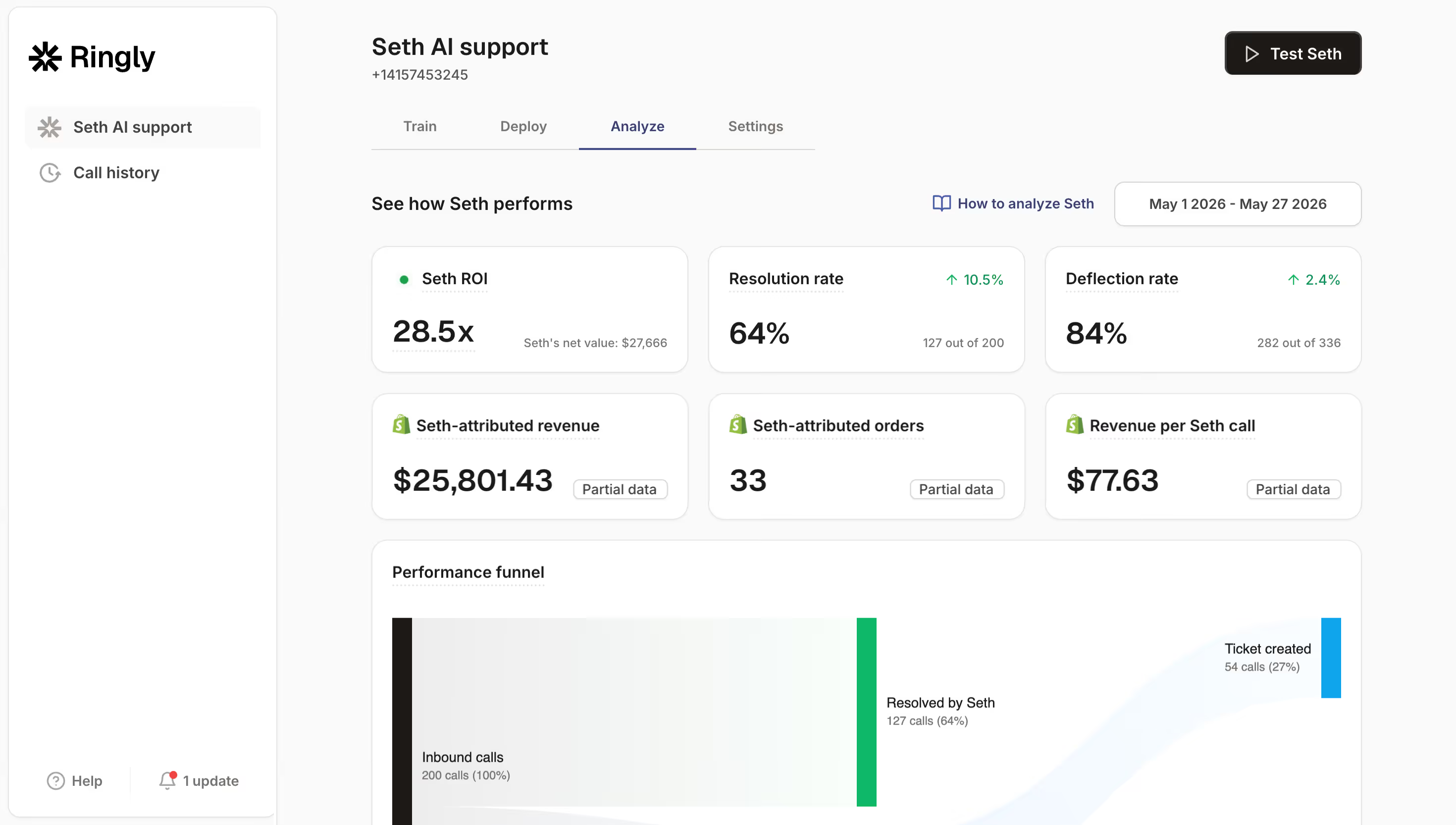
The downside: AI can't handle every situation. Complex complaints, emotional customers, and highly custom orders still need a human. But the best AI phone agents (like Ringly.io's Seth) know when to escalate, resolving about 73% of calls without human intervention and transferring the rest.
Ecommerce phone support ROI: how to calculate yours
Here's the formula. It's simpler than you think.
ROI = ((Revenue from phone + Cost savings - Phone support cost) / Phone support cost) x 100
Let's break down each piece.
Revenue from phone is where most stores undercount. It's not just the orders placed over the phone. It includes:
- Converted calls: Number of calls x your close rate x your average order value
- Upsells: Additional revenue from product recommendations during calls
- Recovered carts: Revenue from abandoned cart callbacks that would otherwise be lost
Cost savings come from several places:
- Reduced returns: Customers who get phone guidance before purchasing return products less often
- Lower churn: Satisfied callers stay longer, increasing lifetime value
- Fewer escalations: Quick phone resolutions prevent small issues from becoming expensive complaints
Here's a benchmark table to help you estimate:
| Input Variable | Benchmark Range |
|---|---|
| Calls per month | 50-2,000 (depends on store size) |
| Call-to-sale conversion rate | 15-29% |
| Average order value | $50-$200 |
| Cart recovery rate (phone) | 25-35% |
| Return rate reduction | 5-15% |
| Monthly phone support cost | $349-$3,000 |
Track these customer service KPIs monthly. The ROI becomes obvious within 30-60 days.
ROI scenarios by store size
Let's put real numbers to three common scenarios. These are conservative estimates based on industry benchmarks.
Small store ($500K-$1M revenue)
A store at this size typically gets 50-100 support calls per month. Many of these are order tracking questions and return requests.
| Metric | Value |
|---|---|
| Monthly calls | 75 |
| AI phone agent cost | $349/month |
| Calls converted to sales (20%) | 15 |
| Average order value | $85 |
| Revenue from converted calls | $1,275/month |
| Recovered abandoned carts (5/month) | $425/month |
| Reduced returns savings | $200/month |
| Total monthly value | $1,900/month |
| Monthly ROI | 445% |
Even at this small scale, phone support pays for itself more than 4x over. And this doesn't count the lifetime value of customers who become repeat buyers because they had a good phone experience.
Mid-size store ($1M-$5M revenue)
At this level, you're handling 200-500 calls per month. The ROI gets even more compelling.
| Metric | Value |
|---|---|
| Monthly calls | 350 |
| AI phone agent cost | $500/month (with overage) |
| Calls converted to sales (22%) | 77 |
| Average order value | $110 |
| Revenue from converted calls | $8,470/month |
| Recovered abandoned carts (15/month) | $1,650/month |
| Reduced returns savings | $600/month |
| After-hours revenue capture | $1,500/month |
| Total monthly value | $12,220/month |
| Monthly ROI | 2,344% |
This is where the hiring vs. AI decision becomes clear. An in-house team handling this volume would cost $150,000+/year. AI handles it for under $6,000/year.
Scaling store ($5M+ revenue)
Larger stores often use a hybrid approach: AI for routine calls, humans for complex ones.
| Metric | Value |
|---|---|
| Monthly calls | 1,200 |
| Hybrid cost (AI + part-time human) | $2,000/month |
| Calls converted to sales (25%) | 300 |
| Average order value | $130 |
| Revenue from converted calls | $39,000/month |
| Recovered abandoned carts (40/month) | $5,200/month |
| Reduced returns savings | $1,800/month |
| After-hours revenue capture | $4,500/month |
| Total monthly value | $50,500/month |
| Monthly ROI | 2,425% |
At this scale, phone support isn't optional. It's one of your highest-returning investments. The key is building the right team structure around AI and human agents working together.
Five ways phone support directly increases revenue
Phone support ROI isn't just about answering calls. It's about what happens during and after those calls.
- Abandoned cart recovery: Phone outreach recovers 25-55% of abandoned carts, compared to 3-5% for email alone. For a store losing $10,000/month to cart abandonment, that's $2,500-$5,500 in recovered revenue. Learn how to set up abandoned cart phone calls.
- Upselling and cross-selling: When a customer calls about a product, you (or your AI agent) can recommend complementary items. This increases average order value by 10-30%. It's the ecommerce equivalent of "would you like fries with that?"
- Reduced returns: Customers who get product guidance on the phone buy the right product the first time. This cuts return rates by 5-15%, which directly improves your margins. Fewer returns also means lower refund rates and less reverse logistics cost.
- Customer retention and lifetime value: 89% of consumers who have a positive service experience make another purchase. Phone creates stronger emotional connections than email or chat, which translates to higher customer retention and lifetime value.
- After-hours revenue capture: About 40% of ecommerce calls happen outside business hours. If you're only available 9-5, you're missing nearly half your phone opportunities. 24/7 coverage (easy with AI) turns those missed calls into sales.
Try Ringly.io free for 14 days. Setup takes three minutes, and Seth starts answering your calls the same day.
What the best ecommerce phone support setup looks like in 2026
The winning formula isn't all-human or all-AI. It's a hybrid.
According to Gartner, 50% of all customer interactions will be AI-powered by 2027. For ecommerce specifically, the sweet spot is AI handling 70-80% of routine volume and humans picking up the complex 20-30%.
Here's what that looks like in practice:
- AI handles: Order status checks, return initiation, product FAQ, shipping questions, store hours, basic troubleshooting. These make up the bulk of your call volume (WISMO calls alone are roughly 40%).
- Humans handle: Angry customers, complex complaints, custom orders, VIP accounts, situations that need empathy and judgment.
- 24/7 coverage: AI never sleeps. Your customers in different time zones always get a live answer instead of voicemail.
- Shopify integration: The best AI phone agents pull real-time order data, so they can tell a customer exactly where their package is without putting them on hold. Ringly.io does this natively with Shopify.
- Call analytics: Every call is recorded and analyzed. You see what customers ask about most, where they get stuck, and what converts. This feeds your product, marketing, and customer service training efforts.
- Smart call transfer: When AI hits its limit, it transfers to a human with full context. The customer doesn't have to repeat themselves.
You don't need to build this overnight. Start with AI for routine calls and add human escalation as you grow. Most Shopify stores can set up phone support in under an hour.
Ready to see what this looks like for your store? Start your free trial and get AI phone support running today.
Frequently asked questions
What is a good ROI for ecommerce phone support?
Most stores see 400-2,000%+ ROI on phone support when using AI agents, depending on call volume and average order value. Even at the low end (50 calls/month), phone support typically pays for itself 4-5x over when you factor in converted calls, recovered carts, and reduced returns.
How much does phone support cost for an online store?
It depends on the approach. In-house teams run $200,000-$310,000/year. Outsourced call centers cost $1,000-$2,500/month. AI phone agents like Ringly.io start at $349/month for about 500 calls. For most Shopify stores, AI is the most cost-effective option by far.
Is phone support better than live chat for ecommerce?
For conversion, yes. Phone calls convert 10-15x higher than web leads. But phone costs more per interaction ($0.35-$25/call vs. $0.50-$12/chat). The best approach is offering both: chat for quick questions and phone for complex purchases and high-value customers. Read our full breakdown of ecommerce customer service channels.
How do AI phone agents handle ecommerce calls?
AI phone agents answer calls in natural-sounding voice, look up order information in real-time via Shopify integration, process return requests, answer product questions from your knowledge base, and transfer to humans when needed. Ringly.io's agent Seth resolves about 73% of calls automatically across 40 languages.
How many calls does a typical Shopify store get per month?
It varies widely. Stores doing $500K-$1M typically get 50-100 calls/month. Stores at $1M-$5M handle 200-500 calls. Stores above $5M often see 500-2,000+ calls monthly. Check call center statistics for 2026 for more benchmarks.
Can phone support reduce cart abandonment?
Absolutely. Phone outreach recovers 25-55% of abandoned carts, compared to just 3-5% for email. The personal touch of a phone call (even an AI-powered one) creates urgency and removes purchase hesitation in ways that email can't. See our guide on abandoned cart phone calls for setup instructions.
The bottom line on ecommerce phone support ROI
Phone support isn't a cost center. It's one of the highest-ROI investments an ecommerce store can make. The data is clear: calls convert at 10-15x the rate of web leads, they increase order values, they reduce returns, and they build the kind of customer loyalty that drives repeat purchases.
The barrier used to be cost. Not anymore. AI phone agents bring the entry price down from $200,000+/year to $349/month, while delivering 24/7 coverage in 40 languages. For most Shopify stores, the question isn't whether you can afford phone support. It's whether you can afford not to have it.
Start measuring what you're losing from missed calls. Then do the math. You'll probably find that phone support is the most undervalued channel in your entire ecommerce customer service stack.
Try Ringly.io free for 14 days and see the ROI for yourself. Setup takes three minutes.