

You launched your Shopify store, ran a solid ad campaign, and now you're spending three hours a day answering "where is my order?" emails instead of actually growing your business.
Sound familiar? You're not alone. According to Shopify's own research, 58.3% of shoppers never even receive a response to their inquiries. And when you're a team of one or two, keeping up with customer questions while also managing inventory, marketing, and fulfillment feels impossible.
Here's the thing: you don't need a 20-person support department to deliver great customer service for Shopify. You need a system built specifically for small teams. This guide gives you exactly that. You'll get a practical framework for which channels to cover first, which tools to use (with real pricing), when to automate, and when to actually hire someone.
Hear what AI support calls sound like for your store. Just paste your Shopify URL and get sample calls in under 20 seconds, no email required. Listen to demo calls for my store.
Why small teams need a different customer service approach
Most customer service advice online is written for companies with dedicated support departments. Fifteen agents, a team lead, a Zendesk admin, and a training budget. That advice doesn't work when you're the founder, the marketer, the fulfillment manager, and the support agent all at once.
The numbers make this painfully clear. A SuperOffice study found that 72% of customers expect a response within 30 minutes. But the industry average response time is 4 to 6 hours. For small teams juggling everything, that gap is even wider.
And the stakes are real. According to Salesforce, 89% of customers will switch to a competitor after a poor support experience. American Express found that 50% of US consumers have abandoned a purchase entirely because of bad service. On the flip side, 7 in 10 shoppers will spend 17% more with companies that consistently deliver great service.
The typical enterprise playbook says "be everywhere, respond instantly, and personalize every interaction." That's not happening when your team is three people. And trying to do it all leads to burnout, slow responses, and worse service overall.
So what does this mean for your store? You can't afford to do ecommerce customer service poorly. But you also can't afford to do everything. The answer is to pick fewer channels, do them well, and let automation handle the rest. Think of it as the "good enough" approach: two or three channels done really well beats five channels done badly.
Which channels to cover first (and which to skip)
Decision paralysis is real. Email, live chat, phone, Instagram DMs, Facebook Messenger, TikTok comments. Where do you even start?
Here's the priority order that works for most small Shopify teams:
| Priority | Channel | When to add | Why |
|---|---|---|---|
| 1 | Day one | Asynchronous, manageable, sets clear expectations | |
| 2 | Live chat | Once email response time is consistently under 2 hours | Boosts conversion by up to 69% (Shopify data) |
| 3 | Phone | When you have chat + email running smoothly | Customers want it, AI makes it affordable |
| 4 | Social DMs | Only after the first three are solid | Highest maintenance, lowest ROI for most stores |
Start with email. It's the easiest to manage because it's asynchronous. You can respond in batches two or three times a day rather than needing to be available in real time. Set a clear expectation on your site ("We respond within 24 hours") and beat it consistently.
Add live chat second. Shopify's own data shows that faster chat responses can increase conversion by up to 69%. But only add it when you can actually respond quickly. A chat widget that goes unanswered is worse than no chat at all.
Phone support is the channel most stores skip. And it makes sense: you can't sit by the phone 24/7. But customers still call, especially for high-value orders and urgent issues. This is where AI phone agents change the equation. Tools like Ringly.io let an AI agent handle inbound calls around the clock, looking up orders, processing returns, and escalating to you only when needed. It's like having a Shopify call center without hiring anyone.
Social DMs come last. They're high-maintenance and customers don't expect instant responses there the way they do with chat. Focus on the channels that move the needle first.
The "two-channel start" strategy
If you're just getting started, pick two channels and master them. Email plus one real-time channel (either live chat or AI phone support) covers the vast majority of customer needs without stretching you too thin.
Most Shopify stores start solo, with one person handling everything. That works until you hit about 20-30 support conversations a day. At that point, you need a system rather than just responding to whatever comes in.
The key insight: consistency beats speed for small teams. Responding to every email within 4 hours is better than responding to some within 10 minutes and forgetting others for two days. Pick your target response time, post it on your site, and hit it every single time.
The best tools for Shopify customer service small teams
You don't need enterprise software. Here's what actually works at each stage, with real pricing.
| Tool | Best for | Starting price | Shopify integration |
|---|---|---|---|
| Shopify Inbox | Free chat for any store | $0/mo | Native (built-in) |
| Help Scout | Email-first support | $0/mo (free plan) | Yes |
| Tidio | Chat + AI chatbot | $29/mo | Yes |
| Gorgias | Growing ecommerce teams | $10/mo | Deep (Premier Partner) |
| Ringly.io | AI phone support 24/7 | $349/mo | Deep (order lookups, returns) |
| Zendesk | Large omnichannel teams | $19/agent/mo | Yes (free app) |
Free and low-cost options
Shopify Inbox is the obvious starting point. It's free with every Shopify plan and gives you live chat with AI-powered suggested replies. You can see what's in a customer's cart while you chat, which is genuinely useful for ecommerce personalization. When you're offline, conversations fall back to email so nothing gets lost. The downside: it's chat-only. No email ticketing, no phone, and limited reporting.
Help Scout offers a surprisingly good free plan: 5 users, a shared inbox, a knowledge base, and AI-drafted responses for up to 50 contacts per month. If email is your primary channel and you want something that just works, this is a strong pick. G2 reviewers give it 4.4/5 across 3,696 reviews.
Tidio starts at $29/month and bundles live chat with a visual chatbot builder (no coding required). Their AI agent Lyro is an add-on at $39/month. It's rated 4.6/5 on G2 with 1,879 reviews, and setup is genuinely fast.
Mid-tier tools for growing teams
Gorgias is built specifically for Shopify stores. It's the only helpdesk with deep bi-directional Shopify sync, meaning your agents can edit orders, process refunds, and manage subscriptions without leaving the inbox. Pricing starts at $10/month for 50 tickets, but it scales to $60/month for 300 tickets. The ticket-based pricing means unlimited agents, which is great. But watch out: AI Agent conversations get double-billed (helpdesk ticket plus $0.90-$1.00 per AI conversation). G2 rating: 4.6/5 from 548 reviews.
Zendesk is the enterprise option. It starts at $19 per agent per month for basic ticketing, but most useful features require the Suite Team plan at $55/agent/month. Add AI copilot ($50/agent/month) and it gets expensive fast. It's powerful, but honestly overkill for most stores under 500 tickets per month. Check our Zendesk pricing breakdown for the full picture.
Phone support without a call center
This is the gap nobody else talks about. Your customers want to call you, but you can't staff phones around the clock. Hiring a single customer service rep costs $3,000-$4,000 per month. That's not realistic for most small Shopify stores.
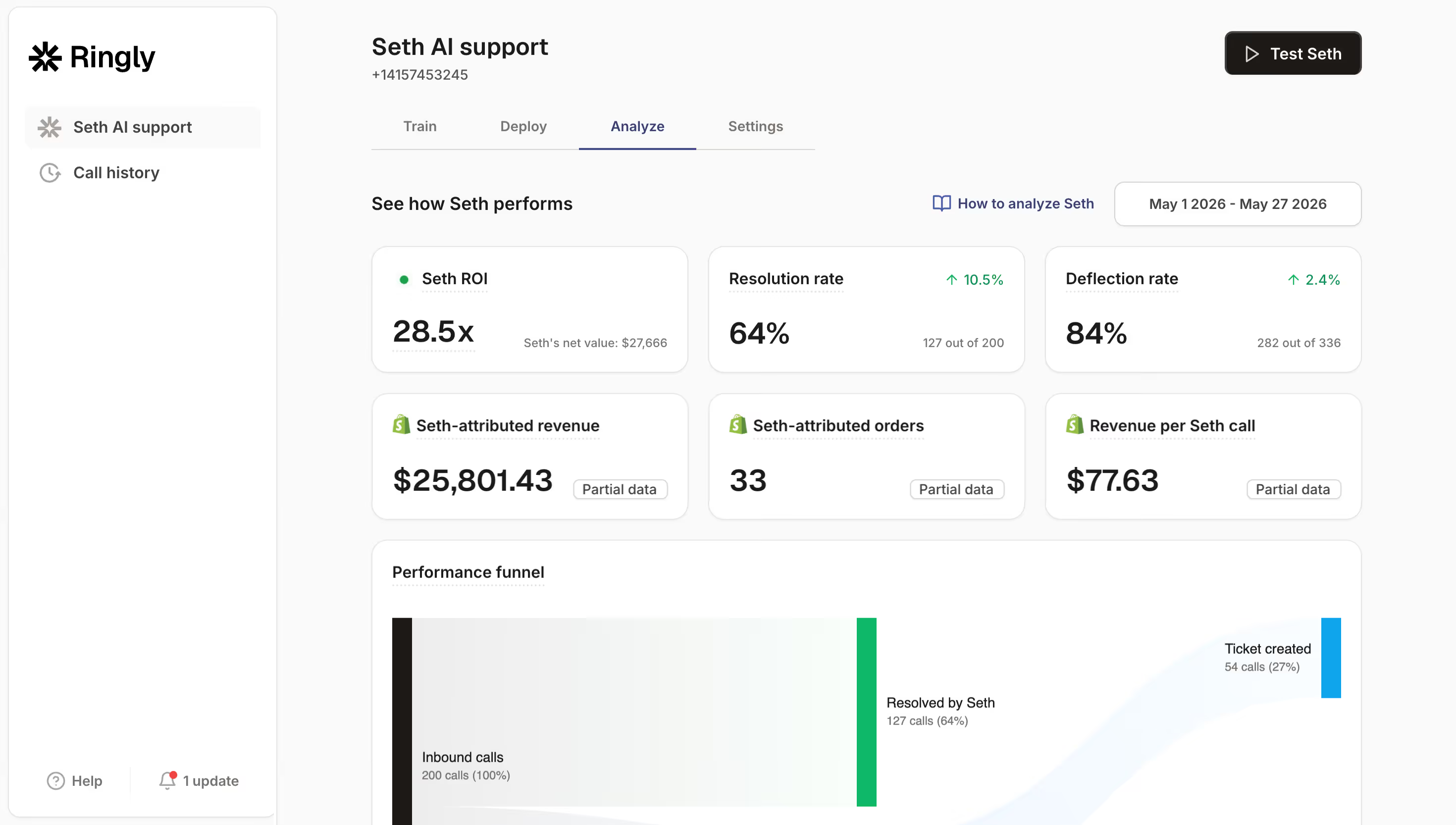
Ringly.io solves this with an AI phone agent called Seth. It picks up every call, 24/7, in 40 languages. Seth looks up orders in your Shopify store in real time, handles WISMO calls ("where is my order?"), processes returns, answers product questions, and only escalates to you when it genuinely can't help. The resolution rate is about 73% without any human involvement.
Setup takes about three minutes. No code, no phone system configuration. And pricing starts at $349/month for 1,000 minutes, which covers most small stores comfortably. Try it free for 14 days and see what it sounds like for your store.
How to set up your Shopify customer service workflow in a weekend
You don't need weeks of planning. A weekend is enough to go from "answering emails randomly" to "running a real support operation."
The goal is simple: give customers ways to help themselves, give yourself templates for the rest, and set up tools so nothing falls through the cracks.
Saturday: build your self-service foundation
Self-service content reduces ticket volume by 30-50%. That's not a small number. If you're getting 20 support emails a day, a good FAQ page and order tracking setup could cut that to 10-14. Start here:
- FAQ page: Cover your top 10 questions. Order tracking, shipping times, return policy, sizing/fit, payment methods, international shipping, damaged items, discount codes, product care, and contact info.
- Shipping and return policies: Write these clearly and link them from product pages, the cart page, and order confirmation emails.
- Order tracking page: If you use an app like Track123 or AfterShip, embed a tracking widget on your site. This alone can cut WISMO calls significantly.
Sunday: set up your tools and templates
Install your tools: Shopify Inbox for chat (5 minutes). Ringly.io for phone support (3 minutes). Help Scout if you want email ticketing (15 minutes).
Build 10-15 canned responses: These handle the bulk of your daily questions. Here are the ones every Shopify store needs:
Order status inquiry: "Your order [#] shipped on [date] via [carrier]. Here's your tracking link: [link]. Delivery is estimated for [date]."
Return/refund request: "We're happy to help with your return. Here's how it works: [policy link]. To start the process, [steps]."
Shipping timeline: "We ship within [X] business days. Standard delivery takes [X-Y] days. Express is available at checkout for [X] days."
Product question: "Great question about [product]. [Answer]. If you want more details, check out [product page link]."
Damaged/wrong item: "I'm sorry about that. Please send us a photo of the issue and we'll get a replacement or refund sorted right away."
Discount/promo inquiry: "Here's what we have running right now: [current promo details]."
Out of stock: "That item is currently out of stock. Sign up for restock notifications here: [link]. We expect it back by [date if known]."
Check out our customer service scripts for ecommerce for even more templates you can copy and paste.
- Create a simple SOP: Write a one-page document covering how to handle customer complaints, escalation rules (when to offer a refund vs. replacement vs. escalate to you), and your response time targets.
Monday: review and refine
After your first full day with the new system, look at what happened. Which canned responses did you use most? Which questions didn't have a template yet? Add those templates. Check if your FAQ page actually answers the questions customers keep asking.
This review loop is what separates stores that run support well from stores that just react to whatever comes in. Spend 15 minutes at the end of each week updating templates and your FAQ based on what customers actually asked.
When to automate vs. when to hire
This is the question every growing Shopify store owner faces. Here's a framework that actually helps.
The benchmark: A single support agent typically handles 30 to 50 tickets per day, depending on complexity. That means one full-time person can cover roughly 600 to 1,000 tickets per month.
Automate first. Before hiring anyone, automate the repetitive stuff:
- WISMO tracking: Set up automated order status emails and a self-service tracking page. This alone can eliminate 30-40% of your tickets.
- FAQ chatbot: Tools like Tidio's Lyro or Shopify Inbox's AI can handle common questions automatically.
- Phone support: An AI phone agent like Ringly.io handles calls 24/7 without you lifting a finger. Based on AI customer service statistics, about 30% of service cases are already resolved by AI as of 2025, and that number is expected to hit 50% by 2027.
- Canned responses: Pre-written templates cut response time by 50% or more.
Hire when these triggers hit:
| Trigger | What it means |
|---|---|
| 2,000+ tickets/month | One person can't keep up, even with automation |
| CSAT drops below 80% | Quality is slipping (ecommerce benchmark is 82%) |
| First response time exceeds 4 hours consistently | Customers are waiting too long |
| You're spending 4+ hours/day on support | It's eating into growth time |
The AI customer service market hit $15.12 billion in 2026 and 89% of small businesses now use AI in some form. The smart move is to automate first, hire second. If phone volume is the bottleneck, try Ringly.io before hiring. It costs a fraction of a full-time agent.
What a realistic monthly support budget looks like
Here's what most small Shopify stores spend on support at different stages:
| Stage | Monthly ticket volume | Recommended tools | Monthly cost |
|---|---|---|---|
| Just started | Under 100 | Shopify Inbox + FAQ page | $0 |
| Growing | 100-500 | Shopify Inbox + Help Scout free + Ringly.io | ~$349 |
| Scaling | 500-2,000 | Gorgias + Ringly.io | ~$160-$460 |
| Hiring point | 2,000+ | Gorgias + Ringly.io + 1 part-time agent | ~$460 + agent salary |
Here's what matters: you can cover chat, email, and phone support for under $200/month before you ever need to hire. That's the power of picking the right tools for a small team. Read more about outsourcing Shopify customer service when you're ready to scale further.
5 metrics every small Shopify team should track
You can't improve what you don't measure. But you also don't need a 50-metric dashboard. Track these five customer service KPIs and you'll know exactly where you stand.
- First response time: How fast you reply to the first message. Target: under 1 hour for chat, under 4 hours for email. Check response time benchmarks for your industry.
- Resolution time: How long it takes to fully resolve an issue, start to finish. Shorter is better, but don't sacrifice quality for speed.
- CSAT score: Customer satisfaction, usually measured with a post-interaction survey. The ecommerce benchmark is 82%. If you're above that, you're doing well.
- Ticket volume by channel: Know where your customers reach out. This tells you which channels to invest in and which to deprioritize.
- First-contact resolution rate: What percentage of issues get resolved in the first interaction, without follow-ups. Higher is better. For more on this, read our guide on first call resolution in ecommerce.
According to Oracle, 73% of customers stay loyal to a brand after positive interactions. These five metrics tell you whether your support is creating those positive experiences or driving customer retention.
You don't need fancy analytics software to track these. Most Shopify helpdesk apps include basic reporting. And if you're using Shopify Inbox, you can track chat volume and response times right from the Shopify admin. Start simple, and add more detailed tracking as you grow.
Frequently asked questions
How many support tickets can one person handle per day?
A single support agent typically handles 30 to 50 tickets per day, depending on ticket complexity. Simple questions (order status, shipping times) go faster. Complex issues (returns, complaints, technical problems) take longer. With canned responses and automation, you can push toward the higher end.
What's the best free customer service app for Shopify?
Shopify Inbox is the best fully free option. It's built into every Shopify plan and gives you live chat with AI-suggested replies. If you also need email ticketing, Help Scout's free plan includes a shared inbox, knowledge base, and 5 user seats for up to 50 contacts per month.
Should a small Shopify store offer phone support?
Yes, if you can do it without staffing a phone line yourself. Customers, especially those making high-value purchases, often prefer calling. AI phone agents like Ringly.io make this affordable for small teams by handling calls 24/7 at a fraction of the cost of hiring a rep.
How do I reduce the number of customer service tickets?
Build a solid FAQ page, add a self-service order tracking widget, write clear shipping and return policies, and use automated email updates for order confirmations and shipping notifications. These steps alone can cut ticket volume by 30-50%.
When should I hire my first customer service agent?
Consider hiring when you're consistently handling 2,000+ tickets per month, your CSAT score drops below 80%, or you're personally spending more than 4 hours a day on support. Before hiring, make sure you've fully used automation (chatbots, AI phone agents, canned responses).
Can AI handle Shopify customer service calls?
Yes. AI phone agents like Ringly.io's Seth can answer inbound calls, look up Shopify orders in real time, process returns, and answer product questions. Resolution rates are around 73% without human involvement. The AI escalates to a human only when it can't resolve the issue.
What's a good first response time target for a small team?
Under 1 hour for live chat, under 4 hours for email. According to research, 72% of customers expect a response within 30 minutes, but the reality is that even beating a 4-hour email response time puts you ahead of most competitors, where the industry average is 4 to 6 hours.
Build your support system, then get back to growing
You don't need a big team to deliver great Shopify customer service. You need the right channels, the right tools, and a system that runs without you babysitting every ticket.
Start with two channels (email plus chat or phone). Set up your FAQ page and canned responses this weekend. Let AI handle the repetitive stuff so you can focus on what actually grows your store.
If you want to cover phone support without hiring anyone, Ringly.io gets Seth answering your Shopify calls in about three minutes. Start your free 14-day trial and see how much time it saves you.