

Here's a number that should make you uncomfortable: only 1 in 26 unhappy customers will actually tell you something's wrong. The other 25? They just leave. No email, no review, no angry tweet. They disappear, and you never know why.
If you're running an online store, customer complaints aren't a problem to avoid. They're a signal. Every complaint you receive represents dozens of customers who had the same issue but didn't bother reaching out. The stores that grow are the ones that build a real system for handling complaints, not just react when someone's upset.
This guide covers 8 practical steps for handling ecommerce customer service complaints across every channel: email, chat, phone, and social media. You'll get response templates, prevention tactics, and the metrics that actually matter.
Hear what AI support calls sound like for your store. Just paste your Shopify URL and get sample calls in under 20 seconds, no email required. Listen to demo calls for my store.
Why customer complaints matter more than you think
Most store owners treat complaints like fires to put out. But complaints are actually your cheapest source of product and process feedback.
According to Qualtrics XM Institute, poor customer experiences cost businesses $3.7 trillion globally per year. That number went up 19% from the previous year. And Forbes research shows that 96% of consumers will leave a brand after a poor service experience.
Now look at the math from the other side. Acquiring a new ecommerce customer costs roughly $78-82. Resolving a support ticket? That costs $2.70-5.60. Fixing a complaint is about 15x cheaper than finding a replacement customer. Your customer retention budget is really a complaint resolution budget.
There's also something called the Service Recovery Paradox. Research shows that customers who have a problem resolved well actually become more loyal than customers who never had a problem at all. A well-handled complaint doesn't just save a customer. It creates a fan.
So when that angry email lands in your inbox, think of it this way: that person cared enough to write to you. The 25 others who had the same issue are already shopping somewhere else.
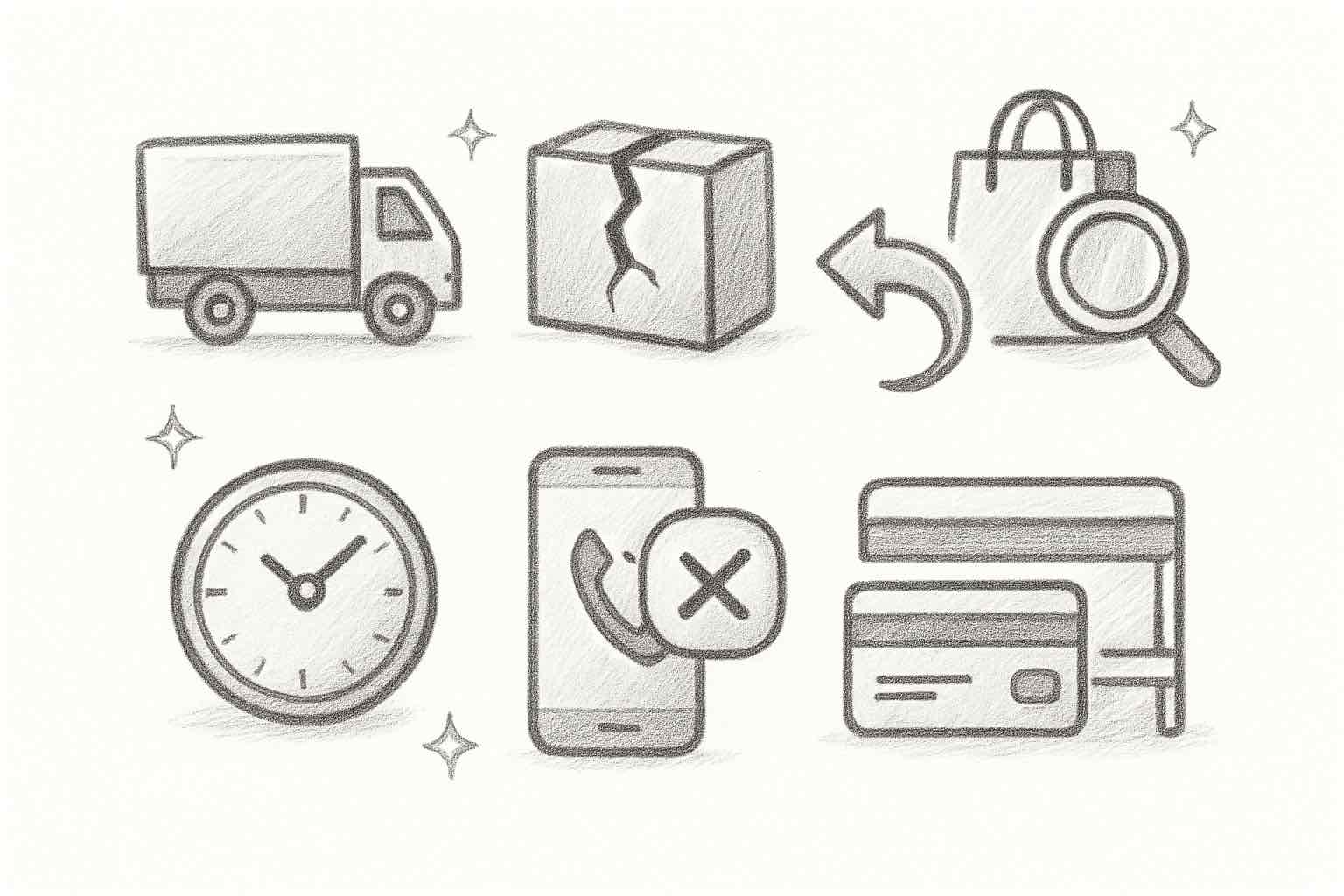
The 8 most common ecommerce customer complaints
Before you can fix complaints, you need to know what people complain about. After reviewing hundreds of support threads and industry data, these are the categories that come up over and over.
- "Where's my order?": WISMO (Where Is My Order?) calls and emails are the single biggest complaint category in ecommerce. They can account for 30-50% of all support volume. Most of these are preventable with better order tracking.
- Wrong or damaged items: The package arrives, but it's the wrong size, wrong color, or broken. This one hurts because the customer waited for something and got disappointed.
- Return and refund friction: Unclear return policies, slow refund processing, or surprise restocking fees. If your returns management process is confusing, expect complaints.
- Product doesn't match the listing: Photos that over-promise, missing measurements, or vague descriptions. Customers feel misled, and they're not wrong.
- Slow response times: According to industry data, 64% of shoppers expect a response within one hour. If you're taking 24-48 hours, you're already losing them. Check out response time benchmarks for your industry.
- Can't reach a real person: Chatbot loops with no escape hatch, no phone number listed, no way to talk to a human. This is the complaint that creates the most frustration. Offering phone support can make a huge difference.
- Billing and payment issues: Double charges, failed transactions, or charges that don't match the listed price. These need immediate resolution because they involve money.
- Out-of-stock after ordering: The customer places an order, pays, and then gets told the item isn't available. This one damages trust fast.
How to handle customer complaints in ecommerce: 8 steps
Now for the framework. These steps work whether you're a one-person Shopify store or a team of 20.
1. Respond fast (and set expectations)
Speed is the single biggest factor in complaint satisfaction. Respond within one hour and you keep 71% of those customers. Wait 24 hours and that number drops to 48%.
You don't need to solve the problem in the first response. You just need to acknowledge it. A quick "We see your message, and here's what happens next" does more for trust than a detailed response that takes two days.
Set up auto-acknowledgment on every channel. Include an estimated resolution time. Something like:
"Hi [Name], thanks for reaching out. We see your concern about [issue] and our team is on it. You'll hear back with a resolution within [X hours]. If you need help faster, call us at [phone number]."
That's it. Fast acknowledgment plus clear timeline. If you want to dig deeper into this, check out our guide to customer service response time benchmarks.
2. Listen first, solve second
The instinct when you get a complaint is to jump straight to the fix. Resist that. Customers who are upset want to feel heard before they want a solution.
Use active listening phrases: "I understand how frustrating that must be" or "That shouldn't have happened, and I'm sorry it did." These aren't empty words. They signal that you're treating the customer like a person, not a ticket number.
Take notes in your helpdesk or CRM under the customer's account. Document what they said, what they're feeling, and what they actually want. This helps your team if the issue gets handed off, and it helps you spot patterns later.
Here's the thing: sometimes customers don't want a refund. They want to vent, feel validated, and know it won't happen again. Read the emotional temperature before jumping to solutions.
3. Give customers control over the resolution
Instead of dictating the solution, offer options. Try something like:
"I'd like to make this right. Here are a few things I can do: (1) send a replacement with express shipping, (2) issue a full refund, or (3) give you store credit plus a 15% discount on your next order. Which works best for you?"
This approach works because it gives the customer control. They choose the outcome that matters most to them. And it almost always leads to higher satisfaction than a one-size-fits-all response.
One practical tip: empower your support agents (or yourself, if you're solo) to resolve issues up to a reasonable dollar amount without needing approval. If an agent has to escalate a $20 problem to a manager, you've just added hours to the resolution time and frustrated everyone involved.
For more approaches like this, see our ecommerce customer service best practices guide.
4. Handle complaints on every channel
Your customers don't all complain the same way. And how you handle a complaint should match the channel it comes in on.
- Email: Still the most common complaint channel. Use templates for speed, but personalize every response with the customer's name and order details. Target response time: under 4 hours. Our customer service email templates post has ready-to-use scripts.
- Live chat: Real-time resolution is the advantage here. Save transcripts and link them to the customer's account. If the issue can't be resolved in chat, schedule a follow-up, don't just say "we'll get back to you."
- Social media: 42% of customers expect a response within one hour when they complain on social. Respond publicly to show other customers you care, then move the conversation to DMs for personal details. Never delete or ignore public complaints.
- Phone: Here's the gap most online stores miss. Phone complaints have the highest resolution satisfaction of any channel, but most stores don't offer phone support because it seems expensive or hard to staff. That's where AI phone agents come in. Ringly.io puts an AI agent on your phone line that handles common complaints like order status, returns, and refund requests 24/7. It resolves about 73% of calls without a human ever picking up.
The key principle: match the right tool to the right complaint. Simple questions go to automation. Emotional, complex situations go to people.
5. Prevent complaints before they happen
The best complaint is the one that never happens. And a surprising amount of support volume is preventable.
- Automated shipping updates: Sending tracking notifications at each milestone (shipped, in transit, out for delivery, delivered) reduces WISMO inquiries by 60-90%. That alone can cut your support volume in half. If you're on Shopify, check out Shopify order tracking tools.
- Clear return policies: Put your return policy on every product page, not buried in the footer. Spell out timelines, conditions, and who pays for return shipping. Ambiguity creates complaints. See our Shopify return policy best practices guide.
- Accurate product listings: Include high-quality photos from multiple angles. Add detailed measurements, materials, and size charts. Address common questions proactively in the description. If your sizing runs small, say so.
- Proactive delay communication: If a shipment is going to be late, tell the customer before they ask. A proactive "your order is delayed by 2 days, here's why" prevents an angry complaint later.
- FAQ and self-service: Build a knowledge base that answers the top 20 questions your support team gets. Link to it from your product pages and confirmation emails.
Prevention doesn't eliminate all complaints. But it removes the low-hanging fruit so your team can focus on the issues that actually need human attention.
6. Track every complaint and find patterns
Individual complaints are fires. Patterns are the thing that's starting the fires.
Categorize every complaint by type (shipping, product quality, billing, etc.) and by product. After 30 days, review the data. If the same issue keeps popping up (sizing confusion on a specific product, shipping delays from a particular fulfillment center, a defective batch), fix the root cause.
Here are the metrics worth tracking for your customer service KPIs:
- Resolution time: How long from first contact to resolved? Target under 24 hours.
- First contact resolution rate: What percentage gets solved without escalation? Industry average is 68%, and first call resolution above 80% is best-in-class.
- CSAT score: Post-resolution satisfaction rating.
- Complaint volume by category: Which types are growing or shrinking?
- Repeat contact rate: Are customers coming back with the same problem?
You don't need expensive software for this. A spreadsheet works fine when you're starting out. The important thing is that you're looking at the data, not just closing tickets.
7. Follow up after resolution
Most stores stop at "problem solved." That's a missed opportunity.
Check back with the customer 48-72 hours after resolving their issue. A simple message works:
"Hi [Name], just checking in. Is everything working out with [resolution you provided]? Let us know if there's anything else we can help with."
This does three things. It shows the customer you genuinely care (not just closing a ticket). It catches any unresolved issues before they turn into negative reviews. And it gives you a natural moment to ask for a review or referral.
Customers who've had a complaint resolved well are actually great candidates for testimonials. They've experienced both the problem and your response, and that story resonates with other buyers. For more strategies like this, see our guide on improving Shopify customer satisfaction.
8. Use AI and automation for speed and scale
You can't be awake 24 hours a day. But your customers shop at all hours, and they expect support when they need it.
According to Salesforce, about 30% of customer service cases are now resolved by AI (as of 2025). And 89% of service professionals say conversational AI increases self-service resolution rates. This isn't future talk. It's happening now.
Here's what AI can handle today:
- Order status and tracking: AI pulls the info from your system and gives a real-time update
- Return and exchange requests: AI walks the customer through your return policy and initiates the process
- Product questions: AI uses your knowledge base to answer sizing, shipping, and availability questions
- Complaint acknowledgment: AI captures the issue and routes it to the right person if it needs human attention
The key is knowing where AI works and where it doesn't. Simple, data-driven requests? Perfect for automation. Emotionally charged complaints where the customer is genuinely upset? That needs a human.
If you're running a Shopify store and want phone support without hiring a team, Ringly.io handles this with an AI phone agent named Seth. It connects to your Shopify data, answers calls in 40 languages, and resolves about 73% of issues automatically. Setup takes about 3 minutes. See what it sounds like for your store.
For a deeper look at AI in customer service, check out our AI customer service statistics and ecommerce customer service automation guides.
Response templates you can use today
Having templates ready saves time and ensures consistency. Here are five you can copy and adapt for your store. For a full library, see our customer service scripts for ecommerce.
First response / acknowledgment
Hi [Name], thank you for reaching out. I'm sorry to hear about [issue]. I've pulled up your order ([order number]) and I'm looking into this now. You'll have an update from me within [X hours]. If you need immediate help, feel free to call us at [phone number].
Shipping delay apology
Hi [Name], I checked on your order and I see it's running behind schedule. I know that's frustrating, especially when you're waiting for [product]. Here's what I know: [tracking update]. I'll keep an eye on this and update you as soon as it moves. If you'd prefer a refund instead of waiting, just let me know.
Wrong item received
Hi [Name], I'm really sorry you received the wrong item. That's completely on us. I've already scheduled a replacement [correct item] to ship out today with express delivery, and you don't need to return the wrong item. You should receive the correct order by [date].
Refund confirmation
Hi [Name], your refund of [amount] has been processed. It should appear in your account within 3-5 business days, depending on your bank. If you don't see it by [date], let me know and I'll follow up. Thank you for your patience with this.
Follow-up after resolution
Hi [Name], just checking in on [issue from earlier]. Is everything working out? If there's anything else I can help with, I'm here. And if you had a good experience, we'd really appreciate a quick review. It helps other shoppers find us. [review link]
How to measure your complaint handling
You can't improve what you don't measure. Here are the five metrics that matter most for ecommerce customer service cost per contact and overall quality.
| Metric | What it measures | Target |
|---|---|---|
| First contact resolution (FCR) | % of complaints resolved without escalation | 80%+ |
| Average resolution time | Time from first contact to resolved | Under 24 hours |
| CSAT score | Post-resolution customer satisfaction | 85%+ |
| Complaint volume by category | Distribution of complaint types | Declining trend |
| Repeat contact rate | % of customers returning with same issue | Under 10% |
FCR is the most important one on this list. Research shows that first contact resolution increases retention by 67%, while escalations reduce it by 45%. If you're only going to focus on one metric, make it FCR.
For phone-based support, AI call analysis tools can automatically score calls, flag issues, and track resolution rates without manual review. That's a big time saver for quality assurance.
Ready to automate your phone support? Try Ringly.io free for 14 days and let AI handle your most common complaints while you focus on growing your store.
Frequently asked questions
What is the best way to respond to an angry ecommerce customer?
Acknowledge the problem immediately and validate their frustration before offering a solution. Use phrases like "I understand how frustrating this is" rather than jumping straight to a fix. Give them 2-3 resolution options and let them choose.
How quickly should I respond to a customer complaint?
Within one hour is the target. Research shows that responding within 60 minutes retains 71% of customers, while waiting 24 hours drops that to 48%. Even if you can't solve it right away, send an acknowledgment with an estimated resolution time.
Should I offer a refund or replacement for a damaged product?
Offer both and let the customer decide. Some customers want the product and will wait for a replacement. Others just want their money back. Giving them the choice leads to higher satisfaction every time.
How can I prevent customer complaints in my online store?
The biggest win is automated shipping updates, which reduce WISMO inquiries by 60-90%. After that, focus on clear return policies on every product page, accurate product photos and descriptions, and proactive communication about delays.
Can AI handle customer complaints effectively?
Yes, for specific complaint types. AI excels at order status inquiries, return initiation, and FAQ-style questions. About 30% of service cases are now resolved by AI (Salesforce, 2025). For emotionally charged complaints, you still want a human in the loop.
What tools do I need for ecommerce complaint management?
At minimum, you need a helpdesk or ticketing system, an order tracking notification tool, and a way for customers to reach you by phone. Shopify customer service apps cover the first two. For phone support, an AI phone agent like Ringly.io handles calls without hiring staff.
How do I handle complaints on social media?
Respond publicly within an hour (42% of customers expect this). Acknowledge the issue in public to show other followers you care, then move the conversation to DMs for personal details like order numbers. Never delete or ignore public complaints because other customers are watching.
Your complaints are your roadmap
Every complaint your store receives is a customer telling you exactly what to fix. The stores that treat complaints as data (and build systems to handle them fast, learn from them, and prevent them) are the ones that grow.
The 8 steps here give you a framework: respond fast, listen first, give options, cover every channel, prevent what you can, track patterns, follow up, and automate the repetitive stuff.
If phone support is the gap in your system (and for most ecommerce stores, it is), Ringly.io fills it with an AI phone agent that handles common complaints 24/7. Start your free trial and see the difference in your first week.