
If you run a Shopify brand, somewhere between 30% and 50% of your support tickets right now are some version of "where is my order?" That's not exaggeration. Shopify's own data puts WISMO at 30 to 40% during normal periods, and over 50% during peak season.
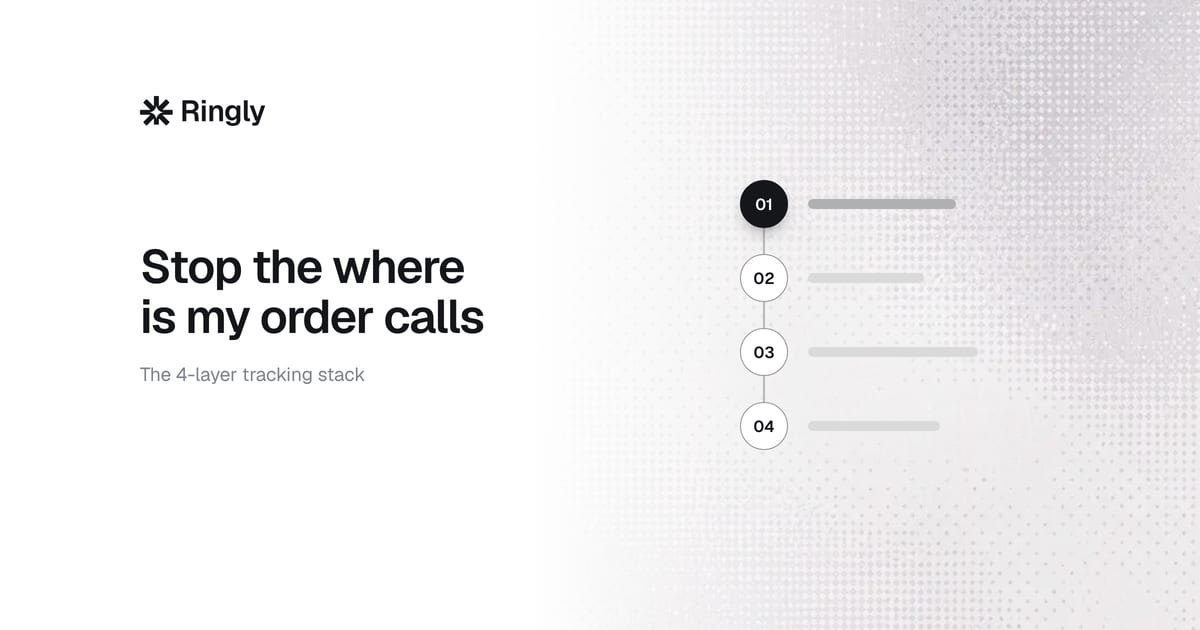
The frustrating part: most "WISMO tracking" advice tells you to install a tracking app, send a few notifications, and call it done. Real DTC brands don't run one tool. They run a stack. Four layers, each catching what the previous one missed.
This guide walks through what those four layers actually are in 2026, how much WISMO each one deflects, what they cost, and where the phone layer fits in (because most articles pretend phone WISMO doesn't exist, even though it's the most expensive ticket you have).
Hear what AI support calls sound like for your store. Just paste your Shopify URL and get sample calls in under 20 seconds, no email required. Listen to demo calls for my store.
What WISMO tracking actually means in 2026
WISMO stands for "where is my order?" WISMO tracking is the set of systems you run so customers can get that answer without filing a ticket: tracking pages, shipping notifications, in-helpdesk lookups, and AI agents on phone, chat, and email that surface tracking info on demand.
It's a sub-discipline of broader WISMO automation. Automation is the full project (cut WISMO tickets across every channel). Tracking is the customer-facing systems that show shipping status on every channel they might ask. Different scope, same end goal.
Here's why it matters in dollars:
| Variable | Industry consensus |
|---|---|
| WISMO share of all support tickets | 30 to 50% |
| WISMO tickets preventable through proactive comms | 73% (per Forrester) |
| Avg shopper tracking checks per shipment | 4.6 (per Alhena) |
| Cost per WISMO ticket (agent-handled) | $5 to $22 |
| Cost per WISMO phone call | ~$7.16 (ContactBabel) |
| Cost per AI-resolved WISMO ticket | $1 to $3 |
| Healthy WISMO rate (% of shipments) | 3 to 4% |
A brand doing 1,000 orders a month sits at ~$2,800 a month, or $33,600 a year, in WISMO costs at baseline. Get to 3 to 4% WISMO rate and that drops below $5,000 a year. The difference is whether you've stacked the layers properly or not.
One more number worth holding in your head: 44% of US consumers stop shopping with a brand after one bad service experience. WISMO is the most common service experience your customer has. Quietly, it's also one of the most fragile.
The 4 layers of modern WISMO tracking
Think of WISMO like a funnel. Customers ask the same question through different channels, and your job is to catch them as early in the funnel as possible. Earlier = cheaper.
The four layers, in cost order:
- Layer 1: Branded tracking page. Customer self-serves on your domain. Each lookup is a ticket avoided. Cost per deflection: roughly $0.
- Layer 2: Proactive shipping notifications. SMS, email, push at every fulfillment milestone. Kills the question before they think to ask.
- Layer 3: Helpdesk AI on chat and email. When they do ask, AI looks up the Shopify order live and replies in seconds.
- Layer 4: AI on the phone. When they call (and they will, 15-25% of WISMO arrives by phone), an AI agent answers, pulls the order, gives status, sends a tracking link by SMS.
Layered together, the math is brutal in your favor:
| Layer | What it deflects | Typical deflection | Reactive cost saved |
|---|---|---|---|
| 1. Branded tracking page | Customers who check on their own | 30 to 50% of WISMO | $0 per lookup |
| 2. Proactive notifications | Customers who wouldn't have asked if they knew | 50 to 80% of what's left | $0 per send |
| 3. Helpdesk AI | Customers who ask in chat or email | 50 to 70% of those | $1 to $3 per resolve |
| 4. Phone AI | Customers who call | 70%+ | ~$0.42 per call |
Skip any layer and the load shifts to a more expensive channel. Skip the phone layer specifically and you're paying $7 to $16 a call to answer the cheapest possible question.
Layer 1. Branded tracking page
This is the foundation. A branded tracking page lives at a URL like yourbrand.com/track-order and lets customers paste an order number and email to see real-time shipping status. Each visit is a ticket that didn't get filed.
The word that matters is branded. Default carrier pages (UPS, USPS, FedEx) are the enemy here. They break the post-purchase experience, look generic, and miss the upsell opportunity that lives in the most-clicked email a brand ever sends.
The benchmark case is IDEAL OF SWEDEN. They dropped delivery-related tickets from 37% to 4% of total support volume after adding proactive tracking, with the branded tracking page doing a chunk of that lift. Vograce reported a 73% WISMO drop from the tracking page layer alone.
The realistic tool picks
A few worth knowing about. None of them require dev time on Shopify.
| Tool | Free tier | Mid tier | Best for |
|---|---|---|---|
| ParcelPanel (ParcelWILL) | 20 orders/mo | ~$11/mo+ | Cleanest tracking page UI, multilingual |
| AfterShip Tracking | 50 shipments/mo | $11/mo Essentials, $119/mo Pro | Most carriers (1,200+), heavyweight |
| Tracktor | Trial | $15-30/mo+ | Custom statuses, ShopPad ecosystem |
| Track123 | Free + paid | Mid | Mid-market tracking + lookup |
| Shopify Shop App | Free | n/a | Default safety net, not a finished answer |
ParcelPanel rates 5.0 stars across 4,207 reviews on the Shopify App Store and the free plan is generous (lookups don't count against the order quota). AfterShip rates ~4.7/5 on G2 across 1,200+ reviews and supports more carriers than anyone else, which matters if you ship internationally.
The Shop App is fine as a starting point, but you don't fully control branding and it doesn't live on your domain. Treat it as a fallback, not your primary tracking experience.
A pattern worth copying: link the tracking page from your order confirmation email, your shipping notification email, the customer account page, and a small post-purchase pop-up. Make it impossible for the customer to miss.
If you're running phone support alongside chat, Ringly.io is AI phone support for Shopify brands that complements every tracking page on this list. See how it works.
Layer 2. Proactive shipping notifications
Layer 1 is reactive. The customer has to come to you. Layer 2 flips that: you go to them, on the channels they actually open, at the moments they actually care.
Forrester's number is the one to remember here: 73% of WISMO tickets are preventable through proactive communication. That's not a marketing claim, it's the consensus across Crisp, Shopify, and ShippyPro coverage. The strategy is simple: tell the customer what's happening before they think to ask.
A clean WISMO notification flow has 5 to 7 milestones per shipment:
- Order confirmed
- Order shipped (with tracking link)
- Out for delivery (the highest-CTR one)
- Delivered
- Delivery exception (lost, delayed, returned to sender)
- Carrier handed off / cleared customs (for international)
- Replacement shipped (if applicable)
You don't need fancy AI for this. You need a notification engine plugged into a carrier API plugged into your messaging tool.
The realistic tool picks
Most DTC brands run Klaviyo for transactional + marketing email and pair it with a shipment-data provider that fires events into Klaviyo flows.
| Tool | Pricing | What it does |
|---|---|---|
| Wonderment (now Loop Tracking) | $29/mo Essentials, $239/mo Advanced | Fires shipment milestones into Klaviyo, Postscript, Attentive |
| Klaviyo | Free up to 250 contacts, then volume-based | Email + SMS engine that runs the actual flows |
| Postscript | ~$100/mo+ usage-based | SMS-first, DTC favorite |
| Attentive | Custom, enterprise | High-volume SMS |
| Yotpo SMSBump | $19/mo+ | SMS bundled with reviews/loyalty |
Wonderment was acquired by Loop (the returns platform) and is now sold as Loop Tracking. The core integration with Klaviyo still works: Wonderment pulls carrier data and pushes events like OrderShipped, OrderOutForDelivery, and OrderDelayed into Klaviyo, where you build the actual email and SMS flows.
The case-study evidence is consistent. The Ridge cut shipping and tracking CX tickets after wiring Wonderment notifications into Klaviyo. Across Vital Proteins, The Ridge, and Chomps, Wonderment-powered transactional flows averaged 20-40% CTR, with real upsell revenue stacked on top.
A small detail that matters: SMS WISMO notifications outperform email WISMO notifications by 2-3x on open rate, because customers actually read them. If you're SMS-shy, the post-purchase window is the most justifiable place to use it.
Layer 3. Helpdesk AI on chat and email
Even with Layers 1 and 2 wired, some customers will still type "where is my order?" into your chat widget or email it to support@. Layer 3 catches those.
The play here is straightforward: an AI agent reads the message, looks up the order in Shopify (or your OMS), checks the carrier's API, and replies with the real status. It also writes the response in your brand voice, links to the tracking page, and offers to escalate if the customer wants a human.
The tools that do this well are all helpdesks with AI agent modules bolted on top.
| Tool | AI Agent | Best for |
|---|---|---|
| Gorgias | AI Agent | Shopify-first brands, native order lookups |
| Richpanel | AI assist | Self-service portal style |
| Reamaze | Reamaze AI | Mid-market multichannel |
| Intercom | Fin AI | Cross-vertical, more chat-heavy |
| Zendesk | Resolution Bot | Enterprise |
| Siena AI | Built-in | Ecommerce-focused agentic AI |
Gorgias publicly claims its AI Agent can resolve up to 60% of inquiries. Real customer case studies show a wider range, 26 to 56% depending on the implementation. The honest read: if your knowledge base is clean and your Shopify data is connected, expect closer to 50% on WISMO tickets specifically. Less than that on edge cases like missing packages or international delays.
The thing to watch is data freshness. WISMO answers go stale in hours, not days. If the AI is reading a cached status from yesterday, it'll confidently tell the customer their package is "out for delivery" when it actually arrived (or got returned to sender). Make sure your AI agent pulls live carrier data, not just whatever was in the order record at the time of last sync.
A common mistake at this layer: brands install Gorgias AI Agent, leave it on default settings, and don't tune the macros for WISMO specifically. The result is generic answers that don't include the actual tracking link. Spend an afternoon writing your WISMO macros and you'll double your deflection.
Pair this with your existing Shopify helpdesk app and you've covered chat and email. Which leaves one channel.
Layer 4. AI on the phone (the layer nobody covers)
Every WISMO playbook I've read this year stops at chat. They cover tracking pages, notifications, AI helpdesks. Then they hit the phone and pretend it doesn't exist.
The phone is 15 to 25% of WISMO interactions for most DTC brands. For supplements, pets, and older-skewing categories, it's higher (often closer to 30%). And it's the single most expensive channel: ~$7.16 a call per ContactBabel, vs $1-3 for AI-resolved chat.
Add to that the after-hours problem: phone calls don't wait for business hours. A customer who calls Saturday at 9pm and gets voicemail is roughly 3x more likely to file a chargeback or churn than one who gets a real answer. (We've seen this pattern across our 50+ active brands.)
This is the layer where AI is finally good enough to do something real. An AI phone agent for WISMO does one job well:
- Answers in 1-2 rings
- Asks the caller for an order number or email
- Pulls the order from Shopify
- Reads back the real shipping status (in plain language, not robot)
- Sends the tracking link by SMS while still on the call
- Escalates to a human only if the customer asks or hits a real exception
For 73% of calls, that's the whole interaction. Sub-60-second handle time. Customer gets the answer. Phone never reaches a human.
Ringly.io: AI phone support for Shopify brands
Ringly is AI phone support for Shopify brands. Phone support, without the payroll. Instead of growing your support headcount every time call volume goes up, the AI takes the routine inbound calls so your team can focus on the work that actually moves revenue.
The AI answers inbound calls 24/7. It finds orders in your Shopify store, processes returns and exchanges, answers product questions from your knowledge base, and rescues abandoned carts via outbound follow-up. Across 50+ brands, the AI resolves 73% of calls autonomously at roughly $0.42 per resolved call. Calls that need a human escalate cleanly to Gorgias, Richpanel, Reamaze, or whatever helpdesk you already run.
WISMO is the sweet spot for the AI. The data needed to answer is structured (order ID → carrier API → status), the conversation is short (most resolve in under 60 seconds), and the customer is rarely in a complex emotional state. It's the exact opposite of a complaint call.
Plans: Grow $349/mo (1,000 minutes), Pro $799/mo (2,500 minutes), Enterprise custom. 14-day free trial on Pro. Live in under an hour. 65% resolution guarantee: if the AI resolves under 65% of your calls in 90 days, we refund the last 3 months.
Ready to see what AI WISMO calls sound like for your store? Start your free trial. Setup takes about three minutes.
What the full WISMO tracking stack looks like in numbers
Worked example. A Shopify brand doing 1,000 orders a month at a 35% WISMO baseline. $8 average ticket cost (chat/email blended).
Starting load:
- 350 WISMO interactions/month
- $2,800/month in support cost
- $33,600/year
| Layer | Deflection | WISMO interactions remaining |
|---|---|---|
| 0. Baseline | n/a | 350 |
| 1. Branded tracking page (~40%) | -140 | 210 |
| 2. Proactive notifications (~50% of what's left) | -105 | 105 |
| 3. Helpdesk AI (~60% of those) | -63 | 42 |
| 4. Phone AI (~73% of phone share) | -7 | ~35 |
End state:
- 35 agent-touched WISMO tickets/month (down from 350)
- 10x reduction
- Effective WISMO rate: 3.5% of shipments (squarely in the healthy 3-4% benchmark)
- Annual savings: roughly $28-30K after subtracting ~$3-5K in tool costs
This is the realistic outcome for a brand that actually wires all four layers. The "we installed AfterShip last quarter" version of WISMO tracking is still leaving 200+ tickets/month on the table.
How to roll the stack out without breaking everything
Order matters here. Each layer takes a few hours to install and a few weeks to tune. Don't try to do all four in one week.
The sensible sequence:
- Week 1: Branded tracking page. Install ParcelPanel or AfterShip. Customize the page to match your brand. Link it from order confirmation + shipping notification emails. Add a small post-purchase pop-up. (Highest deflection per dollar, do this first.)
- Week 2-3: Proactive notifications. Wire Wonderment (or AfterShip's notification add-on) into Klaviyo. Build the 5-7 milestone flow. Add an SMS channel if you don't have one. (Kills the question before they ask.)
- Week 4-5: Helpdesk AI. If you have Gorgias, Richpanel, or Reamaze, turn on the AI agent module. Tune WISMO macros. Test against your last 50 WISMO tickets and check accuracy. (Most brands already have a helpdesk, so this is bolt-on work.)
- Week 6-7: Phone AI. Add an AI phone agent to your existing number. Test against your last 50 WISMO calls. Set escalation rules. (By now you know exactly which calls you're getting, so you can tune the agent precisely.)
Two things to avoid. Don't skip Layer 1 to jump straight to AI on chat (chat AI without a tracking page is doing reactive work that should never have been a ticket). And don't add the phone layer last because you forgot the phone channel exists; do it last because it's the highest-stakes channel and benefits from going in with full data on what your other layers are leaving behind.
Pair the full stack with a clean post-purchase customer service workflow and you've built the modern WISMO tracking system.
WISMO tracking FAQ
What's a healthy WISMO rate for a DTC brand?
3 to 4% of shipments generating a WISMO inquiry is the benchmark per WISMOlabs. Above 8% means your stack is broken or your shipping is broken. Below 3% usually means you're tracking the metric incorrectly.
Do I need a branded tracking page if I already have Klaviyo shipping notifications?
Yes. Notifications get the customer the first update. The tracking page is where they go for the next 4 to 5 status checks (per Alhena, the average shopper checks tracking 4.6 times per shipment). Without a branded page, those checks happen on the carrier site, with zero brand benefit to you.
What's the difference between WISMO tracking and WISMO automation?
WISMO tracking is the customer-facing systems: tracking page, notifications, AI agents that look up shipping status. WISMO automation is the broader project of cutting WISMO ticket volume across every channel. Tracking is a subset of automation. Same end goal.
Can AI really handle WISMO calls on the phone?
Yes, and WISMO is the sweet spot. The data is structured (order ID, carrier API, status), the conversations are short (under 60 seconds typical), and the caller's emotional state is usually neutral. Across 50+ brands, Ringly resolves 73% of inbound calls autonomously, with WISMO sitting at the high end of that number.
How much does the full WISMO tracking stack cost for a 1,000-orders/month brand?
Realistic budget: $40-80/mo for the tracking page (ParcelPanel or AfterShip), $30-100/mo for Wonderment + Klaviyo SMS, your existing helpdesk subscription (often already paid), and $349/mo for Grow-tier phone AI. Roughly $500/mo all-in. The savings on agent labor cover it 5-6x over.
Should I build this stack before BFCM or after?
Before. WISMO volume can climb past 50% of all tickets during peak. If your stack isn't wired by mid-October, you'll spend Q4 hiring temps to answer the same five-word question. Start the rollout in August at the latest.
The takeaway
WISMO tracking isn't a tool. It's a stack. The brands hitting 3 to 5% WISMO rates have all four layers wired: branded tracking page, proactive notifications, AI on chat and email, and AI on the phone. The brands stuck at 30 to 40% are usually missing one layer (often the phone one), and that single gap costs them tens of thousands a year in agent time.
If you're on Shopify and the phone is the layer you've been putting off, that's the highest-ROI fix on the board. Try Ringly.io free for 14 days. Live in under an hour.
Article by Ruben Boonzaaijer. Co-founder of Ringly.io. We build AI phone support for Shopify brands so they can scale support without hiring a phone team.