
Every refund that hits your Shopify store costs more than the dollar amount on the receipt. When you factor in return shipping, restocking labor, inventory depreciation, and the customer acquisition cost you just burned, a single return can eat 20-65% of the product's original price. And the average Shopify store sees roughly one in five orders come back.
Here's the thing: most of these refunds are preventable. According to ReturnLogic, 65% of ecommerce returns are the retailer's fault (wrong item shipped, inaccurate descriptions, damage during transit). That means you're not fighting customer behavior. You're fighting your own operations.
This post covers 12 specific strategies to reduce your Shopify refund rate, backed by real data. Some are quick fixes. Others take a few weeks to implement. All of them work.
Hear what AI support calls sound like for your store. Just paste your Shopify URL and get sample calls in under 20 seconds, no email required. Listen to demo calls for my store.
What does a normal Shopify refund rate look like?
Before you can fix the problem, you need to know if you actually have one. The National Retail Federation reported that 19.3% of online sales were returned in 2025. For 2026, the average ecommerce return rate is projected at 20.8%, roughly 2.5 times higher than brick-and-mortar's 8.72%.
But averages hide a lot. Your refund rate depends heavily on what you sell.
| Category | Average return rate |
|---|---|
| Apparel | 20-30% |
| Footwear | 18% |
| Home goods & furniture | 15-20% |
| Electronics | 8-11% |
| Beauty & skincare | 4-10% |
To calculate your own refund rate, use this formula: (Refunded Orders / Total Orders) x 100. You can pull these numbers from Shopify's Orders report by filtering for refunded orders over the last 90 days.
If you're running below 10%, you're doing well. Between 10-15% is average for most categories. Above 20%? That's where refunds start killing your margins. And every percentage point you shave off drops straight to your bottom line.
The total cost is staggering. U.S. retailers lost $849.9 billion to returns in 2025. Processing a single return costs between $10 and $65 when you add up shipping, inspection, restocking, and potential markdowns. For a lot of Shopify stores, that's more than the profit on the original sale.
Why customers ask for refunds (and why most are your fault)
The knee-jerk reaction to high refunds is blaming customers. "Serial returners." "Bracketing." "People just changed their mind."
But the data tells a different story. Here's why customers actually return products:
- Size, fit, or color mismatch (45%): the product looks different in person than on screen, or the sizing is off
- Damaged on arrival (16%): poor packaging or rough handling during shipping
- Inaccurate product description (14%): what they received doesn't match what was advertised
- Changed their mind (10%): genuine buyer's remorse
- Late delivery (8%): arrived after the customer needed it
- Bracketing (varies): ordering multiple sizes or colors intending to return some. 63% of consumers do this regularly, and half of Gen Z does it for clothing and shoes.
Add the first three up and you get 75% of all returns. Those are problems your store created. Fix the root cause and you fix the refund rate. No restrictive policies needed.
Now, here are the 12 strategies that actually move the needle.
12 strategies to reduce your Shopify refund rate
1. Fix your product pages first
This is where most refunds start. A customer sees something on your product page, builds an expectation, and when the actual product doesn't match, they return it.
According to ParcelLab's 2026 ecommerce data, 93% of shoppers say product content is crucial when making a purchase decision. Stores that invest in comprehensive visual content see 15-30% fewer "not as described" returns.
Here's what a refund-proof product page looks like:
- Multi-angle photos: show the product from every side, not just the hero shot. Include close-ups of materials, textures, and details.
- Lifestyle context: show the product being used by real people. This helps customers gauge size, scale, and fit.
- Exact specifications: list dimensions, weight, materials, and care instructions. Be specific. "Medium weight fabric" means nothing. "180 GSM cotton blend" tells the customer exactly what they're getting.
- Video demos: a 30-second video showing the product in use reduces returns more than five additional photos.
- User-generated content: real customer photos are powerful. Nearly two-thirds of consumers say UGC makes them less likely to return a product.
If your Shopify conversion rate is already decent, upgrading your product pages will not only cut refunds but also increase sales. Better product info means more confident purchases.
2. Add size and fit tools
For apparel and footwear stores, sizing issues cause 45% of all returns. That's nearly half your refund problem solved by one fix.
AI-powered size recommendation tools analyze a customer's measurements, past purchases, and brand-specific fit data to suggest the right size. Stores using comprehensive sizing tools report up to 70% fewer size-related returns.
A few approaches that work:
- Fit quizzes: ask customers 3-4 questions about their body type and preferences, then recommend a size
- Brand comparison tools: "If you wear a medium in Nike, order a large in ours"
- Measurement guides: include detailed measuring instructions with visuals (not just an S/M/L chart)
- Fit reviews: filter and highlight customer reviews that mention fit ("runs small," "true to size")
Even a basic size guide with actual measurements reduces returns noticeably. You don't need a $500/month AI sizing app to start.
3. Use customer reviews strategically
Reviews aren't just social proof for conversions. They're your best defense against refunds.
When shoppers see reviews that describe exactly what the product looks like, feels like, and fits like in real life, they make better purchase decisions. And better decisions mean fewer returns.
- Display reviews prominently: don't bury them below the fold. Put star ratings and review counts right next to the product title.
- Encourage photo and video reviews: incentivize customers to upload photos with a small discount or loyalty points. Real-world photos set accurate expectations.
- Highlight fit-related feedback: surface reviews that mention sizing ("I'm 5'8 and the medium fits perfectly") because these directly reduce size-related returns.
- Address negative reviews: respond to complaints publicly. This shows future buyers you care, and often the response itself prevents a return.
The data backs this up: nearly two-thirds of consumers say access to user-generated content makes them less likely to return a product. Reviews are free refund insurance.
4. Steer customers toward exchanges, not refunds
This is the single most impactful post-purchase strategy. When a customer wants to return something, your goal isn't to block the return. It's to redirect them toward an exchange.
Merchants who offer instant exchanges with free shipping on the replacement item retain 25-35% more revenue from return interactions compared to refund-only policies. And 51% of merchants now offer an average incentive of $11.28 to encourage exchanges over refunds.
Here's how to make exchanges the default:
- Make the exchange process easier than the refund process: fewer clicks, faster shipping, no hassle
- Offer free shipping on exchange items: this removes the biggest friction point
- Default to exchange in your returns portal: when a customer initiates a return, show exchange options first
- Add bonus incentives: "Exchange for a different size and get free expedited shipping" or "Get $5 extra store credit when you choose an exchange"
Over 60% of ecommerce brands now offer free exchanges while only 30-40% offer free refunds. The economics make sense. An exchange keeps the revenue in your business. A refund doesn't.
5. Offer store credit as an alternative
When an exchange doesn't work (maybe you don't have the right product), store credit is your next best option. It's dramatically better than a cash refund for your bottom line.
Here's why: 40-60% of store credit converts to new purchases, and those new purchases often exceed the original credit amount. The customer doesn't just replace what they returned. They buy more.
A few smart ways to use store credit on Shopify:
- Bonus credit strategy: offer $55 in store credit for a $50 refund. The extra $5 costs you almost nothing but dramatically increases the take rate.
- Instant issuance: don't make customers wait. Issue store credit (as a Shopify gift card) the moment they initiate the return, before you even receive the item back.
- Prominently display the option: in your returns portal, show the store credit option alongside (or before) the cash refund option.
Store credit also gives you a chance to build customer loyalty. A customer with credit in their account has a reason to come back. A customer with a refund has no reason to think about your store again.
6. Extend your return window
This one feels counterintuitive. A longer return window means more returns, right?
Actually, no. Research on the endowment effect shows the opposite. The longer a customer has a product, the more attached to it they become. A study published by De Gruyter found that lenient return policies increase initial purchasing tendency but don't increase the actual return rate.
The psychology works like this: with a 14-day window, customers feel urgency to decide. That pressure pushes them to return "just in case." With a 60 or 90-day window, there's no rush. They use the product, get used to it, and the thought of returning it fades.
The sweet spot for most Shopify stores is 45-90 days. You'll likely see higher conversion rates on the front end (purchase confidence goes up) and equal or lower return rates on the back end.
If you're currently at 14 or 30 days, extending to 60 days is a low-risk experiment worth running.
7. Use AI phone support to intercept refund requests
A lot of refund requests start with a customer reaching out for help. They're frustrated with a product, confused about sizing, or unsure whether an item can be exchanged. If they can't get answers quickly, they default to "just give me a refund."
This is where AI phone agents change the equation. An AI agent can pick up the call instantly, look up the customer's order, and offer solutions before the customer decides to return.
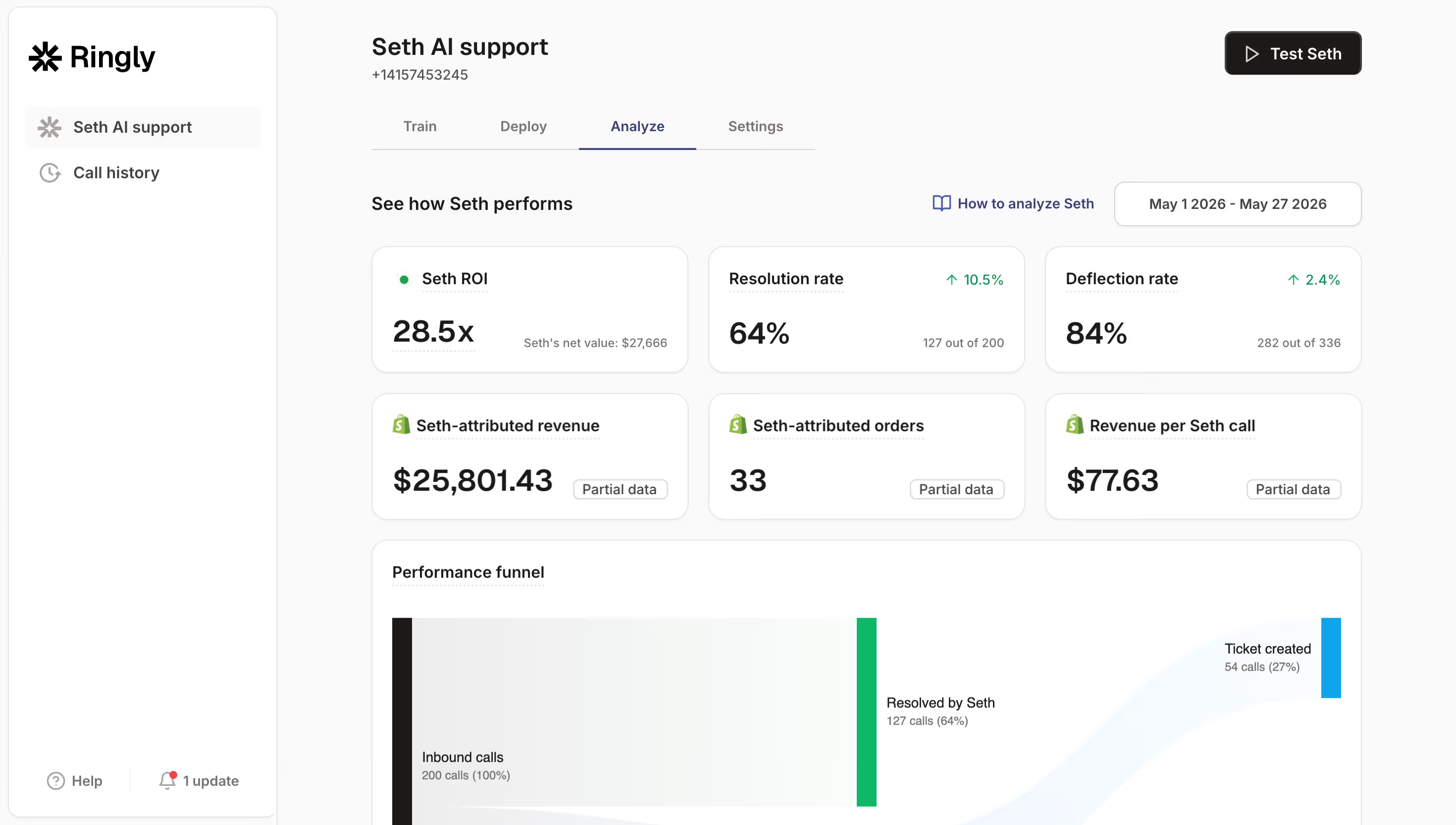
Ringly.io does exactly this for Shopify stores. Its AI agent, Seth, handles inbound support calls 24/7, in 40 languages. It connects directly to your Shopify store, so it can pull up order details, suggest exchanges, answer product questions, and even process an exchange on the spot.
Here's why this matters for refund reduction:
- Speed: customers get answers in seconds, not hours. Delayed responses push people toward refunds.
- Exchange nudging: the AI can suggest a different size, color, or product before the customer asks for a refund.
- 24/7 availability: no missed calls after hours, when frustrated customers are most likely to request refunds.
- Order visibility: the agent can look up tracking, confirm delivery dates, and resolve "where is my order" calls that would otherwise become refund requests.
Ringly.io resolves roughly 73% of calls without any human intervention. For Shopify stores dealing with high call volume and refund requests, it's a direct way to catch refunds before they happen.
Try Ringly.io free for 14 days. Setup takes about three minutes, no code required.
8. Improve your packaging and quality control
Damaged products account for 16% of all returns. That's a completely preventable category.
Better QC and packaging reduce damage-related returns by 40-60%. For fragile items, the difference between a $0.50 packing material and a $2.00 one could save you $30+ in return processing costs.
Practical steps:
- Double-box fragile items: an inner box for the product, an outer box for shipping. The air gap absorbs impact.
- Use right-sized boxes: too much empty space lets products bounce around in transit. Too little and you risk crushing.
- Include a packing slip with clear instructions: make it easy for warehouse staff to pack correctly every time.
- Inspect before shipping: during high-volume periods (BFCM, holidays), quality shortcuts are tempting. Don't take them. A 60-second inspection saves a $30 return.
- Test your packaging: ship a few packages to yourself. See what arrives damaged. Fix accordingly.
If you're dropshipping or using a 3PL, communicate packaging standards clearly. Your fulfillment partner might not care about your refund rate unless you tell them to.
9. Send post-purchase communication
The gap between "order placed" and "product arrives" is where a lot of refund decisions happen. Customers sit with doubt. Did I order the right size? Is this product actually good? Should I have bought the other one instead?
Proactive communication fills that gap and reduces customer complaints before they turn into return requests.
Build this email sequence:
- Order confirmation (immediate): confirm the order, set delivery expectations
- Shipping notification (when shipped): include tracking and estimated delivery date
- Delivery confirmation (on delivery): "Your order has arrived! Here's how to get the most out of it."
- Product tips (2-3 days after delivery): share a usage guide, care instructions, or styling tips
- Check-in (5-7 days after delivery): "How's everything? Need any help?" with a direct link to your customer service team
That last email is critical. It catches problems early, when they're still fixable. A customer who says "the color is slightly different than expected" can often be retained with a small discount or exchange offer. The same customer, left alone for two weeks, just requests a refund.
You can set up basic post-purchase email flows with Shopify Flow or apps like Klaviyo.
10. Let customers edit orders before shipping
Self-service order editing is one of the most underrated refund prevention tools. It converts what would be a $25 return into a $0 modification.
Think about it: a customer realizes they ordered the wrong size five minutes after checkout. Without order editing, they have two options: (1) wait for the product, receive it, return it, wait for a refund, reorder. Or (2) contact support and hope someone catches it before fulfillment.
With self-service order editing, they just change the size themselves. No return. No refund. No shipping cost. No support ticket.
Shopify apps like OrderlyEmails and Order Editing by Cleverific let customers modify orders (size, color, address, even products) before fulfillment. The ROI is immediate because every edit that would have been a return is now just a database update.
11. Use returnless refunds for low-value items
Processing a physical return can cost up to 65% of the sale price in logistics and handling. For a $12 t-shirt, you might spend $8 on return shipping alone. Add inspection, restocking, and admin time, and you're losing money on the return itself.
Returnless refunds solve this. You refund the customer without asking them to ship the item back. It sounds generous, but the math is clear: for items under $15-20, it's cheaper to write off the product than to process the return.
A few guidelines:
- Set a value threshold: items below $15-20 qualify for returnless refunds. Adjust based on your margins and shipping costs.
- Limit per customer: one or two returnless refunds per customer per quarter prevents abuse.
- Track patterns: if the same customer requests returnless refunds repeatedly, flag them for review.
- Don't advertise it: make it an option your support team offers on a case-by-case basis, not a published policy.
This approach improves customer satisfaction (no shipping hassle), reduces your processing costs, and shows goodwill. Just set guardrails against return fraud.
12. Track return data and act on patterns
You can't fix what you don't measure. And most Shopify stores don't measure returns with any rigor.
Start tracking these key customer service metrics:
- Refund rate by product: which SKUs get returned most? Products above a 25% return rate need immediate attention (fix the page, update the description, or discontinue).
- Refund rate by reason: are returns concentrated on sizing? Damage? Description accuracy? This tells you where to focus.
- Refund vs. exchange ratio: a healthy store converts at least 30% of returns into exchanges. If yours is lower, your exchange process needs work.
- Net revenue retention from returns: how much revenue do you keep after all returns are processed?
- Customer segments: are certain acquisition channels producing more returners? This can inform your marketing strategy.
Use Shopify's built-in analytics tools or a returns management app to track these numbers monthly. Set targets. If your overall refund rate is 22%, aim for 17% within 90 days. Then break that target down by product category and reason code.
The stores that reduce refunds the fastest are the ones that treat return data like conversion data: constantly monitoring, constantly optimizing.
How to measure improvement
Once you've implemented a few of these strategies, track your progress with these metrics:
| Metric | Formula | Target |
|---|---|---|
| Refund rate | (Refunded orders / Total orders) x 100 | Below 15% |
| Exchange rate | (Exchanges / Total returns) x 100 | Above 30% |
| Store credit redemption | (Credit redeemed / Credit issued) x 100 | Above 50% |
| Net revenue retention | (Revenue kept / Original revenue) x 100 | Above 85% |
| Return processing cost | Total return costs / Number of returns | Below $15 |
Set a 90-day baseline before making changes. Then measure monthly. You'll usually see the biggest impact from product page improvements and exchange incentives in the first 30 days. Packaging and post-purchase communication take a bit longer to show results.
If you're looking for a faster way to catch refund-bound customers before they hit the return button, see what AI phone support looks like for your store.
Frequently asked questions
What is a good refund rate for a Shopify store?
It depends on your category. For apparel, anything below 20% is solid. For beauty and supplements, below 8% is the target. Across all categories, keeping your refund rate under 15% puts you in healthy territory. If you're above 25%, it's worth investigating specific products and return reasons.
How do I calculate my Shopify refund rate?
Divide the number of refunded orders by total orders over the same period, then multiply by 100. For example, 50 refunds out of 500 orders = 10% refund rate. Pull these numbers from Shopify's Orders report. Filter by "refunded" status and compare against total orders for the last 90 days.
Do longer return windows really reduce refunds?
Yes. Research on the endowment effect shows that customers grow more attached to products the longer they have them. A 60-day or 90-day return window actually reduces returns compared to a 14-day window, while also increasing purchase confidence and conversion rates.
Should I charge a restocking fee on Shopify?
Be careful with this. Restocking fees reduce returns but also reduce purchases and repeat customers. A better approach is to steer customers toward exchanges (where you keep the revenue) instead of adding friction to refunds. If you do charge a fee, keep it under 15% and communicate it clearly before checkout.
How can AI help reduce my refund rate?
AI helps at multiple points. AI phone agents (like Ringly.io) intercept refund-bound callers and offer exchanges in real-time. AI sizing tools reduce fit-related returns by up to 70%. And AI analytics flag products and patterns that drive high return rates so you can fix root causes faster.
What's the average cost of processing a return on Shopify?
Processing a single return costs between $10 and $65, depending on the product and your logistics setup. This includes return shipping ($8-12), inspection, restocking labor, and potential markdowns. For many stores, the return processing cost exceeds the profit margin on the original sale.
How do I handle customers who abuse the return policy?
Track return frequency by customer. Flag accounts with return rates above 40% or more than 5 returns in 90 days. Consider offering store credit only (no cash refunds) for serial returners, or limiting free return shipping for high-frequency returners. Most returns apps let you set these rules automatically.
The bottom line on Shopify refunds
Reducing your refund rate isn't about making returns harder. It's about preventing the reasons people return in the first place.
Fix your product pages. Use sizing tools. Send post-purchase emails. Make exchanges easier and more appealing than refunds. And when customers do reach out with issues, make sure they get fast, helpful responses (whether that's from your team or an AI phone agent).
The math is simple. If your store processes 1,000 orders a month at a 22% refund rate, cutting that to 15% saves you 70 refunds. At $25 per return in processing costs alone, that's $1,750/month back in your pocket. Plus the revenue you keep from exchanges and store credit.
Start with the two or three strategies that match your biggest return reasons. Track the data. Iterate. Your margins will thank you.
Start your free 14-day trial of Ringly.io and put an AI phone agent to work on your refund-bound calls today.