
Most lists of Shopify customer retention apps just recommend loyalty programs. Points here, VIP tiers there, maybe a referral widget. But retention is bigger than rewards.
The average Shopify store has a repeat purchase rate of about 28%. That means roughly 7 out of 10 buyers never come back. And according to research from Bain & Company, increasing retention by just 5% can boost profits by 25-95%.
So where do you actually spend your time and money? We tested and reviewed 12 apps across five categories: loyalty, email/SMS, subscriptions, customer service, and analytics. Not just the usual suspects. The full stack you need to keep customers coming back.
Hear what AI support calls sound like for your store. Just paste your Shopify URL and get sample calls in under 20 seconds, no email required. Listen to demo calls for my store.
How we evaluated these Shopify customer retention apps
We looked at six things for every app on this list:
- Shopify integration depth: does it pull real-time order data, or is it bolted on?
- Pricing transparency: can you predict your bill, or does it spiral with growth?
- Time to value: how fast can you launch and see results?
- Scalability: what happens to your costs at 5,000 orders per month?
- Real merchant feedback: G2, Capterra, and Shopify App Store ratings from actual users
- Retention impact: does it measurably improve repeat purchases or customer lifetime value?
Quick comparison
| App | Category | Best for | Starting price | Rating |
|---|---|---|---|---|
| Smile.io | Loyalty | Simple plug-and-play loyalty | Free (200 orders) | 4.9/5 |
| Yotpo Loyalty | Loyalty | All-in-one (reviews + loyalty + SMS) | Free (100 orders) | 4.7/5 |
| Growave | Loyalty + reviews | Budget all-in-one suite | $49/mo | 4.8/5 |
| Rivo | Loyalty | Shopify-native customization | $49/mo | 4.8/5 |
| Klaviyo | Email/SMS | Data-driven retention automation | Free (250 contacts) | 4.6/5 |
| Omnisend | Email/SMS | Simpler email/SMS at lower cost | Free (250 contacts) | 4.7/5 |
| Recharge | Subscriptions | Recurring revenue for consumables | $25/mo | 4.6/5 |
| Ringly.io | AI phone support | 24/7 Shopify phone support | $349/mo | 4.8/5 |
| Gorgias | Helpdesk | Multi-channel support inbox | Ticket-based | 4.6/5 |
| Loop Returns | Returns | Converting refunds to exchanges | $59/mo | 4.6/5 |
| Lifetimely | Analytics | LTV and cohort tracking | Free plan | 4.7/5 |
| RetentionX | Analytics | Churn prediction and segmentation | Free plan | 4.5/5 |
Best loyalty and rewards apps
Loyalty programs are the most common retention tool for a reason. According to industry data, loyalty members spend 37% more than non-members, and programs deliver an average 4.8x ROI. But not every loyalty app fits every store.
Here's what we found after testing the top options for ecommerce customer loyalty programs.
1. Smile.io
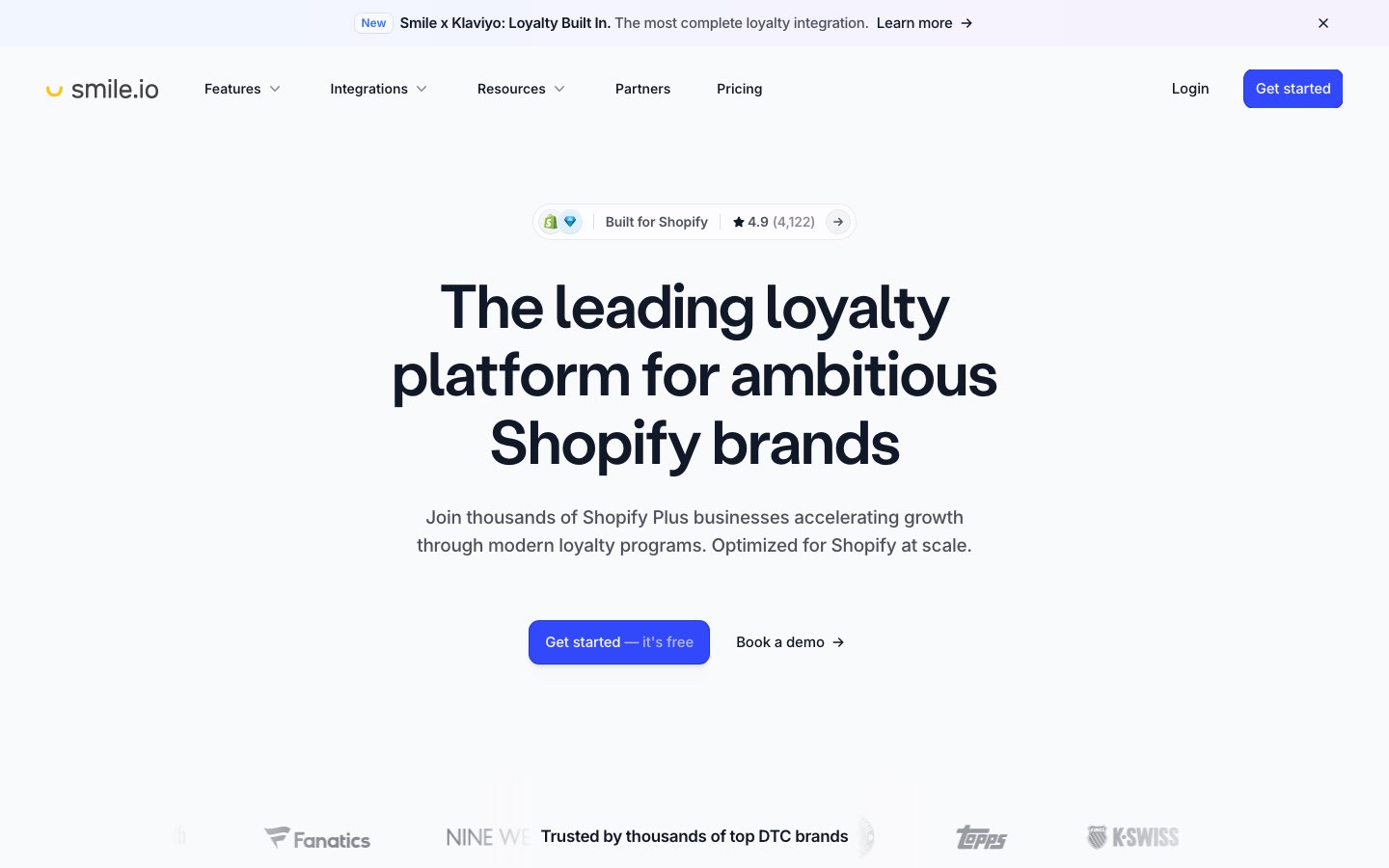
Best for: Stores that want a simple, plug-and-play loyalty program
Smile.io is the most widely installed loyalty app on Shopify, with over 100,000 stores and a 4.9-star rating across 4,149+ reviews. It handles points, VIP tiers, and referrals without any code required. If you've never run a loyalty program before, this is where you start.
Pricing
| Plan | Price | Orders/month | Key features |
|---|---|---|---|
| Free | $0 | 200 | Points, referrals, basic branding |
| Starter | $49/mo | 500 | Custom emails, nudges, 2 integrations |
| Growth | $199/mo | 2,500 | VIP tiers, points expiry, unlimited integrations |
| Pro | $999/mo | 7,500 | API access, priority support |
What works
- Dead-simple setup: you can launch a working loyalty program in under an hour
- Generous free plan: 200 orders per month is enough for most small stores to get started
- Strong Klaviyo integration: syncs loyalty data directly into your email segments
- Month-to-month billing: no annual lock-in required
What doesn't
- Analytics are thin on lower plans: you won't get deep insights until Growth ($199/mo)
- Customization is limited: branding options on Starter feel restrictive
- Expensive at scale: Pro is $999/mo while competitors like BON offer similar features for $349
Why it ranks here: Best starting point. If you're launching your first loyalty program on Shopify, Smile.io gets you live in an afternoon. You can always upgrade or switch later.
2. Yotpo Loyalty & Rewards
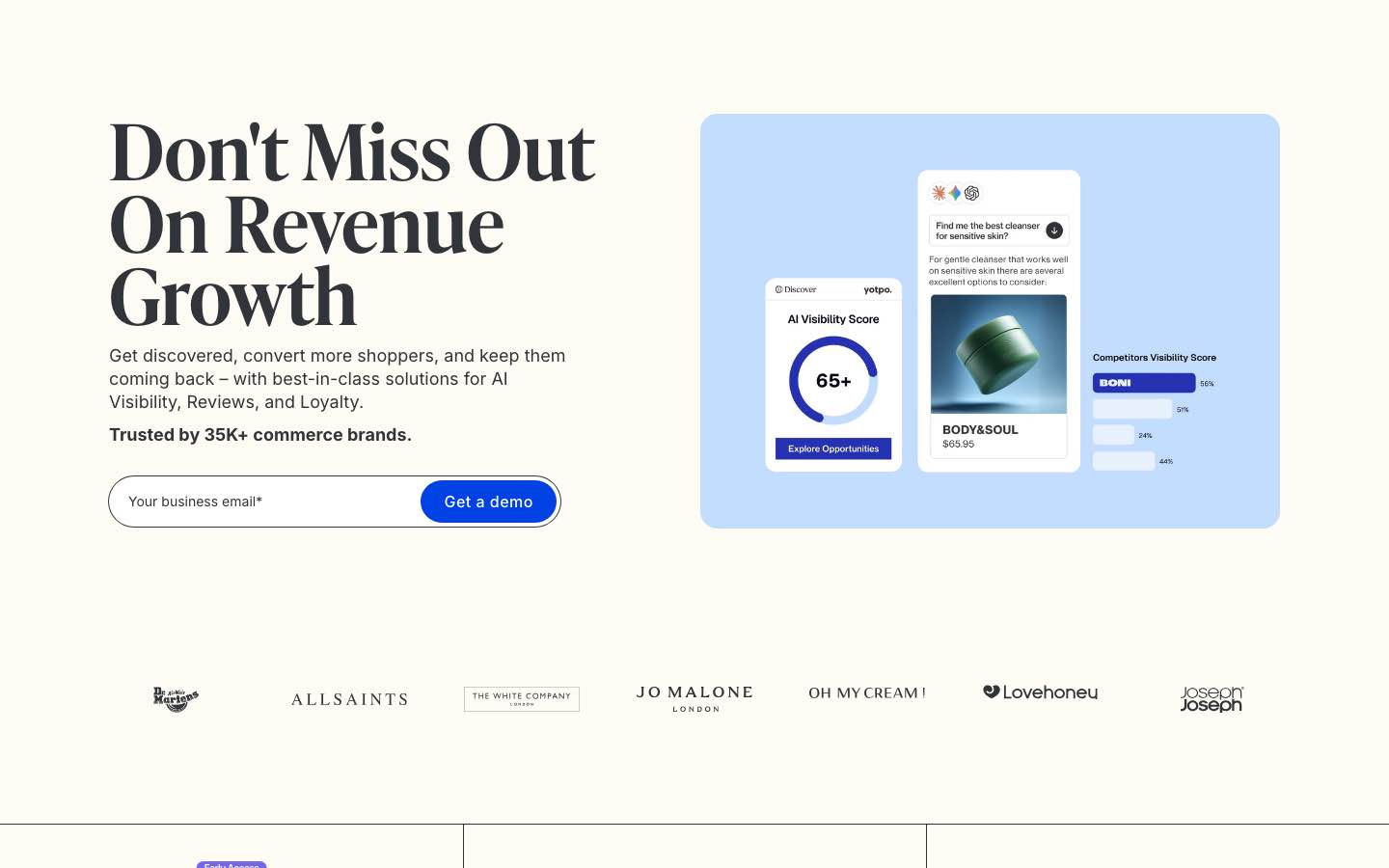
Best for: Mid-market brands wanting loyalty, reviews, and SMS in one platform
Yotpo started as a reviews platform and expanded into loyalty, SMS, and email. The big selling point is consolidation: instead of running three separate apps, you get one dashboard. It's a strong fit for brands doing 500+ orders per month that want to stop juggling tools.
Pricing
| Plan | Price | Key features |
|---|---|---|
| Free | $0 | Under 100 orders, basic loyalty |
| Gold | $199/mo | Advanced rewards, referrals, VIP tiers |
| Premium | $799/mo | Custom rewards, API, dedicated support |
Plus $0.20 per order after 500 monthly orders.
What works
- True all-in-one: reviews, loyalty, SMS, and email from one vendor
- Deep referral tools: more customizable than most competitors
- Shopify Plus native: built for larger stores with complex needs
- 180+ integrations: connects with basically everything
What doesn't
- Pricey: $199/mo is a lot if you only need loyalty
- Setup complexity: Shopify App Store reviewers frequently mention needing developer help
- Annual commitment: Yotpo requires annual billing on most plans, which is unusual for the category
- Interface feels heavy: multiple merchant reviews mention the dashboard being non-intuitive
Why it ranks here: Best for brands ready to consolidate their retention stack under one roof. But if you only need loyalty, you're overpaying. Check our Yotpo alternatives breakdown for other options.
3. Growave
Best for: Stores wanting loyalty, reviews, and wishlists without installing multiple apps
Growave bundles loyalty, product reviews, wishlists, referrals, and Instagram UGC into a single app. It's the budget-friendly alternative to Yotpo for stores that want an all-in-one but don't want to spend $199/mo.
Pricing
| Plan | Price | Orders/month |
|---|---|---|
| Entry | $49/mo | 500 |
| Growth | $199/mo | 1,500 |
| Plus | $499/mo | 3,000 |
| Unlimited | $999/mo | No limit |
14-day free trial on all plans. They also offer a contract buyout if you're switching from a competitor.
What works
- Replaces 3-4 apps: loyalty + reviews + wishlists + referrals in one install
- Competitive pricing: Entry plan matches Smile.io's Starter price but includes more features
- Contract buyout: they'll cover your existing loyalty app contract to make switching easier
What doesn't
- Jack of all trades: individual features aren't as deep as dedicated tools like Smile.io (loyalty) or Judge.me (reviews)
- Can add page weight: loading all those features may slow your storefront slightly
Why it ranks here: Best budget all-in-one. If you want loyalty + reviews without paying Yotpo prices, Growave is the move.
4. Rivo
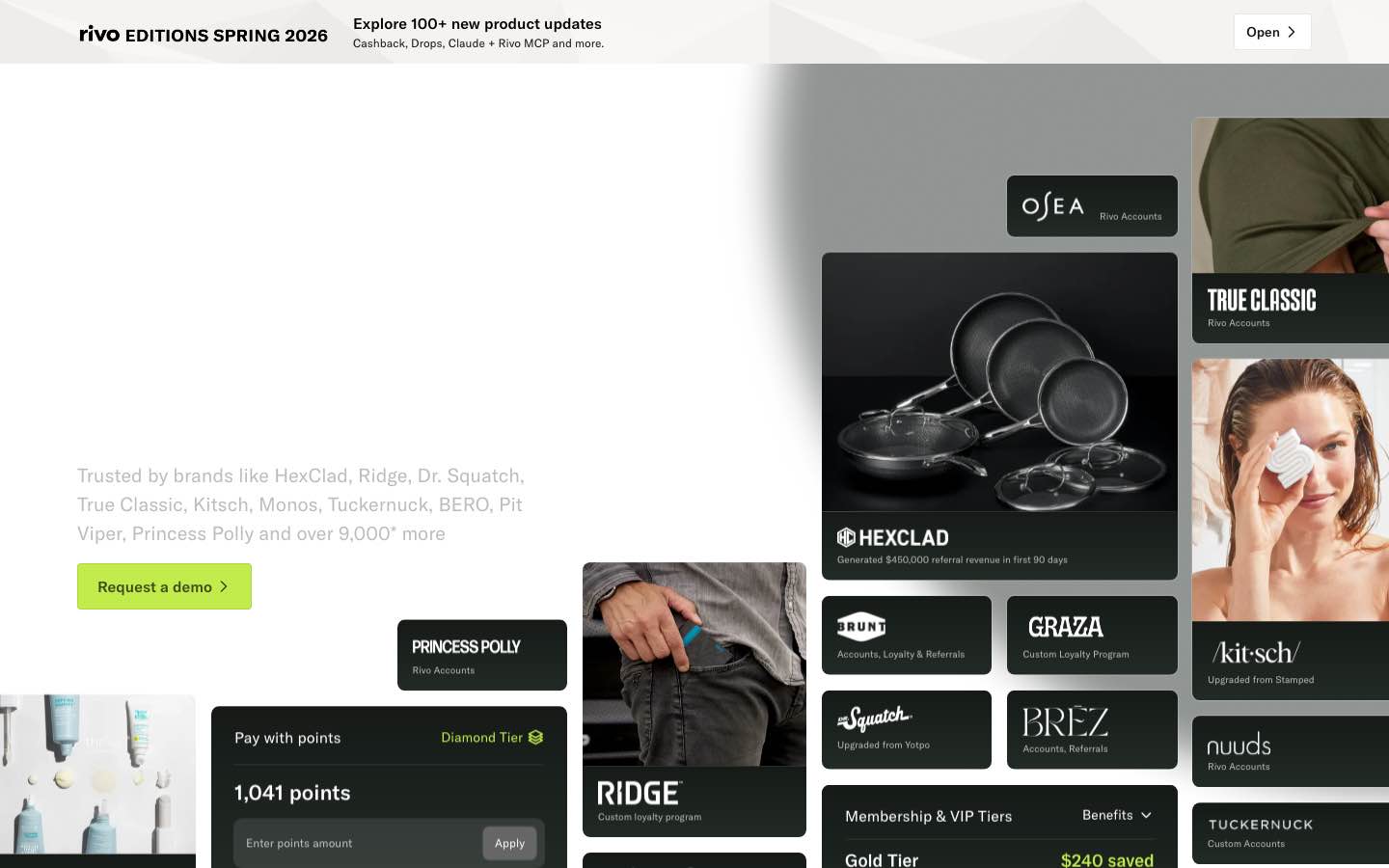
Best for: Shopify-native brands wanting deep customization and a modern customer portal
Rivo is the newer player that's been gaining ground fast. It's built specifically for Shopify (not a generic platform with a Shopify plugin), and it shows. The customer-facing loyalty portal is the best-looking one we've seen, and the developer APIs give you full control.
Pricing
| Plan | Price | Orders/month |
|---|---|---|
| Scale | $49-499/mo | 200-2,500 |
| Plus | $499/mo | Unlimited |
| Custom | Contact sales | Unlimited |
7-day free trial. SOC 2 Type II compliant.
What works
- Shopify-native architecture: not a bolted-on integration. It feels like part of your store.
- Beautiful customer portal: the best-looking loyalty experience we tested
- Developer-friendly: full API, Shopify Flow integration, metafields access
- Strong security: SOC 2 Type II compliance is rare at this price point
What doesn't
- Smaller ecosystem: fewer integrations than Smile or Yotpo (50+ vs 180+)
- Newer platform: less community content and fewer third-party tutorials
Why it ranks here: Best for brands that care about design and want to own their loyalty experience. If you're willing to trade ecosystem breadth for Shopify-native depth, Rivo is excellent.
Best email and SMS marketing apps for retention
Loyalty programs get people to sign up. Email and SMS get them to come back. These two channels drive the bulk of retention revenue for most Shopify marketing apps stacks.
5. Klaviyo
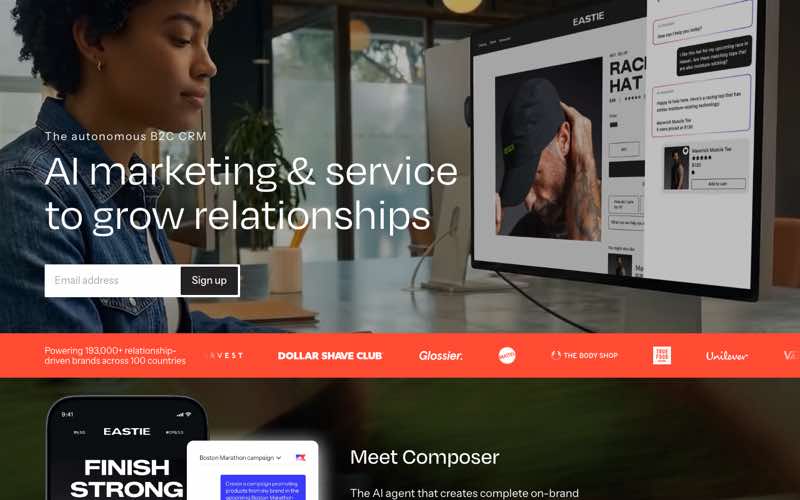
Best for: Data-driven email and SMS retention automation
Klaviyo is the default email/SMS platform for Shopify stores, and for good reason. It pulls every piece of customer data from your store (orders, browsing, cart activity) and lets you build automated flows around it. According to Klaviyo's own data, stores see an average of $85 in revenue for every $1 spent on the platform.
Pricing
| Plan | Price | Contacts | Emails/month |
|---|---|---|---|
| Free | $0 | 250 | 500 |
| $45/mo | 500 | 15,000 | |
| Email + SMS | $60/mo | 500 | 15,000 + 1,250 SMS |
Pricing scales with your contact list. At 10,000 contacts, expect $150-200/mo.
What works
- Best Shopify data integration: pulls everything (orders, browsing, cart activity, refunds) automatically
- 60+ pre-built flows: abandoned cart, win-back, post-purchase, replenishment, sunset sequences
- Predictive analytics: predicts next order date, churn risk, and lifetime value
- 350+ integrations: connects with every loyalty, subscription, and support app on this list
What doesn't
- Gets expensive fast: pricing scales with list size, and it adds up quickly past 5,000 contacts
- Steep learning curve: you need someone actively managing it to get full value
- Not set-and-forget: requires ongoing flow optimization, A/B testing, and list hygiene
Why it ranks here: Best retention email platform for Shopify. Period. But be honest about whether you'll actually use the advanced features. If not, Omnisend might be a better fit. For alternatives, see our Klaviyo alternatives roundup.
6. Omnisend

Best for: Simpler email and SMS marketing at a lower price point
Omnisend gives you email, SMS, and push notifications with nearly all features available on every plan (including free). It's less powerful than Klaviyo in terms of segmentation depth, but for most stores under 10,000 contacts, the difference barely matters.
Pricing
| Plan | Price | Contacts | Emails/month |
|---|---|---|---|
| Free | $0 | 250 | 500 + 60 SMS |
| Standard | $16/mo | 500 | 6,000 |
| Pro | $59/mo | 500 | Unlimited |
Pro includes SMS credits matching your plan cost ($59/mo = $59 in SMS credits).
What works
- All features on all plans: even the free tier includes automation, segmentation, and 24/7 support
- Better pricing at scale: significantly cheaper than Klaviyo once you pass 2,500 contacts
- Push notifications included: an extra channel most email platforms charge extra for
What doesn't
- Less advanced segmentation: Klaviyo's predictive analytics and custom events are more powerful
- Fewer integrations: works with the major apps but doesn't match Klaviyo's 350+ ecosystem
Why it ranks here: Best Klaviyo alternative for stores that want solid email/SMS without the complexity or cost. If you're not running a dedicated marketing team, Omnisend is easier to manage.
Best subscription app for recurring revenue
Subscriptions are the ultimate retention play. Instead of hoping customers come back, you build it into the billing. For stores selling consumables (supplements, coffee, skincare, pet supplies), this is essential. Here's our take on subscription customer service and why the right app matters.
7. Recharge Subscriptions
Best for: Stores selling consumables that customers reorder regularly
Recharge is the most popular subscription platform on Shopify. It powers thousands of brands and gives customers a self-service portal to skip, swap, pause, or cancel their subscriptions. The analytics dashboard shows you churn rates, LTV by cohort, and revenue forecasts.
Pricing
| Plan | Price | Transaction fee |
|---|---|---|
| 25-50 | $25/mo | Included (up to 50 subscribers) |
| Starter | $99/mo | 1.25% + $0.19/txn |
| Pro | $499/mo | 1% + $0.19/txn |
Once you cross 50 subscribers on the entry plan, you auto-upgrade to Starter.
What works
- Proven at scale: used by thousands of high-growth DTC brands
- Self-service portal: customers can manage their subscriptions without contacting support
- Strong analytics: churn tracking, LTV by cohort, revenue forecasting
- Flexible billing: supports prepaid, pay-as-you-go, and build-a-box models
What doesn't
- Transaction fees add up: 1.25% on top of Shopify's payment processing fees cuts into margins
- Overkill for simple use cases: if you just need basic "subscribe and save," Shopify's native subscriptions might be enough
- Auto-upgrade pricing: crossing the 50-subscriber threshold means jumping from $25 to $99/mo overnight
Why it ranks here: Industry standard for subscriptions. The transaction fees are the main complaint, but no other platform matches Recharge's feature depth for DTC brand retention.
Best customer service apps for retention
Here's the part every other "Shopify customer retention apps" list skips: customer service.
According to Shopify's own data, 57% of shoppers won't return after a bad service experience. Your returns process, your response time, your ability to actually pick up the phone. These aren't support costs. They're retention investments.
8. Ringly.io
Best for: Shopify stores that want 24/7 AI phone support without hiring anyone
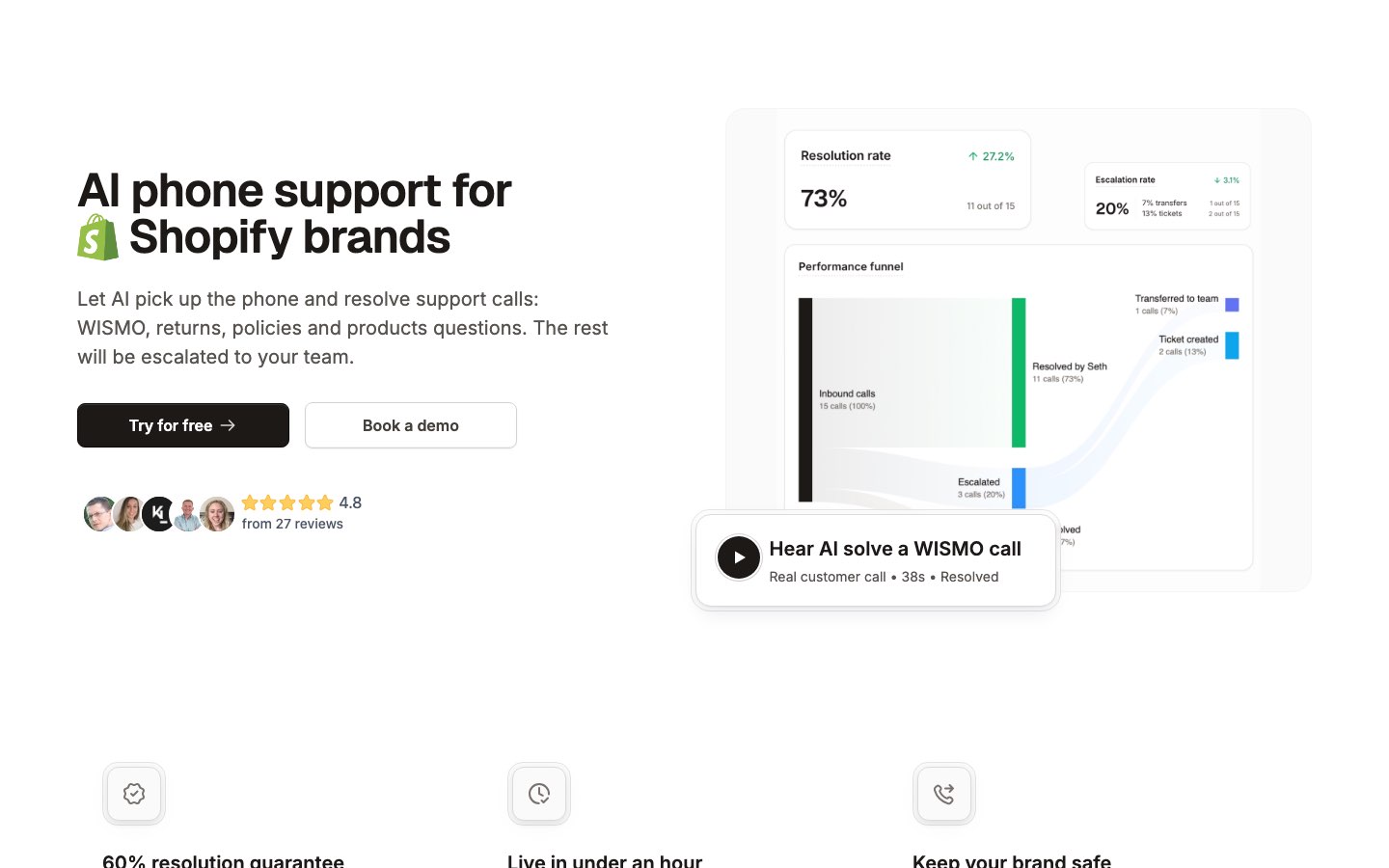
Ringly.io is an AI phone agent built specifically for Shopify. Its agent, Seth, picks up inbound customer calls, looks up orders in real time, processes returns, answers product questions, and escalates to a human when the situation calls for it. It resolves about 73% of calls without any human involvement.
The setup takes about three minutes. You connect your Shopify store, configure your business rules, and Seth starts answering calls. No developer needed. It works in 40 languages and runs 24/7, which means your customers get help even when you're asleep. Over 2,100 Shopify stores use it today.
Pricing
| Plan | Price | Minutes | Key features |
|---|---|---|---|
| Grow | $349/mo | 1,000 (~500 calls) | Self-learning AI, store data integration, recordings |
| Enterprise | Custom | 5,000+ | Private Slack, custom integrations, dedicated setup |
Overage: $0.19/minute. 14-day free trial available.
What works
- Deep Shopify integration: pulls real-time order data, checks inventory, processes returns without custom development
- 3-minute setup: no code, no developer, no onboarding call required
- 24/7 coverage in 40 languages: handles after-hours calls that would otherwise go to voicemail
- 73% resolution rate: most calls get resolved without a human ever touching them
- 14-day free trial: test it with real calls before committing
What doesn't
- Phone-focused: doesn't handle email or chat (pair with Gorgias for those channels)
- E-commerce specific: built for Shopify, not for general business use
Why it ranks here: The only AI phone agent built for Shopify. Customer service is the most underrated retention lever, and phone support is the channel most stores ignore because hiring is expensive. Ringly.io solves that.
Try Ringly.io free for 14 days and get Seth answering calls in under three minutes.
9. Gorgias
Best for: Shopify stores needing a unified helpdesk across email, chat, and social
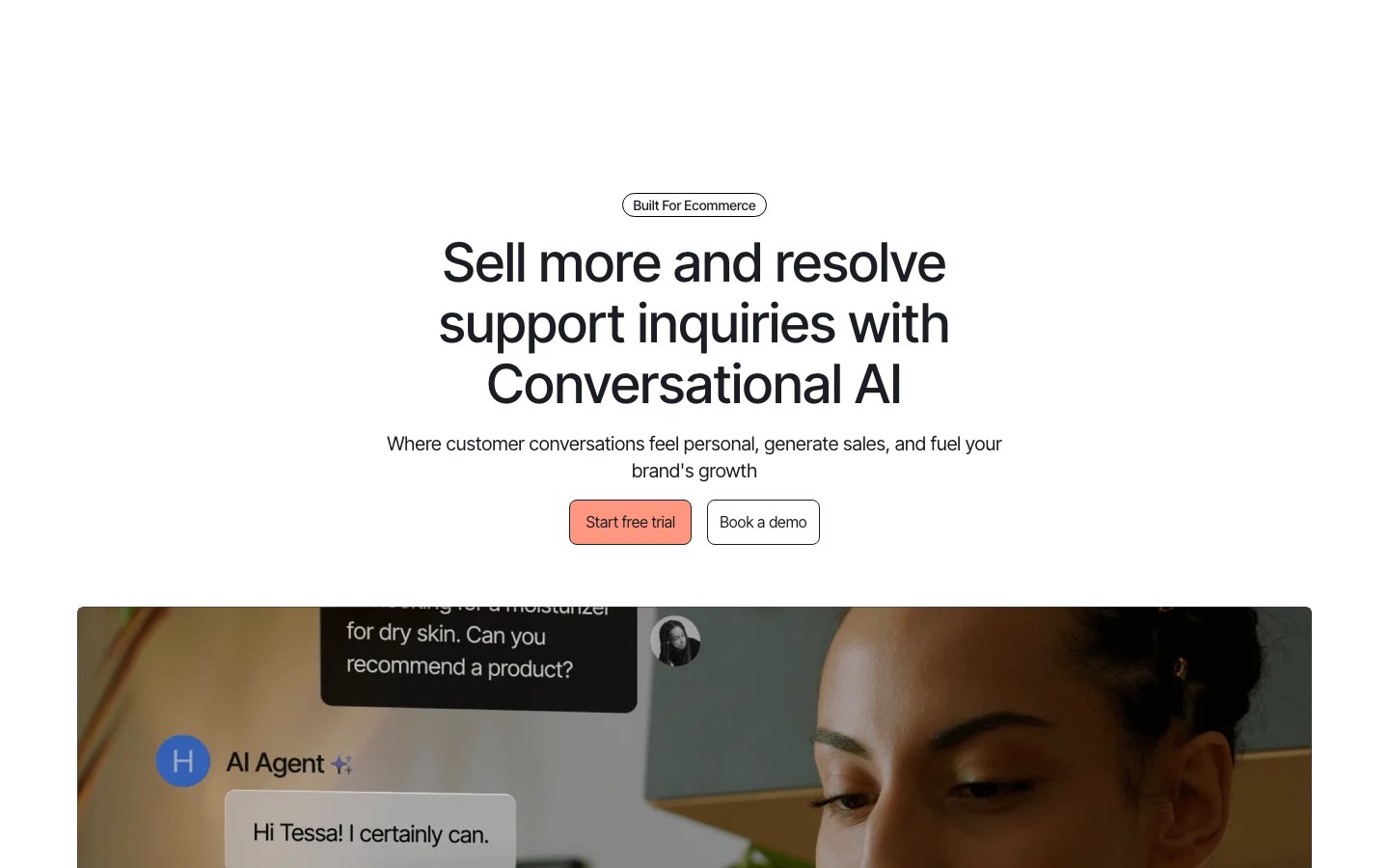
Gorgias is the leading helpdesk for Shopify. It pulls complete customer and order history into every ticket, so your support team can issue refunds, modify orders, and recommend products without leaving the helpdesk. If you need multi-channel text-based support, this is the standard.
Pricing
Gorgias uses ticket-based pricing. You pay for the number of conversations your team handles each month. AI-resolved tickets cost an additional $1 each ($0.90 on annual billing). Overage runs $150 per 100 interactions.
For exact plan breakdowns, see our Gorgias pricing analysis.
What works
- Deep Shopify integration: view and modify orders, process refunds, all from the ticket view
- Unified inbox: email, chat, social, and SMS in one place
- Macros and automation: template responses and auto-tags speed up common tickets
- Good app ecosystem: integrates with Klaviyo, Recharge, Smile.io, and most apps on this list
What doesn't
- Per-ticket pricing adds up: high-volume stores can see costs escalate quickly
- AI agent costs are separate: you pay both the helpdesk fee and $1 per AI-resolved ticket
- Phone support is basic: Gorgias handles phone calls, but it's not their strength (pair with Ringly.io for phone)
Why it ranks here: Best multi-channel helpdesk for Shopify. Pair it with Ringly.io for phone and you have your entire customer service stack covered.
Best returns app for retention
Returns are a retention moment most stores get wrong. A smooth return experience keeps customers. A bad one loses them forever. According to research, reducing your refund rate by converting refunds to exchanges directly improves retention and revenue.
10. Loop Returns

Best for: Turning returns into exchanges and store credit instead of cash refunds
Loop's entire pitch is that returns don't have to be a revenue loss. Their portal nudges customers toward exchanges and store credit instead of refunds. For stores with high return rates (fashion, apparel), this can significantly reduce refund leakage.
Pricing
| Plan | Price | Returns/year |
|---|---|---|
| Starter | $59/mo | 1,000 |
| Essential | $155-165/mo | More returns + automation |
| Advanced | $272-375/mo | Fraud prevention, bonus credit |
14-day free trial. $0.20 per additional return over your limit.
What works
- Exchange-first design: the portal actively nudges customers toward exchanges over refunds
- Branded experience: the returns portal matches your store's look and feel
- Bonus credit: Advanced plan lets you offer extra credit to incentivize exchanges over refunds
What doesn't
- Narrow scope: only handles returns (you still need separate apps for everything else)
- Recently removed budget plan: the $29/mo tier is gone, so $59/mo is now the floor
- Pricing opacity: higher-tier pricing varies and isn't fully transparent
Why it ranks here: Best for stores where returns are a major cost center. If you're in fashion or apparel, Loop can directly improve retention by making the return experience feel good instead of frustrating.
Best analytics apps for retention tracking
You can't improve what you don't measure. These two apps help you understand which customers stick, which ones churn, and where to focus your retention efforts. Good analytics also help you justify your spend on the other apps in this list. Here's more context on customer retention statistics to benchmark against.
11. Lifetimely
Best for: Understanding customer LTV and cohort behavior
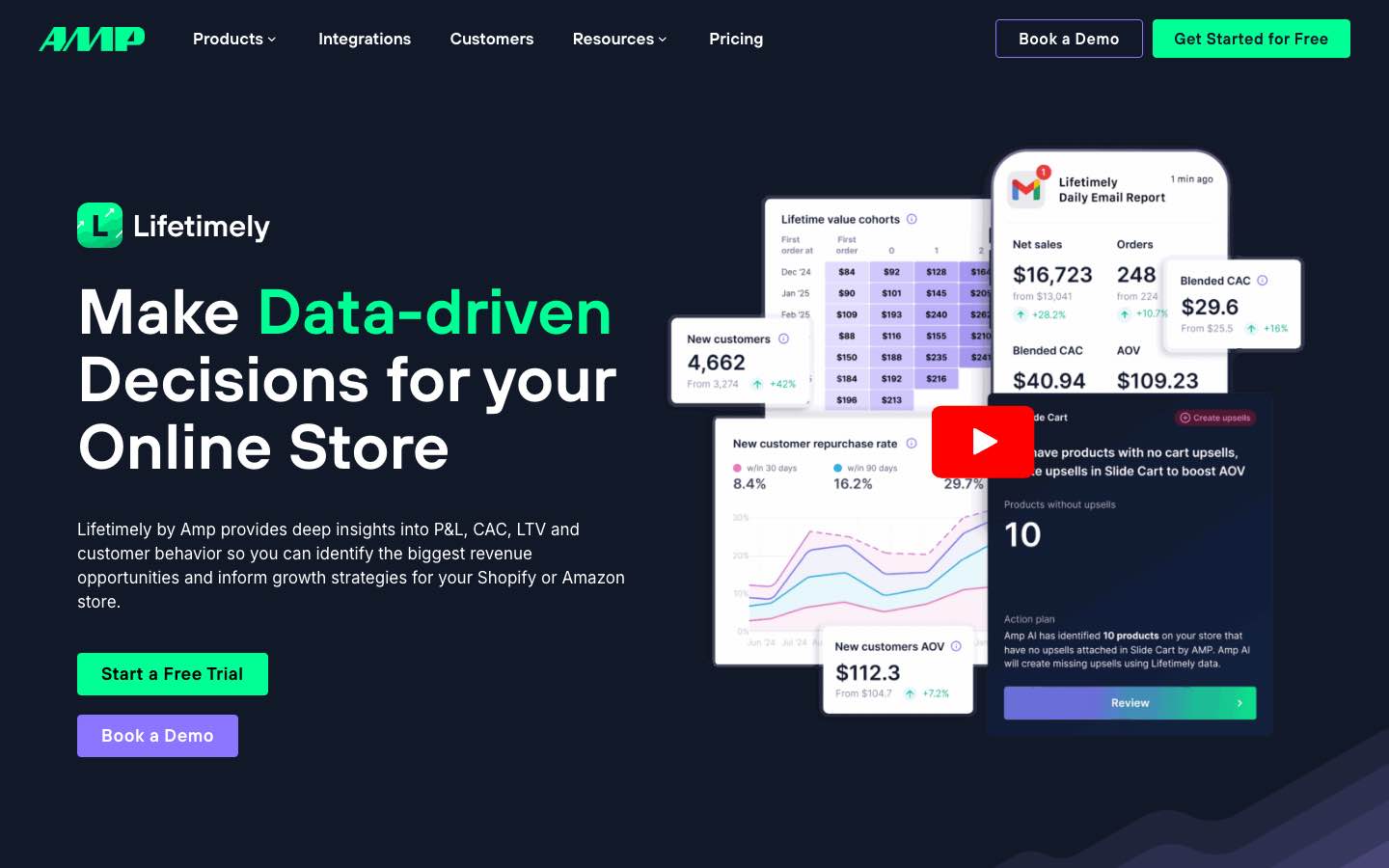
Lifetimely gives you the LTV analytics that Shopify's native reports can't. You get cohort-based reports showing how different customer groups behave over time, profit tracking by channel, and LTV predictions you can actually use for planning.
Pricing
Free plan available. Paid plans start at around $149/mo, with a $299/mo tier that includes a dedicated Slack channel for support.
What works
- Beautiful cohort reports: see exactly how each monthly customer cohort performs over 3, 6, 12 months
- LTV predictions: forecast customer value so you know how much to spend on acquisition
- Profit dashboard: track true profit after COGS, shipping, and ad spend
What doesn't
- Expensive for small stores: $149/mo is hard to justify if you're doing under $30K/mo in revenue
- Analytics only: it tells you what's happening but doesn't take action (you still need other apps to actually improve retention)
Why it ranks here: Best for understanding your retention numbers at a deep level. If you're spending on retention apps and want to prove they're working, Lifetimely is how you measure it.
12. RetentionX
Best for: AI-powered churn prediction and customer segmentation
RetentionX combines customer analytics with actionable automation. It tracks LTV, runs RFM segmentation, predicts churn, and syncs audience segments directly to Klaviyo, Meta, Google, and TikTok for targeting.
Pricing
Free tier available. Paid pricing is order-based, starting from around $10/mo. Significantly cheaper than Lifetimely.
What works
- AI churn predictions: flags customers likely to churn so you can intervene before they leave
- Direct ad platform sync: push segments to Meta, Google, and TikTok without manual exports
- Auto merchandising: sorts products based on real conversion data
- Generous free tier: get started with core analytics at no cost
What doesn't
- Newer platform: smaller user base means less community support and fewer tutorials
- Better at scale: the AI predictions work best with higher order volumes (1,000+/month)
Why it ranks here: Best for proactive retention. Instead of waiting for customers to leave and trying to win them back, RetentionX helps you spot the warning signs early.
How to build your Shopify retention stack
You don't need all 12 apps. Here's what we'd recommend based on where you are.
Starting out (under $50/mo)
- Smile.io Free (loyalty basics)
- Klaviyo Free or Omnisend Free (email automation)
- Ringly.io Grow ($349/mo for AI phone support, 1,000 minutes)
This gives you loyalty, email, and phone support. That covers the three most important retention channels.
Growing brand ($100-300/mo)
- Smile.io Starter or Rivo Scale (loyalty with more features)
- Klaviyo Email ($45/mo)
- Ringly.io Grow ($349/mo, 1,000 minutes)
- Lifetimely or RetentionX (start tracking LTV)
Scaling brand ($500+/mo)
- Yotpo or Rivo Plus (advanced loyalty + reviews)
- Klaviyo Email + SMS
- Recharge (if selling consumables)
- Ringly.io + Gorgias (phone + helpdesk)
- RetentionX (churn prediction + ad targeting)
The key insight: start with customer service and email. Those have the most immediate impact on retention. Add loyalty and subscriptions once you have enough traffic to make them worthwhile. Use analytics to prove your stack is working.
Ready to see what AI phone support looks like for your Shopify store? Start your free trial. Setup takes three minutes.
Frequently asked questions
What's the best free Shopify customer retention app?
Smile.io's free plan (200 orders/month) is the best starting point for loyalty. Klaviyo's free tier (250 contacts) handles email automation. And RetentionX has a free analytics tier. You can run a basic retention stack at zero cost.
Do loyalty programs actually work for small Shopify stores?
Yes, but only if your customers buy more than once a year. If you sell consumables or fashion, loyalty programs can increase repeat purchases by 12-18%. If you sell furniture or one-time purchases, focus on referrals instead of points.
How much should I spend on retention apps?
A reasonable budget is 5-10% of your monthly revenue on retention tools. For a store doing $20K/mo, that's $1,000-2,000 across loyalty, email, and customer service. Start small and scale up as you prove ROI.
Can AI phone support really help with customer retention?
Absolutely. Customers who get fast, helpful answers are far more likely to buy again. Ringly.io resolves 73% of calls automatically, which means your customers get instant help 24/7 instead of hitting voicemail. That kind of response time directly impacts whether someone comes back.
Should I use Klaviyo or Omnisend for retention emails?
Klaviyo if you have the budget and a dedicated person managing it. Omnisend if you want something simpler and cheaper. Both integrate with Shopify, both have abandoned cart and win-back flows. The practical difference only matters past 5,000 contacts.
What's a good repeat purchase rate for Shopify stores?
The average is about 28%. Stores with strong retention strategies (loyalty + email + great service) typically see 35-45%. Top performers in consumables (supplements, coffee, pet food) can hit 50-60%.
How many retention apps do I need?
Two to three is the sweet spot for most stores. One for communication (email/SMS), one for loyalty or subscriptions, and one for customer service. Adding analytics makes sense once you're spending $200+/mo on retention and need to track ROI. More on building a small team customer service setup.
The bottom line
Retention isn't just loyalty points. It's the full experience: fast answers on the phone, easy returns, personalized emails, and real reasons to come back.
Pick two or three apps that cover different parts of the customer journey. Start with the basics (email + service), measure what works, and build from there. The stores that win at retention aren't the ones with the most apps installed. They're the ones that make every interaction feel worth coming back for.
If you want to start with the piece most stores overlook, try Ringly.io free for 14 days. Your customers are calling. Someone should pick up.