
This post in 30 seconds.
- 9 plays that move churn: proactive outreach, pause/skip options, save flows, AI phone for cancellations, billing-failure recovery, FTC click-to-cancel compliance, save rate tracking, 30-min FRT, voice-of-customer loops.
- Realistic lift: brands running this full stack reduce voluntary churn 18-27%. Pause/skip alone is worth 11-20%. Cancellation calls handled by AI convert 14-22% to a save.
- Built for $10M-$100M subscription-DTC brands (supplements, pet, beauty, food) where churn is the metric the board asks about every month.
Every billing cycle is a churn moment. That is the structural difference between subscription ecommerce and one-time purchase. CS in this model is not a cost center, it is the retention engine. Done poorly it accelerates churn. Done well it adds 18-27 percentage points back to net retention.
If you run a $10M-$100M supplement, pet, beauty, or food subscription brand on Shopify, the FTC's October 2024 click-to-cancel rule reshaped the rules of engagement. You cannot bury cancel anymore. The new play is making the cancel flow itself the save flow.
If your save rate sits below 20% and you suspect your CS team is firefighting cancellations instead of preventing them, book a 30-min call and we will map the 3 save moves that fit a brand your size.
What makes subscription CS different
Three structural differences set the operating model.
1. Recurring billing creates recurring failure modes. Failed payments, expired cards, address changes, gift-card edge cases. Involuntary churn (failed-payment cancellations the customer did not actively choose) runs 2-5% monthly for most brands. Recovering half of that adds 1-2.5 points to net retention.
2. Every interaction is either a save or a leak. A consumer who calls about a delayed reorder is either a 30-min FRT save or a same-day cancellation. There is no neutral.
3. The FTC click-to-cancel rule (October 2024) is enforceable. Subscription businesses must make cancellation as easy as sign-up, in the same medium. Violations cost up to $51,744 per instance. Smart brands use this as a trust play, not a fight.
9 strategies that actually reduce subscription churn
1. Run proactive outreach before problems escalate
The play: 7 days before a renewal, send a one-question SMS or email checking in. "Anything you want to adjust before your next box?" 8-15% of replies surface a problem you can fix (wrong flavor, address change, pause request) BEFORE it becomes a cancel-and-refund spiral.
Tools: Klaviyo flows, Postscript SMS, Attentive. Cost: $300-$1,500/month depending on volume. Realistic lift: 2-4 points of net retention.
2. Offer pause and skip prominently in self-service
This is the single biggest save move. Customers who get a "pause for 2 months" or "skip next shipment" option in self-service take it at 35-50% of the rate of cancellation. Pause converts back to active at 60-75% within 90 days.
The data: a properly placed pause/skip flow reduces voluntary churn 11-20% on its own. Most subscription apps (Recharge, Skio, Awtomic) support this in 30 min of setup. The mistake is hiding it under "manage subscription" three clicks deep.
3. Build a cancellation flow that offers alternatives first
The cancel button should be visible per FTC rule. But before they click it, present 3 options: pause, skip, swap to a smaller plan. About 25-40% of would-be cancellers pick an alternative when offered well.
Recharge cancel flows, Skio cancel surveys, Churnkey, and Reachu Save all do this. The save copy matters more than the tool. Lead with empathy ("we get it, life changes"), surface the alternative, then allow cancel.
4. Handle cancellation calls with an AI phone agent
Cancellation calls are the highest-stakes moment in your CS stack. Phone has a 91% satisfaction rate, the highest of any channel. But staffing a 24/7 phone line for cancel calls costs $4K-$8K/month per rep.
An AI phone agent handles cancellation calls at $0.42-$0.91/call, runs the same alternative-offering flow as your web cancel page, and converts 14-22% of cancel calls to a pause/skip/swap. BioLongevity Labs, a supplement brand on Ringly with comparable volume, hits 79% end-to-end resolution autonomously.
5. Recover failed payments with smart dunning
Failed-payment churn is the most preventable category. The fix is multi-step dunning: retry payment at 3, 7, 14, 21 days, with a personalized email/SMS at each step + a phone call at day 14 for orders over $80.
Tools: Recharge dunning, Stunning, Churnbuster. Adding a phone call to the day-14 step lifts recovery rates 22-35% on its own in our data. That is 1-2 net retention points for most brands.
6. Comply with FTC click-to-cancel without losing the save opportunity
The rule: cancellation must be as easy as sign-up, in the same medium. If you allow web sign-up, you must allow web cancel. You cannot force a phone call.
The play that works: make web cancel one click, but route the click through an alternatives-offer flow (pause, skip, swap) before the final cancel button. The customer can still bail at any step. That is compliant AND captures saves.
7. Track save rate as a top-line metric
Most subscription brands track CSAT and churn but not save rate. Save rate = % of cancellation attempts converted to a stay (pause, skip, swap, plan change). Target 20-30% for $10M+ brands.
Below 15%, your cancel flow is broken. Above 30%, you may be holding customers too aggressively (watch refund-request rate as the counter-metric).
8. Hit 30-min FRT on subscription inquiries
Stores replying inside 1 hour see 71% customer retention vs 48% for stores taking 24 hours (HubSpot). For subscription specifically the gap is wider because the renewal is already scheduled. A customer with an unresolved question heading into renewal day is a cancel.
30-min FRT is the floor. Sub-5-min is best in class. Hit it with auto-replies + AI deflection + a real SLA on your helpdesk.
9. Run a voice-of-customer loop on cancellation reasons
Every cancellation should capture a reason. Most brands ignore the data. Review it weekly. The top 3 cancel reasons become next month's product or operations roadmap. Brands that do this kill 2-4 points of structural churn over 6 months by fixing root causes.
The ROI math on the full subscription CS stack
$15M ARR subscription brand with 30,000 active subscribers, $42 AOV, 6% monthly voluntary churn.
Current state:
- 30,000 × 6% = 1,800 cancels/month
- 10% save rate = 180 saves
- 1,620 lost subscribers × $42 × 4-month average LTV remaining = $272,160/month in lost recurring revenue
After full stack (pause/skip + cancel flow + AI phone + dunning + 30-min FRT):
- Voluntary churn drops to 4.5% (25% reduction)
- Save rate rises to 28%
- 1,350 cancels × 28% saved = 378 saves
- 972 lost × $42 × 4 months = $163,296/month in lost recurring revenue
- Monthly recovered revenue: $108,864. Annual: $1.3M.
Stack cost for a brand this size: $4K-$8K/month. The ROI is not close.
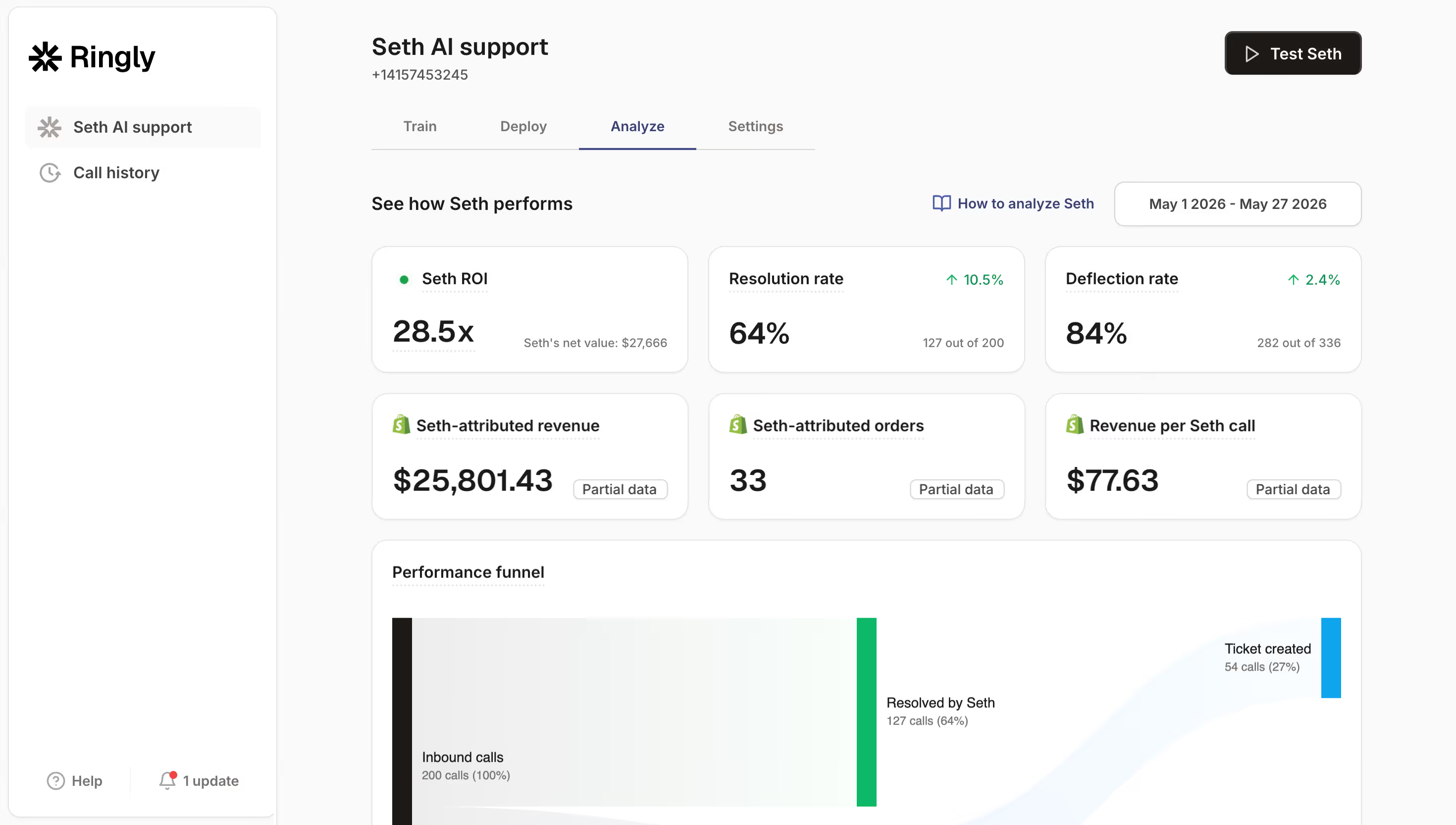
WashCo, a brand we launched, generated $22,664 in attributed revenue in the first 7 days post-launch, 271 calls handled, 85% deflection, 66% resolution, $0.91 per call vs $2.70 for human-handled. Different vertical, same compounding logic on phone.
The call makes sense if:
- You are a Shopify (or Shopify Plus) subscription brand doing $10M-$100M
- You run a paid helpdesk (Gorgias, Zendesk, Gladly, Re:amaze, or Intercom)
- Your phone number is visible on your store
- Your CS team is 3-12 people
If that is you, the math usually works.
What happens on the call.
- We pull your last 7 days of cancellation reasons + save-rate data live, on the call. No homework.
- We show which 2-3 save plays would move your net retention most for your specific churn mix.
- You decide if it is worth a deeper conversation. No deck, no follow-up sequence.
Book a 30-min call and we will run the save-rate math on your actual cancel data.
"My customers also feel like it's a normal person. They feel like they can communicate if they have questions."
Claudia Droge, TechCraft Studio
Vertical notes (supplements, pet, beauty, food)
Different verticals have different churn drivers. The plays still work, the priorities shift.
- Supplements (Ritual, AG1, HUM reference set): reorder timing is the #1 churn driver. Customers churn because their reorder lands a week after they ran out. Fix: 5-days-before reorder reminder + flexible reorder date.
- Pet food (Chewy, BarkBox, Farmer's Dog reference set): weight-change inquiries and breed-specific questions need empathy. Route to humans, but use AI for the routing + initial info gather.
- Beauty (Wonderskin, Glossier, Tatcha reference set): shade/SKU mismatches drive cancels. Add a "swap this month's box" option prominently in the dashboard.
- Specialty food (Trade Coffee, Henry's House of Coffee reference set): flavor preference shifts. Quarterly "tell us what you didn't love" + auto-swap based on feedback.
Frequently asked questions
What makes subscription CS different from regular ecommerce?
Recurring billing, ongoing relationships, and cancellation management. Every billing cycle is a potential churn point. You need proactive communication, self-service management tools, and save strategies that don't exist in standard one-time-purchase ecommerce.
How do I reduce subscription churn with better CS?
Focus on the highest-impact moves: reply inside 30 minutes, offer pause/skip prominently (this alone cuts churn 11-20%), run proactive outreach before renewal, and build a cancellation flow that offers alternatives before the final cancel button. Track save rate as the metric of record.
Should subscription businesses offer phone support?
Yes, especially for cancellation moments. Phone has a 91% satisfaction rate, the highest of any channel. Cancellation calls, billing disputes, and complex account changes are better handled by voice. AI phone agents make 24/7 phone affordable at $0.42-$0.91/call vs $15-$25 for a human.
What is the FTC click-to-cancel rule?
The FTC finalized the rule in October 2024. Subscription businesses must make cancellation as easy as sign-up, in the same medium. Violations cost up to $51,744 per instance. Smart brands use it as an opportunity to build trust and offer alternatives during the cancel flow.
How can AI help with subscription CS?
AI handles the repetitive 60-70% of tickets (order status, billing dates, pause requests) at about $0.50 per interaction vs $6-$15 for a human. AI phone agents go further by managing cancellation save flows, looking up orders in real time, and providing 24/7 voice support. Human team focuses on complex high-empathy conversations.
What metrics should subscription brands track for CS?
Beyond CSAT and FRT, track save rate (target 20-30%), first-call resolution (target 70%+), CS-driven churn (cancels citing poor service, keep under 5%), and involuntary churn rate (failed payments not recovered, keep under 2%). Save rate is the subscription-specific metric most teams miss.
Talk to us
If you run a $10M-$100M Shopify subscription brand and your save rate is below 20%, a 30-min call is the fastest way to see which save play to build first.
The 3-layer guarantee.
- Live in 14 days or it's free until launched.
- 65% resolution in 90 days or we refund the last 3 months of subscription fees.
- We keep working free until we hit 65%.
Ruben (Ringly co-founder) takes these calls personally.