
Most ecommerce support teams spend their day putting out fires. A customer calls about a late package. Another emails asking where their order is. Someone else wants to return a product but can't find the instructions.
Every one of those tickets was preventable.
That's the core idea behind ecommerce proactive customer service: reaching out to customers before they have to ask. And the data backs it up. According to a PRNewswire study, 87% of US consumers actually want companies to contact them proactively. Yet most online stores still run purely reactive support, waiting for problems to land in their inbox.
This guide covers 10 proactive strategies that reduce your ticket volume, improve customer satisfaction, and free your team to focus on the conversations that actually matter. Including one channel that almost every other guide completely ignores: the phone.
Hear what AI support calls sound like for your store. Just paste your Shopify URL and get sample calls in under 20 seconds, no email required. Listen to demo calls for my store.
What is proactive customer service in ecommerce?
Proactive customer service means your team (or your tools) reaches out to customers before they hit a problem. Instead of waiting for a "where is my order?" email, you send a shipping delay notification first. Instead of hoping buyers find your return policy, you include it in the delivery confirmation email.
Here's how it compares to the reactive approach most stores default to:
| Reactive service | Proactive service | |
|---|---|---|
| Trigger | Customer contacts you | You contact the customer |
| Timing | After the problem | Before the problem |
| Customer feeling | Frustrated, needs help | Surprised, feels cared for |
| Ticket volume | High and growing | Lower over time |
| Team workload | Firefighting | Strategic outreach |
The reason proactive service works so well in ecommerce is that the customer journey is incredibly predictable. You know exactly when someone places an order, when it ships, when it arrives, and when the return window opens. Every one of those moments is a chance to reach out before a ticket gets created.
Research from MyCustomer shows that 73% of customers contacted proactively report positive experiences. That's not a marginal improvement. It's the difference between a customer who churns and one who reorders.
Why proactive service matters more than ever for online stores
Your customers expect faster responses than ever. According to a 2026 Zendesk report, 64% of shoppers expect a response within one hour. If your team is buried in reactive tickets, hitting that benchmark is nearly impossible.
The financial case is even more compelling.
Customers who have a great support experience spend 140% more than those who don't. And according to Bain & Company, a 5% increase in customer retention can boost profits by 25-95%.
But here's the part that matters for your operations budget: proactive service reduces ticket volume. Companies implementing proactive strategies see up to a 30% reduction in inbound support requests. For a store handling 500 tickets per month at $8-12 per ticket, that's $1,200-1,800 in monthly savings from ticket deflection alone.
WISMO ("where is my order?") inquiries account for 20-40% of total ecommerce support tickets during normal periods. During peak seasons like Black Friday, that number can surge to 50-80%. Most of those tickets disappear with proactive shipping updates.
The math is simple. Preventing tickets is cheaper than resolving them.
10 ecommerce proactive customer service strategies that work
1. Send shipping updates before customers ask
This is the single highest-impact proactive strategy for most stores. WISMO queries eat up a massive chunk of your support capacity, and most of them exist because customers don't know what's happening with their order.
Set up automated notifications at every key moment:
- Order confirmed: immediate email/SMS with expected delivery window
- Order shipped: tracking number + estimated arrival
- Delay detected: proactive alert explaining what happened and new timeline
- Out for delivery: same-day notification
- Delivered: confirmation + link to support if anything is wrong
The proactive delay notification is the most important one. When carriers flag a delay, your system should alert the customer before they notice. Include a brief apology and, when possible, a small discount on their next order. According to Salesforce research, proactive tracking solutions can cut WISMO calls by up to 70%.
2. Trigger live chat based on browsing behavior
When someone has been sitting on your checkout page for over 60 seconds without completing their purchase, something is wrong. Maybe they have a question about shipping costs. Maybe they're comparing prices. Maybe they're confused by a form field.
A well-timed chat popup can rescue that sale.
Here are the highest-value triggers:
- Cart page lingering: visitor on checkout for 60+ seconds without action
- Repeat product views: someone viewing the same product 3+ times
- Exit intent on cart: cursor moves toward the browser close button
- High-value cart: orders above your average order value deserve extra attention
The key is making the message helpful, not pushy. "Hey, need help with anything?" works better than aggressive discount popups. You're trying to remove friction, not add pressure.
This kind of behavioral targeting is one of the fastest ways to improve your conversion rate without changing your product or pricing.
3. Build a self-service knowledge base that actually gets used
According to Microsoft research, 66% of customers try self-service before contacting support. If your self-service resources are thin, outdated, or hard to find, those customers end up in your ticket queue anyway.
Here's how to build a knowledge base that deflects tickets:
- Audit your top 20 ticket reasons: these become your first 20 help articles
- Write for scanning: use headers, bullet points, and screenshots
- Include search: a knowledge base without search is basically useless
- Update monthly: stale articles create more confusion than they solve
- Link from transactional emails: every order confirmation should link to relevant help content
A good knowledge base is the foundation of any ecommerce customer service operation. Spoonflower, for example, achieved a 45% ticket deflection rate by combining automated routing with strong self-service resources.
4. Automate post-purchase follow-ups
The period between placing an order and receiving it is when anxiety peaks. Proactive post-purchase emails reduce that anxiety and prevent tickets from being created.
Here's a post-purchase sequence that works:
- Day 0: Order confirmation with clear timeline and what to expect
- Day 1-2: "Your order is being prepared" update (especially for custom/handmade products)
- Day 3-5: Shipping confirmation with tracking
- Day 7-10: Delivery confirmation + "How did everything arrive?"
- Day 14-21: Review request + product care tips
- Day 25-28: Replenishment reminder (for consumable products)
Each email should include a direct link to support in case something went wrong. The goal isn't just to inform. It's to give customers an easy path to resolution at every stage, so they never feel stuck.
This is especially important for subscription brands where the post-purchase experience directly affects renewal rates.
5. Use AI to answer the phone 24/7
Here's the strategy that almost every proactive service guide skips entirely: phone support.
Most articles about proactive customer service focus on chat and email. But phone calls aren't going away. Customers still call, especially for high-value orders, urgent issues, or when they can't find answers online. And when they call after hours or on weekends, they hit voicemail. That's not proactive. That's not even reactive. That's just absent.
AI phone agents change this completely. An AI voice agent can answer every call, 24/7, in 40+ languages. It can look up orders, process returns, answer product questions, and escalate to a human when the situation requires it.
This turns phone support from a reactive bottleneck into a proactive channel. Customers get instant help without waiting in a queue. And your team only handles the calls that actually need a human.
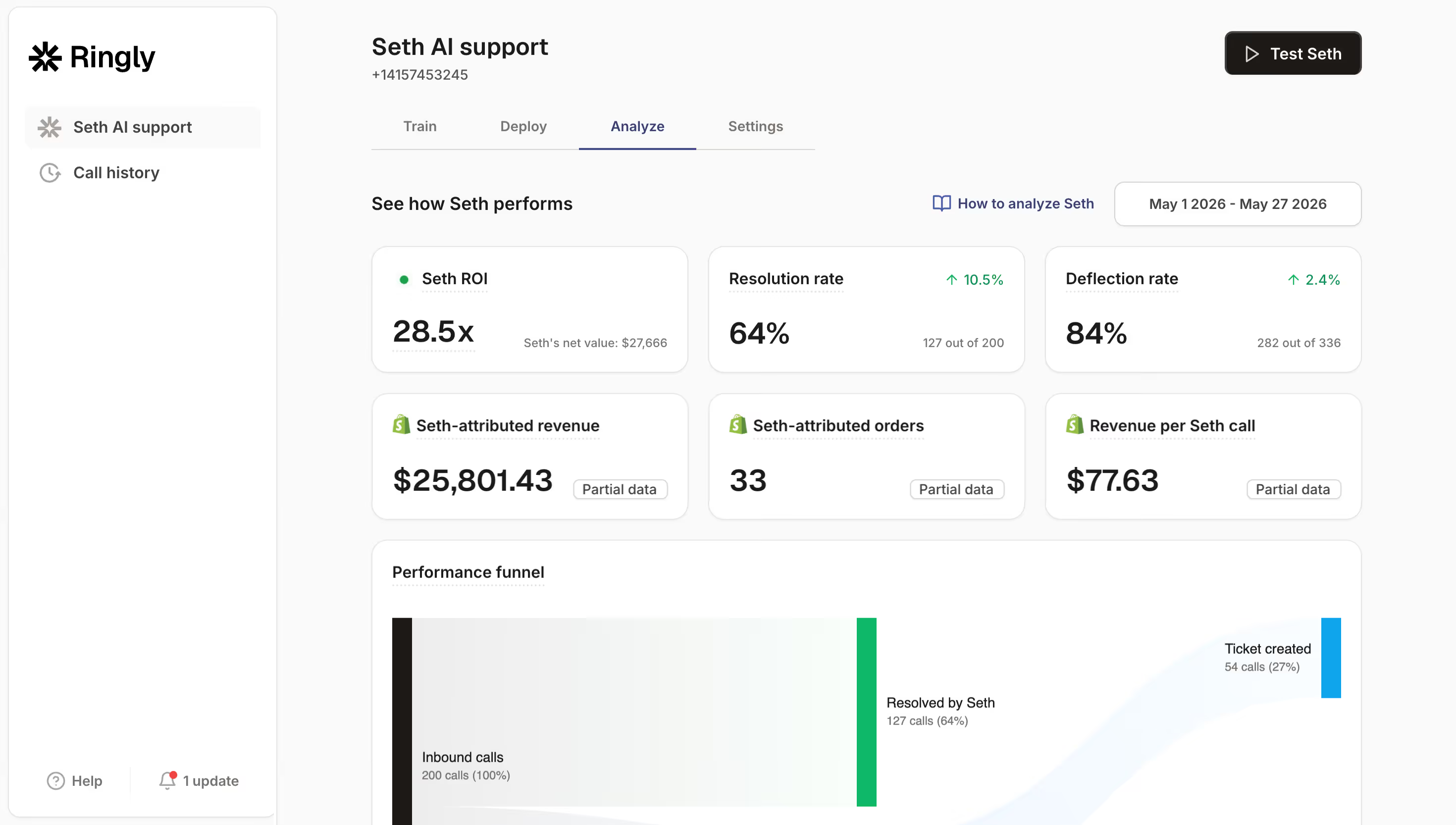
Ringly.io's AI phone agent, Seth, resolves about 73% of calls without any human involvement. Setup takes roughly three minutes. See what it sounds like for your store.
6. Proactively recover abandoned carts with phone calls
Cart abandonment rates hover around 70% for most ecommerce stores. Everyone knows about abandoned cart emails. Fewer stores know about abandoned cart phone calls.
The numbers are striking. Abandoned cart emails convert at roughly 5-15%. Phone calls recover 25-35% of abandoned carts, according to FoneSwift research. That's up to 5x the conversion rate of email.
Why? Because a phone call gets 70-85% connection rates compared to ~45% email open rates. And once someone picks up the phone, you have their full attention.
An AI voice agent can call within 30 minutes of cart abandonment, ask if the customer had any questions, and offer to help complete the purchase. It doesn't feel like a sales call. It feels like customer service.
If you're already running abandoned cart recovery, adding phone as a channel can significantly increase your recovery rate. Multi-channel approaches (phone + email + SMS) recover up to 45% of abandoned carts.
7. Alert customers about subscription renewals and billing changes
Nothing kills customer trust faster than a surprise charge. For stores running subscriptions (supplements, coffee, skincare, pet food), proactive billing communication isn't optional. It's essential.
Send renewal reminders 3-7 days before the charge hits:
- What's renewing: product name, quantity, price
- When: exact charge date
- Easy actions: skip, swap, cancel, or update payment method
- Link to support: in case they have questions
This single automation can dramatically reduce refund rates and chargebacks. It also reduces the "I didn't know I was being charged" support tickets that subscription brands deal with constantly.
Proactive support reduces churn by 27% among subscribers who've already experienced an issue. For subscription ecommerce, that's a direct impact on lifetime value.
8. Monitor social media for complaints before they escalate
A customer who tweets about a bad experience isn't just venting. They're broadcasting that experience to hundreds or thousands of people. And if you don't respond quickly, the narrative gets set without your input.
Proactive social monitoring means:
- Brand mention alerts: get notified every time someone mentions your store
- Hashtag tracking: watch for product names and common complaint phrases
- Respond within 1 hour: speed matters on social more than any other channel
- Move to DMs: acknowledge publicly, resolve privately
When you catch and resolve a complaint fast, you turn a negative moment into a public display of great service. Other potential customers see that.
This is particularly important for DTC brands where brand reputation directly drives new customer acquisition.
9. Create proactive return and exchange flows
Returns are inevitable in ecommerce. But confused, frustrated return experiences generate a disproportionate number of support tickets.
The proactive approach:
- Before purchase: make your return policy visible on product pages, cart pages, and confirmation emails
- After delivery: include return instructions in the delivery confirmation email (don't make them search for it)
- Exchange suggestions: when a customer initiates a return, proactively suggest an exchange (different size, color, or alternative product)
- Status updates: send automated updates at every step of the return process
Proactive exchange suggestions are especially powerful. Instead of losing the revenue entirely, you keep the sale by helping the customer find what they actually wanted. This is a key tactic for reducing return rates without restricting your return policy.
10. Use customer data to predict and prevent churn
This is the most advanced proactive strategy, but also the most valuable for stores with repeat customers.
Watch for these warning signals:
- Decreased order frequency: customer who ordered monthly now hasn't ordered in 60 days
- Multiple support complaints: more than 2 negative interactions in 30 days
- Negative review or low CSAT score: they told you they're unhappy
- Failed payment: their card declined on a subscription renewal
- Browse-without-buying pattern: they're visiting but not converting anymore
When you spot these signals, reach out proactively. A personal email, a phone call, or even a special offer can save a customer who was about to leave silently.
AI makes this scalable. Instead of manually monitoring customer behavior, AI-powered tools can flag at-risk customers automatically and trigger outreach through the right channel.
For more on building a retention-focused support operation, check out our guide to customer retention strategies for ecommerce.
How to keep proactive outreach helpful (not annoying)
The line between "helpful" and "spammy" is thinner than most brands realize. Research shows 67% of customers appreciate proactive notifications, but that number drops fast when you overdo it.
Here are the guardrails that keep you on the right side:
- Cap messages per customer: 2-3 proactive touchpoints per week, max. More than that and you're noise.
- Respect time zones: no notifications at 2 AM. Schedule around your customer's local time.
- Match channel to urgency: email for informational updates, SMS for time-sensitive shipping alerts, phone for high-value issues
- Give easy opt-out control: every proactive message should include a clear way to adjust preferences
- Personalize the content: "Your order #4521 is delayed" beats "We're experiencing shipping delays" every time
- Test and iterate: start with one or two proactive flows, measure the impact, then expand
The best proactive service feels like a friend giving you a heads up. Not a brand trying to sell you something.
If you're looking for an AI phone agent that knows when to reach out and when to stay quiet, Ringly.io handles that balance automatically.
How to measure proactive customer service ROI
You can't improve what you don't measure. Here are the metrics that tell you whether your proactive strategies are working:
| Metric | What it measures | Target |
|---|---|---|
| Ticket deflection rate | % reduction in inbound tickets after proactive flows launch | 20-30% reduction |
| First contact resolution | % of issues resolved on the first interaction | 70%+ |
| CSAT score | Customer satisfaction after proactive interactions | 85%+ |
| Support cost per order | Total support spend divided by total orders | Decreasing trend |
| Cart recovery rate | % of abandoned carts recovered via proactive outreach | 15-25% |
| WISMO ticket percentage | WISMO tickets as % of total volume | Below 15% |
The simplest ROI calculation: count how many tickets per month you were getting before proactive flows, compare to after, and multiply the difference by your average cost per ticket ($8-12 for most stores).
For example, if you reduce tickets from 500/month to 350/month at $10 per ticket, that's $1,500 in monthly savings. Plus the revenue you retain from customers who didn't churn because you caught their issue early.
For a deeper look at which metrics matter most, check out our guide to customer service KPIs for ecommerce and first call resolution benchmarks.
Frequently asked questions
What's the difference between proactive and reactive customer service?
Reactive customer service waits for customers to reach out with problems. Proactive service anticipates those problems and addresses them first. For example, sending a shipping delay notification before the customer notices is proactive. Answering their "where's my order" email after they've been waiting three days is reactive.
How do I start with proactive customer service if my team is small?
Start with your highest-volume ticket type. For most stores, that's WISMO. Set up automated shipping notifications and you'll see an immediate drop in tickets. From there, add a knowledge base for your top 10 questions and a post-purchase email sequence. You don't need a big team. You need the right automations.
Can AI handle proactive customer outreach?
Yes, and it's getting better fast. AI can send automated shipping updates, trigger chat based on browsing behavior, answer phone calls 24/7, and even proactively recover abandoned carts. According to Gartner, 30% of service cases were resolved by AI in 2025, and that number is expected to hit 50% by 2027.
What are the best tools for proactive ecommerce customer service?
It depends on the channel. For helpdesk and chat, Gorgias and Zendesk are popular choices. For AI phone support, Ringly.io handles inbound calls and proactive outreach for Shopify stores. For shipping notifications, most fulfillment platforms (ShipBob, ShipStation) have built-in proactive alerts.
How many proactive messages should I send per customer per week?
Keep it to 2-3 maximum during normal periods. During active order fulfillment, transactional updates (shipping, delivery) don't count toward this limit since customers expect those. The goal is to be helpful without creating notification fatigue.
Does proactive customer service actually reduce support costs?
Yes. Companies implementing proactive strategies report up to 30% reduction in inbound support requests. For a store handling 500 tickets per month at $10 per ticket, that's up to $1,500 per month in savings from ticket deflection alone, not counting the retention and revenue benefits.
Is phone-based proactive service worth it for ecommerce?
Absolutely, especially now that AI makes it affordable. Traditional phone support costs $8-12 per call with human agents. AI phone agents bring that down significantly while handling calls 24/7. Phone calls also convert better than email for abandoned cart recovery and work well for after-hours support when most stores go dark.
Stop reacting. Start preventing.
The best ecommerce support teams don't just answer questions fast. They prevent the questions from being asked in the first place.
Start with one proactive flow. Maybe it's shipping notifications. Maybe it's a knowledge base. Maybe it's an AI phone agent that picks up every call so your customers never hit voicemail. Pick the strategy that addresses your biggest ticket driver and build from there.
The stores that get this right don't just save on support costs. They build the kind of customer experience that drives repeat purchases and word-of-mouth growth.
Try Ringly.io free for 14 days and see what proactive AI phone support looks like for your store. Setup takes about three minutes.