
Most "Recharge pricing" articles give you the marketing version. They list the plans, mention the trial, and skip the math.
This one gives you the math.
Recharge runs three public plans (plus a Custom tier), charges a percentage on every transaction, paywalls some of the better features, and just acquired Skio for $105M cash, which is going to push pricing roadmaps for the entire Shopify subscription market. Here's what it actually costs to run Recharge on a real Shopify store in 2026, at $10K, $50K, and $250K MRR. Plus the hidden fees, the 60-day trial details, and the one cost line nobody talks about.
Hear what AI support calls sound like for your store. Just paste your Shopify URL and get sample calls in under 20 seconds, no email required. Listen to demo calls for my store.
Recharge has three pricing plans (plus a fourth, kind of)
The short version:
| Plan | Monthly fee | Transaction fee | Free trial | Term |
|---|---|---|---|---|
| Starter | $25 | $0 (up to 50 subs) | None | Monthly |
| Standard | $99 | 1.49% + $0.19 | 60 days | Monthly |
| Plus | $499 | 1.34% + $0.19 | Contact sales | 12 months |
| Custom | Volume-based | Negotiated | Contact sales | 12 months |
Here's the catch most articles miss. The Starter plan at $25/mo only shows up on the Shopify App Store listing. Recharge's main pricing page doesn't even mention it. That's because the $25 tier is only available to net-new merchants who installed the app after February 9, 2026, and only up to 50 active subscribers.
Cross 50 subs? You're auto-bumped to Standard at $99/mo plus the transaction fee. Existing merchants who installed before that date can't get the $25 plan at all.
Also worth knowing: the 60-day free trial only applies to the Standard plan. The $25 Starter tier is flat-priced from day one. Plus and Custom run on 12-month annual contracts (a detail buried in Recharge's billing docs).
That's the structural picture. Now the part that actually decides whether Recharge is affordable for your store: how the transaction fees work.
How the transaction fees actually work
Recharge stacks two things on top of every subscription order: a percentage and a flat fee.
- Starter: $25/mo. No transaction fees up to 50 subscribers.
- Standard: $99/mo + 1.49% + $0.19 per transaction.
- Plus: $499/mo + 1.34% + $0.19 per transaction (the percentage drops at very high volume).
- Custom: Volume-based and negotiated, 12-month term.
To make this real, here's the per-order fee at different average order values on Standard:
| AOV | 1.49% piece | + $0.19 | Per-order fee |
|---|---|---|---|
| $40 | $0.60 | $0.19 | $0.79 |
| $60 | $0.89 | $0.19 | $1.08 |
| $80 | $1.19 | $0.19 | $1.38 |
| $120 | $1.79 | $0.19 | $1.98 |
So if your subscription AOV is $40 and you process 1,000 subscription orders a month, you're paying roughly $790 in transaction fees plus the $99 base. That's $889/mo before any add-ons.
And these fees stack with your payment processor. Shopify Payments takes 2.4-2.9% + $0.30. So the $40 order is paying Recharge $0.79 and Shopify Payments roughly $1.26, for a total payment-layer cost of about $2.05 per order. According to a subZwallet breakdown, a store at $20K MRR processing 2,000 transactions sees roughly $630 in Recharge fees plus $99 base, for a total of $729/mo on Standard. That's the kind of math nobody puts on the pricing page.
Quick note. The 1.49% rate on Standard is the 2026 number. Older write-ups still quote 1.25%, which was the pre-2026 rate. Always check live pricing before you commit.
True monthly cost at common MRR levels
Here's what Recharge actually costs at four common subscription store sizes, assuming a $40 average order value:
| MRR | Monthly orders | Standard total | Plus total | Cheaper plan |
|---|---|---|---|---|
| $10K | 250 | $297 | n/a (not eligible) | Standard |
| $30K | 750 | $692 | $809 | Standard |
| $50K | 1,250 | $1,087 | $1,407 | Standard |
| $100K | 2,500 | $2,074 | $2,314 | Standard (close) |
| $250K | 6,250 | $5,037 | $3,852 | Plus |
A few takeaways from the math.
Under $50K MRR, Standard wins on cost. The $400 difference in base fees between Standard and Plus only gets paid back if your volume is big enough that the 1.49% versus 1.34% gap on transactions adds up.
Between $50K and $100K MRR, the two plans are nearly tied on raw cost. You only move to Plus for the feature unlock (bundles, loyalty, SDK), not the savings.
Past $100K MRR, Plus starts winning on math alone, before you even count the features. At 10,000 monthly orders with a $50 AOV, Loop's comparison data puts Recharge Plus at roughly $9,099/mo. That's real money. It's also why Custom (negotiated) becomes a conversation north of $250K MRR.
If you're sitting around the break-even, here's the question to ask. Do you actually use bundles, the JavaScript SDK, or built-in loyalty? If yes, Plus pays for itself in feature value. If no, Standard is the better deal.
What you actually get at each tier
A feature matrix is more useful here than prose.
| Feature | Starter $25 | Standard $99 | Plus $499 | Custom |
|---|---|---|---|---|
| Subscription widget | Yes | Yes | Yes | Yes |
| Customer portal | Yes | Yes | Yes | Yes |
| Upsell/cross-sell | No | Yes | Yes | Yes |
| Failed payment recovery | No | Yes | Yes | Yes |
| Cancellation prevention | No | Yes | Yes | Yes |
| Win-back campaigns | No | Yes | Yes | Yes |
| Analytics & benchmarks | Basic | Yes | Industry | Industry |
| Dynamic bundles | No | No | Yes | Yes |
| Loyalty rewards | No | No | Yes | Yes |
| Referral programs | No | No | Yes | Yes |
| Concierge SMS | No | No | Yes (paid per msg) | Yes |
| JavaScript SDK | No | No | Yes | Yes |
| Implementation help | No | No | Yes | Yes |
| Migration assistance | No | No | Yes | Yes |
| Dedicated support | No | No | No | Yes |
| Quarterly business reviews | No | No | No | Yes |
Two patterns worth noticing.
The Standard plan ($99) is genuinely capable. It has cancellation prevention, upsells, failed-payment recovery, gifting, and analytics. For most stores under $100K MRR, that's enough.
The Plus paywall is steep. Bundles, loyalty, referrals, and the SDK all unlock at $499. If you're running a CPG brand that lives on subscribe-and-save plus build-your-own-box, you'll feel that paywall fast. If you're a single-SKU subscription, you probably won't.
The hidden fees nobody mentions
Beyond the headline monthly + transaction fee, here's what actually adds up:
- Concierge SMS (Plus only): $0.03 per US/Canada message, $0.06 international. Sounds small. Send 5,000 retention SMS in a month at $0.03 and that's $150 on top of your $499.
- Bundles: Plus or Custom only. If you need dynamic bundles or build-a-box, you're paying $499/mo minimum.
- Loyalty Rewards and Referrals: Plus or Custom only.
- 12-month commitment: Plus and Custom are annual contracts. You can upgrade flexibility within the year, but you can't easily downgrade out.
- Migration support: Included on Plus. On Standard you're on your own (or pay a partner agency).
- Payment processor fees on top: Shopify Payments 2.4-2.9% + $0.30. Your subscription order pays Recharge and Shopify Payments.
- Other apps in the stack: Klaviyo (subscription flows), a helpdesk (Gorgias, Zendesk), a returns app, a reviews app. Each adds $30-300/mo.
The honest framing: when people compare "Recharge pricing" to "Loop pricing" or "Skio pricing," they usually mean the Recharge line item. The real subscription operating cost is Recharge plus payment processor plus email plus helpdesk plus the rest of the stack. We'll come back to one piece of that stack nobody costs in.
If you're modeling out the per-transaction impact across your AOV, the AOV calculator helps you sanity-check your average order before plugging it into the Recharge math.
The 60-day free trial: what it actually covers
The 60-day trial is on Standard, not the $25 Starter or Plus. It starts the day you install the Recharge app from the Shopify App Store, and there are no charges during that window.
Standard gives you the core subscription widget, the customer portal, failed payment recovery, cancel prevention, upsell tools, and analytics. That's enough to genuinely test whether subscriptions work for your store.
What to actually test in those 60 days:
- Subscription signup flow: Does the widget convert? Are customers picking the right frequency?
- Customer portal: Can subscribers skip, swap, or reschedule without contacting support? (This matters a lot. The clunky portal complaint is real.)
- Failed payment recovery: How many declines do you recover automatically?
- Cancellation prevention: Are cancel-flow offers (skip, discount, pause) reducing churn?
If the answers are yes, the Standard math probably works. If the portal is confusing your customers or the cancel-flow isn't catching churners, that's your signal to either switch tools or layer on a phone-support solution to handle the spillover.
The Skio acquisition just changed the pricing roadmap
On April 30, 2026, Recharge acquired Skio for $105 million in cash. Both platforms are still operating independently "for now," but this is a structural change in the Shopify subscription market.
Skio's current pricing (still active): $599/mo base + 1% + $0.20 per transaction.
Combined, Recharge now controls 20,000+ Shopify merchants and over $20B in annual GMV (per the Loop coverage of the deal). That leaves Loop as the only major independent Shopify subscription player.
Why this matters for your pricing decision today: acquired platforms historically consolidate within 12-24 months. Pricing tends to consolidate upward, not downward. If you're on Skio today, expect either a feature merge or a price alignment with Recharge tiers within the next year or two. If you're picking a platform today, factor that risk in.
The short read: Recharge isn't going anywhere, but the days of three big independent players are over.
When Recharge is worth it (and when it isn't)
Cutting through the marketing, here's the honest math.
Recharge is worth it if:
- You're at $50K+ MRR with 1,000+ active subscribers and the per-order fees still pencil out
- You need bundles, loyalty rewards, or the JavaScript SDK (Plus features)
- You're already on Shopify Plus and qualify for Custom pricing
- You want a battle-tested platform with 20,000+ merchant references and deep agency support
Recharge probably isn't worth it if:
- You're under $20K MRR. The transaction fees will eat your margin before you have volume to justify them.
- You only need basic recurring billing. Shopify's native subscription tools cover the simple case.
- Your subscription product is a single SKU at a single frequency with no bundles
- You're cost-sensitive and don't need premium retention features. The math on ecommerce customer retention usually leans elsewhere first.
Worth knowing how the reviews break down too. Recharge has a 4.8/5 rating on the Shopify App Store across 2,132 reviews, with 88% five-star. On G2, it's 4.4/5 across 50 reviews. On Capterra, 4.5/5 across 28 reviews. But on Capterra, "Value for Money" gets a 4.2/5, the lowest of all the scored dimensions.
That gap is the story. Users love the product. They flag the pricing. The mature stores stick with it because migration is painful and the integrations are deep. The smaller stores leave because the math doesn't work.
Try Ringly.io free for 14 days if subscription support calls are eating your team's time, and see how a Shopify-aware AI phone agent handles the WISMO and swap-skip calls Recharge doesn't touch.
The cost most subscription brands miss: support calls
Here's the line item nobody puts in the Recharge pricing math.
Recharge handles the in-app subscription experience beautifully. Customers can skip, swap, reschedule, cancel, all from the portal. The failed-payment recovery is solid. The cancellation prevention flow saves a meaningful chunk of churners.
But subscription customers still call you. A lot.
The predictable call drivers, in roughly the order they show up:
- "Where's my next box?" (WISMO calls are the single biggest driver)
- "Can I swap this month's product?"
- "Can I skip the next shipment?"
- "I want to cancel. What's the easiest way?"
- "There's a charge I don't recognize."
- "I moved. How do I change my address?"
- "When's my next renewal?"
Run the math. If you have 1,000 active subscribers and 8% of them call in any given month (a conservative figure for subscription brands; we've seen 10-12% on stores without a self-service portal), that's 80 calls a month. Most of those calls last about 3 minutes. That's 240 minutes a month, or about 4 hours of support time, on calls that almost all have the same patterns.
These calls don't hit Recharge. They hit your support inbox, your phone, or your overwhelmed CS rep at 4pm on a Tuesday. And nobody costs them in when they evaluate "Recharge pricing." We covered the call-load reality in more depth in our ecommerce phone support breakdown, and the 24/7 ecommerce phone support piece if you're running internationally.
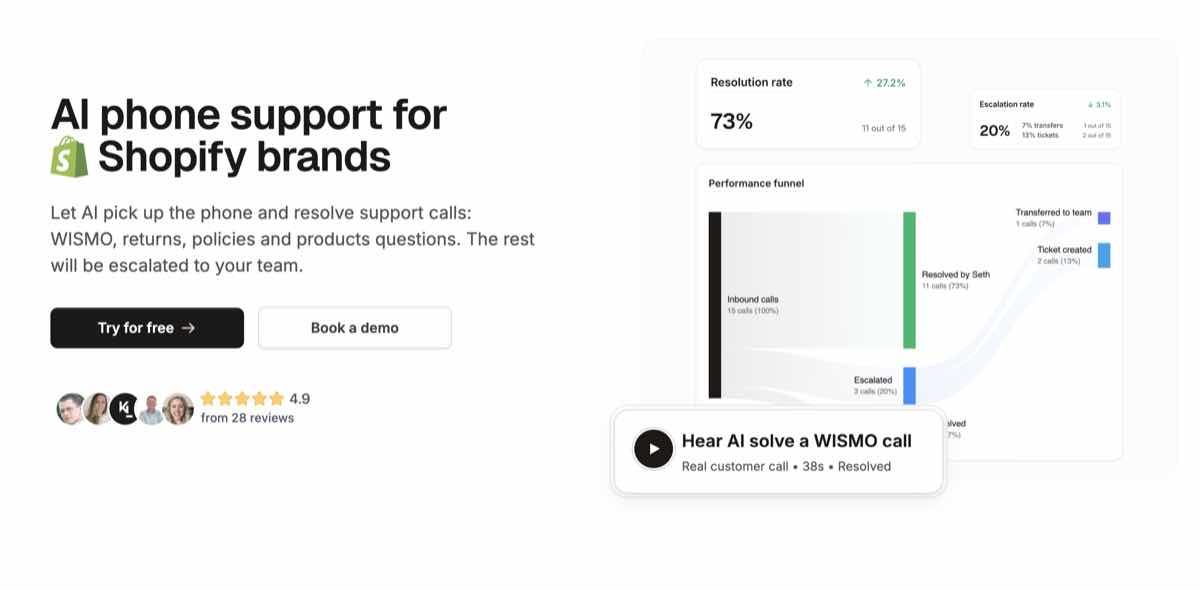
This is the layer Recharge doesn't cover. Ringly.io is an AI phone agent built specifically for Shopify stores. Seth (the agent) answers the phone 24/7, looks up subscription orders directly through your Shopify integration, can walk customers through skip/swap/cancel using your help docs, and escalates the complex billing disputes to a human. It resolves about 73% of calls without any handoff. Setup is roughly 3 minutes (just paste your Shopify URL, no code required).
It's not a Recharge replacement. It's the phone-support layer that sits on top of Recharge (or any subscription tool) and handles the spillover. If you want the deeper background on how this works for Shopify stores, the AI phone agents for Shopify overview walks through it, and the check order status feature page covers the most common subscription call type.
Start your free trial. 14 days, no credit card required.
Frequently asked questions
How much does Recharge subscriptions cost per month? Recharge has three published plans: Starter at $25/mo (for new merchants only, up to 50 subscribers, no transaction fees), Standard at $99/mo plus 1.49% + $0.19 per transaction, and Plus at $499/mo plus 1.34% + $0.19 per transaction. Custom pricing is volume-based.
Does Recharge charge transaction fees on top of the monthly fee? Yes, on every plan except Starter. Standard is 1.49% + $0.19 per subscription order. Plus is 1.34% + $0.19 per order, with the percentage dropping at very high volume.
Is there a free trial for Recharge? Yes, 60 days on the Standard plan. The trial begins the day you install the app. The $25 Starter plan doesn't have a trial since it's already entry-level, and Plus/Custom typically require a sales conversation.
Is the $25 Recharge plan available to existing merchants? No. The $25 Starter plan is only available to net-new merchants who installed Recharge after February 9, 2026. Existing merchants stay on whatever plan they were on previously.
How does Recharge compare to Loop on price? At 10,000 monthly subscription orders, Recharge Plus runs about $9,099/mo, while Loop's Pro plan runs closer to $4,149/mo per Loop's published comparison. The gap mostly comes from Loop's 0.75% transaction fee versus Recharge's 1.34% on Plus.
Will the Skio acquisition affect Recharge pricing? Probably, over time. Recharge acquired Skio for $105M in cash on April 30, 2026, and acquired platforms historically consolidate in pricing and features within 12-24 months. Both platforms operate independently for now.
What's the cheapest Recharge plan? Starter at $25/mo, but only for new Shopify merchants and only up to 50 subscribers. Past 50, you auto-upgrade to Standard at $99/mo plus transaction fees. If you're an existing merchant, Standard is your floor.
Is Recharge worth it for a small Shopify store? Probably not if you're under $20K MRR. The transaction fees on Standard ($0.79 to $2.00 per order depending on AOV) plus the $99 base will eat margin you don't yet have. Look at Shopify's native subscription tool or a lighter-weight alternative first.
Verdict
Recharge is mature, deep, and battle-tested. It's the right tool for stores past about $50K MRR that need bundles, loyalty, and a serious cancel-prevention layer.
It's also expensive. The honest cost is the monthly base, the transaction percentage, the per-order flat fee, and the add-ons people forget to count. The $25 Starter plan looks generous on the surface, but the auto-bump at 50 subscribers means you'll be paying $99/mo plus fees within a few months of any real growth.
And one cost line never makes it onto these pricing pages. The phone calls your subscribers make every month. If you're running subscriptions on Shopify, Ringly.io handles the inbound calls Recharge doesn't, and gets you live in about 3 minutes. Try it free for 14 days.