
The Gorgias Starter plan is $10 a month. That gets you 50 billable tickets, three user seats, and the core helpdesk: email, live chat, and the social channels. It does not include the AI Agent, and it does not answer your phone. Once you pass 50 tickets, every extra one is $0.40.
That is the whole answer to the price question. The more useful question is who the $10 tier is actually for, when you outgrow it, and what it quietly leaves unsolved. Here is the honest read, including a number most pricing posts skip: Gorgias bills tickets, and your inbound phone calls aren't tickets. Across 50+ brands running Ringly, 73% of those calls resolve on their own at about $0.42 each, and none of them touch a Gorgias bill.
This post in 30 seconds.
- The price: Gorgias Starter is $10 a month for 50 tickets, three seats, and no AI agent. Extra tickets are $0.40 each.
- The catch: it's a real entry helpdesk for a tiny store, but most active stores blow through 50 tickets in the first week and jump to Basic ($60 for 300).
- Who it's for: brand-new or very small stores testing the platform. A $10M to $100M Shopify brand with a visible phone line is solving the wrong half of the problem at any Gorgias tier.
If you run support at a $10M to $100M Shopify brand, you probably didn't land here to buy the $10 plan for yourself. You landed here to benchmark what Gorgias costs at the floor, or because a new sub-brand needs a starter helpdesk. Either way, the thing the Starter price hides is the phone backlog nobody on the cheapest tier is answering. Book a 30-min call and we'll show you what your missed calls are worth before you pick a plan.
In this post:
What the Gorgias Starter plan actually costs
Gorgias Starter is $10 per month, billed monthly, with 50 billable tickets included. A ticket in Gorgias is one customer conversation across email, chat, or social. Three teammates can log in. According to the Gorgias pricing page, once you pass 50 tickets in a billing cycle, each additional ticket is $0.40.
At $10 for 50 tickets, you're paying $0.20 per included ticket, then double that for every one after. That sounds cheap, and at very low volume it is. The trouble starts the moment your included tickets run out, because $0.40 each adds up fast and the bill stops being predictable.
| Plan | Price/mo | Tickets | Seats | Overage |
|---|---|---|---|---|
| Starter | $10 | 50 | 3 | $0.40 / ticket |
| Basic (next step) | $60 | 300 | unlimited | $40 / 100 tickets |
Where do these numbers come from? Gorgias's own live pricing page for the plan structure, and our own billing data across 50+ Shopify brands for the phone-call economics later in this post. We sell phone support, not a helpdesk, so we have no reason to talk Gorgias up or down. The $10 number is just the $10 number.
One more thing the price tag doesn't say out loud: Starter is the only plan in the lineup with no automation at all. You're paying for a place to put tickets, not for anything that resolves them.
What is and isn't included on Starter
For $10, Starter is a more complete helpdesk than the price suggests. The gaps are specific, and they're the gaps that matter at scale.
What you get on Starter:
- All the core channels. Email, live chat, and social (Facebook, Instagram, TikTok, WhatsApp) all land in one inbox.
- The workflow basics. Macros, rules, views, assignment, and routing, so a small team can move tickets without stepping on each other.
- A help center. Unlimited articles for self-service deflection, which is the cheapest ticket you'll never pay for.
- Up to 150 integrations. Shopify and the common apps connect, so your reps see order context next to the message.
- Three seats with SSO. Google or Microsoft login for up to three teammates.
What you don't get on Starter:
- No AI Agent. Gorgias's automation tier is not available here. The $10 plan is humans-only.
- No advanced reporting or SLAs. You get the basics, not the dashboards a larger CS team runs on.
- No phone answering. This is the big one. Gorgias is a ticket system. It does not pick up your inbound calls, at this tier or any other.
The cheapest Gorgias plan handles email, chat, and social, and leaves your phone line exactly where it was. That's fine for a store with no real call volume. It's a problem for any brand that prints a phone number on its site. If your real pain is the WISMO calls and after-hours voicemails, the helpdesk tier isn't the lever, no matter which one you pick.
How fast you outgrow 50 tickets
Fifty tickets is not a lot. If you use live chat for pre-sales, or you reply to comments and DMs through Gorgias, you can burn through 50 in the first few days of the month. After that, the $0.40 overages start, and your "cheap" plan stops being cheap.
Here's the crossover most people miss. At 100 tickets, Starter costs $10 plus 50 overage tickets at $0.40, which is $30. Keep climbing and you're better off on Basic, which is $60 a month for 300 tickets ($50 if you pay annually), per eesel's Gorgias breakdown. Basic works out to the same $0.20 per ticket as Starter, but with six times the headroom and unlimited seats.
| Plan | Price/mo | Tickets included | Best for |
|---|---|---|---|
| Starter | $10 | 50 | Brand-new or tiny stores testing Gorgias |
| Basic | $60 | 300 | Small stores, the popular starting point |
| Pro | $300 | 2,000 | Growing brands with steady ticket volume |
| Advanced | $750 | 5,000 | Larger teams that need reporting and SLAs |
Most active stores outgrow Starter within weeks, not months. That's not a knock on the plan. It's what an entry tier is for: get you in, prove the value, move you up. The thing to watch is that every step up the ladder solves more of your email and chat problem and none of your phone problem. For the full plan-by-plan view, our Gorgias pricing guide lays out all five tiers side by side.
The AI Agent add-on costs extra
A lot of people find the Starter price and assume the AI is included. It isn't, on Starter or anywhere else. Gorgias's AI Agent is a separate, usage-based add-on on top of your plan.
The numbers, from eesel's AI Agent pricing breakdown and MyAskAI's 2026 guide:
- $1.00 per automated resolution on a monthly contract, $0.90 if you commit annually.
- $1.50 per resolution once you blow past your included automated interactions.
- It double-bills. Each AI resolution also counts as a billable helpdesk ticket, so you pay the resolution fee and the ticket fee for the same interaction.
I priced this out the way an operator would, and the part that surprises people is the double-counting. You're not just paying for the AI to answer. You're paying for the AI to answer, and then paying again because the answer used up one of your tickets. On Starter, none of that applies, because there's no AI Agent to turn on. You'd have to climb to Basic or higher first, then bolt the add-on on top.
That's the real cost shape of Gorgias AI: the sticker plan is one line, and the automation is a second meter running underneath it.
The channel every Gorgias tier leaves open
Step back from the $10 number for a second. Gorgias prices on tickets, and a ticket is an email, a chat, or a social message. Your inbound phone calls are not tickets. They don't show up in the ticket count, they don't trigger an overage, and the cheapest tier and the most expensive tier treat them exactly the same way: they don't.
For a brand doing $10M to $100M on Shopify with a visible phone number, that's where the expensive support hours live. The after-hours calls. The "where's my order" calls that repeat all day. The ones that roll to voicemail and never get returned, where, per PCN's missed-call study, 62% of callers who can't reach a person switch to a competitor. Higher-AOV stores feel it harder, because 12% to 18% of orders at a $250 AOV generate a phone call, versus 3% at a $40 AOV.
No Gorgias plan answers the phone, so the channel that costs you the most stays off the helpdesk entirely. That's the gap, and it's the same gap whether you pay $10 or $750.
Where Ringly fits
Ringly.io is AI phone support for Shopify brands. The phone shouldn't be a tax on your support team. Instead of routing calls to voicemail or hiring a night shift, the AI answers inbound calls 24/7: order status, returns, product questions, abandoned cart rescue.
It finds orders in your Shopify store, answers from your knowledge base, and the calls that need a human escalate cleanly to Gorgias or whatever helpdesk you already run. You keep Gorgias. Ringly sits in front of it on the phone line, not in place of it.
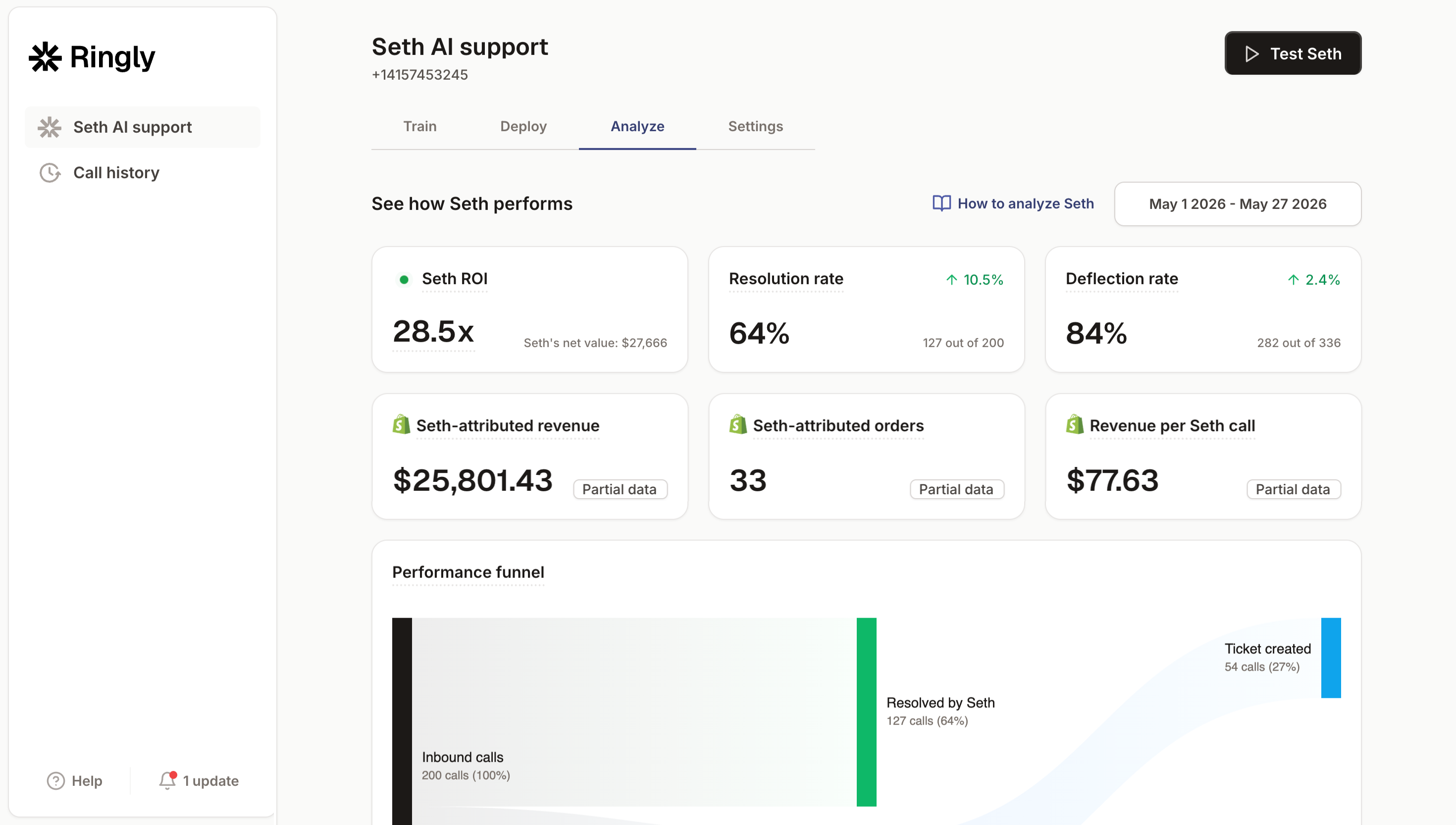
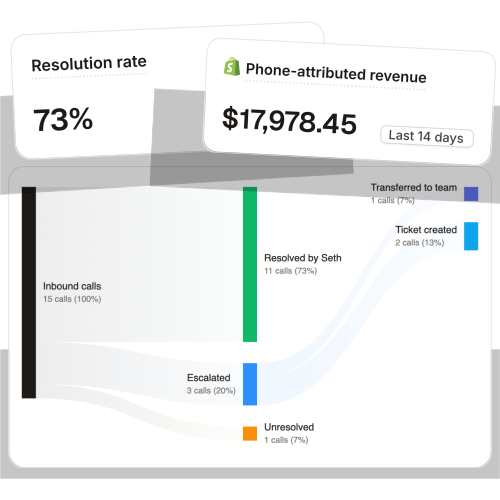
Across 50+ brands, the AI resolves 73% of calls on its own at roughly $0.42 per resolved call, versus $7 to $16 a call for a human BPO. WashCo, a Shopify brand we launched, recovered $22,664 in its first 7 days on the phone. Plans run Grow $349/mo and Pro $799/mo, with a 65% resolution guarantee. Live in under an hour. That's a different line item than a $10 ticket plan, because it's solving a different problem.
What phone coverage actually costs vs the helpdesk line item
Here's the reframe. The $10-versus-$60 helpdesk decision is real, but it's small money. The number that actually moves your P&L is the CS payroll behind the phone.
Take a typical brand running a 6-rep CS team:
| Line item | Today | With Ringly |
|---|---|---|
| 6 reps × $4K loaded per rep | $24,000/mo | n/a |
| Ringly (illustrative) | n/a | ~$5,000/mo |
| Net monthly CS spend | $24,000/mo | $5,000/mo |
| Monthly savings | n/a | $19,000/mo |
| Annual savings | n/a | $228,000/yr |
That's roughly 70% of repeatable calls (order status, returns, the same questions over and over) handled by the AI. The genuinely complex 30% still go to your reps, who now have time to solve them instead of reading tracking numbers off a screen all day.
"My customers also feel like it's a normal person. They feel like they can communicate if they have questions."
Claudia Droge, TechCraft Studio
A 6-rep team is $228,000 a year. The gap between Gorgias Starter and Basic is about $600 a year. Spend your energy on the right number.
If you're picking a helpdesk plan and a phone line at the same time, book a 30-min call and we'll do the math on your actual call volume live.
Frequently asked questions
How much is the Gorgias Starter plan? Gorgias Starter is $10 a month, billed monthly. It includes 50 billable tickets and three user seats, with each ticket over 50 costing $0.40.
What's included in the Gorgias Starter plan? Email, live chat, social channels, macros, rules, views, a help center with unlimited articles, and up to 150 integrations, for three teammates. It does not include the AI Agent, advanced reporting, or any phone answering.
What happens when you go over 50 tickets on Gorgias Starter? Every ticket past 50 is billed at $0.40 each. At higher volume those overages add up fast, which is why most stores move to Basic ($60 for 300 tickets) instead.
Does the Gorgias Starter plan include the AI Agent? No. The AI Agent is a separate usage-based add-on that costs $0.90 to $1.00 per automated resolution, and it isn't available on Starter at all. Each AI resolution also counts as a billable ticket, so it bills twice.
When should you upgrade from Gorgias Starter to Basic? Once your overages push you past about $30 a month, Basic's $60 for 300 tickets is the better deal per ticket and gives you six times the headroom. Most active stores hit that point within the first few weeks.
Does Gorgias answer phone calls? No. Gorgias is a ticket-based helpdesk for email, chat, and social. It does not pick up inbound phone calls at any tier, which is the channel an AI phone agent covers instead.
Is the Gorgias Starter plan good for a $10M+ Shopify brand? No. Starter is an entry tier for brand-new or very small stores. A brand with a 3-12 rep CS team and a visible phone line needs the phone channel solved, not the cheapest ticket plan.
Talk to us

If you run a $10M to $100M Shopify brand, the $10 helpdesk question isn't the one costing you money. The phone is. A 30-min call is the fastest way to see what your missed and after-hours calls are actually worth.
The 3-layer guarantee.
- Live in 14 days or it's free until launched.
- 65% resolution in 90 days or we refund the last 3 months of subscription fees.
- We keep working free until we hit it.
Ruben (Ringly co-founder) takes these calls personally.