
This post in 30 seconds.
- Gorgias Automate (the AI Agent add-on) is priced per automated resolution: $1.00 a conversation on monthly billing, $0.90 on annual, and $1.50 once you pass your plan's included bundle.
- The number that surprises most operators is the all-in one. A resolved ticket gets billed twice, as an AI resolution and as a helpdesk ticket, so a $360 Pro plan running 50% automation lands closer to $960 a month.
- Written for founders, COOs, and heads of CX at $10M-$100M Shopify brands pricing Automate at real volume, and wondering what the phone line still costs after it.
You opened the Gorgias AI Agent pricing page, saw "$0.90 per resolved conversation," and it looked cheap. The bill that shows up a month later is rarely that number. Automate is priced per resolution, billed on top of your helpdesk plan, and the rate you actually pay most months is the overage rate, not the headline.
This is a breakdown of what Gorgias Automate costs once you account for the double billing, the overage, and the included bundles. It is not a rundown of Gorgias's general plan prices (that lives in our Gorgias pricing breakdown). This one is scoped to the Automate add-on only.
Most heads of CX I talk to run a paid Gorgias instance, a phone line, and the same five questions over and over coming in on both. If that is you, and you want to see the real all-in cost on your own ticket volume, book a 30-min call and we will do the math live.
Gorgias Automate pricing at a glance
Gorgias Automate is priced per automated resolution, not per seat or per ticket, which means the cost rises with every conversation the AI closes on its own. On monthly billing it is $1.00 per resolved conversation, on annual billing it drops to $0.90, and once you blow past your plan's included bundle, overage runs $1.50 per interaction on the Support plus Shopping Assistant tiers (according to Gorgias's own AI Agent pricing page).
| Automate cost | Rate |
|---|---|
| Per resolved conversation (monthly) | $1.00 |
| Per resolved conversation (annual) | $0.90 |
| Overage per interaction (Support + Shopping Assistant) | $1.50 |
| Included automated interactions per plan | 90 to 2,500+ / month |
That is the add-on. It sits on top of your base Gorgias helpdesk plan, which is billed separately on tickets (Starter $10, Basic $60, Pro $360, Advanced $900, Enterprise custom, per Gorgias's pricing page). The Automate fee and the helpdesk fee are two different meters running at the same time, and that is where the surprise lives.
One more pricing wrinkle: Gorgias bundles a set number of automated interactions into each plan, from around 90 on the smallest tiers to 2,500-plus on the larger ones, mapped to target automation rates of roughly 10% to 50%. So your effective Automate cost depends on three moving parts at once: which base plan you are on, how many resolutions are bundled into it, and how far past that bundle your real volume runs. None of those three show up as a single headline price, which is exactly why the per-resolution pricing question is harder to answer than "what's the monthly fee."
Where these numbers come from
I'm Ruben, co-founder of Ringly. We run AI phone support for more than 50 Shopify brands, which means I price Gorgias Automate against the phone channel almost every week, not as a critic but as the person an operator asks "is this cheaper than another rep?"
The figures in this post are pulled from Gorgias's live AI Agent pricing page and main pricing page, then cross-checked against three third-party 2026 cost breakdowns (eesel, myaskai, and Zipchat) and against Gorgias's own published Psycho Bunny case study. Where a number is illustrative rather than printed by Gorgias (the worked cost examples below), I say so.
Here is the part nobody else writing about this keyword does. Every page that ranks for "gorgias automate pricing" prices the add-on for chat and email. None of them price the phone line Automate never touches, and none of them show you the all-in number once a resolved ticket is billed twice. That is the gap this post fills.
What counts as a resolution (and why you pay twice)
Gorgias only charges Automate when the AI closes a conversation entirely on its own. If a human steps in, that conversation is not a billable resolution. In Gorgias's words, "a billable interaction is counted when the AI resolves a customer conversation entirely on its own."
There is a catch in the timing. An automated interaction is only counted after 72 hours pass with no human touching it (per myaskai's 2026 teardown). So the resolution count you see today is not final until three days later, which makes mid-month forecasting harder than the sticker price suggests. If a customer replies on day two and a rep picks it up, the conversation drops out of the billable count, which is good for your wallet but bad for predictability.
There is also a channel limit worth naming early. Automate is Shopify-only and runs on chat and email, so it is not supported on BigCommerce, Magento, or WooCommerce. If your stack is mixed, the per-resolution meter only covers part of your support surface, and the rest stays on human reps at full loaded cost.
The bigger surprise is that one AI resolution is billed twice: once as an automated interaction, and again as a standard helpdesk ticket on your base plan. When the AI resolves a conversation, that conversation still counts against your plan's ticket allotment and is billed accordingly. You are paying the $0.90 to $1.00 resolution fee and the ticket cost on the same closed conversation.
Run the math on a real plan. A brand on the Pro plan at 2,000 tickets a month, hitting 50% AI automation, generates roughly 1,000 AI resolutions. The advertised Pro base is $360. The same brand ends up paying around $960 a month once Automate is on (Zipchat documented exactly this jump from $360 to $960). The loaded cost is not on the pricing page.
It gets sharper at the top. One Shopify App Store reviewer reported being charged about $14,000 in AI Agent fees on top of a roughly $13,500 annual Advanced subscription, with nothing flagging it until the invoice landed. That is a reviewer account, not a Gorgias-published figure, but it is the kind of number operators trade in the Gorgias CFO conversation.
What Automate actually costs at your volume
Pricing this honestly means stacking three layers: the base helpdesk plan, the included automation bundle, and the overage on every resolution past it. Here is what that looks like across the common plans. The base and bundle figures are from Gorgias; the all-in column is illustrative, built from the per-resolution and overage rates above.
| Plan | Base (monthly) | Included AI interactions | Illustrative all-in at target automation |
|---|---|---|---|
| Basic | $60 | ~90-150 | ~$120 at ~60 resolutions |
| Pro | $360 | ~190-1,000 | ~$770-$960 at 30-50% automation |
| Advanced | $900 | ~530-2,500 | ~$1,900 at ~1,000 resolutions |
Two things to notice. First, per-resolution billing means the better Automate performs, the bigger your bill, which is the opposite of how a flat tool prices. Every conversation the AI wins adds a line item. A product launch or a BFCM spike that doubles your volume does not just stress the team, it multiplies the automation invoice.
Second, the rate you budget around should be the overage rate. Most brands of any size blow through the bundled interactions (which top out around 2,500), so the marginal resolution is billed at $1.50, not the $0.90 you saw first. The dashboard shows you the headline rate; the invoice shows you the overage one.
There is a quieter cost layered under all of this: the helpdesk tickets themselves. Every resolution still counts against your plan's ticket allotment, and once you pass it, Gorgias charges $0.36 to $0.40 per overage ticket on top. So a single resolved conversation past both bundles can carry a resolution overage and a ticket overage at the same time. Annual billing softens the blow (rates run roughly 16% to 25% lower), but the structure does not change. The cost is a function of volume, and volume is the one thing a launch, a viral moment, or a seasonal spike sends straight up.
If you want this run against your actual ticket volume and your actual automation rate, rather than an illustrative table, book a 30-min call and we will work the numbers with you.
The automation rate Automate actually hits
Pricing only makes sense next to the automation rate you can expect, because you are paying per resolution either way. Gorgias markets the AI Agent at "up to 60%" automation. The published reality is lower.
Gorgias's own flagship case study, Psycho Bunny, shows the AI agent resolving 26% of tickets, not 60. It resolved them fast (under 2 minutes versus 4-plus hours for the human team, per Gorgias's Psycho Bunny story), but 26% is the headline number from their best public example. Independent reviews put AI Agent response accuracy around 59%, below the 71% category average, according to eesel's 2026 review.
Why does this matter for pricing? Because the gap cuts both ways against you. You budget for 60% automation, you size your bundle for it, and then you hit 26% to 56%. You are paying the per-resolution fee on the wins you do get while still staffing humans for the volume the AI did not touch. Gorgias is a strong helpdesk (it holds a 4.6 out of 5 across more than 540 reviews on G2), and our own read of its AI customer service reviews backs that up for chat and email. The friction is the add-on's pricing model, and the channel it leaves alone.
There is a planning lesson in that gap. The honest way to budget Automate is to model your bill at the automation rate your own tickets will realistically hit, not the marketed ceiling, and to assume most of those resolutions land at the overage rate. If you are doing that exercise, it is worth doing the same one for the Gorgias helpdesk base plan at the same time, because the two meters move together and a launch pushes both up at once.
Where Automate leaves your phone line
Here is the thing the pricing page never says out loud: Automate is built for chat and email. Your phone line is not in scope. So you can be paying $0.90 a resolution for text and still have a phone that rolls to voicemail after 6pm, with the same WISMO questions piling up there that the AI is resolving in chat.
That is not a small leak. Businesses answer only 37.8% of inbound calls (according to AmbsCallCenter), and 85% of callers who cannot reach a person never call back, with 62% switching to a competitor (per PCN's 2026 study). Automate's per-resolution meter does nothing for any of that, because none of those calls are tickets it can close. This is the WISMO call problem moving to the one channel Automate cannot see.
So you end up with a strange split. The same "where is my order" question is a $0.90 resolution when it comes in as a chat and a missed call when it comes in on the phone. One gets handled and billed, the other rolls to a voicemail nobody returns. For brands with an older customer base or a higher AOV, the phone is often the channel that carries the most revenue per contact, which means the gap Automate leaves open is not the cheap channel, it is frequently the expensive one. This is why we wrote a whole breakdown of ecommerce phone support as its own problem rather than a chat afterthought.
Ringly.io is AI phone support for Shopify brands, and it is built for exactly that channel. Instead of growing your support headcount every time call volume goes up, the AI takes the routine inbound calls so your team can focus on the work that actually moves revenue. It answers calls 24/7, finds orders in your Shopify store, processes returns, and answers product questions from your knowledge base. Across 50+ brands it resolves 73% of calls on its own at roughly $0.42 per resolved call. Calls that need a person escalate cleanly into Gorgias, Richpanel, or whatever helpdesk you already run. We sit in front of the phone line, we do not replace your helpdesk.
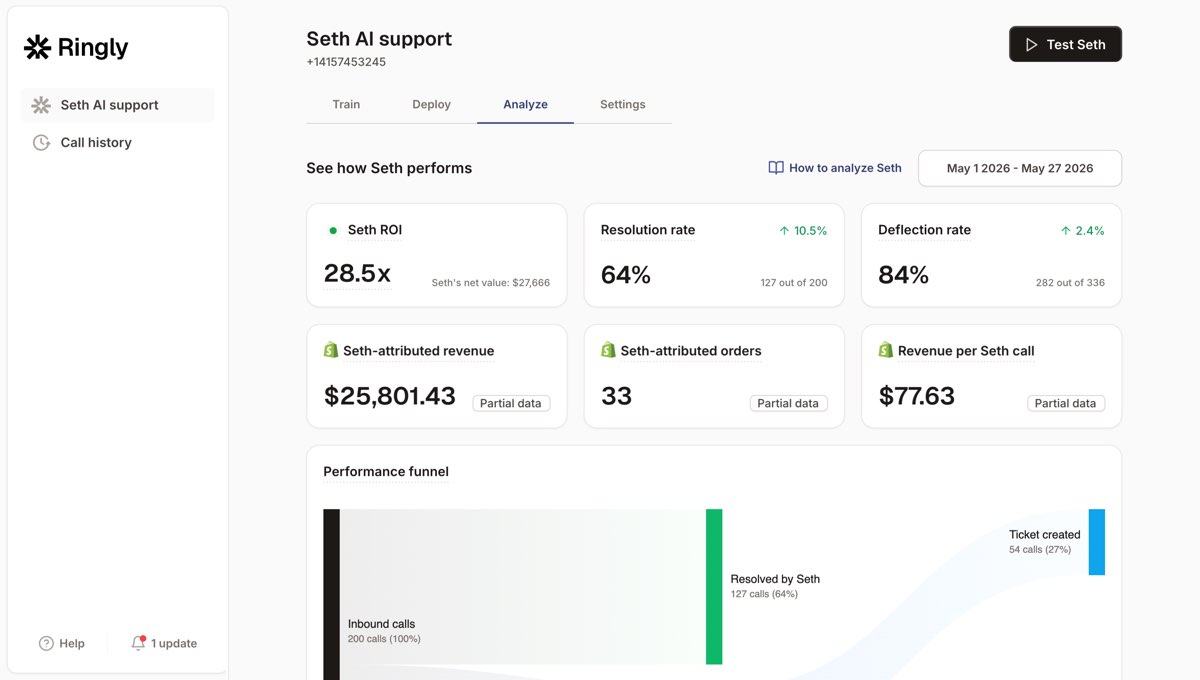
The pricing shape is the real contrast. Automate bills you more on every success and spikes on a launch. A per-call phone agent prices flat and is backed by a 65% resolution guarantee, so you are not betting the budget on an automation rate that "emerges over time." On a per-conversation basis the gap is wide:
| Channel | Per-call cost (loaded) |
|---|---|
| In-house CS rep | $2.70 / call |
| BPO contract | $1.50-$3.50 / call |
| Ringly phone agent | $1.20-$2.00 / call |
WashCo, a Shopify brand we launched, handled calls at $0.91 each versus $2.70 for a human-handled call. That is the cost-per-conversation question that an AI-voice-vs-human comparison actually turns on, and it is the one Automate's per-resolution model makes hard to pin down.
The quality worry is fair, and it is usually the first objection. The most repeated thing customers say after a Ringly call is that it does not sound like AI:
"My customers also feel like it's a normal person. They feel like they can communicate if they have questions."
Claudia Droge, TechCraft Studio
TechCraft handles 88% of its calls without a human. The point is not that Automate is bad. It is that you can pay its per-resolution rate all year and your most expensive channel, the phone, stays exactly as broken as it was.
Frequently asked questions
How much does Gorgias Automate cost per resolution? $1.00 per resolved conversation on monthly billing and $0.90 on annual billing, according to Gorgias's AI Agent pricing page. Once you pass your plan's included interactions, overage is $1.50 per interaction on the Support plus Shopping Assistant tiers.
What counts as an automated resolution in Gorgias? A conversation the AI closes entirely on its own, with no human stepping in. It is only counted as billable after 72 hours pass with no human intervention, so your final resolution count lags the live number by about three days.
Why is my Gorgias bill higher than the plan price? Because an AI resolution is billed twice: once as an automated interaction and again as a standard helpdesk ticket against your plan. A $360 Pro plan running 50% automation commonly lands near $960 a month once Automate is on.
What is the Gorgias Automate overage rate? $1.50 per interaction on the Support plus Shopping Assistant tiers, charged on every resolution past your plan's bundle. Support-only tiers run roughly $1.00 to $2.00 monthly. Since bundles top out around 2,500 interactions, most higher-volume brands pay the overage rate, not the headline rate.
What automation rate does Gorgias Automate actually achieve? Marketing says up to 60%, but Gorgias's own Psycho Bunny case study shows 26%, and published results across cases land in the 26% to 56% range. Budget against the lower end so the per-resolution fees do not outrun the savings.
Does Gorgias Automate handle phone calls? No. Automate (the AI Agent) is built for chat and email on Shopify. Inbound phone calls are outside its scope, which is why a brand can pay for Automate and still miss calls after hours.
How does Ringly's per-call pricing compare to Automate's per-resolution pricing? Ringly prices the phone channel on a flat plan with a 65% resolution guarantee, while Automate charges per text resolution with cost rising as automation rises. For phone specifically, Ringly handles calls at roughly $0.42 to $0.91 each versus $2.70 for a human, and it escalates into Gorgias rather than replacing it.
Talk to us

If you run a $10M-$100M Shopify brand and your phone line goes to voicemail after 6pm, a 30-minute call is the fastest way to see what that channel is costing you. We will look at your real call volume and show you the per-call number next to whatever you are paying for resolutions today.
The 3-layer guarantee.
- Live in 14 days or it's free until launched.
- 65% resolution in 90 days or we refund the last 3 months of subscription fees.
- We keep working free until we hit it.
Ruben (Ringly co-founder) takes these calls personally.