


Every single minute your team spends on the phone explaining "where a package is" is a minute wasted.
You have built a successful store with a real team, but you are probably still burning thousands of dollars on manual labor.
Managing a growing support staff while trying to keep costs down keeps many founders stuck.
But there is a fix.
In this guide, you will find the best Synthflow AI alternatives for eCommerce.
First, we will go over why general AI tools fail for e-commerce.
Then, we will rank the top six alternatives that actually connect to your backend.
Editor’s note: Want to hear some sample support calls made for your Shopify store?
- Just paste your store URL
- Hear sample calls for your store (no email required)
- Listen to demo calls for my store
What are AI voice agents and why look for Synthflow AI alternatives for ecommerce?
In the world of online shopping, an AI voice agent is more than just a simple call bot.
It's a specialized assistant built to handle the kinds of phone calls ecommerce stores get every day. You can think of it as a virtual team member who knows your products, policies, and customer orders inside and out.
These agents can instantly answer "where is my order?" questions, help customers start returns, give product recommendations, and answer common questions about your shipping or return policies.
This kind of automation is becoming more common. Gartner even expects conversational AI to reduce agent labor costs by $80 billion by 2026.
The biggest plus is their ability to connect with platforms like Shopify.
This link lets them pull up-to-the-minute information, giving your customers accurate answers that build trust and free up your human support team for more complicated problems.
How we chose the best Synthflow AI alternatives for ecommerce
To find the best options, we thought about what a busy ecommerce store owner actually needs. Here’s what we looked for:
- Easy setup: How fast can you go live without hiring a developer? We gave extra points to platforms with a no-code setup that takes minutes, not days.
- Ecommerce integration: Does it connect directly to your store? We looked for tools with native Shopify integrations to pull real-time order data. This is much smoother than using third-party tools or custom APIs.
- Voice quality: Does the AI sound like a real person? We checked for low lag and the ability to handle interruptions without getting flustered.
- Clear pricing: Are the costs easy to understand? We prefer platforms with simple pricing, so you know what you’re paying without any surprise fees.
- Ecommerce features: Is the platform ready to go for common ecommerce tasks? We looked for built-in tools for things like looking up orders and managing returns.
Comparing the top Synthflow AI alternatives for ecommerce
Here’s a quick look at how the top platforms compare.
| Platform | Best For | Ecommerce Integration | No-Code Setup | Starting Price |
|---|---|---|---|---|
| Ringly.io | Shopify Stores | Native Shopify (Orders & Returns) | Yes | From $99 a month (50 conversations included) |
| Goodcall | Small Businesses & Reception | Via Zapier | Yes | $59/mo (Starter plan) |
| Retell AI | Developer-Led Teams | API / Custom | No | $0.13 - $0.31/min (All-in real cost) |
| Bland AI | High-Volume Outbound | API / Custom | No | $0.09/min + $299/mo (Build plan) |
| Vocode.dev | Open-Source Custom Builds | API / Custom | No | $0 (Self-hosted) or $25/mo (Cloud) |
A look at 5 of the best Synthflow AI alternatives for ecommerce
Now let's get into the details of each platform to help you find the right one for your store.
1. Ringly.io

Ringly.io offers an AI phone agent built specifically for Shopify stores. Its AI representative, the AI, is already trained to handle the most frequent support calls, like order status questions, returns, and FAQs.
Seth resolves up to 90% of support calls, all without human help.
A key advantage of Ringly.io is its focus on ecommerce. The native Shopify integration lets the AI provide accurate, real-time order information and even process returns automatically, which saves a lot of time.
The setup is also fast, letting store owners get a fully working AI agent live in under 1 hour. Since it's so tailored to ecommerce, it may not be the best fit for businesses in other areas.
Pricing:
- Guarantee: You get that month back as credit if Seth resolves under 65% of your calls in a month (after 90 days on Pay per call).
- Pay per call: $99 a month for the first 50 conversations, then $1.99 each.
- Spam, hang-ups and wrong numbers are free.
- You can also try it for free.
Why it’s on the list: Ringly.io is a strong option for Shopify merchants looking for a dedicated phone support solution. Its ability to automatically handle common ecommerce questions makes it a useful tool for scaling customer support.
2. Goodcall

Goodcall is a conversational AI platform that helps small businesses manage their inbound calls.
It acts like an automated receptionist that can answer calls, take messages, and handle tasks like scheduling appointments for service-based businesses.
The platform’s main benefit is its simplicity and focus on the general needs of a small business.
The setup is quick, and it can connect with over 10,000 tools through Zapier for basic automation. However, it lacks the deep, native ecommerce integrations needed for specific tasks like looking up a customer's order in real-time.
Pricing:
- Starter Plan: Begins at $66 per agent per month when you pay annually.
- Pricing is based on the number of unique customers per month, not call minutes, which can make costs easier to predict.
Why it’s on the list: Goodcall is an affordable choice if your business just needs a reliable way to answer every call and handle basic questions or appointments, rather than data-heavy ecommerce support.
3. Retell AI

Retell AI is a voice agent platform for developers who want to build their own custom conversational AI.
It provides the APIs and tools needed to create low-latency voice agents that can handle interruptions naturally and be integrated into different applications.
Retell AI is known for its voice quality and low latency, which makes conversations feel more real.
Its pay-as-you-go pricing is also great for managing costs. The main drawback is that it’s not a no-code solution and requires engineers to build and integrate.
Pricing:
- A pay-as-you-go model that starts at $0.07+ per minute.
- This is a component-based price, so you’ll have separate costs for the voice engine, language model, and telephony.
Why it’s on the list: For ecommerce businesses with an in-house development team, Retell AI offers a powerful and flexible base for building a custom AI phone agent from the ground up.
4. Bland AI

Bland AI is another developer-first platform that provides an API for building voice agents, with a focus on high-volume calling.
It's often used for large-scale outbound campaigns and can be programmed to handle a variety of conversations.
The platform is built to scale and can reportedly handle up to 1 million calls at once. It also gives developers a lot of control over the agent's behavior. On the flip side, some user reviews mention that the voice can sound a bit robotic and that the platform can require significant engineering work to customize.
Pricing:
- Pricing isn't public and is customized for enterprise customers.
- It's generally a fit for teams with a minimum annual budget around $150,000.
Why it’s on the list: Bland AI could be a good fit for larger ecommerce companies that need to run high-volume outbound campaigns, like promotions or surveys, and have the technical team to manage it.
5. Vocode.dev

Vocode.dev is an open-source library for building your own voice-based AI applications. It's made for developers who want maximum control and flexibility, letting them build everything from phone agents to voice-enabled bots from scratch.
As an open-source tool, Vocode.dev is completely free to use and can be customized however you like.
The main consideration is that it requires significant technical expertise. It's not a ready-made platform and has no user interface for non-coders, making it impractical for most ecommerce store owners.
Pricing:
- Free to use (open-source).
- Users are responsible for paying for their own hosting, telephony, and infrastructure.
Why it’s on the list: We included Vocode.dev because it's the best choice for ecommerce brands with a strong engineering team that wants to build and own their technology stack.
How to choose the right Synthflow AI alternative for your store
Picking the right tool really comes down to what your store needs. Here are a few tips to help you decide.
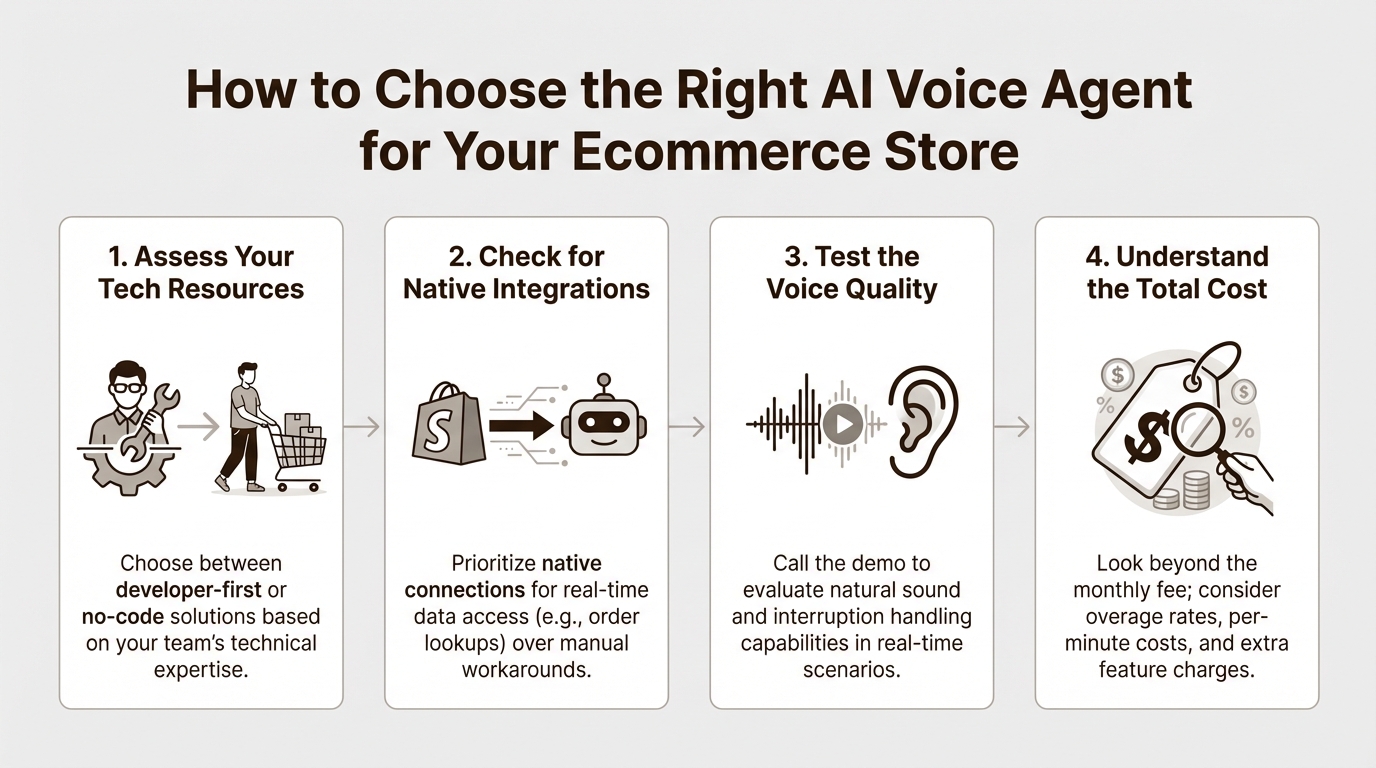
First, think about your technical resources. If you don't have a developer on your team, platforms like Bland AI, Retell AI, and Vocode.dev may not be the best fit.
In that case, you'll want to stick with a no-code solution.
Next, focus on native integrations. If you run your store on Shopify, a platform with a native app like Ringly.io will save you significant time compared to one that needs Zapier or custom API work for simple things like order lookups.
Also, listen to the voice quality. Most platforms offer a demo, so give them a call and see how the agent sounds. Is it natural? Can it handle interruptions?
Finally, make sure you understand the total cost. Look past the base monthly fee and check for any per-minute overage rates or extra costs for features you might need later, like a dedicated support channel.
For a hands-on look at how an AI voice agent can be tailored for an ecommerce store, the video below demonstrates building one for a Shopify business.
It covers common use cases like handling abandoned checkouts, which showcases the practical application of these tools.
Finding the right tool for your store
While there are many general voice AI tools out there, ecommerce businesses have specific needs that are best met by a specialized platform.
A tool that understands orders, products, and returns right out of the box will provide more value and a better customer experience than a generic one you have to build out yourself.
Ready to see how an AI phone agent built for Shopify can help your store? Try Ringly.io for free, with a 65% resolution guarantee behind it.
Frequently Asked Questions
What's the main difference between general tools and specialized Synthflow AI alternatives for ecommerce?
The primary difference is integration. Specialized alternatives, like Ringly.io, connect directly to ecommerce platforms like Shopify. This allows them to pull real-time order information and handle specific tasks like returns right away, while general tools often require extra setup with third-party apps like Zapier.
When should my business consider using Synthflow AI alternatives for ecommerce?
If you're spending a lot of time answering repetitive phone calls about order status, returns, or basic product questions, it's a good time to look into these alternatives. They can free up your team to focus on more complex customer issues and business growth.
How important is a native Shopify integration when choosing between Synthflow AI alternatives for ecommerce?
It is important for a smooth experience. A native integration means the AI can instantly and accurately access customer order data without relying on slower, sometimes less reliable, third-party connections. This leads to faster resolutions and happier customers.
Are there any free Synthflow AI alternatives for ecommerce?
While most platforms are paid, some offer free trials or unique pricing models. For example, Ringly.io is free to try and comes with a 65% resolution guarantee. Open-source options like Vocode.dev are free to use, but you'll have to pay for hosting and development costs.
What kind of technical skill is needed to set up most Synthflow AI alternatives for ecommerce?
It really depends on the platform. No-code options like Ringly.io or Goodcall need no technical knowledge: Ringly.io is live in under 1 hour, and Goodcall can be set up in minutes. On the other hand, developer-focused platforms like Retell AI, Bland AI, and Vocode.dev require an engineering team to build and maintain the voice agent.