

The best ecommerce shipping software depends on volume and reach. ShipStation suits multi-channel sellers (from $14.99/month), Shippo offers a free plan up to 30 labels/month, Easyship is strong for cross-border shipping (free up to 50 shipments), and Pirate Ship is completely free for USPS and UPS in the US.
Shipping can make or break an ecommerce business.
When a customer clicks "buy," they're trusting you to deliver their order on time and in perfect condition.
The right ecommerce shipping software helps you fulfill that promise by automating label printing, comparing carrier rates, and keeping customers informed every step of the way.
I tested 7 of the top shipping platforms to find the best options for different business sizes and needs.
Whether you're just starting out with a few orders per month or managing thousands of shipments daily, there's a tool on this list that fits your workflow.
Editor’s note: Want to hear some sample AI support calls made for your Shopify store?
- Just paste your store URL
- Get sample calls in under 20 seconds (no email required)
- Listen to demo calls for my store
What is ecommerce shipping software?
Ecommerce shipping software connects your online store to multiple shipping carriers.
Instead of logging into USPS, UPS, and FedEx separately, you manage everything from one dashboard.
These platforms typically handle:
- Rate shopping - automatically comparing prices across carriers to find the cheapest option
- Label printing - generating shipping labels in bulk with one click
- Order management - importing orders from Shopify, Amazon, eBay, and other channels
- Tracking - sending automated updates to customers with branded tracking pages
- Returns - creating return labels and managing the reverse logistics process
The best part? Most tools negotiate discounted rates with carriers that you can't get on your own.
Even free plans often include commercial pricing that's cheaper than walking into a post office.
How I evaluated these ecommerce shipping software tools
I tested each platform against the same criteria to keep comparisons fair:
- Carrier support - how many shipping options are available and which regions they cover
- Platform integrations - which ecommerce platforms connect seamlessly
- Pricing transparency - whether you can understand costs before signing up
- Ease of setup - how quickly you can start shipping real orders
- Automation features - rules for auto-selecting carriers, batch processing, and workflow shortcuts
I connected a real Shopify store to each platform, generated labels for test orders, and compared rates across multiple carriers. Here's what I found.
Ecommerce shipping software comparison
| Tool | Starting Price | Carriers | Best For | Free Plan |
|---|---|---|---|---|
| ShipStation | $14.99/month | 100+ | Multi-channel sellers | Yes (10 shipments) |
| Veeqo | Free | US/UK major carriers | Amazon multichannel sellers | Yes (unlimited) |
| Shippo | Free | 40+ | Startups, low volume | Yes (30 labels) |
| Easyship | $29/month | 550+ | International sellers | Yes |
| Sendcloud | €33/month | 160+ | European businesses | Yes |
| Pirate Ship | Free | USPS, UPS | US-based small businesses | Yes (unlimited) |
| ReadyShipper X | Custom | Major carriers | High-volume warehouses | No |
| Ordoro | $59/month | Multiple | Dropshippers | No |
1. ShipStation
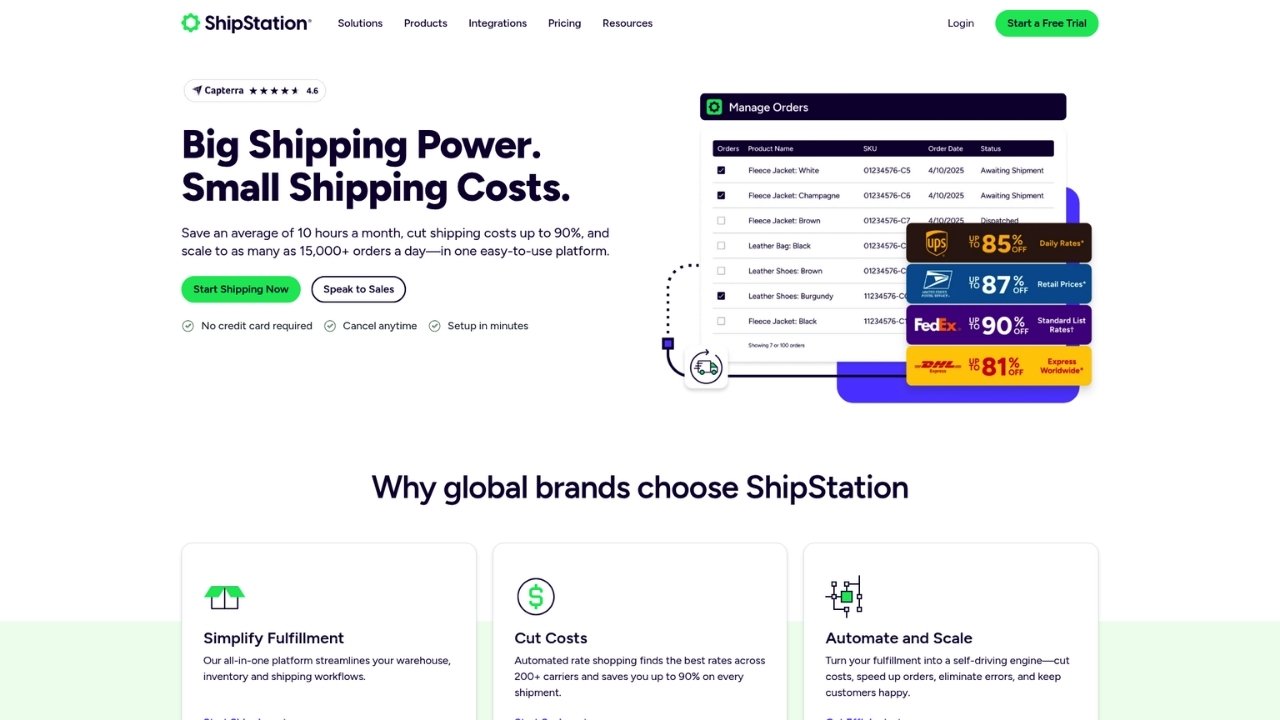
ShipStation is the most popular shipping software in the US for good reason.
With 130,000+ brands using the platform and integrations with virtually every major ecommerce platform, it's built to scale with your business.
Key features
- 100+ integrations including Shopify, Amazon, eBay, and Etsy
- Batch label printing for high-volume days
- Branded tracking pages and notification emails
- Returns management with a customer self-service portal
- Inventory management (Premium plan and above)
- API access for custom integrations
Pricing
| Plan | Monthly Price | Shipments | Users |
|---|---|---|---|
| Free | $0 | 10 | 1 |
| Starter | $14.99 | 50 | 3 |
| Standard | $29.99 | 50-100 | 10 |
| Premium | $349.99 | 50+ | 15 |
Best for: Multi-channel sellers who need to manage orders from multiple platforms in one place. If you're selling on Shopify, Amazon, and eBay simultaneously, ShipStation keeps everything organized.
Pros
- Extensive integration ecosystem
- Strong automation rules for carrier selection
- Good reporting and analytics
- 30-day free trial
Cons
- Can be overwhelming for beginners
- US-centric carrier focus
- Premium features require expensive plans
2. Veeqo
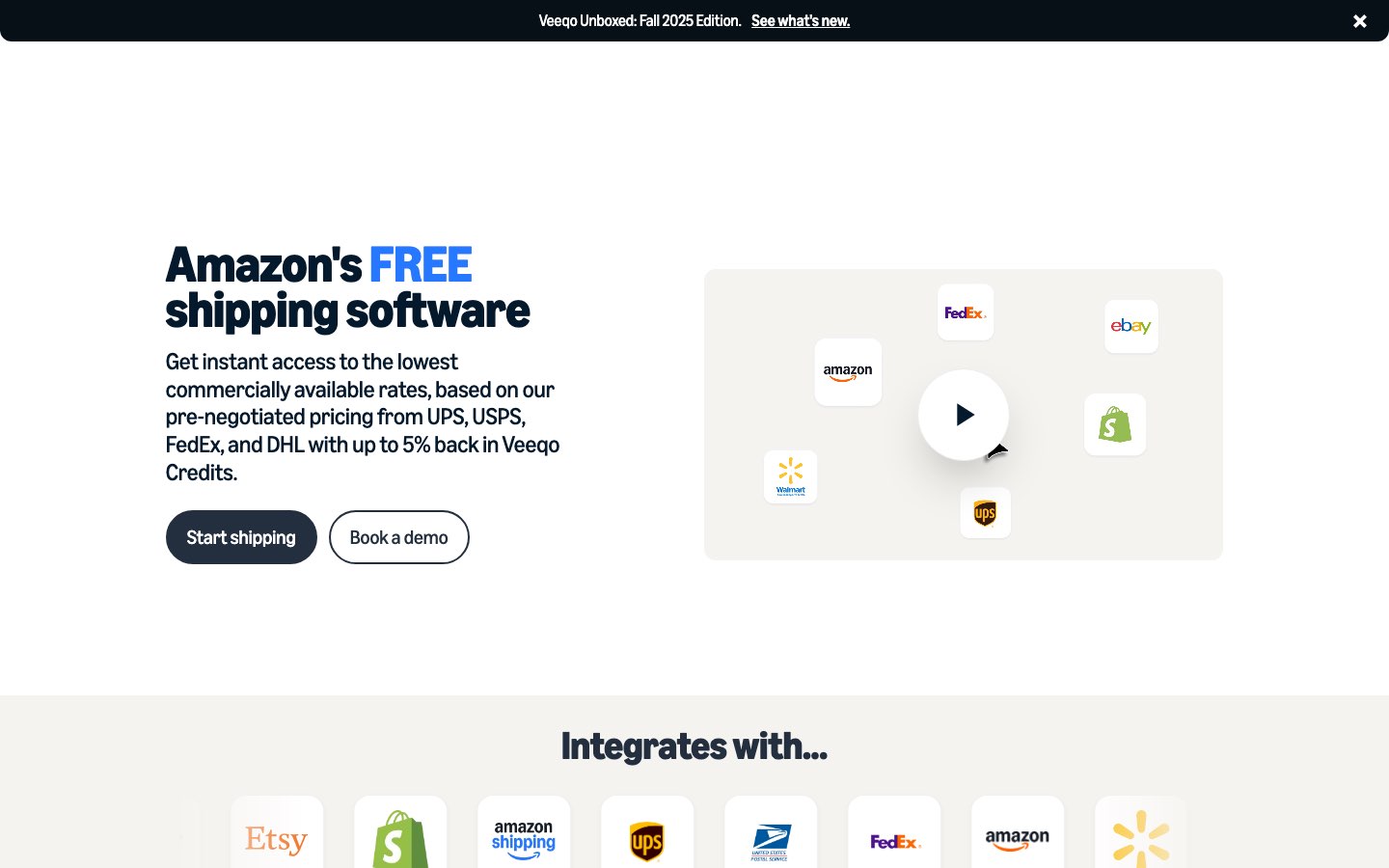
Veeqo is Amazon's free shipping software for multichannel ecommerce sellers. You don't need to sell on Amazon to use Veeqo, but it works especially well for Amazon sellers thanks to seamless integration and built-in account health protection.
Key features
- Integrations with major US and UK carriers and ecommerce channels
- Discounted rates from UPS, USPS, FedEx, DHL, OnTrac, and Amazon Shipping
- Custom workflows and shipping automations
- Batch label printing
- Shipping API access
- Inventory and warehouse management (paid plans)
Pricing
| Plan | Monthly Price | Includes |
|---|---|---|
| Shipping | $0 | Unlimited shipments |
| Inventory | From $19 | Cross-channel inventory and warehouse systems |
| High Volume | From $350 | Premium support for large businesses |
Best for: Ecommerce businesses who sell across Amazon and other channels. Veeqo helps multichannel businesses manage shipping and fulfillment from one system, with extra benefits for Amazon sellers.
Pros
- Free shipping plan with unlimited users and shipments
- Up to 5% back on eligible shipments with Veeqo Credits
- Built-in account health protection for Amazon orders
Cons
- Currently for businesses shipping from the US and UK only
- Inventory and warehouse features require paid plans
3. Shippo

Shippo stands out for its pay-as-you-go model.
You can start completely free and only pay when you ship, making it ideal for businesses just getting started.
Key features
- 40+ global carriers with pre-negotiated discounts
- Unlimited store connections on all plans
- Branded tracking pages (Pro plan and above)
- Developer-friendly API
- International shipping support
- Return label generation
Pricing
| Plan | Monthly Price | Labels/Month | Users |
|---|---|---|---|
| Starter | Free | 30 | 1 |
| Pro | $17 | 1-200 | 5 |
| Premier | Custom | Unlimited | 15+ |
Best for: Startups and low-volume shippers who want to avoid monthly commitments. The free tier handles up to 30 labels per month without charging a subscription fee.
Pros
- No monthly fees on Starter plan
- Easy setup process
- Good carrier discounts even on free tier
- Clean, simple interface
Cons
- 5 cent per-label fee for using your own carrier accounts on free plan
- Limited to 30 labels/month on free tier
- Advanced features require paid plans
4. Easyship
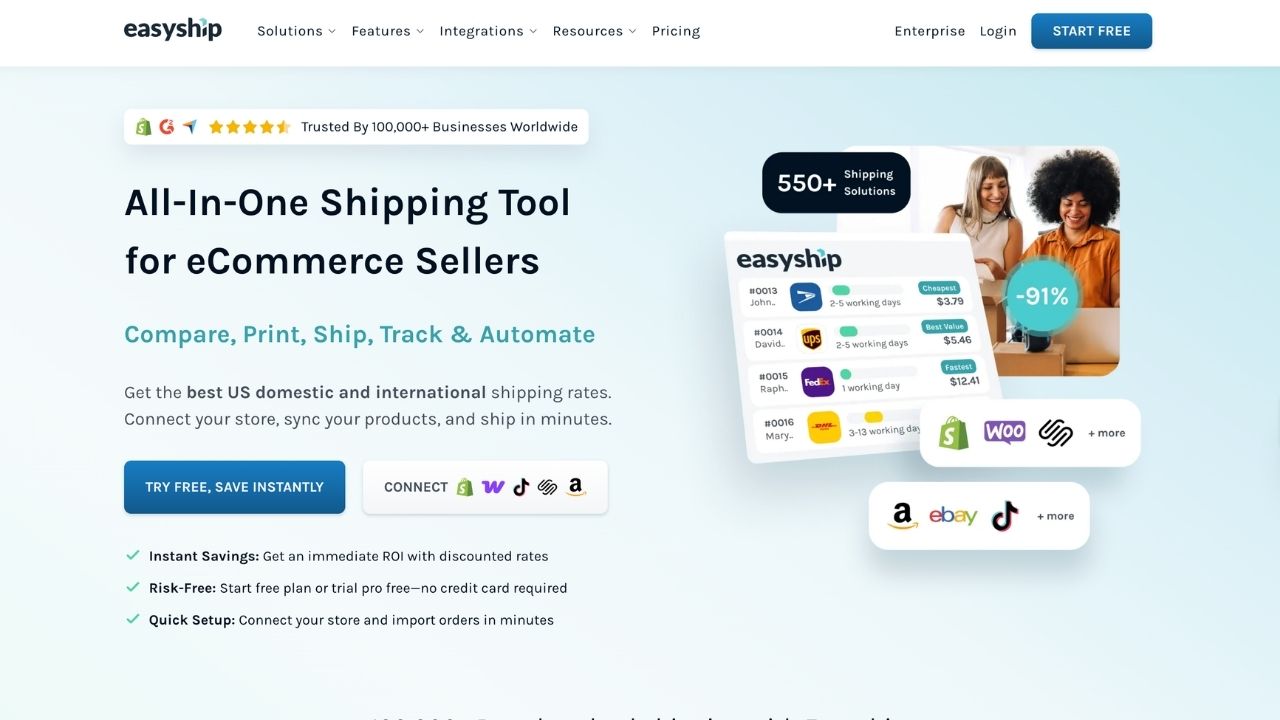
Easyship dominates international shipping with 550+ courier services worldwide.
If you're selling across borders, this platform handles customs, duties, and tax calculations automatically.
Key features
- 550+ carriers globally
- Up to 91% off shipping rates
- Automated customs documentation
- Duties and tax calculations at checkout
- Multi-currency support
- Pre-negotiated rates with major carriers
Pricing
| Plan | Monthly Price | Best For |
|---|---|---|
| Free | $0 | Testing the platform |
| Basic | $29 | Small businesses |
| Plus | $69 | Growing businesses |
| Enterprise | Custom | High volume |
Best for: International ecommerce businesses shipping to multiple countries. The automated customs handling saves hours of paperwork.
Pros
- Best international carrier coverage
- Transparent duties and taxes
- Strong in Asia-Pacific markets
- Good for cross-border ecommerce
Cons
- More expensive for domestic-only shippers
- Complex pricing structure
- Limited value for US-only businesses
5. Sendcloud
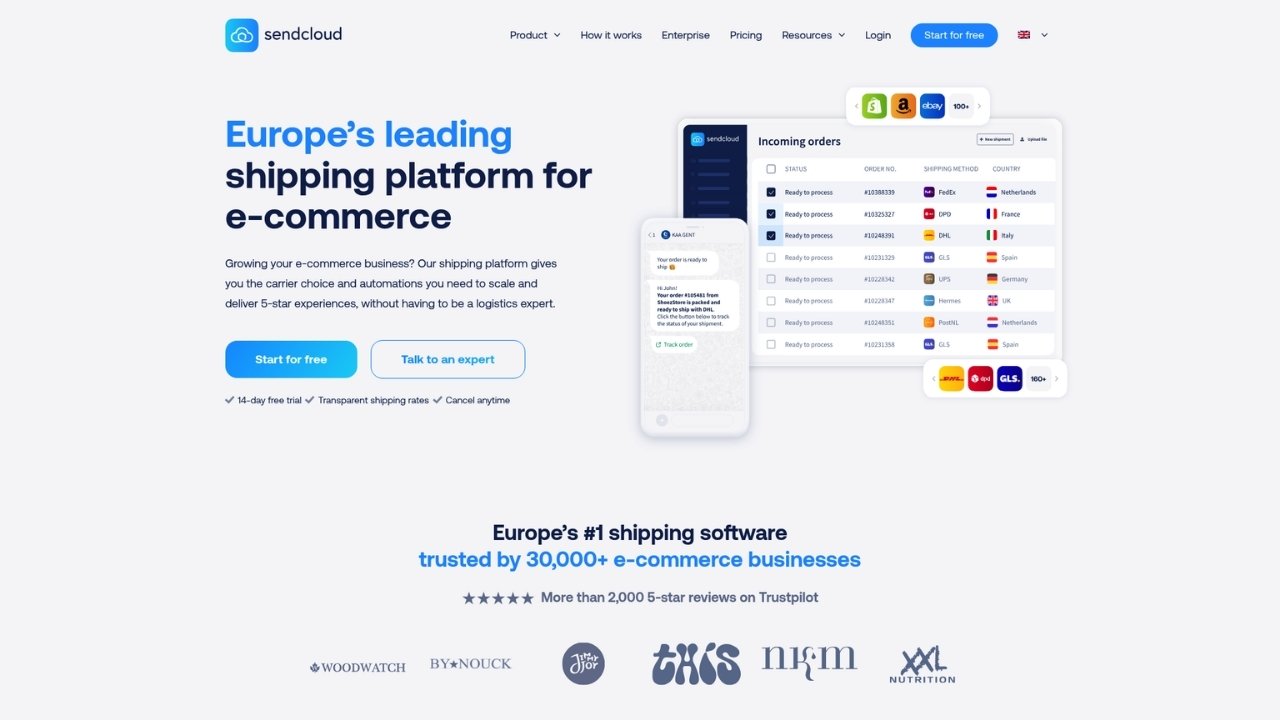
Sendcloud is Europe's leading shipping platform, trusted by 30,000+ businesses.
It offers strong European carrier coverage and advanced checkout optimization features.
Key features
- 160+ carriers with strong European focus (DHL, DPD, UPS, GLS, FedEx)
- 100+ shop integrations
- Service point picker in checkout
- Branded tracking pages and return portals
- WhatsApp Business integration
- Multi-language tracking (8 languages)
Pricing
| Plan | Monthly Price | Labels/Month | Users |
|---|---|---|---|
| Free | €0 | Pay per label | 1 |
| Lite | €33 | 400 | 3 |
| Growth | €99 | 1,000 | 5 |
| Premium | €195 | 10,000 | 10 |
| Pro | €799 | 30,000 | Unlimited |
Best for: European ecommerce businesses needing local carrier options and multi-language customer support.
Pros
- Excellent European carrier coverage
- Strong customer reviews (2,000+ 5-star Trustpilot reviews)
- Advanced return management features
- Checkout optimization tools
Cons
- Limited value for US-only sellers
- Per-label fees on top of subscription
- Euro pricing complicates budgeting for US businesses
6. Pirate Ship
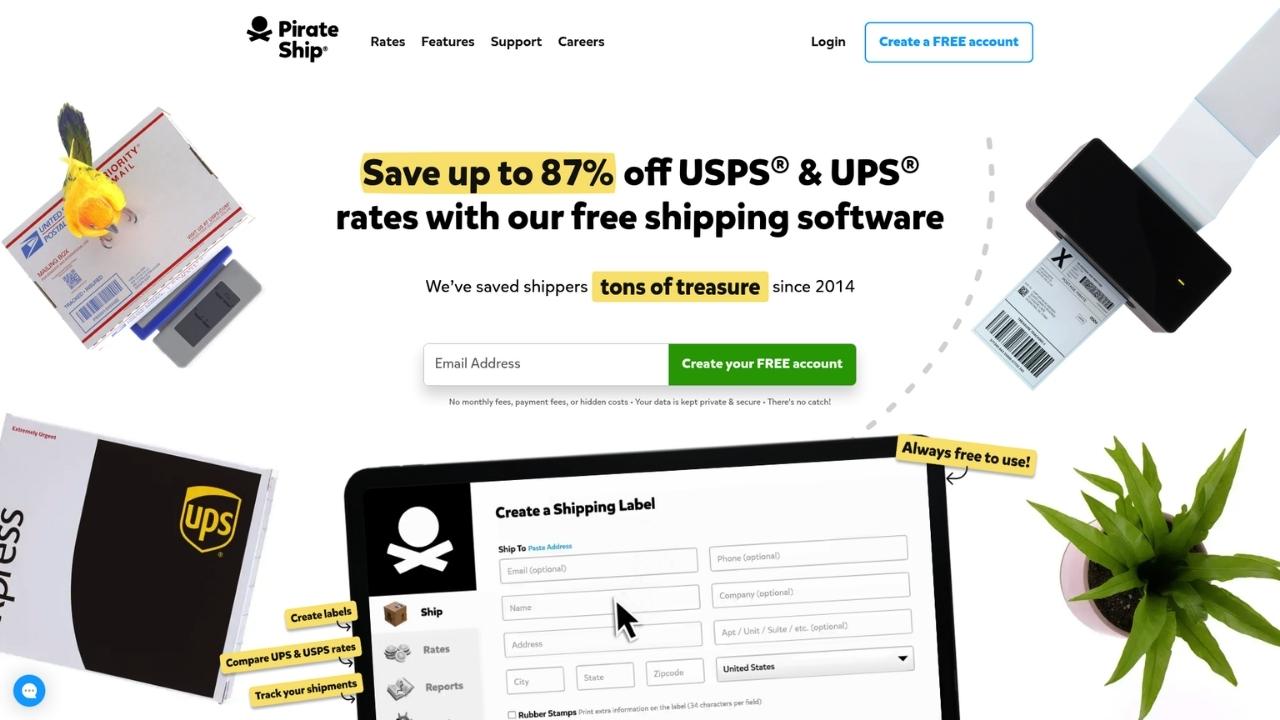
Pirate Ship is completely free. No monthly fees, no per-label fees, no hidden costs.
They've saved shippers over $705 million since 2014 by offering USPS Commercial Pricing and UPS discounts at no charge.
Key features
- USPS Commercial Pricing (up to 87% off)
- UPS discounted rates
- Priority Mail Cubic pricing (secret rates most shippers don't know about)
- Batch label printing
- Address book and presets
- Simple, web-based interface
Pricing
| Plan | Monthly Price | Limits |
|---|---|---|
| Free | $0 | None - unlimited labels |
Best for: US-based small businesses shipping primarily USPS. Etsy sellers and marketplace sellers love the simplicity and cost savings.
Pros
- Completely free with no catches
- Cheapest USPS rates available
- Simple, easy-to-use interface
- No software to install
Cons
- USPS and UPS only (no FedEx, DHL)
- US-focused only
- No advanced automation
- No inventory management
7. ReadyShipper X

ReadyShipper X is built for speed. Its hybrid-cloud architecture processes labels faster than browser-based systems, making it ideal for warehouses and high-volume operations.
Key features
- AI-powered shipping rules (create rules with natural language)
- Hybrid-cloud for maximum speed
- Batch shipping and scan-to-print
- Multi-carrier support (USPS, UPS, FedEx, DHL, Amazon Shipping)
- ODBC and CSV integration
- Select-to-ship functionality
Pricing: Custom pricing based on volume and features. Contact sales for quotes.
Best for: High-volume shippers and warehouse operations where speed matters more than cost.
Pros
- Fastest label printing available
- AI automation for shipping rules
- Handles complex workflows
- Good for enterprise operations
Cons
- Complex setup process
- Overkill for small sellers
- Enterprise pricing (expensive)
- Not suitable for beginners
8. Ordoro

Ordoro combines inventory management with shipping in one platform.
It's designed for dropshippers and businesses that need tight inventory control alongside their shipping operations.
Key features
- Inventory management integrated with shipping
- Dropshipping support with vendor management
- Multi-carrier shipping
- Purchase order management
- Analytics and reporting
- Barcode scanning
Pricing
| Plan | Monthly Price | Features |
|---|---|---|
| Shipping Only | $59 | Shipping features only |
| Full Suite | $499 | Inventory + shipping + dropshipping |
Best for: Dropshippers and inventory-heavy businesses that want unified inventory and shipping management.
Pros
- Best-in-class inventory integration
- Strong dropshipping features
- Good for complex fulfillment workflows
- Comprehensive analytics
Cons
- Expensive for shipping-only needs
- Complex feature set with learning curve
- Overkill for simple shipping needs
Choosing the right ecommerce shipping software for your business
The best tool depends on your specific situation:
Just starting out: Pirate Ship (free) or Shippo (pay-as-you-go) keep costs at zero while you validate your business.
Growing business: ShipStation or Easyship offer the scalability and features you'll need as order volume increases.
International focus: Easyship or Sendcloud handle customs, duties, and international carriers better than US-centric tools.
High volume: ReadyShipper X or ShipStation Premium provide the automation and speed needed for warehouse operations.
Dropshipping: Ordoro's inventory management integration makes it the clear choice for dropshippers.
Tips for getting the most from your shipping software
Once you've chosen a platform, these strategies will help you maximize the value:
- Negotiate carrier rates once you have volume. Most platforms let you connect your own carrier accounts alongside their discounted rates.
- Set up automation rules early. Configure weight-based carrier selection, destination-based shipping methods, and automatic insurance thresholds before you need them.
- Use branded tracking to reduce "where's my order" inquiries. A custom tracking page keeps customers on your brand instead of sending them to carrier websites.
- Integrate with your inventory system to prevent overselling. Real-time stock levels across all sales channels save you from cancellation headaches.
- Monitor analytics to identify cost-saving opportunities. Most platforms show you which carriers and methods you're using most.
Streamline your entire ecommerce operation
Shipping software handles fulfillment, but what about customer support?
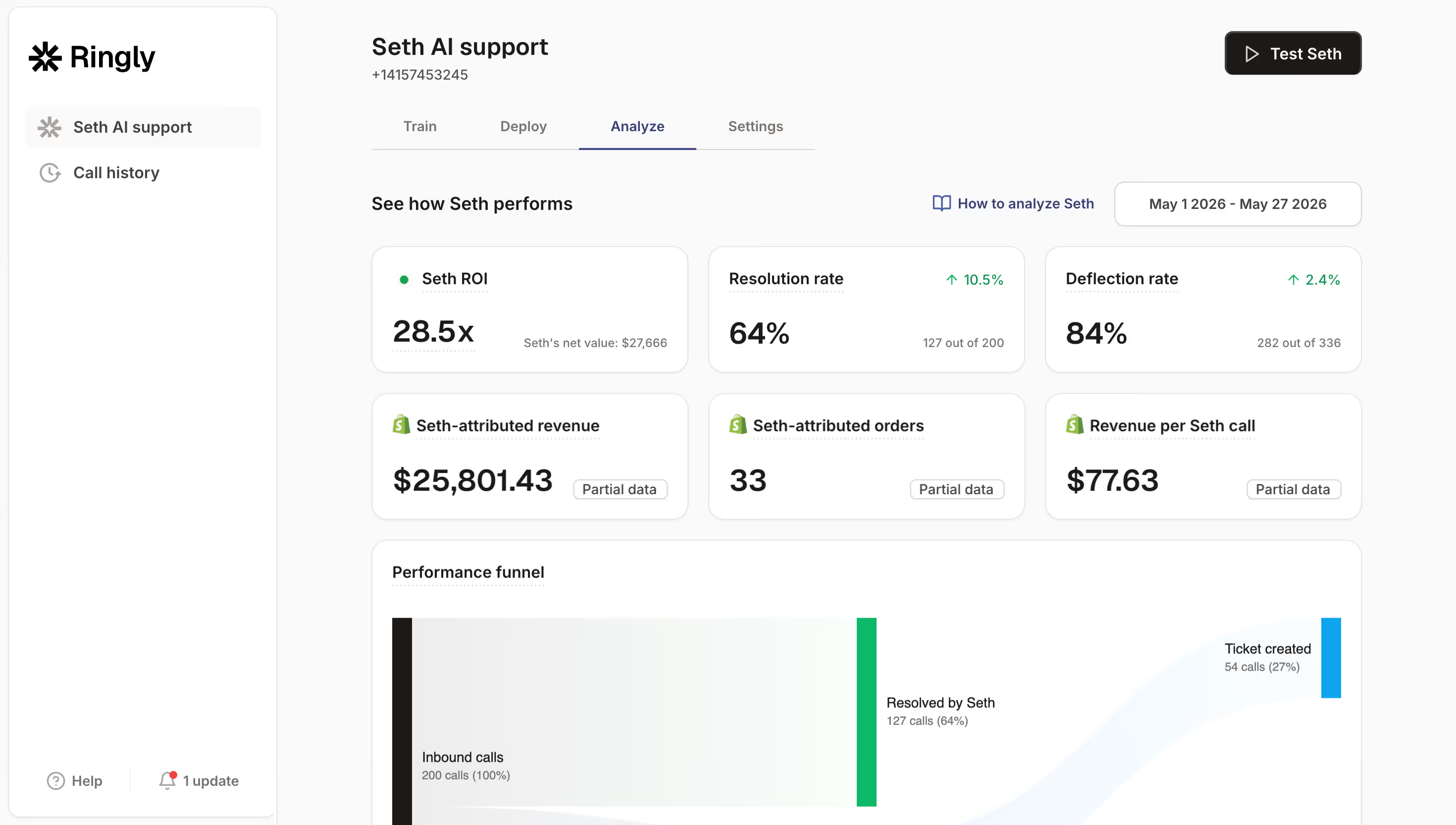
Ringly.io offers an AI phone agent called an AI agent that handles order inquiries, returns, and support calls automatically.
the AI integrates with your Shopify store just like these shipping tools, pulling order information and resolving customer questions without human intervention.
It handles about 73% of calls autonomously, escalating only complex issues to your team.
The combination of automated shipping and automated support creates a fully hands-off backend for your store.
While your shipping software moves packages, the AI keeps customers informed and happy.
Frequently Asked Questions
What is the best ecommerce shipping software for small businesses?
Pirate Ship is the best free option for US-based small businesses shipping USPS. For international shipping or multi-carrier needs, Shippo's free tier handles up to 30 labels per month without subscription fees.
Can I use ecommerce shipping software for free?
Yes, several platforms offer free plans. Pirate Ship is completely free with unlimited labels. Shippo offers 30 free labels per month. ShipStation provides 10 free shipments monthly. Sendcloud and Easyship also have free tiers with limited features.
Which ecommerce shipping software has the best international shipping features?
Easyship leads for international shipping with 550+ carriers worldwide and automated customs documentation. Sendcloud is excellent for European international shipping with 160+ carriers and multi-language support.
How does ecommerce shipping software save money on shipping costs?
These platforms negotiate discounted rates with carriers that individual shippers can't access. Pirate Ship offers USPS Commercial Pricing up to 87% off retail rates. Most platforms also provide rate shopping to automatically select the cheapest carrier for each shipment.
Can ecommerce shipping software integrate with my Shopify store?
Yes, all major shipping platforms integrate with Shopify. ShipStation, Shippo, Easyship, Sendcloud, and Pirate Ship all offer native Shopify integrations that sync orders automatically and update tracking information in real-time.
What is the difference between ShipStation and Shippo?
ShipStation offers more advanced features like inventory management and branded returns portals but requires a monthly subscription. Shippo provides a free tier with pay-as-you-go pricing, making it better for low-volume shippers who want to avoid monthly fees.
Which ecommerce shipping software is best for high-volume shippers?
ShipStation Premium ($349.99/month) and ReadyShipper X (custom pricing) are built for high-volume operations. ShipStation offers warehouse management and automation rules, while ReadyShipper X provides hybrid-cloud speed for maximum throughput.
Ecommerce shipping software pricing compared (2026)
Most comparison pages only show a single starting price. Here's how the main tools actually tier, with current figures:
- ShipStation — Starter $14.99/month (50 shipments), Standard $29.99/month, Premium $349.99/month; carrier-connection fees were removed for accounts created after July 8, 2025
- Shippo — Free (30 labels/month), then paid tiers for higher volume
- Easyship — Free (50 shipments/month), then paid plans
- Pirate Ship — completely free, no monthly or per-label fees (USPS and UPS)
Prices verified June 2026; confirm on each vendor's site before purchase, since shipping software pricing changes often.
Ecommerce shipping software: common questions
What is the best shipping software for small businesses?
For low volume, Pirate Ship is the most cost-effective, completely free with USPS and UPS discounts. Shippo's free plan (up to 30 labels/month) is a strong alternative if you want multi-carrier rate comparison and a Shopify integration.
Are free ecommerce shipping plans reliable?
Yes. Free tools like Pirate Ship and the free plans from Shippo and Easyship use the same carrier networks and discounted rates as paid plans. The trade-offs are usage caps and fewer automation features, not reliability.
How much does ShipStation cost in 2026?
ShipStation starts at $14.99/month (Starter, 50 shipments), with Standard at $29.99 and Premium at $349.99. Carrier-connection fees were removed for accounts created after July 8, 2025.