
Shopify Plus is quote-based enterprise pricing, not a public flat rate. Shopify publicly lists Plus at about EUR 2,100/month (3-year term) in the EU and directs other regions to sales. Above a high revenue threshold, billing switches to a variable platform fee, so the real total depends on your contract, sales volume, apps, and development.
Shopify Plus starts at $2,300 per month. That is the headline number you will see everywhere.
But the real cost of running a Shopify Plus store is rarely that simple.
If you are doing $1 million a year in revenue, your actual monthly bill will likely be closer to $5,000-$8,000 once you factor in transaction fees, apps, and the occasional custom development project.
At $10 million a year, you could be looking at $15,000-$25,000 monthly.
The platform is powerful. It handles flash sales without breaking, lets you customize checkout (which lower-tier plans cannot do), and gives you dedicated support.
But it is also expensive in ways that are not obvious from the pricing page.
Let's break down exactly what you will pay, what you get for that money, and whether it makes sense for your business.
Editor’s note: Want to hear some sample AI support calls made for your Shopify store?
- Just paste your store URL
- Get sample calls in under 20 seconds (no email required)
- Listen to demo calls for my store
What is Shopify Plus and who is it for?
Shopify Plus is Shopify's enterprise platform. It is built for high-growth brands that have outgrown the standard Shopify plans (Basic, Grow, and Advanced).
The typical Plus merchant is doing $1 million or more in annual revenue, though Shopify officially says brands doing $80,000+ per month should consider upgrading.
The platform adds features that matter at scale: custom checkout, automation tools, B2B capabilities, and the ability to handle massive traffic spikes without downtime.
Here is what differentiates Plus from the standard plans:
- Custom checkout: You can modify the checkout experience, add custom fields, and optimize for conversion. This alone often justifies the upgrade for high-volume stores.
- Automation tools: Shopify Flow and Launchpad let you automate complex workflows and schedule flash sales without manual intervention.
- B2B on Shopify: Built-in wholesale features for selling B2B and DTC from the same store.
- Higher API limits: Up to 10x the API calls of Advanced plans, essential for complex integrations.
- Priority support: 24/7 phone and chat support with a dedicated Merchant Success Manager.
The trade-off is cost. At $2,300-$2,500 per month just for the platform fee, Plus is roughly 10x the price of the Advanced plan ($299/month).
You need to be confident the features will drive enough additional revenue or savings to justify that jump.
Shopify Plus pricing breakdown
Base platform fee
Shopify Plus has two pricing tiers based on contract length:
| Term | Monthly Cost | Annual Cost |
|---|---|---|
| 3-year commitment | $2,300/month | $27,600 |
| 1-year commitment | $2,500/month | $30,000 |
The 3-year term saves you $2,400 annually, which is why most established brands opt for it.
But it also locks you in. If you are not certain Plus is right for you, the 1-year term gives you an exit option.
Variable pricing explained
Here is where Shopify Plus variable platform fees get interesting. Once your monthly sales exceed approximately $800,000, you switch from the flat fee to a variable rate of 0.35% of sales (on a 3-year term) or 0.40% (on a 1-year term).
There is a cap, though. You will never pay more than $40,000 per month in platform fees, no matter how high your sales go.
Real-world examples:
- $500,000/month in sales: $2,300 flat fee
- $1,000,000/month in sales: $3,500 (0.35% of $1M)
- $10,000,000/month in sales: $40,000 (capped)
This variable model means your costs scale with your success. It also means you need to budget for higher fees during peak seasons like Black Friday.
What is included in the base fee
Your $2,300+ monthly fee includes:
- Unlimited staff accounts (vs. 15 on Advanced)
- 9 free expansion stores for international markets or wholesale
- Shopify POS Pro for 20 locations (200 if using Shopify Payments)
- Shopify Flow for automation
- Launchpad for flash sales and product drops
- B2B on Shopify for wholesale selling
- Shopify Audiences for customer acquisition
- 24/7 priority support with dedicated account management
- 200 inventory locations (vs. 10 on lower plans)
- Up to 10x API rate limits for complex integrations
Transaction fees and processing costs
Shopify Plus credit card rates
Even on Plus, you still pay credit card processing fees. These are separate from the platform fee and apply to every transaction.
US rates with Shopify Payments:
| Card Type | Rate |
|---|---|
| Visa/Mastercard (online) | 2.15% + $0.30 |
| American Express (online) | 3.15% + $0.30 |
| International cards | +1% surcharge |
| In-person (Shopify POS) | 2.4% + $0.10 |
These rates are competitive, especially for high-volume merchants. You can often negotiate better rates once you are processing significant volume.
Example calculation: If you process $500,000 per month with an average order value of $100, that is 5,000 transactions.
Your processing fees would be approximately (2.15% of $500,000) + (5,000 x $0.30) = $10,750 + $1,500 = $12,250 per month.
Third-party payment processor fees
If you choose not to use Shopify Payments and instead use a third-party processor like PayPal, Stripe, or Authorize.net, Shopify charges an additional 0.20% per transaction.
This might not sound like much, but at $1 million in monthly sales, that is an extra $2,000 per month.
For most Plus merchants, using Shopify Payments is the better financial move.
Hidden costs to budget for
The $2,300 platform fee is just the starting point. Here are the additional costs that catch many merchants off guard.
App and integration costs
Most Plus stores run on a stack of apps. While Plus replaces some apps with built-in features, you will likely still need:
| App Category | Monthly Cost |
|---|---|
| Email marketing (Klaviyo) | $500-$2,000+ |
| Subscription management (Recharge) | $300-$1,000 |
| Upsell/cross-sell (Rebuy) | $500-$2,000 |
| Reviews (Yotpo/Stamped) | $100-$500 |
| Analytics (Triple Whale/Lifetimely) | $100-$500 |
| Page builder (Shogun/GemPages) | $200-$1,000 |
Typical total app spend: $2,000-$5,000+ per month for a serious Plus operation.
Development and customization
Plus gives you more customization options, but that often means hiring developers.
| Project Type | Cost Range |
|---|---|
| Basic theme customization | $2,000-$5,000 |
| Custom checkout scripts | $5,000-$15,000 |
| Full custom theme development | $10,000-$30,000 |
| Headless commerce setup | $50,000-$150,000 |
| Ongoing maintenance | $2,000-$10,000/month |
If you want a truly unique storefront or headless setup, budget $50,000+ for initial development.
Migration expenses
Moving to Plus from another platform (Magento, WooCommerce, BigCommerce) involves costs:
- Data migration: $5,000-$20,000 (products, customers, orders)
- 301 redirects and SEO: $3,000-$10,000
- App setup and configuration: $2,000-$10,000
- Staff training: $1,000-$5,000
Total migration budget: $15,000-$50,000 depending on complexity.
Multi-store and international costs
Expanding internationally? Here is what adds to your bill:
- Additional Plus stores: $2,000/month per store (if you need separate instances)
- Expansion stores beyond 9: $300/month each
- Currency conversion: 1.5% per transaction (if using Shopify Payments)
- Translation apps: $50-$500/month
If you want dedicated storefronts for the US, UK, and EU, you could pay $6,000+ per month just for the platform fees.
Shopify Plus vs standard Shopify plans
Here is how Plus compares to the rest of the Shopify lineup:
| Feature | Basic ($29/mo) | Grow ($79/mo) | Advanced ($299/mo) | Plus ($2,300+/mo) |
|---|---|---|---|---|
| Staff accounts | 2 | 5 | 15 | Unlimited |
| Inventory locations | 10 | 10 | 10 | 200 |
| Transaction fee (3rd party) | 2.0% | 1.0% | 0.6% | 0.2% |
| Credit card rate | 2.9% + 30¢ | 2.7% + 30¢ | 2.5% + 30¢ | 2.15% + 30¢ |
| Custom checkout | No | No | No | Yes |
| Automation tools | No | No | Limited | Full (Flow, Launchpad) |
| B2B features | No | No | No | Yes |
| Support | Chat | Chat | Enhanced chat | 24/7 priority phone |
The jump from Advanced to Plus is significant. You are paying nearly 10x more, but you are getting features that simply do not exist on lower tiers.
Custom checkout alone can drive a 10-20% conversion rate improvement for optimized stores.
Is Shopify Plus worth the investment?
When to upgrade
Shopify Plus makes sense when:
- You are doing $1M+ annually and the 0.2% transaction fee savings vs Advanced offset the higher platform cost
- You need custom checkout for complex promotions, subscription options, or one-click upsells
- You run flash sales that crash your current site (Plus handles 10,000+ checkouts per minute)
- You sell B2B and DTC and want both from one platform
- You have complex automation needs that standard plans cannot handle
Break-even math: If you process $500,000/month, the 0.4% transaction fee difference between Advanced (0.6%) and Plus (0.2%) saves you $2,000/month. That nearly covers the Plus platform fee right there.
When to stay on Advanced
Plus is overkill if:
- You are under $1M annual revenue - the math does not work in your favor
- You do not need custom checkout - standard checkout works fine for most stores
- Your margins are thin - the fixed cost hurts more than the variable savings help
- You are happy with your current setup - do not fix what is not broken
Real-world cost scenarios
| Store Size | Monthly Platform Fee | Transaction Fees | Apps | Total Monthly Cost |
|---|---|---|---|---|
| Small Plus ($1M/year) | $2,300 | $2,000 | $1,500 | $5,800 |
| Mid-size ($5M/year) | $2,300 | $8,000 | $3,000 | $13,300 |
| Large ($20M/year) | $7,000 (variable) | $30,000 | $5,000 | $42,000 |
These are rough estimates. Your actual costs will vary based on your app stack, development needs, and payment processing choices.
How to reduce Shopify Plus costs
You can lower your Plus bill with some strategic moves:
Negotiate your rate. Shopify is often willing to discuss pricing for high-volume merchants or brands with growth potential.
It never hurts to ask, especially if you are committing to a 3-year term.
Use Shopify Payments. The 0.20% fee savings on third-party processors adds up fast at scale.
Plus, you get better rates and Shop Pay, which converts 15% better on average.
Audit your apps. Many Plus merchants run redundant apps. Review your stack quarterly and cut anything not driving measurable ROI.
Plus has built-in features that replace popular apps (Flow replaces many automation tools, for example).
Leverage expansion stores wisely. You get 9 free expansion stores. Use them for international markets instead of paying for separate Plus instances.
Negotiate processing rates. Once you are processing significant volume, you can often get better credit card rates than the standard 2.15%.
It is worth a conversation with your Shopify rep.
Making the right choice for your store
Shopify Plus is a significant investment. At $2,300-$40,000+ per month depending on your sales volume, it is not a decision to make lightly.
The platform delivers value when you need enterprise features, handle high traffic, or process enough volume that the lower transaction fees offset the platform cost.
For stores doing $1 million+ annually with complex needs, Plus often pays for itself.
But if you are under that threshold, or if your needs are straightforward, the Advanced plan at $299/month gives you most of what you need without the enterprise price tag.
The key is running the numbers for your specific situation.
Calculate your break-even point based on transaction volume, factor in the apps and development you will need, and make sure the ROI is there before you commit.
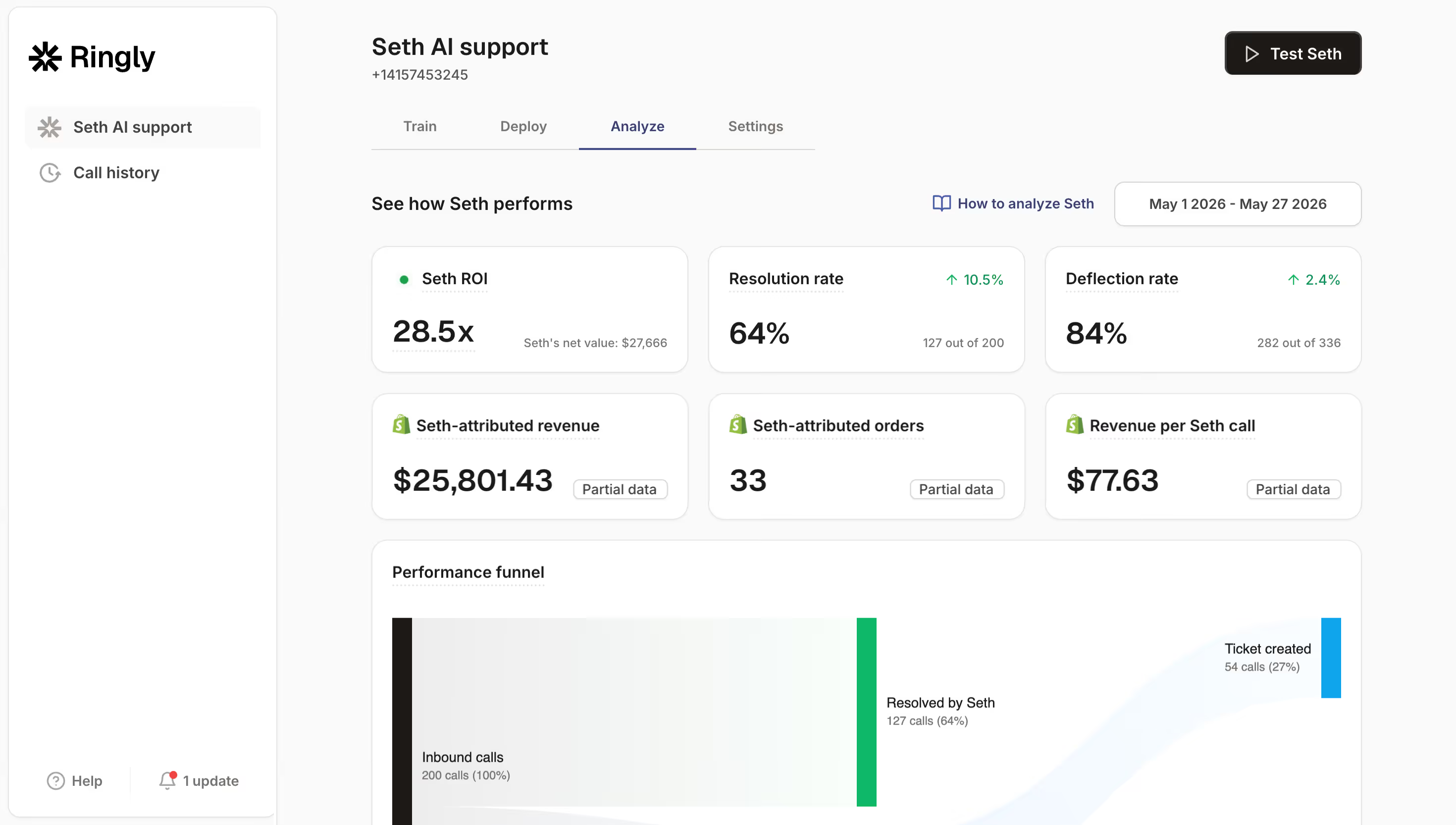
If you are scaling fast and phone support is becoming a bottleneck, Ringly.io offers AI phone agents that integrate with Shopify to handle customer calls 24/7.
It is a fraction of the cost of hiring additional support staff and can resolve up to 73% of calls without human intervention.
Frequently Asked Questions
What is the exact Shopify Plus pricing for a new merchant?
Shopify Plus pricing starts at $2,300 per month on a 3-year contract or $2,500 per month on a 1-year contract. If your monthly sales exceed approximately $800,000, you switch to a variable fee of 0.35% (3-year) or 0.40% (1-year) of sales, capped at $40,000 per month.
Does Shopify Plus pricing include transaction fees?
No, the base Shopify Plus pricing is just the platform fee. You still pay credit card processing fees (2.15% + $0.30 for Visa/MC in the US) and potentially a 0.20% fee if you use a third-party payment processor instead of Shopify Payments.
How does Shopify Plus pricing compare to Advanced Shopify?
Shopify Plus pricing is roughly 10x higher than Advanced ($2,300+ vs $299 per month). However, Plus offers lower transaction fees (0.2% vs 0.6% for third-party processors), custom checkout, unlimited staff accounts, and enterprise features not available on Advanced.
Are there any hidden costs in Shopify Plus pricing?
Yes, beyond the platform fee you should budget for apps ($2,000-$5,000/month), custom development ($10,000-$50,000+), migration costs ($5,000-$20,000), and potentially additional fees for expansion stores beyond your 9 free stores ($300/month each).
Can you negotiate Shopify Plus pricing?
Yes, Shopify is often open to negotiating rates for high-volume merchants or brands with significant growth potential. The 3-year term typically offers better rates than the 1-year term, and you can sometimes secure lower credit card processing rates as your volume increases.
What is the break-even point for upgrading to Shopify Plus?
Most merchants find that Shopify Plus makes financial sense when they are processing around $500,000-$800,000 per month in sales. At that volume, the savings from lower transaction fees (0.2% vs 0.6% on Advanced) start to offset the higher platform cost.
Does Shopify Plus pricing include support?
Yes, Shopify Plus includes 24/7 priority support by phone and chat, plus a dedicated Merchant Success Manager. This is a significant upgrade from lower-tier plans which offer chat support only (Basic/Grow) or enhanced chat (Advanced).
What Shopify Plus really costs (and what isn't public)
Shopify keeps most Plus pricing behind a sales quote, so be careful with figures you see repeated online:
- Published rate — Shopify lists Plus at roughly EUR 2,100/month on a 3-year term in the EU; US and other regions are quote-only
- Variable platform fee — above a high monthly-revenue threshold, Plus switches to a percentage-of-revenue fee instead of the flat rate; the exact rate is set per contract
- Not included — transaction fees (if not using Shopify Payments), apps, themes, and development
Treat any specific US dollar or per-country figure from third-party blogs as approximate. Confirm your actual rate directly with Shopify Plus sales.
Shopify Plus pricing: common questions
How much does Shopify Plus cost per month?
Shopify Plus is quote-based. The one publicly listed figure is roughly EUR 2,100/month (3-year term) in the EU; pricing for the US and other regions is provided by Shopify sales and varies by contract and revenue.
How much does it cost to migrate to Shopify Plus?
Migration has no Shopify fee, but agency or partner help typically runs a few thousand to tens of thousands of dollars depending on store complexity, data volume, and how much custom work is rebuilt.
Why isn't Shopify Plus pricing public?
Plus is sold as an enterprise plan, so Shopify quotes pricing per merchant based on revenue and needs. That's why third-party 'exact price' figures should be treated as estimates, not official rates.