

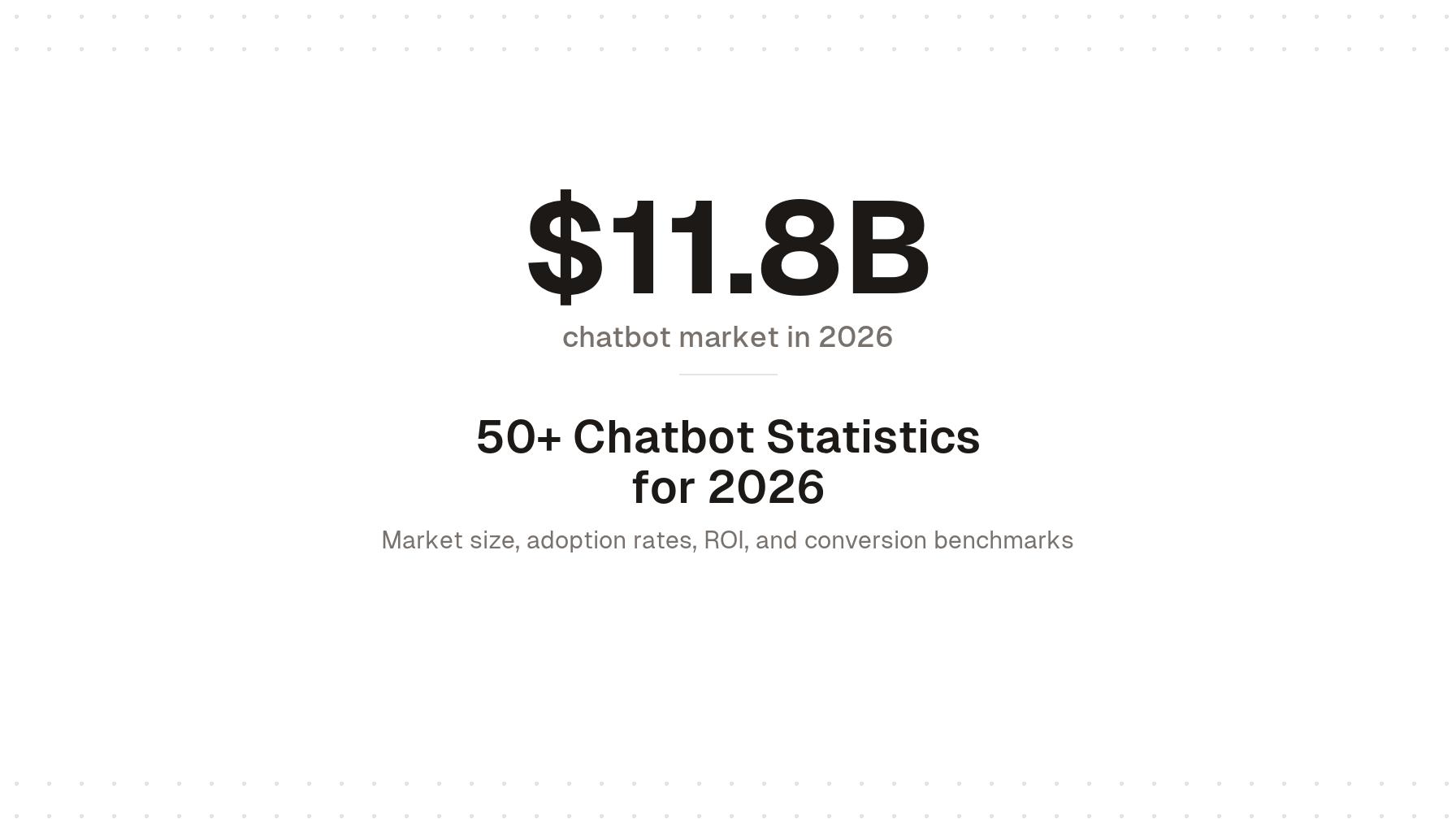
The global chatbot market hit $11.8 billion in 2026. There are now 987 million chatbot users worldwide, and 91% of businesses with 50+ employees use them somewhere in the customer journey.
But the picture is more nuanced than "everyone's using chatbots." Customer preferences are split. ROI varies wildly. And some industries are years ahead of others.
Here are 50+ chatbot statistics from Gartner, Grand View Research, Tidio, and others to help you figure out where chatbots actually make sense for your business, especially if you're running an ecommerce store.
Hear what AI support calls sound like for your store. Just paste your Shopify URL and get sample calls in under 20 seconds, no email required. Listen to demo calls for my store.
Key highlights
- The global chatbot market is projected at $11.8 billion in 2026, up from $9.56 billion in 2025 (Grand View Research)
- There are 987 million chatbot users worldwide in 2026 (DemandSage)
- Businesses report $8 in returns for every $1 invested in chatbots (Botpress)
- 91% of businesses with 50+ employees now use AI chatbots (Tidio)
- Chatbots improve conversion rates by 23% for websites that use them (Glassix)
- 75% of customers prefer chatbots for simple inquiries like order tracking and FAQs (Dante AI)
Market size and growth
1. The global chatbot market reached $11.8 billion in 2026. That's a 23.2% jump from $9.56 billion in 2025. The market is projected to reach $27.29 billion by 2030 at a 23.3% CAGR. (Grand View Research)
2. By 2033, the chatbot market will hit $41.2 billion. That's nearly 4x the 2026 valuation. Growth is driven by AI advances, rising customer expectations, and shrinking deployment costs. (Grand View Research)
3. The generative AI chatbot segment is valued at $12.98 billion in 2026. It's growing at 31.11% CAGR, faster than the overall chatbot market. Generative AI capabilities are the main differentiator for new chatbot products. (Mordor Intelligence)
4. Retail chatbot spending will grow from $12 billion in 2023 to $72 billion by 2028. A 6x increase in five years. Ecommerce is the largest single vertical for chatbot investment. (Master of Code)
5. The conversational commerce market is worth $8.8 billion in 2025. Projected to hit $32.6 billion by 2035 at 14.8% CAGR. This includes chatbots used specifically for sales and transactions. (HelioRep AI)
6. There are 987 million chatbot users worldwide. Up from under 500 million in 2022. More than 1 billion people now interact with AI chatbots regularly. (DemandSage)
The market isn't slowing down. If anything, the jump from basic rule-based chatbots to generative AI models is accelerating spending across every industry.
Adoption rates
7. 91% of businesses with 50+ employees now use AI chatbots. That's up from roughly 58% in 2023. Adoption has nearly doubled in three years. (Tidio)
8. Chatbot adoption across businesses grew 4.7x between 2020 and 2025. The pandemic accelerated initial adoption. AI quality improvements kept the momentum going. (Tidio)
9. 60% of B2B companies and 42% of B2C companies use chatbot software. B2B adoption is higher because sales cycles are longer and lead qualification is more complex. (Tidio)
10. 67% of Fortune 500 companies have implemented AI chatbots. Up from 23% in 2023. That's a 191% increase in two years among the world's largest companies. (Botpress)
11. 64% of small businesses plan to adopt AI chatbots by 2026. Cost has been the main barrier, but prices are dropping fast. AI voice agents now start under $100/month for small stores. (Tidio)
12. 80% of sales and marketing teams have integrated chatbots. Sales (41%) is the most common use case, followed by customer support (37%) and marketing (17%). (DemandSage)
13. Only 44% of companies track chatbot performance with message analytics. More than half are flying blind. Without tracking resolution rates and customer satisfaction, you can't improve. (Tidio)
14. By 2027, chatbots will be the primary customer service channel for 25% of organizations. Gartner predicted this in 2022, and current adoption rates confirm it's on track. (Gartner)
The adoption story has two chapters. Almost everyone has a chatbot now. But most companies haven't figured out how to measure or optimize what it's doing.
ROI and cost savings
15. Businesses report $8 in returns for every $1 invested in chatbots. That's the average across industries. Leading implementations report even higher, with some reaching 533% ROI within nine months. (Botpress)
16. Chatbot interactions cost $0.50 compared to $6.00 for human agents. A 12x cost difference per interaction. For a store handling 1,000 support conversations a month, that's $500 vs $6,000. (Master of Code)
17. Companies save an average of $2.5 million annually through chatbot implementation. This includes reduced customer service costs, faster lead qualification, and fewer abandoned carts. (AI Development Company)
18. Chatbots reduce customer service costs by 30-40%. This is the average reduction across all implementations. Top performers see even larger cuts. (Master of Code)
19. Conversational AI will save $80 billion in contact center labor costs by 2026. Gartner's prediction accounts for both chatbot and voice AI implementations across global contact centers. (Gartner)
20. First-year ROI averages 340%. Early gains come from deflecting simple queries. Year-two and year-three ROI climb higher as the chatbot learns from more interactions. (Go-Globe)
21. Chatbots can save businesses 2.5 billion working hours globally. That's time currently spent on repetitive queries like "Where's my order?" and "What's your return policy?" (DemandSage)
If you're running a Shopify store, the ROI math is simple. Ringly.io handles AI phone support starting at $349/month, which is less than a single shift for a part-time support agent. Try it free for 14 days.
Response time and speed
22. The average chatbot response time is 1.1 seconds. Compare that to 4+ hours for email support and 10+ minutes for phone queue wait times. Speed is where chatbots dominate. (Fullview)
23. 59% of customers expect a chatbot to respond within 5 seconds. And most modern chatbots deliver. Sub-2-second response times are standard for well-implemented bots. (Blogging Wizard)
24. Chatbots reduce first-response time by up to 95%. From minutes with human agents down to seconds. For ecommerce phone support, this translates to zero hold time. (Marketing LTB)
25. Average ticket resolution time: 6 minutes 25 seconds with chatbots vs 7 minutes 50 seconds without. That's an 18% improvement. The gap widens for simple queries where chatbots resolve instantly. (Tidio)
26. Businesses using chatbots see a 35% reduction in average handling time. Less time per interaction means agents can focus on the complex issues that actually need a human touch. (Tidio)
27. Chatbots handle 80% of routine tasks and inquiries without human help. That includes order status checks, basic troubleshooting, and FAQ responses. The 20% that gets escalated tends to be genuinely complex. (Zendesk)
Speed alone justifies chatbot adoption for most ecommerce brands. Customers calling about their orders don't want to wait. They want answers now.
Conversion rates and ecommerce impact
28. Websites using chatbots see a 23% increase in conversion rates. That's a Glassix study comparing sites with and without chatbot implementations. The lift comes from real-time objection handling and product recommendations. (Glassix)
29. Chatbot-powered funnels convert 2.4x more customers than static web forms. Interactive conversations beat "fill out this form and we'll get back to you" every time. (SeoProfy)
30. Ecommerce businesses using chatbots report a 67% increase in sales. This includes both direct chatbot sales and assisted sales where the bot moved a customer further down the funnel. (AppInventiv)
31. AI-driven proactive chats recover 35% of abandoned carts. That's revenue you'd otherwise lose. For a store doing $50K/month, a 35% recovery rate on abandoned carts is significant. (AppInventiv)
32. Chatbots reduce cart abandonment by 20-30%. By engaging customers at the moment of hesitation with discount codes, product info, or shipping details. (AppInventiv)
33. 64% of AI-powered sales come from first-time shoppers. Chatbots are particularly effective at converting visitors who've never bought from you before. They reduce friction for new customers. (HelioRep AI)
34. Ecommerce bots drive 15% higher AOV and 14% revenue lift through conversational upsells. The bot recommends complementary products during the conversation, and it works. (Master of Code)
35. Online stores see a 20% median order value increase within 7 days of implementing chatbots. The quick win comes from upsells and cross-sells during checkout conversations. (DemandSage)
For Shopify stores looking to boost conversion rates, chatbots aren't just a support tool. They're a sales channel.
Combine them with AI phone support to catch the customers who prefer calling over chatting. See what it looks like for your store.
Customer satisfaction and preferences
36. 75% of customers prefer chatbots for simple inquiries. Order tracking, FAQ lookups, account questions. For anything routine, most people don't want to wait for a human. (Dante AI)
37. 62% of consumers prefer chatbots over waiting for a human agent. The key word is "waiting." When a human is immediately available, preferences shift. But chatbots beat phone queues every time. (Tidio)
38. 87.2% of consumers have had positive or neutral chatbot interactions. Only 12.8% report negative experiences. The quality bar has risen significantly since the early days of scripted bots. (Fullview)
39. Chatbots improve CSAT by an average of 27%. This holds across industries. The improvement comes from faster responses, 24/7 availability, and consistent answers. (Master of Code)
40. 61% of users say 24/7 availability is the top benefit of chatbots. Not speed. Not cost. Just the fact that they're always there. For stores selling globally across time zones, this matters enormously. (Zendesk)
41. Chatbot interactions reduce customer frustration by 33%. Largely because customers get answers immediately instead of being put on hold or waiting for an email response. (Zonka Feedback)
42. 64% of customers would prefer companies didn't use AI for customer service. This Gartner finding from 2024 seems to contradict the other stats. But the nuance matters: customers don't want bad AI. They want fast, accurate help regardless of who provides it. (Gartner)
The satisfaction data tells a clear story. Customers don't care whether they're talking to a bot or a human, as long as they get the right answer fast. The brands that win are the ones with smart escalation from AI to human when things get complex.
Industry-specific adoption
43. Retail and ecommerce lead chatbot adoption with 30.34% of the total market. More than any other vertical. The high volume of repetitive queries (order status, returns, shipping) makes ecommerce a perfect fit for chatbots. (Emulent)
44. 88-92% of North American Tier 1 banks use AI chatbots. Banking is the second-highest adopter. Banks using digital assistants see up to a 25% revenue increase from improved customer engagement. (Emulent)
45. Healthcare chatbot AI adoption is growing at 36.8% CAGR, the highest of any industry. The healthcare chatbot market is projected at $543.65 million by 2026. But patient acceptance sits at just 27%, far lower than retail or banking. (Emulent)
46. 39% of all customer-business chats in ecommerce are managed by bots. That's up from roughly 15% in 2021. The other 61% are still handled by humans, but that gap is closing fast. (Master of Code)
47. Telecom leads customer service AI adoption at 95%. Followed by banking at 92% and healthcare at 79%. High call volumes and repetitive queries drive adoption in these sectors. (AllAboutAI)
Future predictions
48. By 2027, 25% of companies will depend on chatbots as their primary service channel. And self-service plus live chat will surpass traditional phone and email as the top support technologies. (Gartner)
49. By 2028, 30% of Fortune 500 companies will offer service through a single AI-enabled channel. One channel, powered entirely by AI. No phone trees, no email queues. Just a chatbot or voice agent. (Gartner)
50. By 2029, agentic AI will resolve 80% of common customer service issues without human help. That's up from roughly 45% today. Three more years of improvement and AI handles the vast majority of support tickets solo. (Gartner)
51. By 2030, GenAI cost per resolution may exceed $3, higher than offshore human agents. Gartner's January 2026 report warns that rising data center costs and AI vendor pricing changes could narrow the cost advantage over time. (Gartner)
52. 50% of companies that cut customer service staff due to AI will rehire by 2027. AI handles volume, not nuance. Companies that cut too deep, too fast, are realizing they still need humans for complex issues. (Gartner)
The trend is clear: chatbots will handle more, cost less (for now), and become the default support channel. But the human layer isn't going away. The best setups combine AI for speed and scale with humans for judgment and empathy.
What this means for ecommerce brands
The numbers paint a consistent picture. Chatbots aren't experimental anymore. They're a core part of how ecommerce businesses serve customers in 2026.
Here's what the data suggests you should do:
- Start with the high-ROI use cases. Order tracking, return policies, product availability. These queries have the highest resolution rates and the fastest payback.
- Don't ignore voice. Chatbots handle text. But plenty of customers still pick up the phone, especially for high-value purchases. AI phone agents cover that gap.
- Track your chatbot's performance. 56% of companies don't measure chatbot analytics. You can't improve what you don't measure. Monitor resolution rates, CSAT, and conversion impact.
- Plan for escalation. The best chatbot setups include smart call transfers to humans for complex issues. 90% of leaders struggle with this handoff, so getting it right is a real competitive edge.
- Watch the cost curve. AI costs are dropping now, but Gartner warns they may rise toward $3 per resolution by 2030. Lock in favorable pricing while you can.
For Shopify store owners, Ringly.io handles the phone side of this equation. Seth, the AI phone agent, answers calls 24/7, looks up orders, processes returns, and transfers to a human when needed. Setup takes about three minutes.
Start your free 14-day trial and see how it handles your store's calls.
Frequently asked questions
How big is the chatbot market in 2026?
The global chatbot market is estimated at $11.8 billion in 2026, according to Grand View Research. It's growing at 23.3% CAGR and projected to reach $27.29 billion by 2030.
What percentage of businesses use chatbots?
91% of businesses with 50+ employees use AI chatbots in some capacity. Among Fortune 500 companies, the adoption rate is 67%. For small businesses, 64% plan to adopt chatbots by end of 2026.
Do chatbots actually increase sales?
Yes. Websites using chatbots see a 23% increase in conversion rates. Ecommerce businesses report a 67% sales increase, and chatbot-powered funnels convert 2.4x more customers than static forms.
How much do chatbots save businesses?
Companies save an average of $2.5 million annually through chatbot implementation. The cost per interaction drops from $6.00 (human agent) to $0.50 (chatbot), a 12x cost advantage.
What's the ROI of chatbots?
Businesses report an average $8 return for every $1 invested. First-year ROI averages 340%, with leading implementations achieving up to 533% within nine months.
Do customers prefer chatbots over human agents?
It depends on the situation. 75% prefer chatbots for simple queries, and 62% prefer chatbots over waiting for a human. But for complex or emotional issues, most customers still want a human agent.
How fast are chatbot response times?
The average chatbot response time is 1.1 seconds. 59% of customers expect a response within 5 seconds. Chatbots reduce first-response times by up to 95% compared to human-only support.
Which industries use chatbots the most?
Retail and ecommerce lead with 30.34% of the total chatbot market. Banking follows with 88-92% adoption among Tier 1 banks. Telecom has the highest customer service AI adoption at 95%.