


Your customer is staring at a product page right now. They have a question about sizing, shipping, or returns. If they don't get an answer in the next 60 seconds, they'll close the tab and buy somewhere else.
That's the case for live chat software. It puts a real-time conversation between your store and the person about to hit "add to cart." But picking the right tool? That's where it gets complicated. Pricing models vary wildly (per agent, per ticket, per conversation, or free), features overlap, and half the options are built for enterprise sales teams, not ecommerce customer service.
We reviewed 11 live chat platforms and compared them on what actually matters: pricing transparency, ecommerce integrations, AI capabilities, and how fast a small team can get set up. Here's what we found.
Hear what AI support calls sound like for your store. Just paste your Shopify URL and get sample calls in under 20 seconds, no email required. Listen to demo calls for my store.
What live chat software actually does
Live chat software adds a messaging widget to your website so visitors can talk to your team (or a chatbot) in real time. The visitor clicks the icon, types a question, and gets a response without leaving the page.
For ecommerce stores, this matters more than most businesses realize. Pre-sale questions like "Does this run true to size?" or "When will this be back in stock?" are make-or-break moments. According to Kayako's research, 83% of consumers have abandoned a live chat session out of frustration, usually because of slow responses or scripted answers that don't actually help.
The best live chat statistics show it consistently beats email and social media for customer satisfaction. It's fast, it's direct, and customers don't have to repeat themselves across channels.
But here's the thing. Live chat only works when someone's there to answer. More on that later.
How we evaluated this list
We looked at each platform through the lens of a growing ecommerce store, not an enterprise IT department.
- Ease of setup: how fast can a non-technical store owner get it running?
- Pricing transparency: is the cost predictable, or does it spiral with agents and conversations?
- Ecommerce integrations: does it connect natively with Shopify, WooCommerce, or BigCommerce?
- AI and chatbot capabilities: can it handle common questions ("Where's my order?") without a human?
- Mobile experience: does the widget work well on phones, where 70%+ of ecommerce traffic comes from?
- Reporting: can you track response times, satisfaction scores, and conversion impact?
The 11 best live chat software compared
Here's a quick overview before we get into the details.
| Tool | Best for | Starting price | Free plan | Shopify app |
|---|---|---|---|---|
| LiveChat | Full-featured chat platform | $20/agent/mo | No (14-day trial) | Yes |
| Tidio | Small ecommerce + AI chatbot | $24/mo | 7-day trial | Yes |
| Gorgias | Shopify helpdesk with chat | $10/mo (50 tickets) | 7-day trial | Yes |
| Intercom | AI-first messaging | $29/seat/mo | 14-day trial | Yes |
| Zendesk | Enterprise omnichannel | $55/agent/mo | 14-day trial | Yes |
| tawk.to | Free live chat | Free | Yes (forever free) | Yes |
| Freshchat | Freshworks ecosystem | $19/agent/mo | Yes (10 agents) | Yes |
| Help Scout | Email-first with chat | $50/mo (100 contacts) | Yes (50 contacts) | Yes |
| Olark | Simple, no-frills chat | $29/seat/mo | 14-day trial | Yes |
| HubSpot | CRM-integrated chat | Free with CRM | Yes | Yes |
| Crisp | Startups (per-workspace pricing) | $45/mo (4 seats) | Yes (2 seats) | Yes |
The 11 best live chat software for 2026
1. LiveChat
Best for: teams that want a polished, full-featured chat platform with strong integrations
LiveChat has been around since 2002 and serves over 35,000 companies. It's one of the most mature live chat tools on the market, and it shows in the UI. Everything feels refined, from the agent dashboard to the customer-facing widget.
Pricing
| Plan | Annual | Monthly |
|---|---|---|
| Starter | $20/agent/mo | $25/agent/mo |
| Team | $49/agent/mo | $59/agent/mo |
| Business | $79/agent/mo | $89/agent/mo |
| Enterprise | Custom | Custom |
14-day free trial, no credit card required. ChatBot add-on starts at $52/mo extra.
What works
- 200+ integrations: connects with Shopify, Salesforce, HubSpot, and most major tools out of the box
- Rich messaging: product cards, carousels, and buttons right inside the chat window
- Omnichannel coverage: SMS, Apple Messages, Facebook Messenger all in one dashboard
- 24/7 support on all plans: even the Starter tier gets round-the-clock help
What doesn't
- ChatBot costs extra: the AI chatbot is a separate product at $52/mo, not included
- Per-agent pricing adds up: a 5-person team on Team plan hits $245/mo fast
- Starter limitations: only tracks 100 visitors and has 60-day chat history
Why it ranks here: LiveChat is the safest pick if you want a dedicated, polished chat tool with deep integrations. G2 reviewers rate it 4.5/5 across 700+ reviews. But that per-agent pricing and separate chatbot cost hurt smaller teams.
2. Tidio
Best for: small ecommerce stores wanting AI chatbot and live chat in one tool
Tidio is the highest-rated live chat app on the Shopify App Store, used by over 300,000 websites. The big draw is Lyro, their AI chatbot that can answer common questions (like order status or product info) without a human.
Pricing
| Plan | Price | Includes |
|---|---|---|
| Starter | $24/mo | 100 conversations, 50 Lyro AI chats |
| Growth | $49/mo | 250+ conversations |
| Plus | $749/mo | Custom limits, dedicated manager |
7-day free trial. Annual billing saves 2 months.
What works
- Lyro AI chatbot: handles FAQs automatically, learns from your knowledge base
- Top Shopify integration: pulls product data, syncs customer info natively
- Visual flow builder: drag-and-drop automation without code
- Multi-channel inbox: chat, email, Messenger, and Instagram in one view
What doesn't
- AI conversation limits: only 50 Lyro conversations included, then you pay more
- Steep price jump: going from Growth ($49) to Plus ($749) is a big leap
- Basic reporting on Starter: limited analytics until you upgrade
Why it ranks here: Tidio is the best option if you're on Shopify and want AI + live chat without stitching two products together. G2 users give it 4.4/5 across 1,500+ reviews. The chatbot capabilities alone make it worth considering.
3. Gorgias
Best for: Shopify stores that want a full helpdesk with live chat built in
Gorgias was built specifically for ecommerce. Unlike most chat tools on this list, it's a helpdesk first and live chat second. The standout feature: agents can see order details, process refunds, and edit orders right inside the chat window.
Pricing
| Plan | Price | Tickets included |
|---|---|---|
| Starter | $10/mo | 50 |
| Basic | $50/mo | 300 |
| Pro | $300/mo | 2,000 |
| Advanced | $750/mo | 5,000 |
Overage: $0.40/ticket on Starter, $36-40/100 tickets on higher plans. AI agent costs $0.90/resolved interaction. 7-day trial.
What works
- Native Shopify data: see orders, tracking, and customer history without switching tabs
- Macros and rules: automate repetitive responses and ticket routing
- Omnichannel: email, chat, social, WhatsApp, and even TikTok in one inbox
- 150+ integrations: works with most ecommerce tools
What doesn't
- Per-ticket pricing can spiral: a busy month means a surprise bill
- Voice and SMS are paid add-ons: $0.40-$1.20 per voice ticket
- Starter is limited: only 3 seats and 50 tickets
Why it ranks here: If you're running a Shopify store and need a full customer service platform (not just chat), Gorgias is the natural fit. Rated 4.6/5 on G2. Just watch those ticket overages.
Need phone support too? Live chat covers text, but some customers want to talk. Ringly.io handles inbound calls for Shopify stores with AI, resolving 73% of calls without a human. See how it works.
4. Intercom
Best for: growing businesses that want AI-first customer messaging
Intercom has gone all-in on AI. Their Fin agent can resolve customer questions independently, pulling from your help center and product data. It's powerful, but the costs can climb quickly.
Pricing
| Plan | Annual | Monthly |
|---|---|---|
| Essential | $29/seat/mo | $39/seat/mo |
| Advanced | $85/seat/mo | $99/seat/mo |
| Expert | $132/seat/mo | $139/seat/mo |
Fin AI costs $0.99 per resolution on top of your plan. 14-day trial, no credit card.
What works
- Fin AI agent: resolves questions without human involvement, trains on your content
- Proactive messaging: trigger messages based on behavior (cart value, time on page)
- Product tours: guide users through features in-app
- Beautiful messenger: the chat widget looks and feels premium
What doesn't
- Pricing escalates fast: users have reported billing jumps of 120% after enabling AI features
- $0.99 per AI resolution: at scale, this adds thousands to your monthly bill
- Complex setup: takes longer than simpler tools to configure properly
Why it ranks here: Intercom is the most capable AI chat platform on this list. But the pricing has burned a lot of teams. If you've got the budget, it's excellent. If you're watching every dollar, look at Tidio or Freshchat first.
5. Zendesk
Best for: mid-size to enterprise teams needing omnichannel support
Zendesk is the industry standard for customer support. Live chat is part of the broader Zendesk Suite, which also includes email, phone, social, and self-service. You can't buy chat separately.
Pricing
| Plan | Annual price |
|---|---|
| Suite Team | $55/agent/mo |
| Suite Growth | $89/agent/mo |
| Suite Professional | $115/agent/mo |
| Suite Enterprise | $169/agent/mo |
14-day free trial.
What works
- True omnichannel: chat, email, phone, social, and self-service in one agent workspace
- Massive marketplace: 1,000+ apps and integrations
- Enterprise reporting: the analytics depth is unmatched for larger teams
- AI agents: automated responses across all channels
What doesn't
- Expensive for small teams: even Suite Team at $55/agent means $275/mo for 5 agents
- Can't buy chat alone: you're paying for the full Suite whether you need it or not
- Complex admin: setup and configuration takes time and often needs dedicated staff
Why it ranks here: If you have 10+ agents and need everything under one roof, Zendesk is hard to beat. For smaller ecommerce teams, it's overkill. G2 rates it 4.3/5.
6. tawk.to
Best for: budget-conscious stores that need free live chat right now
tawk.to is 100% free. Not freemium with crippled features. Actually free, with unlimited agents and unlimited chat. It's used on over 35% of all websites that have live chat, which makes it the most widely deployed option.
Pricing
Free forever. Remove branding: $29/mo. Hire a live agent: $1/hour.
What works
- Genuinely free: unlimited agents, unlimited chats, no catch
- Quick setup: paste one line of JavaScript and you're live
- Multilingual: 45+ languages supported
- Mobile apps: iOS and Android apps for on-the-go responses
What doesn't
- No native AI chatbot: you won't get automated responses without third-party tools
- Limited customization: the widget looks generic unless you upgrade
- Hired agents are inconsistent: the $1/hour agents get mixed reviews on quality
Why it ranks here: If you have zero budget and need live chat today, tawk.to works. It's a solid starting point. G2 rates it 4.5/5 across hundreds of reviews. You'll likely outgrow it as your support operation matures.
7. Freshchat
Best for: teams already in the Freshworks ecosystem
Freshchat (part of Freshworks) gives you a generous free plan with up to 10 agents. The Freddy AI chatbot is included on paid plans with 500 free sessions, which beats most competitors on AI access at this price point.
Pricing
| Plan | Price |
|---|---|
| Free | $0 (10 agents, 100 campaign contacts) |
| Growth | $19/agent/mo |
| Pro | $49/agent/mo |
| Enterprise | $79/agent/mo |
14-day free trial with Enterprise features.
What works
- Generous free plan: 10 agents is unusual and helpful for small teams
- Freddy AI chatbot: 500 free sessions on paid plans, learns from your knowledge base
- Omnichannel: WhatsApp, Facebook, Instagram, and Apple Business Chat
- Affordable entry: Growth at $19/agent is one of the cheapest paid options
What doesn't
- Best features are locked: advanced bots and analytics require Pro ($49) or Enterprise ($79)
- Support can be slow: several users report long wait times for help
- Less polished than LiveChat: the UI works but doesn't feel as refined
Why it ranks here: Freshchat is the best value if you need a free or low-cost starting point with room to grow. The 10-agent free plan is genuinely useful. G2 rating: 4.4/5.
8. Help Scout
Best for: small teams that want simple, email-first support with chat on the side
Help Scout is known for its shared inbox, but the Beacon chat widget is a clean, lightweight addition. The big shift in 2026: they've moved from per-agent pricing to per-contact pricing with unlimited users.
Pricing
| Plan | Price | Contacts/month |
|---|---|---|
| Free | $0 | 50 |
| Standard | $50/mo | 100 |
| Pro | Custom | 1,000+ |
Unlimited users on all plans. 15-day free trial.
What works
- Unlimited users: no per-agent pricing, so your whole team can jump in
- Clean UI: one of the most intuitive help desk interfaces
- Knowledge base integration: Beacon widget surfaces help articles before connecting to an agent
- No ticket/conversation limits: pay per contact, not per interaction
What doesn't
- Chat features are basic: no rich messages, no product cards, no co-browsing
- No standalone AI chatbot: you get AI drafts for agents, but not a customer-facing bot
- Per-contact pricing: can surprise growing stores with lots of unique customers
Why it ranks here: Help Scout is perfect if email is your primary channel and you want to add chat without complexity. G2: 4.4/5. But if chat is your main support channel, look at Tidio or LiveChat instead.
9. Olark
Best for: small businesses wanting simple, affordable live chat without helpdesk complexity
Olark keeps things straightforward. One plan, one price, no confusing tiers. The standout feature is their WCAG 2.1 AA accessibility certification, which matters if your customers include users with disabilities.
Pricing
Standard: $29/seat/mo. Pro: custom pricing (includes AI, chatbots, dedicated manager). 14-day free trial. Free tier: 1 agent, 20 chats/month.
What works
- Simple and fast: set up in minutes, no steep learning curve
- Accessibility certified: WCAG 2.1 AA compliant out of the box
- Co-browsing on Pro: see what your customer sees and guide them
- Transparent pricing: one price, no surprises
What doesn't
- No omnichannel: website chat only, no social media or messaging apps
- AI is Pro-only: chatbot and automation features require the custom-priced Pro plan
- Smaller ecosystem: fewer integrations than LiveChat or Intercom
Why it ranks here: Olark is for teams that want live chat and nothing else. No bloat, no upsell pressure. G2 rates it 4.3/5. You'll outgrow it if you need omnichannel support or AI.
10. HubSpot
Best for: teams already using HubSpot CRM who want free chat
HubSpot gives you free live chat as part of their CRM. Every conversation flows directly into a contact record, which is great for sales teams that want context on every visitor.
Pricing
Free live chat with HubSpot CRM. Service Hub: Starter $20/mo, Professional $100/seat/mo, Enterprise $150/seat/mo.
What works
- Free with CRM: no extra cost if you're already on HubSpot
- Chat-to-CRM flow: conversations auto-create contacts with full history
- Chatbot builder: build simple bots to qualify leads and book meetings
- Meeting scheduling: link chat directly to calendar bookings
What doesn't
- Advanced features are expensive: Professional at $100/seat/mo is a big jump
- Basic chat widget: fewer customization options than dedicated chat tools
- Not ecommerce-focused: built for B2B/SaaS, not Shopify stores
Why it ranks here: If you're already in HubSpot, the free chat is a no-brainer. If you're not, this isn't reason enough to switch. G2: 4.4/5 for the Service Hub.
11. Crisp
Best for: startups wanting a modern, affordable all-in-one messaging platform
Crisp is a French-built platform that charges per workspace, not per agent. That makes it one of the most affordable options for teams with multiple support reps.
Pricing
| Plan | Price | Seats included |
|---|---|---|
| Free | $0 | 2 |
| Mini | $45/mo | 4 |
| Essentials | $95/mo | Included |
| Plus | $295/mo | 20+ |
Extra seats: $10/mo each. Free plan is permanent (not a trial).
What works
- Per-workspace pricing: a team of 10 on Essentials costs $95 total, not $95 each
- Video chat and co-browsing: included on higher plans, rare at this price
- Omnichannel: WhatsApp, Instagram, email, and chat in one inbox
- AI chatbot: available on Essentials and above
What doesn't
- Smaller ecosystem: fewer third-party integrations than LiveChat or Zendesk
- Less known in the US: most of their customer base is European
- AI on higher tiers only: you need Essentials ($95/mo) for the chatbot
Why it ranks here: Crisp is the hidden gem for teams tired of per-agent pricing. G2 rates it 4.5/5. If you need 5-10 agents and don't want to pay per seat, it's worth a hard look.
How to choose the right live chat software
There's no single best tool. It depends on your size, stack, and budget.
- Choose Tidio if you're a small Shopify store and want AI + chat in one tool
- Choose Gorgias if you're on Shopify and need a full helpdesk, not just chat
- Choose LiveChat if you want the most polished, feature-rich chat experience
- Choose tawk.to if you're bootstrapping and need free chat today
- Choose Intercom if you're scaling fast and want AI-first messaging
- Choose Zendesk if you have 10+ agents and need enterprise-grade support
- Choose Freshchat if you want a free plan with up to 10 agents
- Choose Help Scout if email is your primary channel and chat is secondary
- Choose Olark if you want simple, accessible live chat with no bloat
- Choose HubSpot if you already use HubSpot CRM
- Choose Crisp if you're a startup wanting per-workspace pricing
And if you need phone support alongside chat, that's a different tool entirely. Which brings us to the gap most live chat software can't fill.
Try Ringly.io free for 14 days and get an AI phone agent answering calls in under three minutes.
What live chat software can't do (and what to use instead)
Live chat handles text-based conversations. It's great for quick questions, order status checks, and pre-sale info. But it has blind spots.
Complex or emotional issues need voice. A customer who received a damaged product doesn't want to type. They want to talk to someone. A frustrated caller waiting on a refund isn't going to explain the situation in a chat window. According to customer experience research, 42% of customers still prefer phone support for urgent issues.
After-hours is the biggest gap. Most ecommerce teams can't staff live chat 24/7. When a customer in a different time zone has a question at 2 AM, they get a bot or nothing. That's lost revenue.
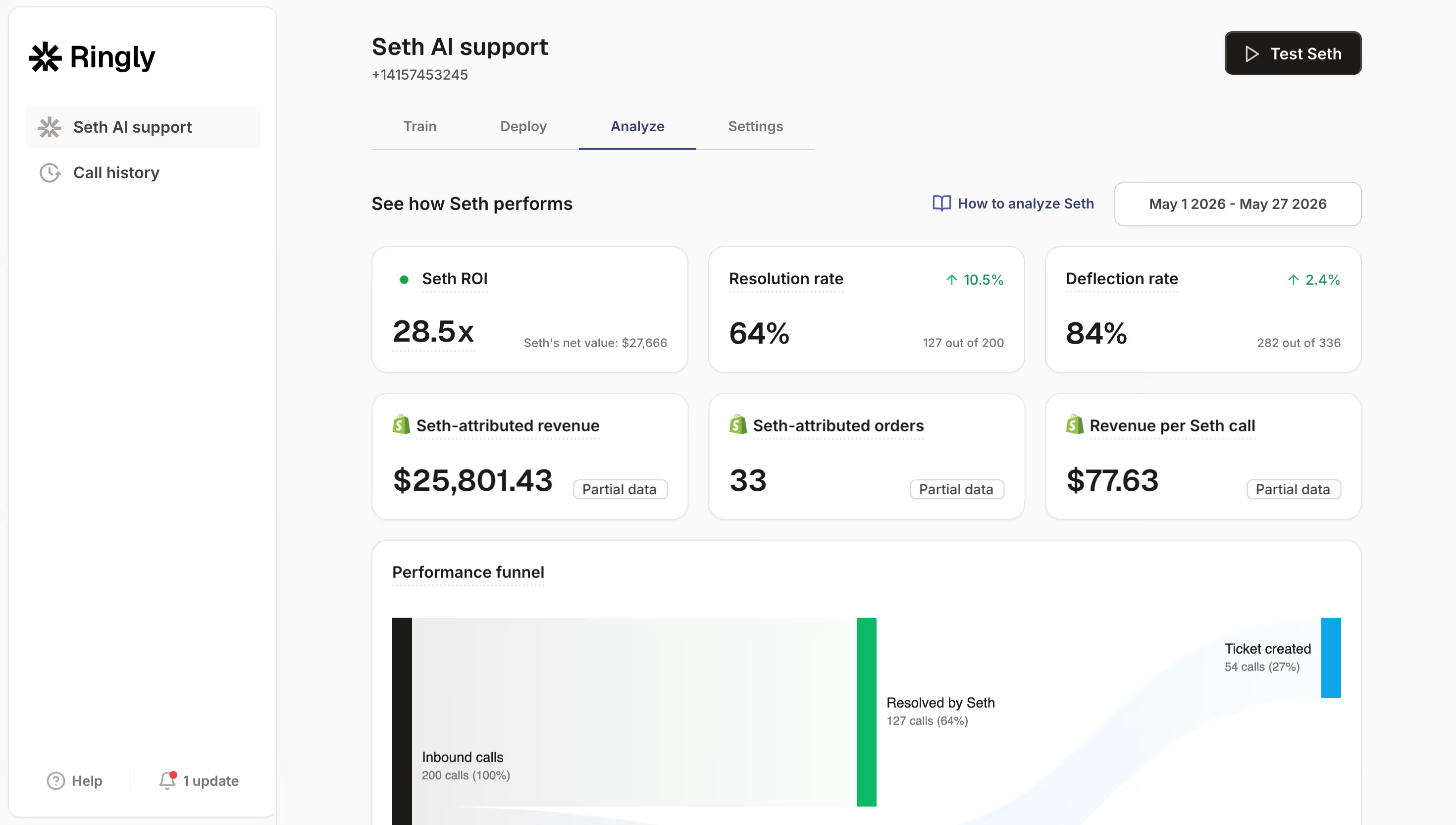
This is where AI phone agents come in. Tools like Ringly.io put an AI agent on your phone line that answers calls 24/7 in 40 languages. It can look up Shopify orders, process returns, and answer product questions, resolving about 73% of calls without a human. Setup takes about three minutes.
Live chat and AI phone support aren't competing channels. They're complementary. Chat handles quick text questions during business hours. AI voice handles everything else, including the calls that chatbots can't replace.
Ready to hear what AI phone support sounds like for your store? Start your free trial. No credit card required.
Frequently asked questions
What is the best free live chat software?
tawk.to is the most popular free option, with unlimited agents and chats at no cost. Freshchat also offers a free plan for up to 10 agents, which is more generous than most. HubSpot includes free chat with its CRM if you're already in that ecosystem.
Is live chat better than phone support for ecommerce?
They serve different needs. Live chat is faster for simple questions like "Do you ship to Canada?" or "What size should I order?" Phone support is better for complex issues like returns, billing disputes, and emotional complaints. The best approach is using both. Check out our comparison of chatbot vs. phone support for more detail.
How much does live chat software cost?
Prices range from free (tawk.to, Freshchat's free tier) to $100+/agent/month (Zendesk, Intercom). Most small ecommerce stores land in the $20-60/month range. Watch for per-ticket and per-conversation pricing that can spike during busy months.
Can live chat software increase sales?
Yes. Answering pre-sale questions in real time reduces cart abandonment. Proactive chat (triggering a message when a visitor hesitates) can increase ecommerce conversion rates by 10-30% depending on the implementation.
What's the difference between live chat and a chatbot?
Live chat connects the visitor to a human agent. A chatbot uses pre-programmed rules or AI to respond automatically. Most modern tools combine both: a chatbot handles routine questions, and a human takes over for anything complex. See our chatbot statistics for current adoption data.
Do I need live chat if I already have email support?
If your customers expect fast answers (and in ecommerce, they do), then yes. Email support averages 12-24 hours for a response. Live chat averages under 2 minutes. That speed difference directly impacts customer satisfaction and repeat purchases.
Pick the right live chat, then fill the gaps
Every ecommerce store needs some form of real-time customer support. Live chat is the easiest starting point. But it's not the whole picture.
Pick the tool that fits your size and budget from this list. If you're on Shopify, Tidio and Gorgias are the strongest options. If you're bootstrapping, start with tawk.to or Freshchat's free plan.
Then think about what happens when customers call. Because they will call, and if nobody answers, you're losing sales. Ringly.io handles that with AI phone support for Shopify stores. Try it free for 14 days.