
The global supplement market hit $211 billion in 2025 and is projected to nearly double to $414 billion by 2033. Over 60% of Americans take at least one supplement daily. The opportunity is massive.
But here's the thing: most supplement brands aren't capturing it. Customer acquisition costs keep climbing. Monthly churn rates sit between 5-15% for DTC supplement brands. And in a market flooded with new products every week, earning trust feels harder than ever.
This guide covers nine specific growth tactics that high-performing supplement ecommerce brands use to build retention, reduce churn, and scale without burning through their margins. No theory. Just what works.
Hear what AI support calls sound like for your store. Just paste your Shopify URL and get sample calls in under 20 seconds, no email required. Listen to demo calls for my store.
Why supplement ecommerce is booming (and why most brands still struggle)
The numbers paint a clear picture. The U.S. supplement market alone is worth $68.7 billion and growing at 8.5% annually. Categories like weight management (17.9% CAGR), probiotics (9.7% CAGR), and sports nutrition (7.8% CAGR) are expanding fast.
And consumers are buying online more than ever. While offline retail still accounts for about 77% of supplement sales, online channels are growing significantly faster. TikTok Shop's supplement category alone is growing at 71.1% year over year, making it the largest product category on the platform.
So why do individual brands struggle?
Three reasons keep coming up:
- Saturated market: thousands of brands sell similar products with nearly identical ingredients. Without a clear differentiation strategy, you're competing on price alone (and losing).
- High acquisition costs: paid ads for supplement keywords are expensive, and building organic traffic takes months. A single click for "best protein powder" can cost $3-5 on Google Ads.
- Brutal churn: DTC supplement brands see 5-15% monthly churn, with involuntary churn from failed payments making up 40% or more of the total. That means almost half your lost customers didn't even mean to leave.
The good news? Industry data from Decile shows that supplement repurchase rates improved from 33% to 37.7% year over year, and retention rates jumped 23%. Purchase frequency also climbed from 1.47 to 1.58 orders per customer. Brands that invest in the right strategies are pulling ahead.
Build a subscription engine that actually retains
Supplements are the perfect subscription product. They're consumable, habitual, and customers need refills on a predictable schedule. When done right, subscriptions turn one-time buyers into long-term customers.
The results can be significant. UMZU, a health supplement brand, achieved a 137x ROI after launching their subscription model through Yotpo. That's not a typo.
But the subscription itself isn't the hard part. Keeping people subscribed is.
Here's what works for reducing subscription churn:
- Flexible scheduling: let subscribers pause, skip, or swap products without canceling entirely. Rigidity kills subscriptions.
- Dunning management: involuntary churn (failed credit cards, expired payment methods) accounts for 40%+ of total churn. Automated retry logic and pre-expiration alerts recover revenue you'd otherwise lose.
- Reframe the offer: "Start your routine" converts better than "Subscribe & Save." Position the subscription as a wellness commitment, not a discount mechanism.
- Milestone rewards: celebrate 3-month, 6-month, and 12-month subscription anniversaries. Small gestures (free sample, exclusive product access) reinforce the habit.
One more tactic worth mentioning: send a "before you cancel" survey when subscribers try to leave. Often, the issue isn't the product. It's the timing, the quantity, or the price. A quick survey that offers alternatives (smaller quantity, less frequent delivery, one-time skip) can save 20-30% of cancellation attempts.
The benchmark to aim for: top-performing supplement brands keep monthly churn below 3%. If you're above 7%, there's significant room for improvement. And remember, even a 1% reduction in monthly churn compounds dramatically over 12 months.
Increase average order value with smart bundling
Supplement customers rarely need just one product. Protein buyers also want creatine. Gut health customers need both probiotics and digestive enzymes. This makes bundling a natural fit.
Three bundling approaches that work well for increasing AOV:
- Stack bundles: group products that work together. A "muscle recovery stack" with protein, BCAAs, and creatine at a 15-20% bundle discount.
- Goal-based bundles: organize around outcomes. "Gut health bundle," "sleep support kit," "energy and focus pack." This simplifies the buying decision.
- Starter kits: lower the barrier for new customers with curated bundles at a slight discount. They get to try multiple products, and you get a higher first-order value.
Cross-selling at checkout matters too. When someone adds magnesium to their cart, suggest melatonin. When they buy protein powder, recommend a shaker bottle. Use contextual pairings, not random suggestions.
You can also use quiz-based product recommendation tools. A short quiz ("What are your health goals?") leads to a personalized bundle suggestion. This approach works especially well for supplement brands because customers often don't know what they need. The quiz both educates and increases cart size.
The average health and beauty AOV sits around $60. Brands that implement smart bundling and upsell strategies regularly push that to $80-120. That's a 33-100% increase from one tactic.
Make trust your conversion weapon
For supplements, trust isn't a nice differentiator. It's the purchase decision. Customers are putting these products in their bodies. If your site doesn't immediately communicate safety and quality, they'll buy from someone who does.
One case study is worth calling out: a supplement brand that tightened trust signals across their product pages saw conversion rates jump from 1.6% to 3.9% in under 60 days. That's a 144% lift without increasing ad spend.
Here are the trust signals that matter most:
- Third-party testing badges: NSF Certified for Sport, USP Verified, or ConsumerLab approved. These instantly signal quality to informed buyers.
- Full ingredient transparency: publish the complete supplement facts panel. No proprietary blends. Customers are increasingly skeptical of hidden dosages.
- Real customer reviews with photos: text-only reviews feel generic. Photo and video reviews from real users build genuine trust.
- Clinical study references: if your product uses clinically studied ingredients at researched dosages, say so. Link to the studies.
- Clear return and refund policy: a visible money-back guarantee reduces purchase anxiety. For supplements, a 30-day guarantee is the baseline expectation.

Health and beauty ecommerce converts at roughly 2.5% on average. Supplement brands that nail trust signals consistently beat that by 50-100%.
Turn customer support into a growth engine
Most supplement brands treat customer support as a cost center. Answer the ticket, close the ticket, move on. That's leaving money on the table.
Think about what supplement customers actually call about:
- Dosage questions: "How much vitamin D should I take?" or "Can I take this with my medication?"
- Subscription changes: "I want to pause my order" or "Can I switch flavors?"
- Order status: "Where's my package?" (the classic WISMO call)
- Product recommendations: "Which protein is best for me?"
Every single one of these is a retention or upsell opportunity. A dosage question, handled well, builds loyalty. A subscription change call that ends with "let me adjust that for you" prevents a cancellation. A product recommendation call can increase order value.
The problem? Most supplement brands can't afford 24/7 phone support. Customers shop evenings and weekends. International buyers call across time zones. And hiring a dedicated customer service team costs roughly $55,000 per year per agent, all in.
That's where the biggest opportunity sits: using technology to make support available around the clock without the headcount.
Try Ringly.io free for 14 days and get AI answering supplement customer calls in under three minutes.
Use AI phone support to scale without hiring
Here's the math. A full-time customer service agent costs about $55,000 per year. An AI phone agent starts at a fraction of that and works 24/7 in 40 languages.
For supplement ecommerce specifically, AI phone support handles the exact call types that eat up your team's time:
- Order tracking: the AI pulls up the order, gives a shipping update, and sends a follow-up SMS. Done in under 90 seconds.
- Subscription management: pause, skip, change flavors, update payment. All handled automatically without the customer needing to log in and navigate your account portal.
- Dosage and product FAQs: trained on your product knowledge base, the AI answers ingredient questions, dosage guidance, and compatibility concerns accurately.
- Returns and exchanges: walks the customer through your return policy and initiates the process.
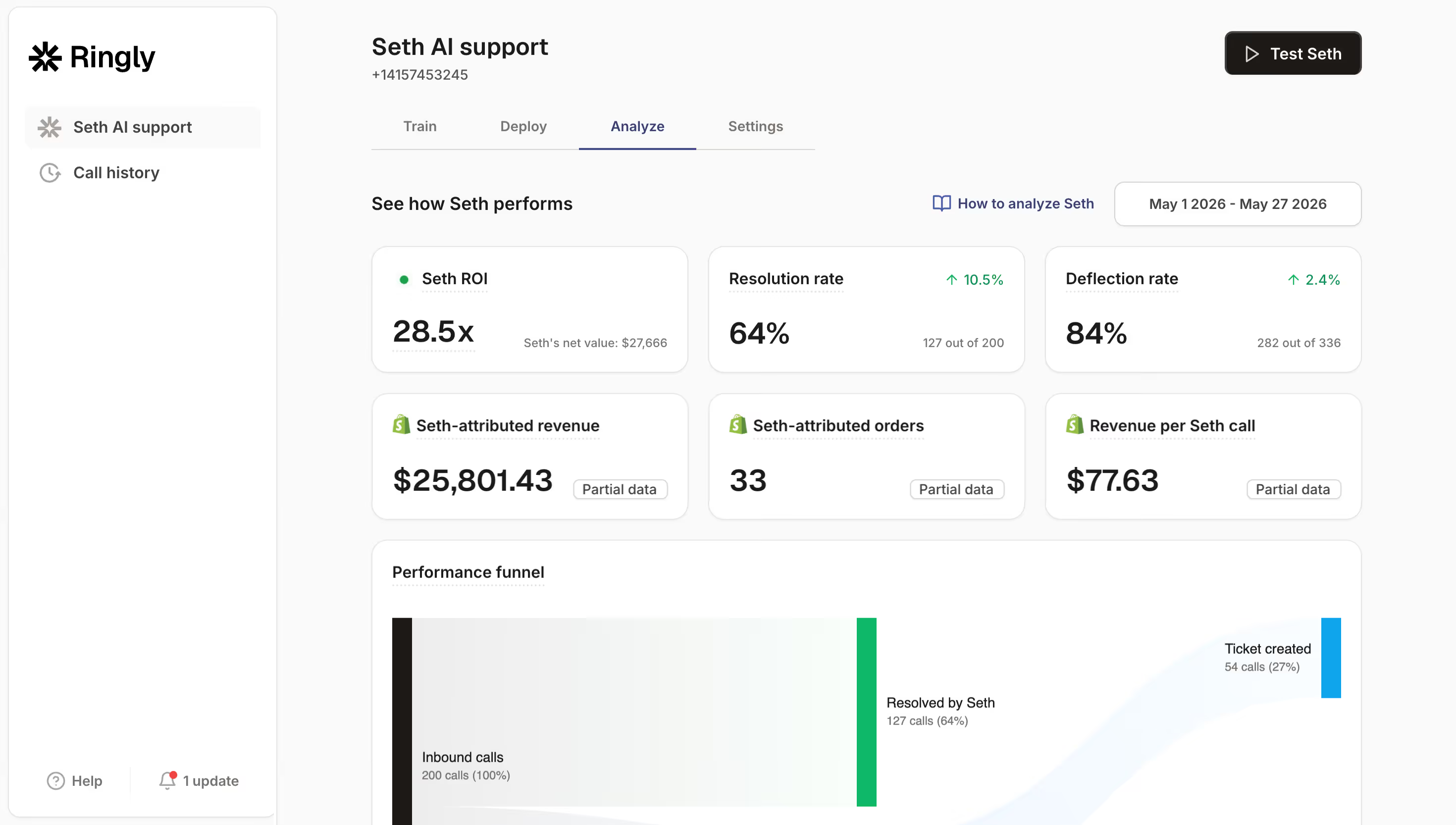
Ringly.io is built specifically for Shopify stores, including supplement brands. Their AI agent, Seth, resolves about 73% of calls without needing a human. When something is too complex (a medical question, an angry customer, a compliance issue), it transfers to your team automatically.
The setup takes about three minutes. No code. No integrations to build. Just connect your Shopify store and the AI starts learning your products, policies, and order data.
For supplement brands specifically, this matters more than in most ecommerce categories. Your customers have questions about what they're putting in their bodies. Having a knowledgeable agent (human or AI) available at 10 PM on a Sunday when someone is deciding whether to reorder can be the difference between a retained subscriber and a lost customer.
For supplement brands weighing hiring vs. AI, the ROI math is straightforward. Most businesses see positive returns within 60-90 days. And unlike hiring, you don't need to worry about training time, turnover, or scheduling coverage across time zones.
Nail your retention email and SMS flows
Email converts twice as effectively as any other channel for health and wellness brands. For supplements, where repurchase timing is predictable, this advantage is even bigger.
The flows that matter most for supplement customer retention:
- Replenishment reminders: if a 30-day supply ships on the 1st, send a reminder on the 22nd. Time these to product usage, not arbitrary schedules.
- Dosage education sequences: after the first purchase, send a 3-4 email series covering how to take the product, when to expect results, and what to stack it with. This reduces returns and builds confidence.
- Cross-sell sequences: 14 days after someone buys a protein powder, suggest creatine. Base recommendations on actual purchase patterns, not random products.
- Win-back campaigns: when a subscriber cancels or a repeat buyer goes quiet, trigger a win-back sequence at 30, 60, and 90 days.
SMS works best for time-sensitive touchpoints: restock alerts, shipping updates, and flash sales. Keep SMS messages short and action-oriented. A simple "Your protein powder ships in 3 days. Need to make changes? Reply PAUSE or tap here" outperforms any long-form SMS.
One often-overlooked flow: the post-purchase education series. Many supplement customers don't know how to use their product correctly. A 5-email series that covers proper dosage, best time to take it, what to expect in weeks 1-4, and what stacks well with it does two things. It reduces returns (because customers see results), and it positions you as a trusted advisor rather than just another store.
According to McKinsey research, brands that personalize their marketing see 40% more revenue than those that don't. For supplement brands, personalization means segmenting by product category, purchase frequency, and health goals.
Build organic traffic with educational content
Supplement buyers are researchers. They don't impulse-buy a $40 bottle of ashwagandha. They Google "best ashwagandha for anxiety," read three articles, check reviews, and then decide.
This makes SEO one of the highest-ROI growth channels for supplement brands. The content strategy maps to the buyer journey:
- Awareness: "benefits of magnesium," "what does creatine do," "best vitamins for energy." Educational content that answers real questions.
- Consideration: "best magnesium supplement for sleep," "collagen powder vs. capsules," "protein powder comparison." Product-oriented content with genuine recommendations.
- Purchase: branded terms, product reviews, "discount codes." Bottom-funnel content that captures ready-to-buy traffic.
Each piece of content should link to your product pages and related articles. This builds topical authority, which Google rewards with higher rankings.
The key mistake supplement brands make with content? Writing generic articles stuffed with keywords instead of genuinely useful guides. If someone searches "best time to take magnesium," they want a clear answer with reasoning, not a 2,000-word preamble about the history of minerals.
Write content your customer would actually bookmark and share. That's what ranks.
One more thing: repurpose your customer support data for content ideas. The questions people call and email about are the exact questions people are searching for on Google. If 30% of your support tickets are about dosage timing, that's your next blog post.
A solid ecommerce marketing strategy combines SEO content with the email and social tactics above. They compound over time.
Use social proof and influencer partnerships
A plant-based supplement brand launched exclusively online, using TikTok and Instagram to drive over 10,000 orders per month. Their secret wasn't a massive ad budget. It was influencer partnerships and user-generated content.
TikTok Shop is the emerging channel for supplements, with the category growing 71.1% year over year. Vitamins and supplements are the largest product category on the platform. If you're not there yet, you're missing where younger buyers shop.
What works for supplement brands on social:
- Micro-influencers (10K-50K followers): they have higher engagement rates and more trust than mega-influencers. A fitness creator genuinely reviewing your protein powder converts better than a celebrity endorsement.
- UGC on product pages: repurpose social content as product page media. Real people using your products builds more trust than studio photography.
- Community over promotion: build a community around shared health goals. Facebook groups, Discord servers, or subreddits where your customers help each other. This creates organic word-of-mouth.
The goal isn't to "go viral." It's to build a consistent presence where your target audience already spends time. Consistency beats virality every time for supplement brands, because trust builds over months, not moments.
One practical approach: partner with 5-10 micro-influencers on a 3-month content calendar instead of one-off sponsored posts. Give them product to use genuinely, and let them share their experience over time. The authenticity comes through, and their audiences notice.
Track the metrics that actually matter
You can't improve what you don't measure. Here are the key metrics for supplement ecommerce, with industry benchmarks:
| Metric | Industry Average | Top Performers |
|---|---|---|
| Repurchase rate | 37.7% | 55%+ |
| Monthly churn (subscription) | 6-7% | Below 3% |
| Conversion rate | 2.5% | 3.5-4%+ |
| Average order value | $60 | $80-120 (with bundling) |
| Customer lifetime value | Varies | 3x+ first order value |
| LTV:CAC ratio | 3:1 minimum | 5:1+ |
The single most important ratio? Customer lifetime value to customer acquisition cost (LTV:CAC). If your LTV:CAC is below 3:1, you're spending too much to acquire customers relative to what they're worth. Above 5:1, and you might be underinvesting in growth.
Track these monthly. Use your ecommerce analytics platform to build dashboards around retention metrics, not just revenue.
Here's a quick health check: if your repurchase rate is below 30%, your retention strategy needs work. If your monthly churn is above 10%, focus on dunning and flexibility before anything else. If your LTV:CAC ratio is below 2:1, you're likely unprofitable and need to either reduce acquisition costs or dramatically improve retention.
A brand growing revenue but losing on retention is building on sand. The supplement brands that win long-term are the ones tracking and improving these numbers every single month.
Ready to see what AI phone support looks like for your supplement store? Try it for free. Setup takes three minutes, and you'll hear real sample calls for your store.
Frequently asked questions
What is the best ecommerce platform for selling supplements?
Shopify is the most popular choice for supplement brands, and for good reason. It handles payment processing, subscription integrations, and compliance features out of the box. Shopify Plus is worth considering once you pass $1M in annual revenue for the additional customization and lower transaction fees.
How do I reduce subscription churn for my supplement brand?
Focus on three areas: flexible scheduling (let customers pause or skip instead of canceling), dunning management to recover failed payments (which cause 40%+ of churn), and ongoing engagement through dosage education and milestone rewards. Top supplement brands keep monthly churn below 3%.
What customer support channels do supplement brands need?
At minimum, you need email and phone support. Supplement customers ask health-related questions that feel too personal for chat. AI phone agents can handle most calls (order tracking, subscription changes, product FAQs) at a fraction of the cost of a human team, with 24/7 availability.
How much does it cost to start a supplement ecommerce business?
Initial costs range from $5,000 to $25,000 depending on your approach. Private labeling is cheaper ($5K-10K) while custom formulation costs more ($15K-25K). Add Shopify fees ($39-399/month), marketing budget ($1,000-5,000/month to start), and fulfillment costs. See Ringly.io's pricing page for AI phone support costs.
What are the biggest challenges growing a supplement brand online?
Market saturation, high customer acquisition costs, and churn are the top three. Regulatory compliance (FDA and FTC guidelines) adds complexity. Most brands underinvest in retention and customer experience, spending heavily on acquisition while ignoring the factors that keep customers coming back.
How can AI help scale a supplement ecommerce business?
AI impacts multiple areas: phone support (handling 73% of calls without humans), personalized product recommendations, email segmentation, and content creation. For customer-facing operations, AI phone agents are the fastest ROI because they replace a direct labor cost while improving availability from business hours to 24/7.
Your supplement ecommerce growth playbook
The supplement market rewards brands that obsess over retention, not just acquisition. Subscriptions, bundling, trust signals, email flows, and great customer support all compound over time.
The most underrated lever? Customer experience. Brands that make it easy to buy, easy to get help, and easy to stay subscribed outperform those that dump their budget into paid ads and hope for the best.
If you're running a supplement store on Shopify and want to see what AI phone support looks like, try Ringly.io free for 14 days. Setup takes three minutes. No code required.