


Ever talked to a supplement customer who's genuinely scared because they think your product gave them a bad reaction? I have. And watching an untrained agent fumble through that call is painful.
The U.S. dietary supplement market hit $68.74 billion in 2025. Massive industry. Yet most supplement brands treat customer service like an afterthought, and it shows.
Selling supplements is nothing like selling t-shirts or phone cases. Your customers call with questions about ingredients, dosages, and side effects. They want to pause their subscription, not cancel it. And your agents need to know exactly what they're legally allowed to say about your products.
Generic ecommerce customer service advice doesn't cut it here. Supplement brands face regulatory constraints, subscription-heavy business models, and emotionally charged interactions that need a completely different playbook.
I've helped set up AI phone agents for supplement brands through Ringly.io, so I've seen what works and what blows up. This guide covers everything: what your customers actually call about, how to build FDA-compliant support scripts, real cost comparisons between support models, and the mistakes that cost supplement brands thousands in lost subscribers every month.
Why customer service is different for supplement brands
Running customer service for a supplement brand is nothing like running it for a typical Shopify store. Three forces make it uniquely difficult.
Regulatory landmines your agents must navigate
Every dietary supplement sold in the U.S. carries the FDA disclaimer: "This statement has not been evaluated by the Food and Drug Administration. This product is not intended to diagnose, treat, cure, or prevent any disease." That disclaimer applies to your customer service agents too.
Your team can discuss structure/function claims. They can say things like "vitamin D supports bone health" or "fiber promotes digestive regularity." What they absolutely cannot do is make disease claims.
Telling a customer "this supplement will cure your arthritis" violates FDA regulations and could expose your brand to serious legal risk.
Here's what FDA-compliant language looks like in practice:
- Allowed: "Many customers report feeling more energized after taking this supplement consistently."
- Not allowed: "This product will fix your chronic fatigue syndrome."
- Ashwagandha has been traditionally used to support the body's stress response. Safe structure/function claim.
- Telling a customer to "take this to treat your anxiety disorder" crosses the line into disease claims. That's the kind of thing that gets brands in real trouble.
- Allowed: "I'd recommend discussing any specific health concerns with your doctor."
- Telling a customer they don't need to see a doctor if they take your supplement is never acceptable
Most ecommerce brands never think about this. For supplement companies, it should be line one of every training manual.
The subscription model creates constant support demand
Subscribe-and-save is the revenue engine for supplement brands. It's how you build predictable monthly revenue and increase customer lifetime value. But it also generates a constant stream of support requests.
Customers want to skip a month, change their delivery date, swap one product for another. They need to update their payment method, pause for vacation, or cancel entirely. Every one of these actions triggers a support interaction.
After setting up our AI agent for several supplement brands, I noticed subscription-related calls spike roughly 40% on billing renewal dates. Your support capacity needs to flex around those cycles or you're dead in the water.
An "acceptable" monthly churn rate for supplement subscriptions is 6-7%. That means for every 1,000 subscribers, 60-70 are trying to leave each month.
If your support team handles those calls well, some of those cancellations become pauses or downgrades instead. Handle them poorly, you lose the customer forever.
Customers ask questions no other ecommerce vertical faces
Nobody calls a clothing brand to ask if their new shirt will interact with their blood pressure medication. But supplement customers do exactly that (with supplements, obviously).
Your support team fields questions about ingredient sourcing, allergen cross-contamination, and whether a product is safe during pregnancy. These are high-stakes questions with real emotional weight. A customer worried about a side effect isn't just annoyed. They're scared.
This means your agents need deeper product knowledge than almost any other ecommerce vertical. They also need clear escalation paths for medical questions they shouldn't attempt to answer.
The 8 most common customer service calls supplement brands get
Understanding your call mix is the first step toward building efficient support. Here are the eight call types that make up the overwhelming majority of supplement brand support volume.
Order status and shipping updates. WISMO ("Where is my order?") calls account for roughly 30-40% of all ecommerce support volume. Across the Shopify stores using Ringly.io, the single most common supplement brand call is about order status, not dosage or ingredient questions.
Subscription management requests are the second largest category for any subscription-heavy supplement brand. Cancel, pause, skip, change frequency, swap products, update payment info. The FTC received roughly 70 subscription-related complaints per day in 2024, up from 42 per day in 2021. Wild numbers.
Ingredient and allergen questions. "Is this gluten-free?" "Does it contain soy?" "Where do you source your fish oil?" These calls require agents who actually know your products inside and out. A wrong answer about allergens isn't just bad service. It's potentially dangerous.
Dosage and usage questions come up constantly. "Should I take this with food?" "Can I take two capsules instead of one?" "What time of day is best?" Your agents should have quick-reference dosage guides for every product in your catalog. No guessing.
Side effect and reaction reports. "I started taking your probiotic and I'm bloated." These calls require empathy first, product knowledge second, and clear escalation protocols third. If a customer reports a serious reaction, your agent needs to know when to recommend contacting their healthcare provider.
Returns for opened products present a unique challenge. An opened bottle of vitamins can't be resold. Most brands offer money-back guarantees anyway because a retained customer's lifetime value far exceeds a $40 bottle. Your return policy needs to be crystal clear to agents.
Billing surprises from auto-ship. "I didn't know I signed up for a subscription!" This happens more than you'd think. Some customers miss the subscription disclosure at checkout, others genuinely forget. Either way, your agent's job is to resolve the situation without losing the customer entirely.
"Does this product actually work?" is the trickiest call of all. The customer wants validation, but your agent can't make health claims. The best approach is sharing that many customers report positive experiences and pointing to specific ingredients that support the product's intended function. Honestly, most supplement brands train agents on product features but completely skip regulatory compliance training. That's backwards.
How to set up phone support for your supplement brand
Whether you're launching your first supplement brand or scaling an existing one, here's how to build phone support that actually works.
Step 1: Map your most common call types
Before you write a single script or hire a single agent, spend two weeks logging every customer inquiry. Categorize them. You'll likely find that 80% of your volume comes from just three or four call types.
For most supplement brands, that's order status, subscription changes, and product questions. Once you know your mix, you can build systems that handle the high-volume, simple calls automatically and route the complex ones to trained humans.
Step 2: Build scripts that stay FDA-compliant
Every call script for a supplement brand needs a compliance review. Not optional.
Create template responses for your most common product questions that use only structure/function claims. Build a "red flag" list of phrases agents should never use. Words like "cures," "treats," "heals," "fixes," and "prevents [specific disease]" should be banned outright.
When a customer asks a medical question, agents should always redirect: "For specific medical advice, I'd recommend speaking with your healthcare provider." The safe language toolkit includes words like "supports," "promotes," "helps maintain," and "traditionally used for."
Include escalation triggers in every script. If a customer mentions a severe allergic reaction, the agent should immediately recommend contacting a healthcare provider or calling 911. If someone asks about drug interactions, the script should direct them to their pharmacist.
Step 3: Create a product knowledge base
Your agents need instant access to detailed product information. Build a searchable knowledge base that includes complete ingredient lists for every SKU with common and scientific names, allergen information covering the top 9 allergens (milk, eggs, fish, shellfish, tree nuts, peanuts, wheat, soy, sesame), and dosage guidelines with timing recommendations and food interaction notes. You'll also want FAQ documents for your 20 most-asked product questions and approved language guides showing FDA-compliant ways to discuss each product's benefits.
This isn't a nice-to-have. Without it, agents either give wrong answers or put customers on hold for five minutes while they hunt for information. Both kill your brand reputation.
Step 4: Set up your phone system
Your phone support infrastructure needs to integrate with your Shopify store so agents can pull up order details instantly. At minimum, you need:
- IVR routing that sends subscription calls, order inquiries, and product questions to the right queue
- Call recording for compliance monitoring and training
- Shopify integration so agents see order history, subscription status, and customer notes before they say hello
- After-hours coverage because supplement customers don't only call during business hours (more on this later)
- CRM logging so every interaction is tracked and searchable
The brands that skip this step end up with agents asking customers to repeat their order number three times while they manually search Shopify. Terrible experience for everyone.
Comparing support models: in-house vs. outsourced vs. AI
This is where most supplement brand founders get stuck. You know you need better customer service, but which model actually makes sense?
| Model | Monthly cost | Coverage | FDA compliance | Setup time |
|---|---|---|---|---|
| In-house (US) | $4,600-7,100/agent | 40 hrs/week | Requires training | 2-4 weeks |
| Outsourced (offshore) | $1,280-2,400/agent | 24/7 available | Hard to enforce | 1-2 weeks |
| Outsourced (nearshore) | $3,200-9,600/agent | Varies | Moderate | 1-2 weeks |
| AI phone support | $349+ | 24/7/365 | Built-in guardrails | 3 minutes |
A few more details on each model:
In-house agents cost $55,000-$85,000 per agent per year when you factor in salary, benefits, overhead, and software. One agent covers roughly 40 hours per week. No evenings, weekends, or holidays unless you hire more.
Outsourced offshore agents run $8-15/hour (Philippines, India) and offer lower cost with scalability, but you get less product knowledge and it's harder to train on FDA compliance nuances.
Nearshore and onshore outsourcing runs $20-60+/hour (Latin America, U.S.) with better language fluency and cultural alignment, but still requires significant supplement-specific training.
AI phone support through Ringly.io starts with the Grow plan at $349/month for 1,000 minutes (~500 calls), with $0.29/minute overage. The Pro plan runs $799/month for 2,500 minutes with $0.19/minute overage, done-for-you setup, and a 14-day free trial. For stores handling 5,000+ minutes a month, Enterprise is custom. It comes with a 65% resolution guarantee: if the AI doesn't resolve 65% of calls after 90 days, you get your last 3 months refunded. No training needed, scales instantly. Complex emotional situations may still need a human touch.
Here's my honest take: if your supplement brand does under $5 million in annual revenue, hiring a full-time in-house customer service team is almost certainly a mistake. The math just doesn't work. You're paying $55,000+ per year for someone who covers 40 hours a week, leaving 128 hours with zero coverage.
AI voice agents or a hybrid model where AI handles the routine calls and humans handle escalations gives you 24/7 coverage at a fraction of the cost. That's not a sales pitch, it's basic math.
If those cost savings sound realistic for your supplement brand, start a free 14-day trial with Ringly.io and hear how Seth handles your supplement brand's calls.
Where supplement brands get customer service wrong
I've seen these patterns across dozens of supplement brands. Fix all seven and you'll be ahead of 90% of your competitors.
Making subscriptions hard to cancel. The FTC pushed its "Click to Cancel" rule for a reason. Even though the rule was vacated by courts in 2025, the FTC still actively enforces against brands that make cancellation unnecessarily difficult. Forcing customers through a gauntlet of retention offers and phone trees destroys trust. Make it easy to cancel, then focus on building a product so good they don't want to.
Training agents on product features but not regulatory limits. Lawsuit waiting to happen. Your agents know every ingredient in your greens powder but have no idea they can't tell a customer it will "cure their gut issues." Compliance training should come before product training. Always.
Offering email-only support when customers want to call. 76% of consumers prefer phone support for resolving issues. Supplement customers especially want to talk to someone when they have concerns about side effects or ingredient safety. If you're email-only, you're ignoring what most of your customers actually want.
I'll go further. Supplement brands that don't offer phone support are leaving money on the table. Email can't convey the same trust and reassurance as a voice conversation.
Ignoring after-hours calls is a silent revenue killer. Your customers take their supplements in the morning and evening. They think about their subscriptions on weekends and discover billing charges at 10 PM. If your support is only available Monday through Friday, 9 to 5, you're missing the calls that matter most.
A customer who can't reach you at 8 PM on a Tuesday to cancel their subscription will just file a chargeback instead. Seen it happen a hundred times.
Not tracking call reasons systematically. If you can't pull a report showing what percentage of your calls are subscription changes vs. product questions vs. complaints, you're flying blind. You can't reduce call volume if you don't know what's driving it. Start tagging every call with a reason code today.
Treating returns as pure losses instead of retention opportunities costs you more than you realize. When a customer returns an opened bottle of supplements, your reflex is to see a $40 loss. But what if the agent offers to swap them to a different product? Or adjusts their dosage? Or switches them to a different flavor? A return call handled well can save a customer worth $500+ in lifetime value.
Using generic scripts that ignore supplement-specific questions. If customer service for supplements is a chess game, generic ecommerce scripts are playing checkers. Your customers ask about bioavailability, third-party testing, and whether your turmeric contains BioPerine. Generic scripts don't have answers for any of that.
Tools and solutions for supplement brand customer service
You don't need to build everything from scratch. Here are the categories of tools that make supplement brand customer service actually manageable.
AI phone support
This is the fastest-growing category for a reason. AI phone agents can handle the high-volume, repetitive calls that eat up most of your support bandwidth.
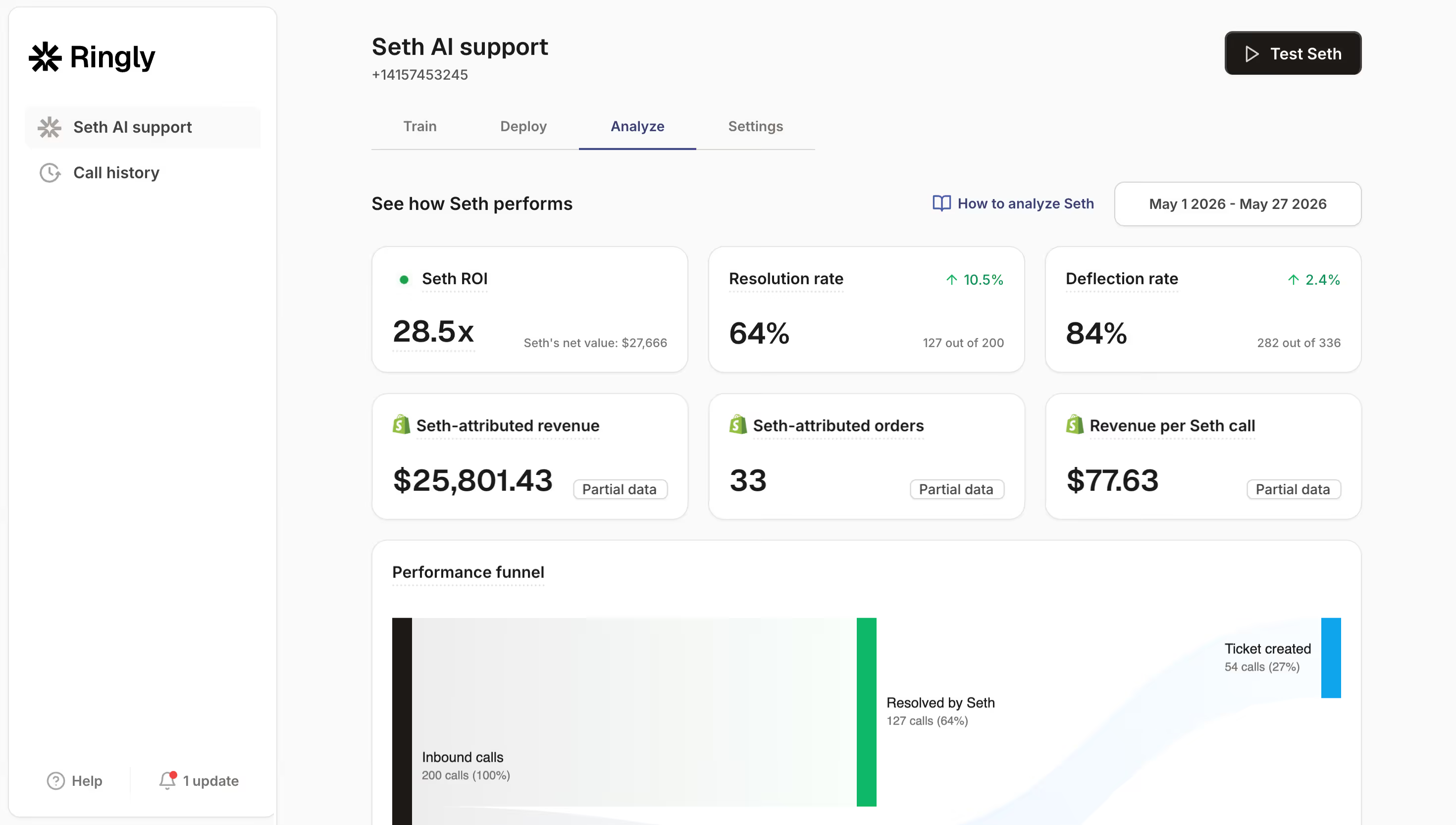
I built Ringly.io to focus on Shopify stores, including supplement brands. The AI agent (named Seth) connects directly to your Shopify store and pulls real-time order data. You can configure it with your product knowledge base, approved language guidelines, and escalation rules.
It handles order status calls, subscription modifications, and basic product questions while routing complex cases (side effect reports, medical questions) to your human team. Setup takes about 3 minutes. Tested it myself dozens of times.
Pricing starts at $349/month on the Grow plan (1,000 minutes, roughly 500 calls). The Pro plan is $799/month for 2,500 minutes with done-for-you setup and AI call insights. Enterprise is custom pricing for stores doing 5,000+ minutes/month. There's a 14-day free trial on Pro, plus a 65% resolution guarantee: if Seth doesn't resolve 65% of calls after 90 days, you get your last 3 months refunded.
Helpdesk platforms
You still need a central hub for managing support tickets across email, chat, and phone. Look for platforms that integrate with Shopify and support subscription management workflows. The best ones automatically pull in order history, subscription status, and customer notes so your agents (human or AI) have full context before the conversation starts.
Key features to prioritize for supplement brands:
- Shopify subscription app integration (ReCharge, Bold, Skio, etc.)
- Automated ticket tagging by topic so you can track call reasons
- FDA compliance templates that agents can insert with one click
- Macro libraries for your most common product questions
Knowledge base and self-service
Many supplement customers will help themselves if you give them the tools. Build a public-facing FAQ that covers shipping and delivery timelines for every shipping method you offer, subscription management instructions with screenshots showing how to pause, skip, or cancel, and product-specific FAQ pages covering ingredients, dosage, allergens, and storage. Don't forget return and refund policies with clear steps and timelines, plus certificate of analysis (COA) access for customers who want to verify third-party testing.
A good self-service portal can reduce your support ticket volume by 20-30%. For a customer service operation for Shopify stores, that's a meaningful cost reduction.
Building a customer service strategy that actually retains subscribers
Customer service isn't just about resolving problems. For subscription-based supplement brands, it's your single best retention tool. Treat it like one.
Turn cancellation calls into save opportunities
When a subscriber calls to cancel, your agent's first job is to understand why. The reason determines the response:
- "It's too expensive." Offer a smaller size, lower dose, or a temporary discount.
- "I have too much product." Switch them to every-other-month delivery instead of canceling.
- "It's not working." Ask how long they've been taking it and whether they're following the recommended dosage. Many supplements take 4-8 weeks to show results. Worth mentioning.
- "I found something cheaper." Highlight your differentiators: third-party testing, ingredient sourcing, customer support quality.
- "I just don't need it anymore." Accept gracefully. Offer to pause instead. Leave the door open.
The difference between a 5% and 3% monthly churn rate is massive. With 5% churn, you retain 54 out of 100 subscribers after one year. With 3% churn, you retain 70. That's 16 more paying customers per 100, compounding month over month.
Use support data to improve your product
Your customer service team talks to more customers than anyone else in your company. They know which products get the most complaints, which flavors people hate, and which subscription frequency causes the most cancellations.
Start pulling monthly reports on your top 10 call reasons and how they trend over time, product-specific complaint rates per SKU, subscription modification patterns (what frequency changes are most common?), and return reasons broken down by product.
This data should feed directly into your product development and marketing decisions. If 40% of your protein powder cancellations mention "taste," that's not a customer service problem. It's a product problem. Big difference.
Make proactive outreach part of your CS workflow
Don't wait for customers to call you. The best supplement brands reach out first.
- Day 3 after first delivery: Send a welcome message with usage tips and what to expect.
- Day 14 is a good time to check in. "How are you feeling? Any questions about your supplement routine?"
- Day 25 (before second shipment): Remind them their next order is coming. Give them a chance to adjust.
- After a return or complaint, follow up to make sure the resolution was satisfactory. Most brands don't bother. You should.
Proactive outreach reduces inbound call volume by answering questions before they're asked. It also signals to customers that you actually care about their experience beyond the transaction.
FAQ
What's the best customer service channel for supplement brands?
Phone support should be your primary channel. 76% of consumers prefer phone for resolving support issues, and supplement customers especially value speaking with someone about health-related questions. Add email, live chat, a self-service knowledge base, and multilingual support if you sell internationally.
How many support agents does a supplement brand need?
Depends on your order volume and subscription base. A rough benchmark: one full-time agent per 50-100 daily support interactions. With AI phone support handling routine calls, many supplement brands operate with zero or one dedicated agent even at $1M+ in annual revenue.
Can AI handle supplement-specific customer questions?
Yes, if configured properly. Modern AI phone agents like Ringly.io can be loaded with your product knowledge base, ingredient information, and FDA-compliant language guidelines. Complex medical questions should still route to a human or redirect the customer to their healthcare provider.
How do I handle customers asking about drug interactions?
Never have agents provide medical advice about drug interactions. The correct response is always: "I'd recommend speaking with your doctor or pharmacist about supplement interactions." Train every agent on this and make it non-negotiable.
What's a good customer satisfaction score for supplement brands?
The industry average CSAT across all ecommerce is roughly 78%. Supplement brands should aim for 80%+ given the health-sensitive nature of the products. First-contact resolution rate is equally important: shoot for 70%+ and work toward 85%.
How much does customer service cost for a supplement brand?
Costs vary dramatically by model. In-house agents run $55,000-$85,000 per year fully loaded, while outsourced offshore agents cost $1,280-$2,400 per month. AI phone support starts at $349/month on the Grow plan with a 14-day free trial. Check the ROI of AI phone support breakdown for subscription businesses.
Supplement support is a retention engine, not a cost center
Supplement brands operate under constraints that most ecommerce stores never deal with. Every customer call carries FDA compliance risk. Every subscription renewal is a retention opportunity. Every ingredient question is a chance to build trust or destroy it.
And the brands that treat customer service as a growth lever, not an expense line, are the ones compounding subscriber lifetime value month over month. They bake compliance into their scripts, staff coverage around billing cycles, and make cancellation easy enough that customers come back on their own.
I've personally seen this play out across the supplement brands using Ringly.io. The ones that invest in proper phone support (whether human, AI, or hybrid) retain more subscribers and bleed less revenue. No contest.
If you want to see what that looks like in practice, try Ringly.io free for 14 days. Paste your Shopify store URL, and Seth will show you how he handles supplement brand calls, from subscription pauses to allergen questions, in under 20 seconds.