


In 2026, the average cost to outsource a single customer service call has climbed to $5.60, meaning a busy month of "Where is my order?" inquiries can quietly bleed your margins dry.
You’ve built a brand, but your current support team is likely drowning in repetitive calls that stall their productivity and spike your overhead.
You are stuck choosing between expensive headcount and frustrated customers who hate waiting on hold.
But there is a fix.
In this article, we will go over the best AI voice agents for e-commerce.
First, we will break down the essential features your brand needs to stay competitive.
Then, we will rank the top 7 AI voice agents designed specifically to handle the scale and complexity of modern e-commerce.
Editor’s note: Want to hear some sample support calls made for your Shopify store?
- Just paste your store URL
- Get sample calls in under 20 seconds (no email required)
- Listen to demo calls for my store

This post compares 7 AI voice agent platforms with e-commerce use cases in mind.
We focused on Shopify integration depth, built-in commerce workflows, pricing transparency, and how quickly you can get up and running.
What are AI voice agents?
AI voice agents are phone systems powered by large language models.
Unlike traditional IVR menus that force callers to press 1 for this or 2 for that, these agents understand natural speech and respond conversationally.
The technology stack typically includes speech-to-text to understand what callers say, natural language processing to interpret intent, and text-to-speech to generate responses.
The best platforms can handle complex back-and-forth conversations rather than just matching keywords.
For e-commerce specifically, AI voice agents shine because of the repetitive nature of support calls.
Studies suggest that "where is my order" queries alone account for a large portion of inbound calls. Returns, exchanges, and basic product questions follow close behind.
These are exactly the kinds of calls that AI can handle well. The information needed to answer them sits in your Shopify admin.
A well-integrated voice agent can pull that data and resolve the call without a human ever getting involved.
What to look for in an e-commerce AI voice agent
Not every AI voice platform will work well for online stores. Here are the criteria that matter most when evaluating your options.
Platform integration is the foundation. Can the agent pull order data directly from Shopify or your e-commerce platform?
Without this, callers will just hear generic responses instead of actual answers about their orders.
Built-in e-commerce workflows save you from building everything from scratch.
Look for platforms that already know how to handle returns, exchanges, and order tracking out of the box.
Setup complexity varies widely. Some platforms require weeks of development work. Others can be live in minutes.
Consider your team's technical resources honestly.
Pricing transparency matters for budgeting. Per-minute billing, monthly subscriptions, and outcome-based models all exist.
Make sure you understand what you will actually pay.
Multilingual support becomes important if you sell internationally.
A voice agent that only speaks English will not help your French or Spanish-speaking customers.
Escalation handling determines what happens when the AI cannot help.
Good platforms detect frustration, complex issues, and edge cases, then route those calls to your human team smoothly.

Quick comparison: AI voice agents for e-commerce
Before diving into each platform, here is how they stack up across the key criteria.
| Platform | Best For | Shopify Integration | Starting Price | E-commerce Focus |
|---|---|---|---|---|
| Ringly.io | Shopify stores needing 24/7 phone support | Native | $349/month | Very High |
| Siena AI | Brand-focused commerce CX | Shopify-optimized | Contact sales | Very High |
| Consio AI | Abandoned cart recovery | Native | Free trial | Very High |
| Sierra AI | Enterprise e-commerce | Limited | Outcome-based | High |
| Voiceflow | Teams building custom agents | Shopify Plus only | 14-day free trial | Medium |
| Retell AI | Developer-first teams | No | $10 free credits | Low |
| ElevenLabs | High-volume multilingual | No | Contact sales | Low |
The platforms at the top of this list were built specifically for e-commerce.
Those toward the bottom are general-purpose tools that can be adapted for commerce use cases but require more work.
7 best AI voice agents for e-commerce
1. Ringly.io
Best for: Shopify stores wanting plug-and-play AI phone support
Ringly.io provides the AI, an AI phone support agent built specifically for e-commerce.
It answers calls around the clock, looks up orders directly from Shopify, handles returns and exchanges, and escalates to your team when needed.
The platform is currently Shopify stores.
What sets Ringly.io apart is how deeply it integrates with Shopify. the AI pulls order data automatically, so when a customer calls asking about their shipment, the agent already knows their order status, tracking number, and delivery estimate. No API setup required on your end.
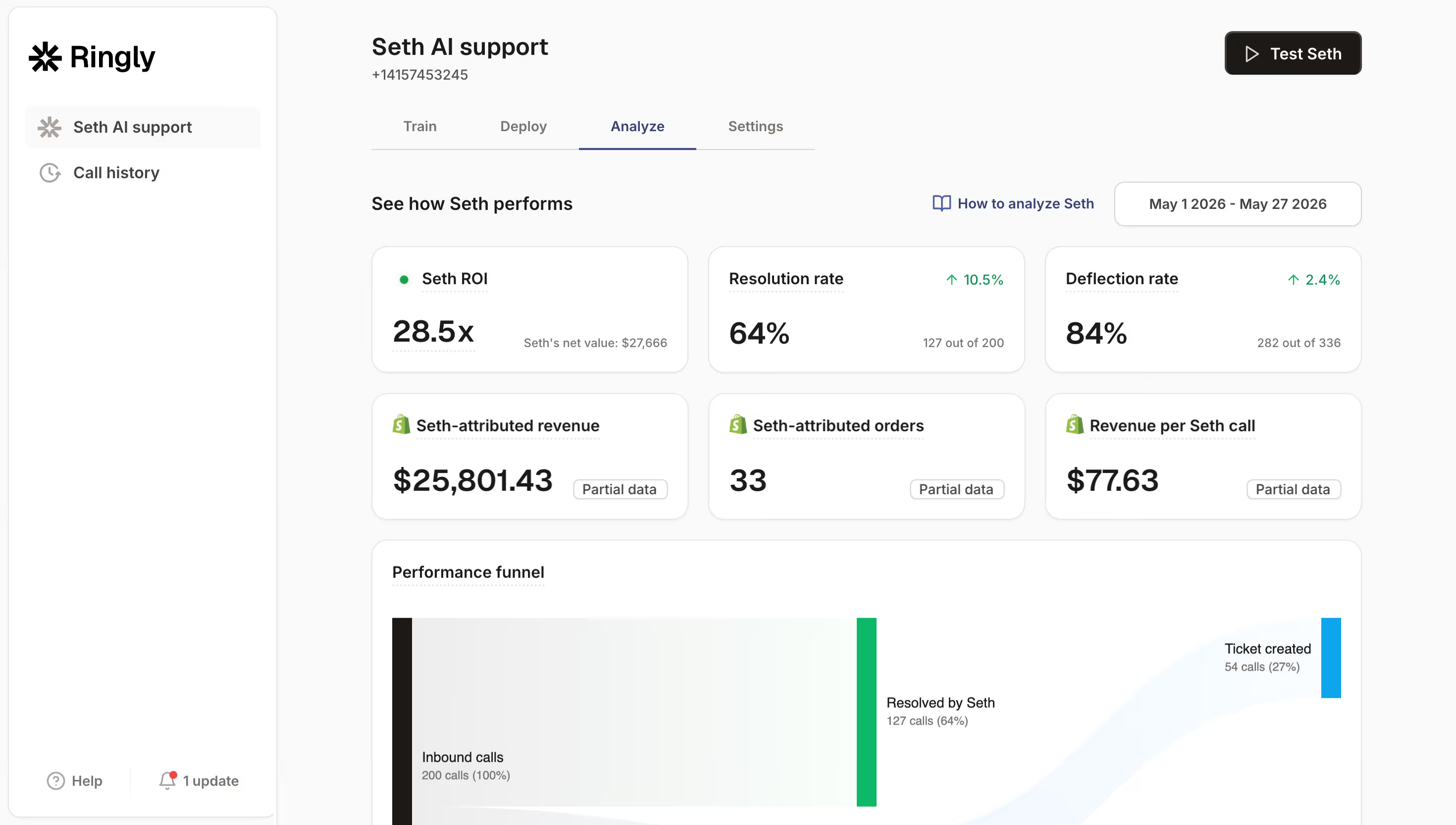
The resolution rates are solid. According to Ringly.io's data, The AI handles about 73% of calls without needing a human, which translates to real cost savings when you are paying support agents by the hour.
Setup takes about 3 minutes. You connect your Shopify store, choose a phone number, and the agent starts taking calls.
Non-technical teams can launch without any development work.
Key features:
- Native Shopify integration with automatic order data pull
- 40 language support with automatic detection
- Returns and exchanges automation
- Call recordings, transcripts, and analytics
- Knowledge base uploads for custom training
- Escalation rules based on caller sentiment
Pricing:
| Plan | Price | Minutes | Overage |
|---|---|---|---|
| Start | $349/month | 250 | $0.36/min |
| Grow | $349/mo | 1,000 | $0.19/min |
| Enterprise | Custom | 5,000+ | $0.19/min |
Ringly.io offers a 14-day free trial. They also have a performance guarantee where you get your last 3 months refunded if the AI resolves under 65% of calls in 90 days within the first 21 days on at least 100 calls.
Pros: quick setup, high resolution rate, Shopify-native workflows
Cons: Primarily focused on Shopify, phone-only (no chat or email automation)
2. Siena AI
Best for: Mid-market to enterprise e-commerce brands prioritizing brand voice
Siena AI positions itself as the "empathic AI agent for commerce." The platform handles customer interactions across voice, chat, and social while maintaining your brand personality. Their pitch centers on turning CX from a cost center into a revenue driver.
The feature set goes beyond basic support automation.
Siena offers generative product recommendations during conversations, subscription management for DTC brands, and social media moderation. The AI Copilot feature helps human agents draft responses faster when they do need to step in.
Enterprise customers like Kitsch, Prose, and Simple Modern use Siena.
The platform claims up to 80% automation of customer interactions and a 94.7% average CSAT score across deployments.
Key features:
- Generative product recommendations
- Post-purchase automation (returns, refunds, address changes)
- Subscription management (skip, pause, swap)
- Social media engagement
- AI Copilot for agent assistance
- Brand voice customization per channel
Pricing: Not publicly disclosed. You will need to book a demo to get pricing information.
Pros: Purpose-built for commerce, strong brand empathy focus, proven enterprise customer roster
Cons: No public pricing, requires sales conversation to evaluate, may be overkill for smaller stores
A screenshot of Siena AI's landing page.
3. Consio AI
Best for: Shopify merchants focused on recovering abandoned carts via phone
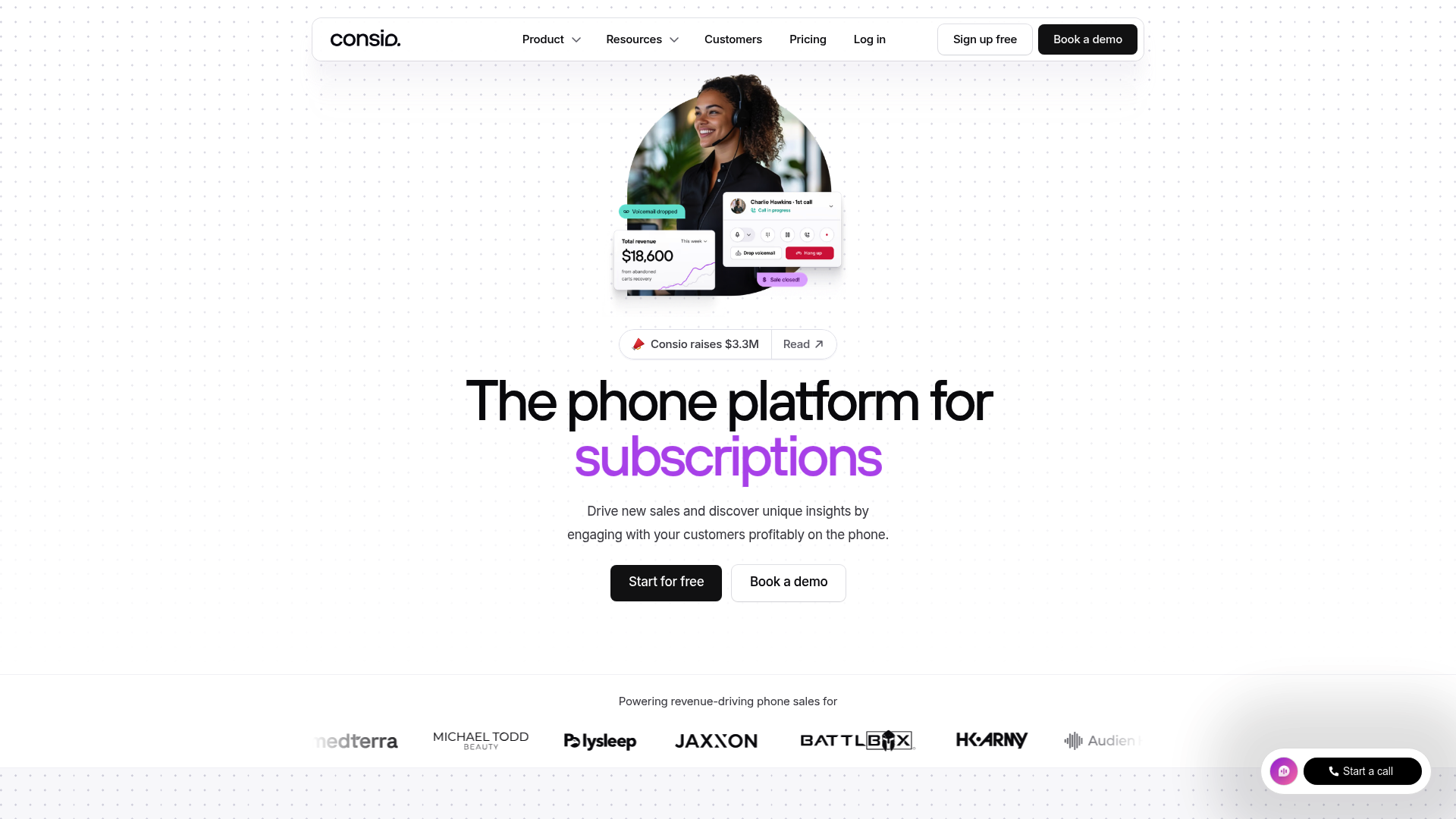
Consio AI calls itself "the phone platform for e-commerce." What makes it different is the dual focus on inbound support and outbound sales recovery.
Their power dialer lets you proactively call customers who abandoned checkout.
The abandoned cart recovery angle is interesting. Consio claims a 40% conversion rate on abandoned checkouts for customers like Evolv. Another case study shows +$80K in phone sales within 30 days for Andor Willow.
For inbound calls, the AI voice agent handles FAQ questions and basic support.
The platform integrates with Klaviyo for customer segmentation, so you can target campaigns based on purchase history or cart value.
Key features:
- Ecommerce Power Dialer for outbound calls
- AI Voice Agent for inbound FAQ handling
- Campaign targeting (abandoned carts, VIP customers)
- Automatic voicemail drops
- Call summaries, recordings, transcripts
- Shopify and Klaviyo integrations
Pricing: Free trial available. Full pricing not disclosed publicly.
Pros: Outbound focus for cart recovery, Shopify native, revenue attribution tracking
Cons: Primarily phone focused, newer player with less enterprise validation
4. Sierra AI
Best for: Enterprise e-commerce brands needing multi-channel AI agents
Sierra AI takes an "Agent OS" approach with orchestration across chat, SMS, WhatsApp, email, and voice.
The customer roster speaks for itself: Wayfair, Gap Inc., ASOS, Casper, and Deliveroo all use Sierra.
The outcome-based pricing model is unusual. Instead of paying per minute or per seat, you pay based on results delivered.
Sierra does not disclose specifics publicly, but the model aligns their incentives with yours.
The Agent Memory feature gives the AI persistent context across interactions.
If a customer called last week about a delayed shipment and now chats about the same order, the agent remembers. This kind of continuity is hard to achieve with most platforms.
Key features:
- Agent Studio (no-code builder with guardrails)
- Agent Memory (persistent context across interactions)
- Multi-channel support (voice, chat, SMS, WhatsApp, email)
- Advanced analytics and experimentation tools
Pricing: Outcome-based pricing. Contact sales for specifics.
Pros: Enterprise proven with major brands, true multi-channel orchestration, outcome-aligned pricing
Cons: Enterprise only, complex implementation, not suited for smaller stores

5. Voiceflow
Best for: Product teams wanting to build custom voice and chat agents
Voiceflow is a no-code/low-code platform for building AI agents.
With 200,000+ users and a 4.8/5 rating on G2, it offers flexibility for teams that want control over agent behavior and conversation logic.
This is not a plug-and-play solution. Voiceflow gives you the building blocks to create your own agent from scratch.
The visual drag-and-drop builder makes it accessible to non-developers, but you still need to design the flows, connect the integrations, and test thoroughly.
One limitation for e-commerce: Shopify integration is only available for Shopify Plus stores.
Standard Shopify merchants would need to build custom API connections.
Key features:
- Visual drag-and-drop agent builder
- Voice and chat agent support
- Shopify Plus integration
- Developer SDK and API
- Simulation testing
Pricing: Free tier available. Pro and Enterprise tiers require sales contact.
Pros: Flexible builder with no-code option, large user community, functional free tier
Cons: DIY approach requires building rather than deploying, Shopify Plus only

6. Retell AI
Best for: Developer teams building custom voice automation
Retell AI positions itself as a developer-first platform for automating phone calls.
The emphasis is on low latency (around 600ms response time) and enterprise security compliance.
For teams with development resources, Retell offers real-time function calling during conversations.
This means the agent can execute actions like processing payments or booking appointments while the caller is still on the line.
The platform is SOC 2, HIPAA, and GDPR compliant, which matters for regulated industries.
However, there are no e-commerce-specific features or Shopify integrations. You would need to build those connections yourself.
Key features:
- Low latency voice responses (~600ms)
- Drag-and-drop agentic framework
- Real-time function calling
- Streaming RAG for knowledge integration
- Enterprise security compliance
Pricing: Free trial with $10 credits. Usage-based pricing, contact sales for details.
Pros: Developer friendly with good documentation, enterprise security certifications
Cons: No e-commerce focus, no Shopify integration, requires development work

7. ElevenLabs
Best for: High-volume operations needing multilingual voice agents
ElevenLabs built its reputation on realistic AI voices. The voice agents product extends that strength to phone automation.
If voice quality and natural conversation matter most, ElevenLabs delivers.
The scale capabilities are impressive. The platform supports up to 1 million concurrent calls with batch calling for outbound campaigns.
Language support covers 30+ languages with dynamic switching mid-conversation.
This is enterprise infrastructure, not an e-commerce tool. There are no Shopify integrations or commerce workflows.
You would use ElevenLabs as the voice layer in a custom-built solution.
Key features:
- 30+ languages with dynamic switching
- Batch calling (thousands in parallel)
- Ultra-low latency (<1 second)
- Twilio and SIP integration
- Hyper-realistic voice quality
Pricing: Not publicly disclosed. Contact sales required.
Pros: Best-in-class voice quality, massive scale capability, broad language support
Cons: No e-commerce features, enterprise pricing only, requires custom development

How to choose the right AI voice agent
Your choice depends on your specific situation. Here is a quick decision framework.
Choose Ringly.io if you run a Shopify store, want fast setup without developers, and primarily need to handle inbound support calls like WISMO and returns. The 14-day free trial lets you test with real calls before committing.
Choose Siena AI or Sierra AI if you are a mid-market to enterprise brand needing multi-channel automation beyond just phone. Both require sales conversations but offer comprehensive CX platforms.
Choose Consio AI if abandoned cart recovery is a priority and you want outbound calling capabilities alongside inbound support.
Choose Voiceflow if you have product or development resources and want to build custom agent logic rather than use a pre-built solution.
Choose Retell or ElevenLabs if you are building from scratch, need enterprise compliance, or require massive scale. Neither has e-commerce-specific features, so plan for custom development.
For most Shopify stores, purpose-built solutions will get you to value faster than general platforms. The integration depth and pre-built workflows mean you spend less time configuring and more time benefiting from automation.
Get started with AI phone support for your store
AI voice agents are no longer experimental technology. Thousands of e-commerce stores already use them to handle customer calls around the clock.
The key is choosing a platform that matches your tech stack and use case. For Shopify stores, solutions with native integration and built-in commerce workflows offer the fastest path to results.
If you want to see how this works in practice, start a free trial with Ringly.io and let the AI handle a few hundred calls.
You will quickly see how many inquiries can be resolved without your team lifting a finger.
For more on ai voice agents for ecommerce, murf.ai has a helpful overview.
For more on ai voice agents for ecommerce, speechify.ai has a helpful overview.
For more on best call center software, callhippo.com has a helpful overview.
Frequently Asked Questions
What are AI voice agents for e-commerce and how do they work?
AI voice agents for e-commerce are phone systems powered by large language models that handle customer calls automatically. They use speech-to-text to understand callers, natural language processing to interpret requests, and text-to-speech to respond. For online stores, they can look up orders, process returns, and answer product questions.
How much do AI voice agents for e-commerce typically cost?
Pricing varies widely. Ringly.io starts at $349/month for 1,000 minutes. Enterprise platforms like Sierra AI use outcome-based pricing. General platforms like Voiceflow offer free tiers. Most charge per minute for usage overages, typically between $0.15-$0.25 per minute.
Can AI voice agents for e-commerce integrate with Shopify?
Some can, but integration depth varies. Ringly.io and Consio AI have native Shopify integrations that pull order data automatically. Voiceflow only supports Shopify Plus. General platforms like Retell AI and ElevenLabs have no built-in Shopify support.
What percentage of calls can AI voice agents for e-commerce handle without humans?
Resolution rates depend on the platform and use case. Ringly.io reports 73% of calls resolved without human intervention. Siena AI claims up to 80% automation. ElevenLabs advertises up to 90% resolution. Actual results will vary based on your specific call types.
Are AI voice agents for e-commerce available in multiple languages?
Most platforms support multiple languages, but coverage varies. Ringly.io supports 30 languages. ElevenLabs offers 30+ with dynamic switching. Siena AI and Sierra AI offer multi-language support but do not publish specific counts. Check each platform for your specific language needs.
How long does it take to set up AI voice agents for e-commerce?
Setup time ranges from minutes to weeks. Ringly.io advertises quick setup for Shopify stores. Consio AI uses a 3-step onboarding process. Enterprise platforms like Sierra AI require longer implementation periods with custom configuration.
Can AI voice agents for e-commerce handle returns and exchanges?
E-commerce-focused platforms like Ringly.io and Siena AI have built-in returns and exchanges workflows. General platforms like Retell AI and ElevenLabs would require custom development to add these capabilities.