

It costs $2.35 for a human to answer one support call, but an AI agent does it for just $0.38.
You are working hard to scale your brand, but your payroll is leaking cash every time the phone rings with a simple question.
It feels like you are stuck choosing between expensive labor or frustrated customers who are left on hold for way too long.
And when you scale it will only get worse.
This guide will show you how to manage an overload of support calls for your Shopify store.
First, we will look at why traditional phone teams fail as you grow.
Then, we will show you how to set up an AI agent that handles your order tracking and returns automatically.
Editor’s note: Want to hear some sample support calls made for your Shopify store?
- Just paste your store URL
- Get sample calls in under 20 seconds (no email required)
- Listen to demo calls for my store
What are Shopify customer support calls?
This term refers to the phone inquiries businesses receive from customers; it is not a built-in Shopify feature.
For any Shopify store, these phone calls are important for building trust and resolving problems on the spot.
Many of these calls address similar, recurring topics, which can occupy a significant amount of your team's time:
- WISMO ("Where Is My Order?"): This is one of the most common questions. Customers want to know their package's location and estimated arrival time, so they look for order and shipping updates.
- Returns & Exchanges: People call to understand how to start a return, check on a refund's status, or ask about swapping an item for a different size or color.
- Product Questions: These are often pre-sale questions from interested customers. They might want more details about a product, stock availability, or usage instructions.
- Technical Issues: Customers might experience issues with your website, the Shopify checkout, or applying a discount code.
- Complaints & Negative Feedback: When a customer is unhappy, they often prefer to call for an immediate conversation and a quick resolution.
Despite the availability of chat and email, phone support remains an important channel for many customers.
It offers a direct connection, provides an instant answer, and is a common channel for urgent problems. Effective phone support can have a positive impact on customer retention and overall brand loyalty.
The challenges of traditional phone support
As a Shopify store grows, traditional methods of managing phone support can become less efficient.
This can create a bottleneck that impacts scalability. Here’s a look at some of the reasons why.
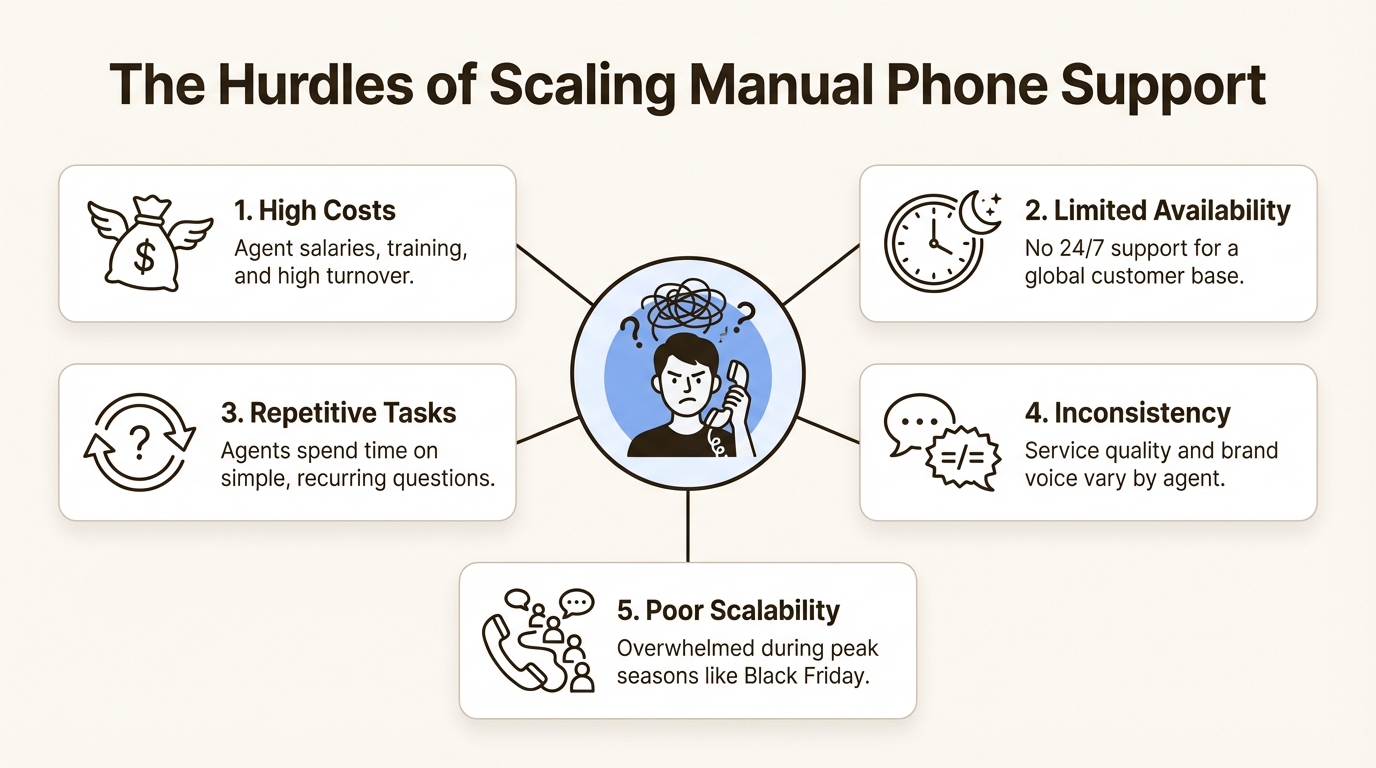
High costs
A significant portion of a support budget is often allocated to labor costs. Paying staff can account for 60-70% of a call center's expenses.
Hiring, training, and retaining agents is a serious investment. With industry turnover rates between 30-45% annually, businesses can find themselves in a continuous cycle of hiring and training.
Limited availability
Customers shop at all hours, but providing 24/7 support with a human team can be challenging. Online shoppers often expect round-the-clock support, which can lead to frustration if they are unable to reach someone.
Missed calls after business hours, on weekends, or during holidays can represent missed opportunities and affect customer perception.
Repetitive tasks
A significant portion of calls relate to simple, repetitive tasks like tracking an order. Handling these calls occupies agents' time, which could otherwise be spent on more complex issues requiring human intervention that may lead to more sales.
Inconsistency
Ensuring every customer receives a consistent experience can be difficult.
Service quality and brand voice can vary between agents and shifts. This inconsistency can make your support feel unreliable.
Poor scalability
During peak seasons like Black Friday, a surge in Shopify customer support calls can overwhelm a team.
Hiring temporary staff can be a complex and inefficient solution. This can result in long hold times, a common point of frustration for customers.
Available channels for Shopify customer support and their limitations
Shopify merchants use several different channels to assist their customers, but each has its own limitations, especially for phone inquiries.
Manual phone support
While direct conversation offers a personal touch, it can be the most challenging channel to scale.
It is expensive to staff, cannot realistically be available 24/7, and can be overwhelmed when call volumes spike during busy seasons.
Email support
Email is useful for non-urgent issues, but it can create slower response cycles.
A simple question can turn into a multi-day exchange, which may not meet customer expectations for a speedy resolution.
Live chat and Shopify Inbox

Tools like Shopify Inbox are a solid option for handling text-based chats.
And while features like Shopify Magic can offer AI-suggested replies, they do not address the needs of customers who prefer to call. A live agent must still be logged in and available to type.
Help centers and FAQs
A comprehensive help center is valuable for self-service, allowing customers to find answers to general questions on their own.
However, they are generally not equipped to handle specific inquiries related to individual orders.
| Feature | Manual Phone Support | Email Support | Live Chat | AI Phone Agent |
|---|---|---|---|---|
| Response Time | Instant (if answered) | Slow (hours to days) | Fast (minutes) | Instant |
| Scalability | Low | Medium | Low to Medium | High |
| Cost | High | Medium | Medium | Low |
| 24/7 Availability | Very Difficult | Yes (but delayed) | Difficult | Yes (Standard) |
| Personalization | High | Low | Medium | High (with data) |
Automating calls with an AI phone agent
AI phone agents offer a solution. Modern AI phone agents are more advanced than earlier interactive voice response (IVR) systems. They can understand natural language, integrate directly with your Shopify store for live data, and provide customers with instant answers.
The benefits of AI automation
By automating your phone support, you can address many of the challenges associated with the traditional model.
- 24/7/365 Availability: An AI agent is always available. You can offer instant support at any time, ensuring you never miss a call or a sales opportunity.
- Cost Reduction: Automation can help decrease support costs. The average cost per call with an AI agent like Ringly.io is around $0.38, compared to the typical $2.35 for a human agent.
- Instant & Consistent Answers: Eliminate hold times. Every customer gets an immediate, on-brand response, every time.
- Seamless Scalability: An AI agent can handle 15+ calls simultaneously, allowing you to manage large call spikes during sales events without hiring extra staff.
Introducing the AI: An AI phone agent from Ringly.io
Tools like Ringly.io are designed for this purpose. It's a platform built to automate phone support for e-commerce stores.
Their AI phone agent, the AI, functions as a dedicated support representative.

The setup process is designed to be straightforward. the AI connects with Shopify within an hour for most stores.
Once connected, it can immediately look up order statuses, start returns, or answer common questions using your knowledge base.
More than 2,179 merchants are using Ringly, and The AI handles about 73% of calls autonomously. It also supports over 30 languages, which is beneficial for international customers. An important feature is that the AI is designed to recognize its limitations.
If a customer asks for a person or if it doesn't have the answer, it will smoothly transfer the call to a human agent.
Comparing the cost of different support models
Analyzing the costs can clarify the return on investment for an AI phone agent.
The cost of an in-house agent
Hiring just one full-time support agent in the US will cost between $32,000 and $42,000 per year in salary alone.
This figure does not include the cost of benefits, training, equipment, or overhead. This cost provides coverage for a single 40-hour work week.
The cost of an AI phone agent
Ringly.io's pricing offers a transparent and cost-effective way to manage phone support.
Ringly.io also offers a risk-free guarantee. You pay nothing until The AI resolves at least 65% of your first 100+ calls.
This allows you to confirm it works for your store before making a financial commitment.
- Grow Plan: The most popular plan starts at $349/month and includes 1,000 call minutes.
- Enterprise: custom pricing for 5,000+ minutes and include custom integrations and dedicated support.
For a fraction of the cost of a full-time human agent, Ringly.io provides 24/7 coverage.
The future of Shopify customer support calls
Manually handling Shopify customer support calls presents ongoing challenges. This approach can be costly, inefficient, and difficult to scale with your business.
AI phone agents like the AI are accessible tools available for businesses today. They can help businesses save money, improve customer satisfaction, and grow without the associated support constraints.
When you automate repetitive calls, your team can focus on higher-value tasks, like building customer relationships and growing the brand.
This frees up your team from handling repetitive inquiries like
Frequently Asked Questions
How can I reduce the cost of my Shopify customer support calls?
Automating with an AI phone agent like the AI agent from Ringly.io is a great way to lower costs. It can handle common queries like order status and returns for a fraction of the cost of a human agent, freeing up your team for more complex issues.
What's the best way to handle Shopify customer support calls 24/7?
An AI phone agent is the most effective solution for 24/7 availability. Unlike a human team, an AI agent never sleeps, ensuring your customers get instant answers during nights, weekends, and holidays.
Can AI really understand the variety of Shopify customer support calls?
Yes, modern AI agents are designed to handle a wide range of common e-commerce questions. They integrate directly with your Shopify store to provide real-time, accurate information on orders, returns, and product FAQs, and can escalate complex calls to a human.
How do I improve response times for Shopify customer support calls?
The quickest way to improve response times is to eliminate hold times altogether. An AI phone agent answers every call instantly and can handle multiple conversations at once, so your customers never have to wait for help.
What are the most common types of Shopify customer support calls?
The most frequent calls are about order status (often called "Where Is My Order?" or WISMO), questions about returns and exchanges, product inquiries, and technical issues with checkout or discount codes.
Is it difficult to set up an automated system for Shopify customer support calls?
Not at all. Platforms like Ringly.io are designed for easy setup. You can connect your Shopify store and have an AI agent answering calls in just a few minutes, with no coding required.