


Customer satisfaction with online retailers is going down, not up. The American Customer Satisfaction Index (ACSI) 2025 study found that over two-thirds of online brands saw their satisfaction scores decline, dropping the industry average to 79 out of 100.
That's a problem. But it's also an opportunity.
If most of your competitors are getting worse at keeping customers happy, even small improvements on your end can set you apart. And the payoff is real: a 5% increase in customer retention can boost profits by 25 to 95%, according to research by Bain & Company.
This guide covers 12 specific, data-backed strategies to improve customer satisfaction in ecommerce. No generic advice. Each strategy comes with benchmarks, tools, and real numbers so you can measure progress.
Hear what AI support calls sound like for your store. Just paste your Shopify URL and get sample calls in under 20 seconds, no email required. Listen to demo calls for my store.
Why customer satisfaction is the one metric you can't ignore
Here's the business case in plain numbers.
Repeat customers make up just 21% of a typical store's customer base, but they generate 44% of total revenue. Losing even a fraction of those customers hits your bottom line hard. And acquiring a new customer costs 5 to 25 times more than retaining an existing one, according to Harvard Business Review.
Satisfaction also compounds. Happy customers leave positive reviews, refer friends, and forgive the occasional mistake. Unhappy customers do the opposite. According to Salesforce, 84% of customers say being treated like a person (not a number) is critical to winning their business.
The data is clear: if you want to grow an ecommerce business sustainably, customer retention starts with satisfaction. And right now, with customer experience benchmarks declining across the industry, there's a real window to pull ahead.
How to measure customer satisfaction (before you try to fix it)
You can't improve what you don't measure. Before making changes, pick 2-3 of these metrics and establish a baseline.
| Metric | What it measures | How to calculate | Benchmark |
|---|---|---|---|
| CSAT | Overall satisfaction | (Satisfied responses / Total responses) x 100 | 82% average, 85%+ good |
| NPS | Loyalty and referral likelihood | % Promoters - % Detractors | 30-40 is good for ecommerce |
| CES | How easy it is to get help | Average effort score (1-7 scale) | Lower is better, target <3 |
| Repeat purchase rate | Customer coming back | Returning customers / Total customers | 35% industry average |
CSAT is the most common starting point. Ask customers "How satisfied were you with your experience?" on a 1-5 scale after key touchpoints (post-purchase, after a support interaction, after a return). The ecommerce average sits at 82%. If you're below that, there's clear room to improve.
NPS tells you who would recommend your store. It's a single question: "How likely are you to recommend us?" on a 0-10 scale. Anything above 30 is solid for ecommerce.
CES is underrated. It measures how much effort a customer had to put in to resolve an issue. Research shows that 95% of customers value thorough, high-quality support more than speed alone. If your processes make customers jump through hoops, CES will catch it.
Track these through your customer service KPIs dashboard. Measure monthly and look for trends, not just snapshots.
12 strategies to improve customer satisfaction in ecommerce
1. Speed up your website (and especially mobile)
This one is non-negotiable. According to Google, 53% of mobile visits are abandoned if a page takes longer than 3 seconds to load. And mobile cart abandonment sits at 80%, compared to 66% on desktop.
Your action list:
- Compress images: use WebP format, keep hero images under 100KB
- Use a CDN: serve content from servers closest to your customers
- Lazy load below-the-fold content: don't load what users can't see yet
- Check Core Web Vitals: aim for LCP under 2.5 seconds, CLS under 0.1
- Test on real devices: emulators lie, test on actual mid-range phones
Site speed affects everything from conversion rates to SEO rankings. It's the foundation.
2. Fix your checkout before anything else
The average ecommerce cart abandonment rate is 70.19%, according to the Baymard Institute's analysis of 50 different studies. That means roughly 7 out of every 10 shoppers who add something to their cart leave without buying.
The top reasons, according to Baymard:
- 48% abandon due to hidden costs: extra fees, taxes, or shipping charges that appear at checkout
- 26% abandon because they're forced to create an account
- 21% abandon due to a checkout process that's too long
The fix is straightforward:
- Show total costs upfront: display shipping and tax estimates on product pages, not just at checkout
- Offer guest checkout: don't make account creation mandatory
- Minimize form fields: name, email, address, payment. That's it.
- Support multiple payment methods: Shop Pay, Apple Pay, Google Pay, PayPal
- Add trust signals: security badges, money-back guarantee, clear return policy
Better checkout design alone can increase conversions by 35%, according to Baymard Institute.
3. Write product descriptions that prevent returns
One study found that 20% of online purchases fail because of incomplete or misleading product descriptions. When customers receive something different from what they expected, satisfaction tanks and return costs eat your margins.
Good product descriptions reduce returns and increase confidence:
- Include exact measurements: size charts, weight, dimensions
- Use real photos: multiple angles, lifestyle shots, scale references
- Add comparison info: "runs large" or "fits true to size" saves a lot of returns
- Cover materials and care: what it's made of, how to wash it, how long it lasts
- Include video when possible: even a 15-second clip beats a paragraph
This directly ties into your returns management strategy. Every return you prevent is a customer who stays satisfied. Check the latest ecommerce return statistics to see why this matters.
4. Add phone support (the highest-satisfaction channel)
Here's a stat most ecommerce brands overlook: phone support has a 91% satisfaction rate, compared to 85% for live chat and 82% for email, according to Zendesk.
And yet, most online stores don't offer phone support at all. The reason is usually cost. Traditional phone support runs $15-25 per interaction, compared to $4-8 for chat.
But customers want it. 76% of consumers prefer phone calls for support. And the top complaint on Shopify community forums? "I can't get ahold of anyone."
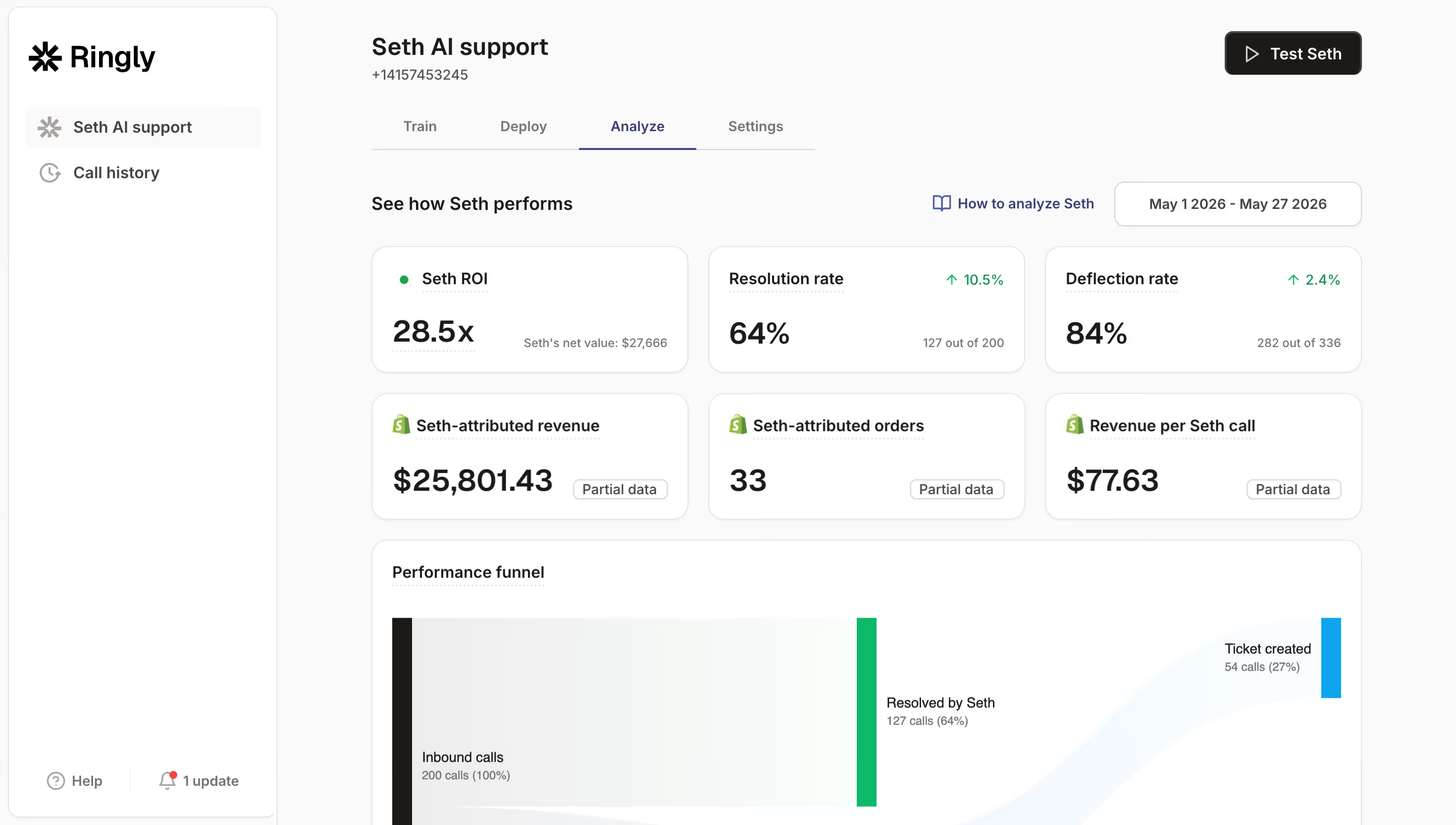
The good news: AI phone agents have completely changed the cost equation. Tools like Ringly.io let you offer 24/7 phone support for ecommerce at a fraction of traditional costs. Ringly's AI agent, Seth, handles order lookups, return requests, and product questions across 40 languages, resolving about 73% of calls without a human.
Setup takes about three minutes. No code required. Try it free for 14 days and see how it handles your actual calls.
Adding phone support isn't just about handling complaints. It's about giving customers the option they trust most when something goes wrong.
5. Offer real-time order tracking
"Where is my order?" (WISMO) queries account for 30 to 40% of all support tickets during normal periods, according to Shopify. During peak seasons like Black Friday, that number climbs to 50% or higher.
Each one of those tickets costs your team time and money. And every time a customer has to ask, their satisfaction drops a little.
The fix:
- Send proactive shipping notifications: order confirmed, shipped, out for delivery, delivered
- Offer a self-service tracking page: let customers check status without emailing you
- Set realistic delivery expectations: underpromise and overdeliver on shipping times
- Alert proactively about delays: if something is late, tell them before they have to ask
Reducing WISMO calls frees up your support team for issues that actually need a human touch. Better order tracking is one of the highest-ROI improvements you can make.
6. Respond faster (with realistic targets)
64% of shoppers expect a response within one hour. That's the bar now.
But speed without quality doesn't work. Here are realistic response time benchmarks by channel:
| Channel | Customer expectation | Realistic target |
|---|---|---|
| Live chat | Immediate (under 1 min) | Under 30 seconds |
| Phone | Pick up quickly | Under 3 rings |
| Within hours | Under 4 hours | |
| Social media | Same day | Under 2 hours |
If you can't hit these targets with your current team, automation and triage help. Route simple questions (order status, return labels, store hours) to automated systems. Save human agents for complex issues that need empathy and judgment.
The fastest way to improve response time on phone? Use an AI phone agent that picks up instantly, 24/7. No hold music, no queue. That alone moves the needle on satisfaction.
7. Make returns painless
A generous return policy doesn't cost you money. It makes money. Customers who know they can return easily are more confident buying in the first place. And confident buyers spend more.
Here's what a customer-friendly return process looks like:
- Clear policy: spell out the window (30+ days), conditions, and process in plain language
- Prepaid labels: include them or make them easy to generate
- Self-service portal: let customers initiate returns without emailing support
- Fast refunds: process refunds within 2-3 business days of receiving the return
- Exchange options: offer exchanges or store credit as alternatives to refunds
The best Shopify returns apps automate most of this. Your team shouldn't be manually processing returns in 2026.
8. Personalize the experience beyond "Hi [First Name]"
Real personalization goes deeper than using someone's name in an email subject line.
Effective personalization that moves satisfaction scores:
- Product recommendations based on browsing and purchase history: "Customers who bought X also bought Y" actually works when the data is good
- Segment-specific emails: a first-time buyer gets different content than a repeat customer
- Personalized offers: birthday discounts, loyalty rewards, early access for top customers
- Dynamic content: show different homepage sections based on past behavior
- Post-purchase follow-ups tailored to what they bought: care instructions for the specific product, not a generic thank-you
According to personalization statistics, personalized experiences drive significantly higher repeat purchase rates. The key is making it useful, not creepy. Recommend products they'd actually want. Don't show ads for things they already bought.
9. Use AI support that actually works
AI in customer service is growing fast. According to Salesforce, 30% of service cases were resolved by AI in 2025, and that number is expected to hit 50% by 2027. And 80% of businesses plan to adopt AI-driven voice technology for customer service by 2026.
But there's a difference between bad AI and good AI.
Bad AI (what customers hate):
- Chatbots that loop: "I'm sorry, I didn't understand that. Can you rephrase?"
- No escalation path: stuck in a bot with no way to reach a human
- Generic responses: copy-pasted answers that don't address the actual question
Good AI (what actually improves satisfaction):
- Handles real actions: looks up orders, processes returns, checks inventory
- Knows when to escalate: complex issues get routed to humans automatically
- Works across channels: phone, chat, email, all connected
- Available 24/7: no more "sorry, we're closed"
Ringly.io is built specifically for ecommerce. The AI agent, Seth, connects directly to your Shopify store, so it can actually look up order status, process returns, and answer product questions with real data. It handles about 73% of calls without a human, and the rest get transferred smoothly to your team. Over 2,100 stores use it.
Want to see how it handles calls for your store? Start a free trial. Setup takes three minutes.
Check out the latest AI customer service statistics for more on where the industry is heading.
10. Build a self-service knowledge base
According to Zendesk, 67% of customers prefer to find solutions on their own before contacting support. And Harvard Business Review found that 81% of customers attempt to solve problems themselves first.
If you don't have solid self-service options, you're forcing customers to contact you for answers they'd rather find themselves. That hurts both their experience and your support costs.
What to include:
- FAQ page: cover the top 20 questions your team answers repeatedly
- Searchable help center: organized by category (orders, returns, products, account)
- Video guides: short how-to videos for common tasks (tracking an order, initiating a return)
- Sizing and fit guides: if you sell apparel, this alone reduces returns significantly
- Chatbot for quick answers: a well-implemented chatbot that routes to real answers, not loops
A solid knowledge base can reduce ticket volume by 20-40%. That's fewer frustrated customers waiting for replies and more time for your team to handle complex issues well. Learn more about building better ecommerce customer service from the ground up.
11. Follow up after the sale
The sale isn't the finish line. What happens after checkout matters just as much for satisfaction and retention.
Effective post-purchase communication:
- Order confirmation email: send immediately with clear details and expected delivery
- Shipping updates: proactive, not just when customers ask
- Product tips: how to use, care for, or get the most from what they bought
- Review request: ask 7-14 days after delivery (not the day of)
- Replenishment reminders: for consumable products, remind them before they run out
The timing matters. Follow up too early and it feels pushy. Too late and they've already moved on.
A strong post-purchase flow directly improves customer loyalty. Check the latest customer retention statistics to see how much repeat buyers are worth to your business.
12. Collect feedback and actually do something with it
Collecting feedback is easy. Acting on it is where most stores drop the ball.
Here's a system that works:
- Trigger CSAT surveys after key moments: post-purchase, post-support interaction, post-return
- Monitor reviews daily: on your site, Google, Trustpilot, social media
- Respond to negative reviews publicly: acknowledge the issue, explain what you're doing about it
- Tag and categorize feedback: track themes (shipping complaints, product quality, support speed)
- Close the loop: when you fix something based on feedback, tell customers you did it
This last point is the one nobody does. When a customer complains about slow shipping and you switch carriers, email those customers: "We heard you. We've changed our shipping partner." That turns a detractor into a promoter.
Learn more about handling customer complaints in ecommerce and setting up proper customer service SLAs.
Common mistakes that kill customer satisfaction
Even stores with good intentions make these errors. Here are the ones we see most often:
- Hiding your contact information: making customers hunt for a phone number or email address signals that you don't want to be reached. That's the opposite of trust.
- Making returns complicated on purpose: yes, some stores do this to reduce return rates. It backfires. Customers who can't return easily just stop buying from you entirely.
- Deploying chatbots that can't actually do anything: a chatbot that says "I'll connect you with an agent" and then puts you in a queue is worse than no chatbot at all.
- Ignoring negative reviews: unresponded negative reviews tell future customers that you don't care. Always respond, even if you can't fix the issue.
- Over-promising on delivery times: saying "2-3 business days" when you know it's usually 5-7 is a guaranteed disappointment. Underpromise, overdeliver.
- Only measuring satisfaction when things go well: if you only survey customers after positive experiences, your numbers are meaningless. Survey after returns and complaints too.
Avoiding these mistakes is sometimes more impactful than adding new features. Get the basics right first.
If you're running a Shopify store and want phone support handling calls by this afternoon, Ringly.io gets Seth answering in about three minutes. See the pricing or start your free trial.
Frequently asked questions
What is a good customer satisfaction score for ecommerce?
The average ecommerce CSAT score is 82%, according to industry benchmarks. Top-performing stores target 85% or above. If you're below 80%, there are likely quick wins in checkout, response time, or returns that can move the number fast.
How do you measure customer satisfaction in online stores?
The three most common metrics are CSAT (post-interaction satisfaction), NPS (willingness to recommend), and CES (customer effort score). Start with CSAT after purchases and support interactions. Add NPS quarterly. Track repeat purchase rate as a behavioral proxy for satisfaction.
What is the biggest driver of customer satisfaction in ecommerce?
Response speed and ease of resolution consistently rank highest. Customers forgive product issues if the support experience is smooth. Research shows 86% of buyers are willing to pay more for a great experience, and effort (how hard it is to get help) matters more than almost anything else.
How does phone support improve customer satisfaction?
Phone support has a 91% satisfaction rate, the highest of any channel according to Zendesk. It's preferred by 76% of consumers for support. Phone calls resolve issues faster and feel more personal. AI phone agents like Ringly.io make it affordable to offer 24/7 phone support without the traditional $15-25 per interaction cost.
Can AI improve customer satisfaction in ecommerce?
Yes, when done right. Salesforce reports that 30% of service cases were resolved by AI in 2025, and good AI (the kind that can look up orders, process returns, and escalate complex issues) actually improves satisfaction by reducing wait times and offering 24/7 availability. Bad AI (looping chatbots with no escalation) makes things worse.
How much does it cost to improve customer satisfaction?
Many high-impact improvements are free or low-cost: better product descriptions, faster response templates, clearer return policies, proactive shipping notifications. Bigger investments like AI phone support or help desk software typically pay for themselves through reduced churn and increased repeat purchases.
What is the difference between CSAT, NPS, and CES?
CSAT measures satisfaction with a specific interaction (scale of 1-5). NPS measures overall loyalty (scale of 0-10, asking "would you recommend us?"). CES measures how much effort a customer had to put in (scale of 1-7). Use all three for a complete picture: CSAT for touchpoints, NPS for overall health, CES for process friction.
The bottom line
Customer satisfaction in ecommerce is declining across the industry. That's not a reason to panic. It's a reason to act.
Start with the highest-impact strategies: speed up your site, fix your checkout, and add phone support. These three moves alone can shift your CSAT score significantly. Then layer in personalization, better self-service, and a real feedback loop.
Measure before and after. Track CSAT, NPS, and repeat purchase rate monthly. The stores that take satisfaction seriously are the ones that keep growing while their competitors wonder where all the customers went.
Ready to add the highest-satisfaction support channel to your store? Try Ringly.io free for 14 days and get AI phone support answering calls in under three minutes.