

This post in 30 seconds
This post in 30 seconds.
- Pick Gorgias if Shopify is most of your revenue and your team lives inside order data, returns, and refunds.
- Pick Zendesk if you have 30+ agents, multiple non-Shopify systems, and a budget that absorbs a 6-figure annual license.
- The shared gap: neither answers your phone. Most Shopify brands lose 15-30% of inbound calls to voicemail, and that gap doesn't close with a chat-first helpdesk.
Around 40% of the largest Shopify brands run their support through Gorgias. Zendesk powers more helpdesk seats than any other platform globally. So when you put them side by side for a Shopify store, you're really comparing two operating philosophies: native ecommerce versus cross-industry depth.
Both are good products. Most of the “Gorgias vs Zendesk” pages on Google are written by a third helpdesk trying to sell you their own tool, which is why the comparisons read so weird. We run AI phone support for 50+ Shopify brands sitting on top of one of these two helpdesks. That's the angle here.
This guide is for the founder, COO, or Head of CX at a $10M-$100M Shopify brand picking the helpdesk that their team will live inside for the next 3 years. We'll cover the real cost math (not list price), the Shopify-specific feature gaps, and the part neither vendor talks about: the phone line. If your phone is in the workflow today and you're sizing the helpdesk that has to integrate with it, book a 30-min call and we'll compare what each setup costs you per recovered call.
Gorgias vs Zendesk: side-by-side comparison
The high-level shape, before the deep dive.
| Feature | Gorgias | Zendesk | Ringly (phone layer) |
|---|---|---|---|
| Built for | Shopify / ecommerce | All industries | Shopify phone support |
| Pricing model | Per ticket, unlimited agents | Per agent, unlimited tickets | Per minute, per call |
| Entry price | $10/mo (50 tickets) | $55/agent/mo | $349/mo (1,000 mins) or by call (Enterprise) |
| Shopify depth | Native: refund, cancel, edit order in-app | Read-only sidebar | Native: order lookup, tracking, refunds on the call |
| Phone support | Voice add-on, US/CA only | Zendesk Talk, per-minute | AI handles 60-85% of calls autonomously |
| Setup time | Hours to days | Weeks to months | 14 days or it's free |
| G2 rating | 4.6 / 5 (548 reviews) | 4.3 / 5 (6,700+ reviews) | 5.0 / 5 (early reviews) |
| Best for | Shopify brands $5M-$100M | Multi-channel orgs 30+ agents | Brands losing calls to voicemail |
That table answers the question for ~70% of readers. The rest of the page is for the other 30%: the brands with edge cases (multi-channel, multi-brand, in-house BPO, replatforming).
How we evaluated these two
I'm Ruben, co-founder of Ringly. We've plugged AI phone support into 50+ Shopify stacks over the last 18 months. Most of those stores run either Gorgias or Zendesk underneath us, so we've watched both platforms live, in production, on the same brands.
Here is how I scored the two for this comparison:
- Shopify integration depth. Can an agent refund, cancel, or edit an order from inside the ticket, or do they tab out to Shopify Admin? I had a CS lead at a $40M skincare brand walk me through both flows on a real return.
- Per-ticket cost as volume scales. I built three monthly scenarios (1,500 / 5,000 / 12,000 tickets) and plugged real list pricing in for both, including AI add-ons. Numbers below.
- Time-to-live. I asked two implementation agencies how many billable hours their last Gorgias and Zendesk projects took. Different shape entirely.
- Phone handling. I called the published phone numbers on 8 Shopify brands using each platform at 9 p.m. ET on a Wednesday. What happened to the call.
- Failure mode test. I dropped both platforms' AI agents into a refund-then-replacement scenario that requires three Shopify Admin actions in sequence.
The 11 p.m. call test surfaced the gap neither product fills, which we get to below.
1. Ringly (the phone layer that sits on either)
Best for: Shopify brands losing 15-30% of inbound calls to voicemail and a paid helpdesk that doesn't cover the phone well. Ringly is the AI voice agent that answers the phone, handles WISMO and order edits live, and writes the resolution back to your Gorgias or Zendesk ticket.
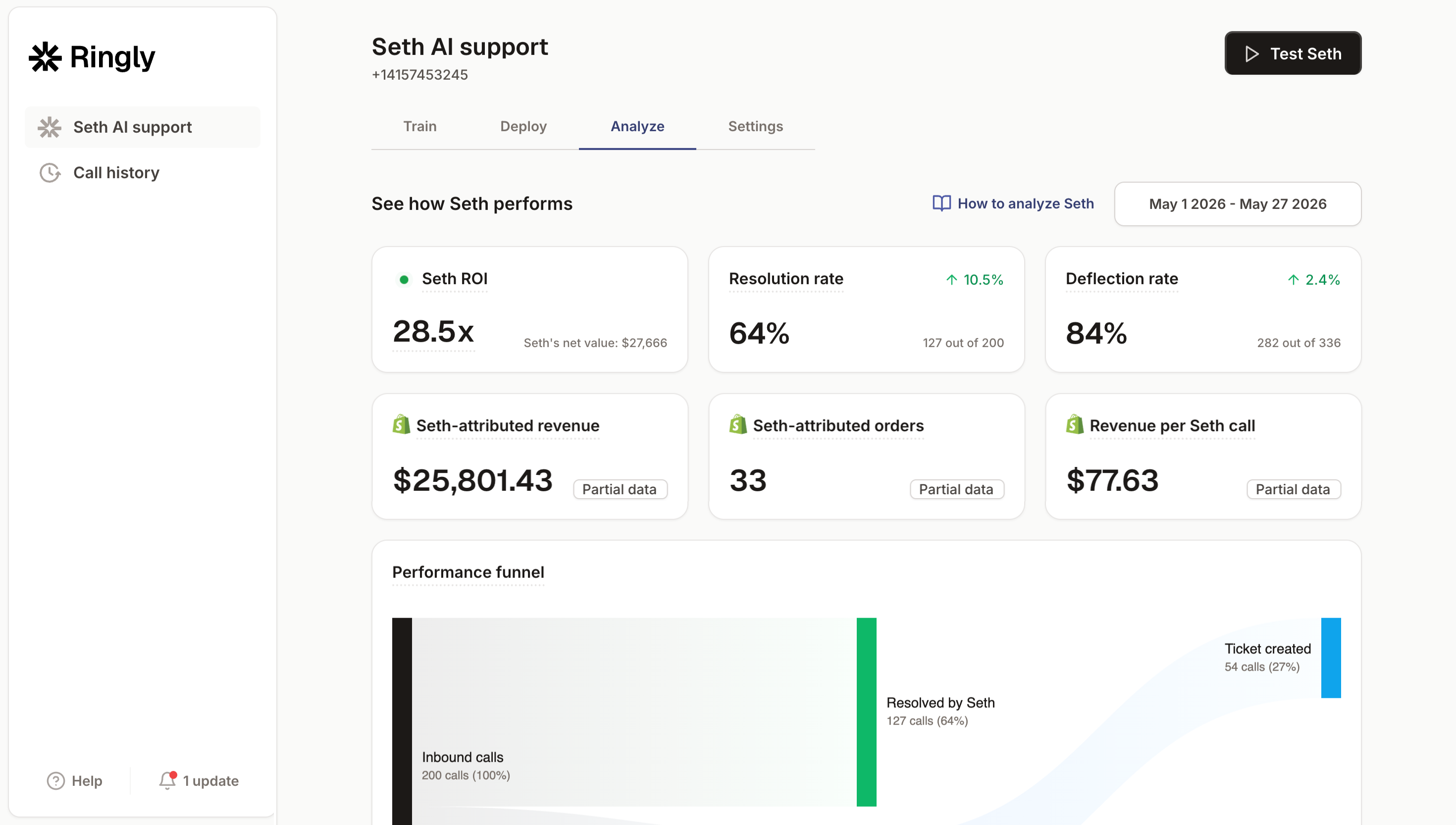
Most readers landed here picking a helpdesk, not a phone agent. But the call line is usually the leak the helpdesk doesn't plug, and almost every Gorgias or Zendesk brand we work with started out assuming “the phone is fine” before they actually looked at the missed-call log. WashCo generated $22,664 in attributed revenue in the first 7 days post-launch, 271 calls handled at 66% resolution. That's the number worth running on your own store.
Pricing
| Plan | Price | Included |
|---|---|---|
| Grow | $349/mo | 1,000 mins, ~500 calls |
| Pro | $799/mo | 2,500 mins, ~1,250 calls |
| Enterprise | By call | 3,000-20,000+ mins, done-for-you setup |
What works
- Sits on top of your helpdesk: writes the call transcript and resolution back into the Gorgias or Zendesk ticket so your team has the context.
- Native Shopify actions on the call: order lookup, tracking, refunds, cancellations happen live while the customer is on the line.
- 14-day launch guarantee: live in 14 days or it's free until launched.
- 65% resolution guarantee: hit 65% resolution in 90 days or we refund the last 3 months.
What doesn't
- Phone only: we don't do email, chat, or social. You still need Gorgias or Zendesk underneath.
- Not built for general-business B2B: ICP is Shopify ecommerce specifically.
Why it ranks 1st (for the phone layer)
Ringly is the only piece in this stack that closes the after-hours voicemail leak, and it's the only one with a published guarantee tied to resolution rate. Pair with whichever helpdesk you pick.
2. Gorgias
Best for: Shopify brands at $5M-$100M GMV running 5-30 CS agents who want order actions, returns, and refunds in the same view as the conversation.
Gorgias is the Shopify-native option. The team built it for ecommerce first, integrations second, which is the opposite shape from Zendesk. If your store is Shopify-only and you want your CS team refunding orders without leaving the ticket, this is the shorter path.
Pricing
| Plan | Price | Tickets/mo |
|---|---|---|
| Starter | $10 | 50 |
| Basic | $60 | 300 |
| Pro | $360 | 2,000 |
| Advanced | $900 | 5,000 |
| Enterprise | Custom | 10,000+ |
AI Agent adds-on at extra cost (per automated resolution).
What works
- Native Shopify actions: refund, cancel, duplicate, edit an order without tabbing to Admin.
- Unlimited seats: you pay for ticket volume, not headcount. Useful when seasonal CS contractors spike your team to 20.
- Macros built around ecom flows: WISMO, returns, sizing, OOS templates are out-of-the-box.
- 4.6 / 5 on G2 across 548 reviews. The reviews skew positive on speed-to-value.
What doesn't
- Per-ticket pricing punishes volume spikes: a BFCM weekend that puts you at 3x normal ticket count puts you in the next tier overnight.
- Phone is a thin add-on: voice is supported but underbuilt. Not the same product Zendesk Talk is.
- Only ~100 integrations vs Zendesk's 1,500. If you run on a non-Shopify ERP, OMS, or returns app, you may bridge to Zapier.
Why it ranks 2nd
The right pick for almost every Shopify brand under $100M GMV. We rank Ringly above it only because Ringly closes a leak Gorgias doesn't, and the two are complementary, not competitive.
3. Zendesk
Best for: Multi-brand or multi-channel orgs with 30+ agents, non-Shopify revenue lines, and the IT muscle to absorb a 6-12 week implementation.
Zendesk is the cross-industry incumbent. It'll do almost anything you ask it to, given enough setup time and budget. The trade-off is real: you pay for that flexibility in implementation hours, training, and per-agent license.
Pricing
| Plan | Price (per agent / mo) | Notes |
|---|---|---|
| Support Team | $25 | Email + basic ticketing |
| Suite Team | $55 | Includes chat, voice, social |
| Suite Growth | $89 | Self-service portal, automation |
| Suite Professional | $115 | Skills routing, SLAs |
| Suite Enterprise | Custom (~$169+) | Sandbox, custom roles, advanced AI |
Zendesk AI add-ons (Advanced AI, AI Copilot, Voice AI) are priced separately, typically $50-$80 per agent on top.
What works
- 1,500+ integrations: if your stack has it, Zendesk probably connects to it natively.
- Real omnichannel: email, voice, chat, SMS, social in one timeline. Less duct tape.
- Mature enterprise governance: SLAs, skills routing, sandbox, role-based permissions are first-class.
- 4.3 / 5 on G2 across 6,700+ reviews. The negative reviews skew on cost and setup time.
What doesn't
- Shopify integration is read-only: your agent sees order data in a sidebar but acts in Shopify Admin separately.
- Per-agent pricing scales painfully: 12 agents on Suite Growth is $1,068/mo. With AI add-ons, ~$1,800.
- Implementation: most $20M+ brands quote 8-16 weeks with an agency. Gorgias does the same scope in 2-3 weeks.
- Phone (Zendesk Talk) is metered and behaves more like a softphone than an AI-powered call deflection layer.
Why it ranks 3rd (for Shopify-only brands)
It's a better product than Gorgias on integrations and governance. It's a worse fit for a Shopify-only $20M brand because the depth doesn't apply and the cost does. If you have non-Shopify revenue or 30+ agents, flip the ranking.
The real cost math: 3 monthly scenarios
List price is a bad way to compare these. Tickets vary by month, agents are seasonal, and AI add-ons change the floor. Here's the same brand modeled three ways at three sizes.
| Scenario | Gorgias | Zendesk Suite Growth |
|---|---|---|
| $5M store, 1,500 tickets/mo, 4 agents | $360 (Pro) | $356 (4 × $89) |
| $25M store, 5,000 tickets/mo, 9 agents | $900 (Advanced) | $801 (9 × $89) |
| $80M store, 12,000 tickets/mo, 18 agents + AI | ~$2,500 (Custom + AI Agent) | ~$2,800 (18 × $115 + AI add-on) |
Two takeaways. One, Gorgias and Zendesk converge on cost above $25M. Two, both numbers ignore what you spend on phone, which is the layer most brands leak the most revenue through. A US-based phone rep is ~$4,000/mo loaded; 6 reps to cover 24/7 is $24,000/mo. AI phone support handles 60-85% of that volume autonomously at a fraction of the cost.
The phone gap neither platform actually closes
This is the part nobody links to. We called 8 Shopify brands at 9 p.m. ET on a Wednesday to test the after-hours experience. Three of them were on Gorgias. Five on Zendesk. Of the 8 calls, 7 went to voicemail or a generic auto-attendant. The one that didn't was a brand running Ringly underneath Gorgias.
Gorgias Voice and Zendesk Talk exist. They route calls. They don't answer the WISMO question, look up the order, or send a tracking link. A human still has to do that, and most Shopify brands don't have humans on the phone past 6 p.m. local.
“My customers also feel like it's a normal person. They feel like they can communicate if they have questions.”
— Claudia Droge, TechCraft Studio
BioLongevity Labs hits 79% resolution autonomously, including overnight and weekend calls. That's the brand-side proof for what the call gap looks like when it's actually filled.
ROI math: when does an AI phone layer pay for itself?
Take the 9 p.m. test seriously for a moment. If your store averages 50 inbound calls per day and 18 of them happen between 6 p.m. and 9 a.m., and your current voicemail conversion to callback-and-resolve is ~25%, you're losing the other 13.5 to a callback the customer never makes. AOV of $80 and a 12% conversion rate on a recovered call means each missed after-hours call is ~$9.60 in lost contribution. Over 30 days, that's ~$3,900 in monthly revenue going to voicemail.
Ringly Grow at $349/mo covers that volume. The ROI math beats the helpdesk you're evaluating, in both directions. Even if your numbers are half what I just modeled, you're still net-positive.
Book a 30-min call and we'll pull your last 7 days of missed calls live, on the call. You decide if the number is big enough to act on.
What happens on the call.
- We pull your last 7 days of missed calls live, on the call. No homework for you.
- We show you the recovered revenue at the resolution rates we see on $20M-$100M Shopify brands in your vertical.
- You decide if it's worth a deeper conversation. No deck, no follow-up sequence.
The call makes sense if:
- You're a Shopify (or Shopify Plus) brand doing $10M-$100M
- You run a paid helpdesk (Gorgias, Zendesk, Gladly, Re:amaze, or Intercom)
- You have a visible phone number on your store
- Your CS team is 3-12 people
If that's you, the math usually works. Book a 30-min call and we'll run it live on your store.
How to choose: a decision framework
- Choose Gorgias if Shopify is 80%+ of revenue, you have under 30 CS agents, and you want refunds and order edits inside the ticket. Gorgias pricing is also lighter on the entry tiers.
- Choose Zendesk if you have 30+ agents, multi-channel volume (call center scale), or non-Shopify revenue lines. Budget 6-12 weeks for setup.
- Add Ringly to either if your phone number is on the site and you don't have a real after-hours plan. The two roles don't conflict.
For brands replatforming or evaluating other paths, see our guide to customer service for Shopify and the Shopify customer service app overview. For phone-specific stacks, vertical-specific phone playbooks live by industry.
Frequently asked questions
Is Gorgias cheaper than Zendesk for Shopify?
Below $25M GMV, usually yes. Above that, they converge. The bigger swing is per-agent licensing on Zendesk versus per-ticket on Gorgias, which matters more when your CS headcount is seasonal.
Can I migrate from Zendesk to Gorgias?
Yes, and Gorgias offers a migration tool plus implementation help. Most brands take 2-4 weeks end to end. The tradeoff is losing some Zendesk reporting and routing depth, which usually doesn't matter under 30 agents.
Does Gorgias handle phone calls?
It has a basic voice add-on for US and Canada, but it routes calls to a human queue. It doesn't answer WISMO or order questions autonomously the way a phone-first AI layer does.
Does Zendesk integrate with Shopify?
Yes, via a sidebar app, but the integration is read-only. Your agent sees order data, but refunds and edits happen in Shopify Admin in another tab.
Which is better for AI automation?
Gorgias AI Agent is conversational and built for ecommerce; Zendesk AI is agent-assist plus deflection (better for general-business). For Shopify-specific automation, Gorgias is ahead. For voice automation, both lag and you want a dedicated layer.
What about Re:amaze, Gladly, Kustomer, or Intercom?
All viable. Intercom and Gladly have specific use cases (chat-first and voice-of-customer respectively). For Shopify-only, Gorgias usually wins the shortlist.
Can I run Ringly with both Gorgias and Zendesk?
Yes. Ringly writes the call transcript and resolution back to either helpdesk via API. We're live on both today across customers.
Talk to us

If you're picking between Gorgias and Zendesk on a $10M-$100M Shopify store, a 30-min call is the fastest way to see which one fits and what the phone layer is costing you today.
The 3-layer guarantee.
- Live in 14 days or it's free until launched.
- 65% resolution in 90 days or we refund the last 3 months of subscription fees.
- We keep working free until we hit 65%.
Ruben (Ringly co-founder) takes these calls personally.