

It's 11 PM on a Tuesday. A customer just got the wrong color hoodie. They want a return label, and they want it now.
Your team is asleep. Your email queue is growing. And that customer? They're already writing a 1-star review.
A customer service chatbot fixes this. It answers instantly, pulls up the order, processes the return, and moves on to the next conversation. No staffing gaps, no timezone problems, no angry reviews piling up overnight.
But not all chatbots are built the same. Some are glorified FAQ pages. Others actually connect to your store, look up orders, and handle ecommerce customer service requests end to end.
This guide breaks down what a customer service chatbot actually does, which ones are worth paying for in 2026, and the one support channel most chatbot articles completely ignore.
Hear what AI support calls sound like for your store. Just paste your Shopify URL and get sample calls in under 20 seconds, no email required. Listen to demo calls for my store.
What is a customer service chatbot?
A customer service chatbot is software that uses AI to handle customer questions through text-based channels like website chat, email, WhatsApp, or social media. Instead of a human typing responses, the bot reads the question, searches your knowledge base, and gives an answer.
There are three main types:
- Rule-based chatbots: follow predefined scripts and decision trees. Good for simple FAQs, but they break the moment a customer goes off-script.
- AI-powered chatbots: use natural language processing to understand what customers actually mean, not just keyword matching. They learn from your docs and get better over time.
- Hybrid chatbots: combine both. Rules handle the predictable stuff, AI handles the rest, and complex issues get passed to a human agent.
The AI-powered ones are what most companies are buying right now. According to chatbot statistics from industry research, 91% of businesses with 50+ employees now use some form of AI chatbot in their customer journey. And Gartner predicts that agentic AI will resolve 80% of common customer service issues without human help by 2029.
How a customer service chatbot helps your business
Here's why so many ecommerce brands are adding chatbots to their support stack:
- Instant responses, 24/7: Customers don't wait. Whether it's 3 AM or Christmas Day, the bot answers. This matters more than you'd think. According to customer experience statistics, response time is the single biggest driver of customer satisfaction.
- Lower cost per resolution: A human agent costs roughly $6 per interaction. An AI chatbot handles the same conversation for about $0.50. That's a 12x difference. For stores handling hundreds of tickets a day, the savings add up fast. Check out our cost per contact breakdown for the full math.
- Faster complaint resolution: 90% of companies report faster resolution times after adding chatbots. Customers get answers in under 3 seconds instead of waiting 4-12 hours for an email reply.
- Frees your team for hard problems: The bot handles "where's my order?" and "what's your return policy?" Your agents focus on the stuff that actually needs a human, like angry customers or complex product issues.
- Scales without hiring: Black Friday traffic spikes? A chatbot handles 10x the conversations without 10x the headcount. No recruiting, no training, no overtime pay. If you're trying to scale customer service without hiring, this is the fastest lever.
The global chatbot market hit $7.01 billion in 2026, projected to reach $27.3 billion by 2030 (Grand View Research). Companies aren't experimenting with chatbots anymore. They're building their entire support operations around them.

What to look for in a customer service chatbot
Not every chatbot is worth your money. Here's what separates the good ones from the expensive disappointments:
- Knowledge base integration: Can it learn from your help docs, product pages, and FAQs? Or does it need you to manually program every answer? The best chatbots pull from your existing content automatically.
- Ecommerce integrations: Does it connect to Shopify, WooCommerce, or whatever platform you run? Can it actually look up orders, check inventory, and process returns? A chatbot that can't touch your store data is just a fancy search bar.
- Human handoff: When the bot can't solve it (and it won't always), how does it transfer to a real person? Does the agent get the full conversation history, or does the customer have to repeat everything? Bad handoff destroys the experience.
- Multi-channel support: Website chat alone isn't enough. You need email, WhatsApp, social DMs, maybe SMS. The more channels covered, the fewer gaps in your support.
- Analytics and reporting: Deflection rate, CSAT score, resolution time, cost per ticket. If you can't measure it, you can't improve it.
- Pricing model: Some charge per resolution, some per conversation, some per seat. The differences are massive at scale. A $0.99/resolution chatbot handling 5,000 tickets a month costs $4,950 just in AI fees. Know what you're signing up for.
- Setup complexity: Can you get it running in a day? Or do you need a consultant and three months of implementation? For most ecommerce stores, simpler is better.
Here's a stat that should keep you honest: 43% of customers report technical problems when interacting with bots. So pick one that actually works, not just one that demos well.
Want to see how AI customer service tools compare on ROI? We break down the numbers in our guide to AI customer service ROI.
8 best customer service chatbots in 2026
We reviewed dozens of platforms, compared pricing, tested demos, and read through hundreds of G2 and Capterra reviews. Here are the eight that actually deserve your attention.
| Platform | Best for | Starting price | AI resolution cost | G2 rating |
|---|---|---|---|---|
| Intercom Fin | SaaS and subscription commerce | $29/seat/mo | $0.99/resolution | 4.5/5 |
| Zendesk AI | Mid-size to enterprise teams | $55/agent/mo | $1.50-2.00/resolution | 4.3/5 |
| Tidio Lyro | Small ecommerce on a budget | Free (paid from $29/mo) | ~$0.58-0.78/conversation | 4.7/5 |
| Gorgias | Shopify stores | ~$10/mo | $0.90-1.00/resolution | 4.6/5 |
| Freshdesk Freddy | Freshworks users | Free (paid from $15/agent/mo) | $0.10/session | 4.4/5 |
| Ada | Enterprise, multilingual | ~$30,000/year | $1.00-3.50/resolution | 4.6/5 |
| Chatbase | Quick custom chatbot | Free (paid from $40/mo) | Credit-based | 4.5/5 |
| Salesforce Agentforce | Enterprise CRM | $25/user/mo | $2.00/conversation | 4.4/5 |
1. Intercom Fin
Best for: SaaS and subscription ecommerce with moderate to high ticket volume
Intercom built Fin as an AI agent that resolves customer conversations on its own. It pulls from your help center, learns your product, and handles questions across chat, email, and WhatsApp. G2 ranks it the #1 AI Agent with 4.5/5 across 3,796 reviews.
Pricing
| Plan | Price |
|---|---|
| Essential | $29/seat/mo |
| Advanced | $85/seat/mo |
| Expert | $132/seat/mo |
| Fin AI resolutions | $0.99 each |
14-day free trial available.
What works
- Resolution quality: Fin actually resolves conversations, not just deflects them. It cites sources and stays on-topic.
- Multi-channel coverage: Chat, email, WhatsApp, and social from one inbox.
- Smooth human handoff: When Fin can't solve it, your agent gets the full context.
What doesn't
- Cost at scale: $0.99 per resolution means 2,000 resolutions/month adds $1,980 on top of your base plan.
- Complex pricing: Base seat fee plus per-resolution fee plus add-ons. Hard to predict your actual bill.
- Overkill for small stores: The feature set is built for teams with dedicated support staff.
Why it ranks first: Fin consistently delivers the highest resolution quality in testing. If you can handle the pricing, it's the most capable AI agent in this list.
2. Zendesk AI Agents
Best for: Mid-size to enterprise support teams already invested in the Zendesk ecosystem
Zendesk baked AI agents into their Suite platform. Every plan gets basic AI capabilities, but the real power (advanced automations, copilot features) requires add-ons. They serve over 100,000 businesses and score 4.3/5 on G2 across 6,707 reviews.
Pricing
| Plan | Price |
|---|---|
| Suite Team | $55/agent/mo |
| Suite Professional | $115/agent/mo |
| Suite Enterprise | $169/agent/mo |
| Advanced AI add-on | $50/agent/mo |
| Automated resolutions | $1.50-2.00 each |
14-day free trial available.
What works
- Ecosystem depth: Thousands of integrations and apps. If you need it, someone's built it.
- AI included in base plans: You get basic AI agents without paying extra (though advanced features cost more).
- Strong analytics: Deep reporting on resolution rates, agent performance, and customer satisfaction.
What doesn't
- Hidden costs: Real costs run 2-3x the advertised price once you add advanced AI, copilot, and phone support.
- Per-resolution on top of per-seat: You're paying both ways. The math gets ugly at volume.
- Slow to implement: Enterprise features require configuration that takes weeks, not days.
Why it ranks second: If your team already lives in Zendesk, adding AI agents makes sense. But if you're starting fresh, the total cost of ownership is hard to justify for smaller operations.
3. Tidio Lyro
Best for: Small ecommerce stores that want live chat and AI chatbot in one affordable package
Tidio is one of the most popular chat tools for small Shopify and WooCommerce stores. Lyro is their AI chatbot add-on that handles customer conversations automatically. It's rated 4.7/5 on G2 across 1,880 reviews, the highest in this list.
Pricing
| Plan | Price |
|---|---|
| Free | $0 (50 conversations/mo) |
| Starter | $29/mo |
| Growth | $59/mo |
| Lyro AI add-on | $39/mo (50 AI conversations) |
Free plan available. Paid plans have a free trial.
What works
- Free plan exists: You can test the live chat without paying anything.
- Easy setup: Visual chatbot builder, no coding. Most stores get it running in under an hour.
- Good Shopify integration: Connects to your store, shows order data in conversations.
What doesn't
- Confusing pricing: Lyro AI is a separate add-on. Flows are another add-on. Total cost can easily double what you expected.
- Limited AI at lower tiers: 50 AI conversations for $39/mo is just $0.78 each, but you'll hit that limit fast.
- Not built for scale: Works great for stores doing 50-200 tickets/month. Beyond that, you'll outgrow it.
Why it ranks third: Best entry point for small stores. Start with the free plan, add Lyro when you're ready, and upgrade when you outgrow it.
4. Gorgias
Best for: Shopify stores that need deep ecommerce integration in their helpdesk
Gorgias is built specifically for ecommerce. It connects to Shopify, BigCommerce, and Magento, and lets you manage orders, process returns, and answer product questions right from the support ticket. Their AI Agent automates routine conversations. Rated 4.6/5 on G2.
Pricing
| Plan | Price |
|---|---|
| Starter | ~$10/mo (50 tickets) |
| Basic | ~$60/mo (300 tickets) |
| Pro | ~$360/mo (2,000 tickets) |
| AI resolutions | $0.90-1.00 each |
Ticket-based pricing, unlimited agent seats. Annual billing saves 20-25%.
What works
- Ecommerce-native: Pull up orders, process returns, check inventory. All inside the ticket, no tab-switching.
- Unlimited agents: Pay per ticket, not per seat. Add your whole team without extra costs.
- Revenue tracking: See how much revenue your support team generates through upsells and saved carts.
What doesn't
- AI is an add-on: The base plans don't include AI automation. That costs extra.
- Phone and SMS cost extra: If you need ecommerce phone support, Gorgias charges separately for it.
- Expensive at high volume: Ticket-based pricing means costs grow linearly with your business.
Why it ranks fourth: If you run a Shopify store and want your helpdesk to actually understand ecommerce, Gorgias is hard to beat. Just budget for the AI add-on separately.
5. Freshdesk Freddy AI
Best for: Teams already using Freshworks who want affordable AI automation
Freshdesk is Freshworks' helpdesk platform. Freddy AI is their bot layer, handling ticket resolution autonomously and assisting agents with suggested responses. With a free plan and AI sessions starting at $0.10 each, it's one of the most affordable options.
Pricing
| Plan | Price |
|---|---|
| Free | $0 (up to 2 agents) |
| Growth | $15/agent/mo |
| Pro | $49/agent/mo (Freddy access) |
| Enterprise | $79/agent/mo |
| Freddy AI Agent | $0.10/session |
| Freddy Copilot | $29/agent/mo |
500 free AI sessions on Pro and Enterprise plans.
What works
- Cheapest per-interaction cost: At $0.10 per session, Freddy is 10x cheaper than Intercom Fin per resolution.
- Free plan for tiny teams: Two agents, basic ticketing, no credit card required.
- Multi-channel inbox: Email, chat, phone, social, all in one place.
What doesn't
- AI locked behind Pro plan: You need the $49/agent/mo plan minimum to use Freddy AI.
- Add-on fatigue: Freddy AI Agent and Freddy Copilot are separate purchases. Budget for both.
- Less ecommerce-specific: No native Shopify integration like Gorgias. You'll need third-party connectors.
Why it ranks fifth: If you're already on Freshworks, adding Freddy AI is a no-brainer at $0.10/session. If you're not, the total package (Pro plan + Freddy AI + Copilot) starts adding up.
6. Ada
Best for: High-volume enterprise brands needing multilingual, omnichannel AI support
Ada is an AI-first platform that claims to resolve up to 83% of support issues autonomously. It works across chat, email, voice, and social, and supports 50+ languages. Big brands like Meta and Shopify have used it.
Pricing
No public pricing. Reports suggest it starts around $30,000/year with per-resolution fees of $1-3.50 depending on volume. You'll need to talk to their sales team.
What works
- High resolution rate: 83% autonomous resolution is among the highest claimed in the market.
- True omnichannel: Chat, email, voice, and social all covered by one AI.
- Multilingual depth: 50+ languages without separate configuration for each.
What doesn't
- No pricing transparency: Starting at ~$30K/year with usage fees on top makes budgeting difficult.
- End-user frustration: Ada has a 2.0/5 Trustpilot score, with customers complaining about bot loops and unhelpful responses.
- Consumption-based pricing: Hard to forecast costs when you don't know next month's volume.
Why it ranks sixth: Ada's capabilities are impressive on paper. But the lack of transparent pricing and that Trustpilot score should make you think twice. If you're enterprise-scale and can negotiate a deal, it's worth a demo. Otherwise, look elsewhere.
7. Chatbase
Best for: Small teams that want a custom AI chatbot up and running in minutes
Chatbase lets you upload your docs, connect your website, and have a working chatbot in under 10 minutes. It's not a full helpdesk. It's a focused chatbot builder for teams that want AI answers without a major platform commitment.
Pricing
| Plan | Price | Messages/mo |
|---|---|---|
| Free | $0 | 50 |
| Hobby | $40/mo | 2,000 |
| Standard | $150/mo | 10,000 |
| Pro | $500/mo | 40,000 |
Credits vary by AI model. GPT-4 burns 20 credits per message. Gemini burns 1. Choose wisely.
What works
- Fastest setup: Upload a PDF, point it at your URL, and you've got a chatbot. No coding.
- Model flexibility: Choose between GPT-4, Claude, Gemini depending on your quality vs. cost needs.
- Affordable entry point: The Hobby plan at $40/mo covers most small business needs.
What doesn't
- Confusing credit system: The same plan gives you either 100 or 2,000 conversations depending on which AI model you pick. That's a bad UX.
- Remove branding costs extra: $39-199/mo just to remove the Chatbase logo. Feels nickel-and-dime.
- No helpdesk features: It's a chatbot, not a ticketing system. You'll still need something for email tickets and agent workflows.
Why it ranks seventh: Best for teams that want a chatbot and nothing else. Quick, cheap, and effective for simple use cases. But if you need a full support platform, you'll outgrow it.
8. Salesforce Service Cloud (Agentforce)
Best for: Enterprise ecommerce with complex CRM needs and an existing Salesforce investment
Salesforce doesn't need an introduction. Their Service Cloud is the enterprise standard for customer service, and Agentforce is the AI layer that resolves cases autonomously. It's powerful. It's also expensive and complex.
Pricing
| Plan | Price |
|---|---|
| Starter Suite | $25/user/mo |
| Professional | $80/user/mo |
| Enterprise | $165/user/mo |
| Unlimited | $330/user/mo |
| Agentforce conversations | $2.00 each |
Free tier includes 1,000 conversations on Enterprise+. Implementation typically costs $50,000-$150,000.
What works
- Deepest CRM integration: Full 360-degree customer view, case history, purchase data, all connected.
- Enterprise security: SOC 2, HIPAA, GDPR, everything you'd expect at this price point.
- Massive ecosystem: AppExchange has thousands of add-ons for every use case imaginable.
What doesn't
- Total cost is staggering: Base license + AI + implementation + consulting. Expect six figures in year one.
- You'll need consultants: This isn't a "sign up and go" product. Most deployments take months.
- Overkill for most ecommerce: Unless you're doing $50M+ in annual revenue, there are better fits on this list.
Why it ranks eighth: Salesforce is the right choice for enterprise operations that already live in the Salesforce ecosystem. For everyone else, it's too expensive and too complex. Check out Salesforce Service Cloud alternatives if you want the CRM depth without the price tag.
How to choose the right customer service chatbot
Here's a quick decision framework:
- Choose Intercom Fin if you want the highest resolution quality and can handle per-resolution pricing at scale.
- Choose Zendesk AI if your team already uses Zendesk and you want AI built into your existing workflow.
- Choose Tidio Lyro if you're a small store that wants live chat + AI for under $100/month.
- Choose Gorgias if you run a Shopify store and need your helpdesk to pull order data and process returns natively.
- Choose Freshdesk Freddy if you want the cheapest per-interaction cost and you're already on Freshworks.
- Choose Ada if you're an enterprise brand handling 50,000+ tickets/month in multiple languages.
- Choose Chatbase if you just need a chatbot on your site and don't want a full helpdesk platform.
- Choose Salesforce if you're enterprise-scale and already invested in the Salesforce ecosystem.
Before you commit, calculate your customer service KPIs and project the total cost at your ticket volume. The cheapest base price doesn't always mean the cheapest total bill.
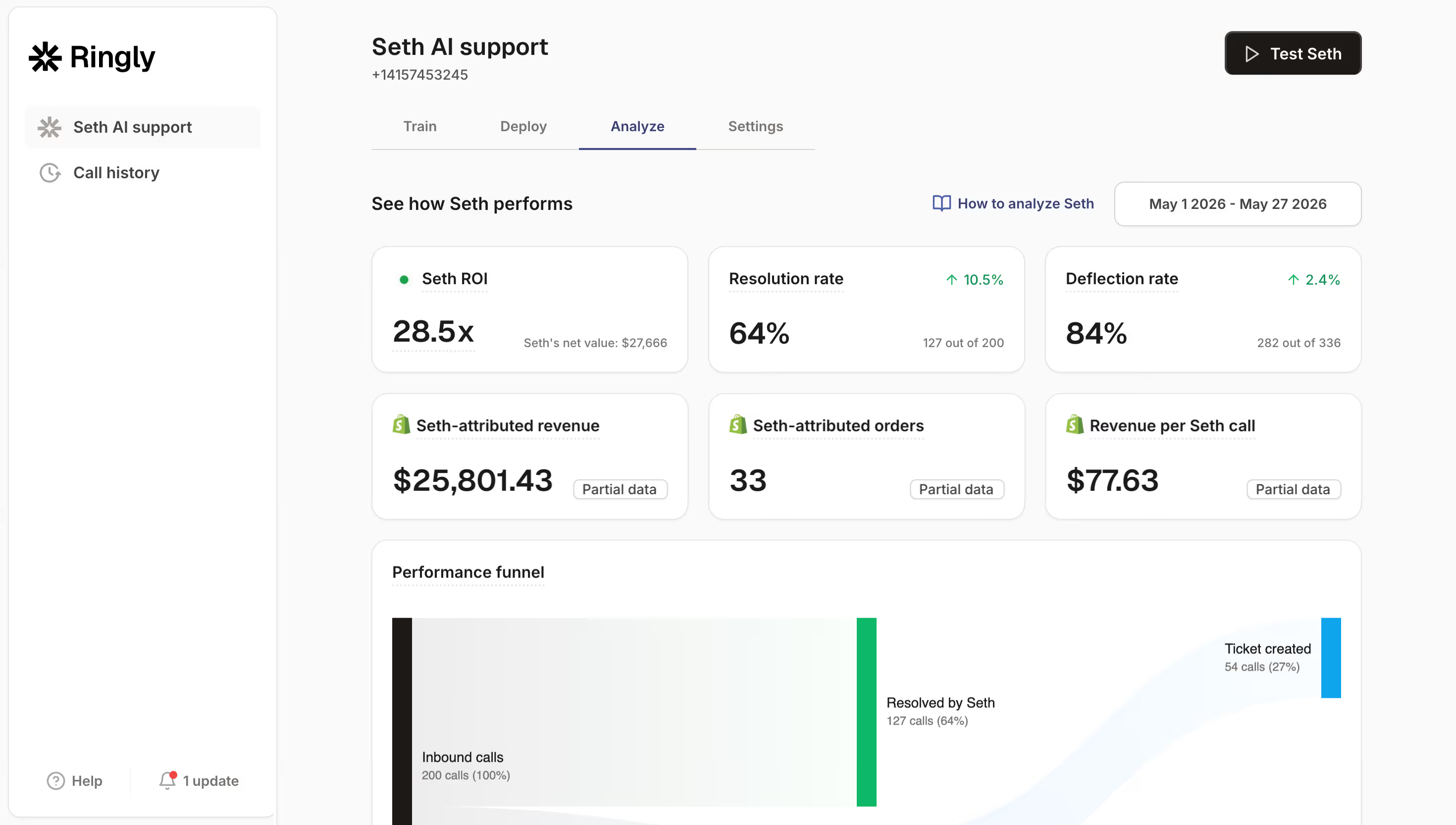
If you're running a Shopify store, Ringly.io handles the phone calls your chatbot can't. Seth, our AI phone agent, picks up in under a second, looks up orders, and resolves 73% of calls without a human. Try it free for 14 days.
When a chatbot isn't enough: the phone support gap
Here's the thing most chatbot articles won't tell you: your customers still call.
Even with a great chatbot handling live chat, email, and WhatsApp, the phone keeps ringing. And when nobody picks up, you lose the sale. We break this down in detail in our guide to missed calls in ecommerce.
The data backs this up. 60% of consumers say humans understand their needs better than any bot. And when they want that human touch, they reach for the phone, not the chat widget.
So what do you do? You can't afford to staff a call center. But you can't afford to ignore the phone either.
That's where voice AI customer support comes in. AI phone agents work like chatbots, but for phone calls. They answer, understand the question, look up orders, process returns, and escalate to a human when needed.
Ringly.io is built specifically for this. Seth, our AI phone agent, connects to your Shopify store and handles inbound calls 24/7 in 40 languages. Setup takes about three minutes, no dev work required. And it resolves 73% of calls without human help.
The best support stacks in 2026 aren't choosing between chatbot and phone. They're running both. Chatbot covers text channels. AI phone agent covers voice. Your human team handles the edge cases neither AI can solve.
Gartner projects $80 billion in contact center labor cost reductions by the end of 2026. The brands making those savings are the ones automating every channel, not just chat.
Want to hear what it sounds like? Paste your Shopify URL and get sample calls in under 20 seconds. No email required.
Frequently asked questions
What is a customer service chatbot?
It's software that uses AI to answer customer questions through text channels like website chat, email, and social media. Modern chatbots learn from your knowledge base and can handle tasks like order lookups and returns, not just simple FAQs.
How much does a customer service chatbot cost?
It depends on the platform and your volume. Entry-level tools like Tidio start free, while enterprise solutions like Ada start around $30,000/year. Most mid-market options charge $0.50-2.00 per AI resolution on top of a monthly base fee.
Can a chatbot fully replace human support agents?
No. Chatbots handle 60-80% of routine questions well, but complex issues, angry customers, and edge cases still need a real person. The goal is to free your team from repetitive work, not eliminate them.
What's the difference between a rule-based chatbot and an AI chatbot?
Rule-based chatbots follow scripted decision trees. They work for simple, predictable questions but break when customers go off-script. AI chatbots use natural language processing to understand intent and generate responses, handling a much wider range of questions.
How long does it take to set up a customer service chatbot?
Simple tools like Chatbase or Tidio can be live in under an hour. Full helpdesk platforms like Zendesk or Intercom typically take days to weeks depending on your setup complexity and integrations.
Do customer service chatbots work for ecommerce?
Yes, especially when they integrate with your store platform. The best ecommerce chatbots connect to Shopify or WooCommerce, pull real-time order data, and handle returns and order tracking requests automatically.
Should I use a chatbot or AI phone support?
Both. Chatbots cover text channels (chat, email, social). AI phone agents like Ringly.io cover voice calls. Together, they handle every support channel without forcing you to hire more agents. The question isn't one or the other, it's whether you can afford gaps in either channel.
A customer service chatbot is a requirement for ecommerce in 2026. The AI customer service statistics are clear: automation isn't optional anymore.
Pick a chatbot that actually connects to your store, measure the results, and don't forget about the phone. Your customers are calling whether you're ready or not.
Start a free trial with Ringly.io and get AI phone support live in three minutes. No dev team needed.