


The recurring charge fires at 2 a.m. The card declines. Your billing software does its job: it retries the charge, then emails the customer a link to update their card. Some of them fix it. The rest call you the next morning, confused about why their order didn't ship, or annoyed that they got charged for a renewal they thought they'd cancelled.
That second group is the part nobody writes about. If you run a $10M to $100M Shopify subscription brand, you already have software handling the recurring charge. What you don't have is anything handling the calls that charge sets off. This guide covers what online subscription billing software actually does, the seven platforms worth knowing for a DTC brand, and the layer the billing engine never touches.
Most guides on this topic are a list of platforms and their feature checkboxes. We work with 50+ Shopify brands that run subscriptions, so we wrote this from the other side: what happens after the charge, when the customer who didn't self-serve picks up the phone. If your renewal cycle quietly fills your queue with the same questions over and over, book a 30-min call and we'll show you what that's costing you.
The short version.
- What it does: online subscription billing software runs the recurring charge, retries the failed ones, prorates mid-cycle changes, invoices, and emails the customer to fix their card.
- What it recovers: even at its best, dunning recovers roughly 55-70% of failed payments. The other 30-45%, plus every cancel and "why was I charged" call, doesn't fix itself.
- Who it's for: $10M-$100M Shopify subscription brands. The billing engine handles the money. It does not handle the phone, which is a separate problem.
At a glance: 7 subscription billing platforms
Here is the quick map before the detail. None of these process the call that follows a failed charge, which is the column no comparison table ever has.
| Platform | Best for | Pricing (2026) | Dunning + recovery | Verdict |
|---|---|---|---|---|
| Stripe Billing | Billing + payments in one stack | 0.7% of billing volume + processing (2.9% + 30c) | AI Smart Retries, card updater, ~55% recovered | Strongest if you're already on Stripe |
| Chargebee | Complex recurring models | Free under $250K, then 0.75% overage | Smart timing + customer comms | Powerful, watch the overage fees |
| Recurly | Fighting involuntary churn | From ~$249/mo, custom at scale | Heavy dunning + card-updater focus | Solid, pricing not transparent |
| Zuora | Large enterprise | $50K-$75K+/yr, quote only | Enterprise-grade Collect module | Overkill for most DTC brands |
| Maxio | B2B SaaS billing + rev-rec | From $599/mo | Standard retries + dunning | Built for SaaS, not DTC ecommerce |
| Zoho Billing | SMB on Zoho | Free tier, paid from ~$15/mo | Basic dunning + retries | Simple, thin outside Zoho |
| Recharge | Shopify DTC subscriptions | $99/mo + 1.49% + 19c (Starter) | Native dunning + portal | The DTC-native default |
What online subscription billing software actually does
Strip away the marketing and a billing engine does five jobs. It charges a customer on a schedule. It retries the charge when it fails. It runs a dunning sequence (the emails that ask the customer to fix their card). It prorates the math when someone upgrades, downgrades, or changes their plan mid-cycle. And it invoices, handles tax, and gives the customer a self-service portal to manage their own plan.
The whole point of this software is to turn a one-time sale into predictable recurring revenue without a human touching each charge. That part works well. The schedule fires, the card gets charged, the receipt goes out, and you never think about it.
The trouble is the failed charges. Recurring payments fail constantly, mostly from expired cards and insufficient funds, not from customers choosing to leave. Involuntary churn (customers whose payment failed, not customers who quit) makes up 20-40% of all subscription churn and around 9% of MRR, and failed subscription payments cost businesses $129 billion in 2025. That is the leak your billing engine is built to plug. It plugs a lot of it. It does not plug all of it, and the gap is where your phone starts ringing. (More on subscription cancellation management below.)
How I evaluated these platforms
I'm Ruben, co-founder of Ringly. We run AI phone support for 50+ Shopify brands, a lot of them on subscriptions, so I look at billing tools constantly, not as a critic, as the person who picks up what they leave behind.
For this guide I pulled live 2026 pricing on every platform, mapped how each one handles the things that actually matter for recurring revenue, and read our own data to see where the human work starts. Here is what I scored against:
- Recurring billing depth. Does it handle flat, tiered, usage-based, and hybrid plans, plus proration on mid-cycle changes?
- Failed-payment recovery. Smart retries, dunning sequences, and a card updater, with a real recovery rate I could verify.
- Pricing transparency. Is the cost predictable, or does it spiral with overage fees you find out about months later?
- DTC ecommerce fit. Built for Shopify subscription brands, or really a SaaS billing tool wearing a DTC label?
- The call it generates. Here is the criterion nobody else uses: I read our own call logs across the 50+ brands on Ringly. "Cancel my subscription" and "why was I charged" were among the most common reasons a customer picked up the phone, and not one platform on this list touches that call.
I don't take affiliate commissions on any tool below. We sell Ringly, which is the phone layer, not a billing engine, so it shows up in its own section for a different job.
7 online subscription billing platforms worth knowing
1. Stripe Billing
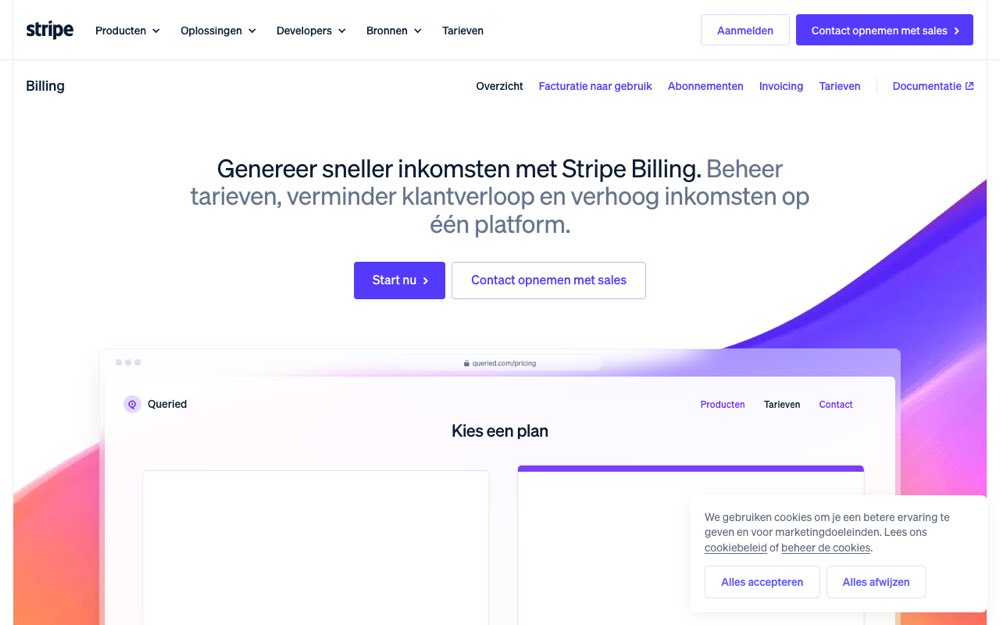
Best for: brands that want billing and payments in one stack. Stripe Billing is the monetization layer on top of Stripe payments, and it's the only major billing tool with a built-in payment processor. OpenAI, Atlassian, and Figma run on it.
Pricing
0.7% of billing volume on the pay-as-you-go plan, charged on top of standard payment processing (US cards are 2.9% + $0.30). The billing fee applies to charges processed on and off Stripe.
What works
- Recovery you can verify: brands using Stripe recover an average of 55% of failed payments, and Stripe recovered $8.2 billion in failed payments in 2025.
- AI Smart Retries plus a card updater that refreshes expired card details automatically.
What to watch
- The 0.7% stacks on processing fees, so the all-in cost climbs with volume.
- Developer-leaning setup if you want anything custom.
Verdict: if you're already on Stripe, this is the path of least resistance.
2. Chargebee
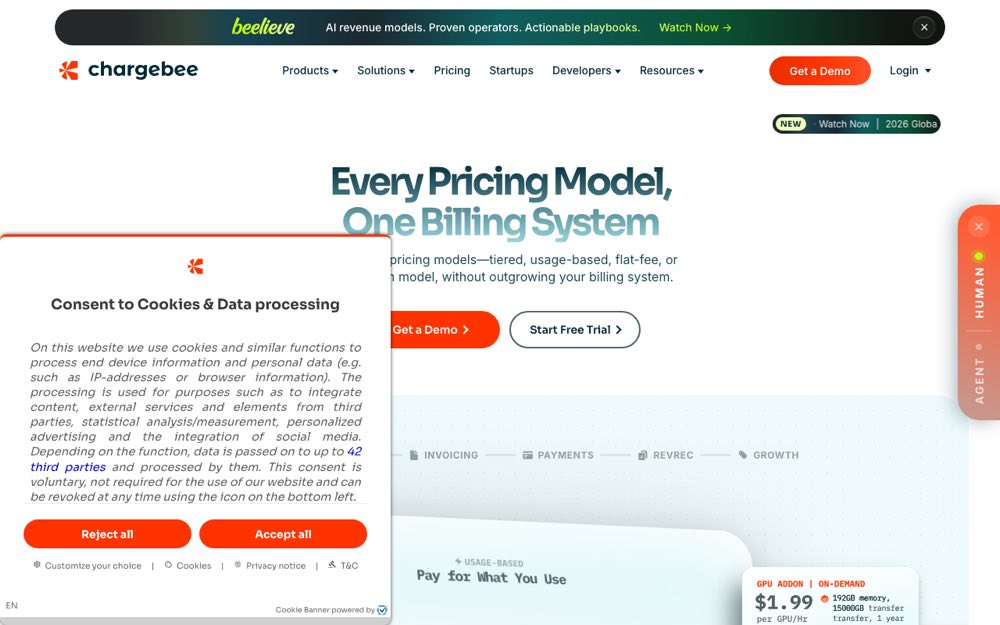
Best for: recurring businesses with complex billing models. Chargebee is an orchestration layer built from the ground up for subscriptions, and it sits on top of your payment gateway rather than processing payments itself.
Pricing
Free until $250K in cumulative billing, then a 0.75% overage on billing above the cap. The Performance plan is $599/mo. Chargebee rates 4.4/5 on G2 across 978 reviews.
What works
- Deep model support: flat-rate, tiered, usage-based, seat-based, and hybrid pricing.
- Dunning that goes past basic retries with smart timing and customer messaging.
What to watch
- Surprise overage fees are the loudest complaint in reviews, landing months later with no mid-period alert when you cross a tier cap.
- Migration pain if you ever want to leave.
Verdict: powerful for complex billing, but read the overage terms before you sign.
3. Recurly
Best for: subscription brands focused on cutting involuntary churn. Recurly handles recurring billing for high-volume digital commerce and leans hard into dunning and card-updater tooling.
Pricing
Starts around $249/mo on the entry tier and moves to custom pricing at scale. The higher tiers aren't published. Recurly rates 4.0/5 on G2.
What works
- Dunning and failed-payment recovery are the core of the product.
- Proration, retries, and automated invoicing out of the box.
What to watch
- Pricing isn't transparent above the entry plan.
- Lower G2 score than Chargebee or Maxio.
Verdict: a solid recovery-focused engine if transparent pricing isn't a dealbreaker.
4. Zuora
Best for: large enterprises with complex global billing. Zuora runs Billing, Revenue, and Collect as separate products and is built for companies with serious tax and revenue-recognition needs.
Pricing
Quote-based, not public. Enterprise typically starts around $50,000-$75,000 a year and scales with volume. Zuora rates 3.9/5 on G2.
What works
- Handles genuinely complex global billing and revenue recognition.
- Modular if you need billing, rev-rec, and collections separately.
What to watch
- Cost and implementation complexity are real.
- Overkill for a $10M-$100M DTC brand.
Verdict: the right tool if you're a large enterprise, the wrong one if you're a Shopify subscription brand.
5. Maxio
Best for: B2B SaaS that needs billing plus revenue recognition. Maxio (formerly Chargify and SaaSOptics) combines billing, rev-rec, and reporting in one platform.
Pricing
Growth plans start at $599/mo, and most B2B SaaS companies pay $1,500-$3,000/mo by volume. Maxio rates 4.3/5 on G2 across 829 reviews.
What works
- Billing and revenue recognition together, which B2B finance teams want.
- Strong reporting for SaaS metrics.
What to watch
- B2B SaaS slant, less native to DTC ecommerce.
Verdict: great for SaaS, not the natural fit for a consumer subscription brand.
6. Zoho Billing
Best for: small businesses already in the Zoho ecosystem. Zoho Billing automates invoicing, retries payments through dunning, and handles lifecycle events like upgrades, downgrades, and renewals.
Pricing
A free tier plus paid plans starting around $15/mo, scaling by feature set. Zoho Billing rates 4.3/5 on G2.
What works
- Simple and affordable for smaller volumes.
- Tight Zoho integration if you live in that suite.
What to watch
- Thinner outside the Zoho ecosystem and fewer reviews to go on.
Verdict: a clean SMB choice, especially if you already run Zoho.
7. Recharge
Best for: Shopify DTC subscription brands. Recharge is the leading Shopify subscription platform, and it handles recurring orders, dunning, and the customer portal natively inside Shopify. It acquired Skio for $105M in 2026.

Pricing
$25/mo for the first 50 lifetime subscribers (net-new merchants only), then Starter at $99/mo + 1.49% + 19c per transaction, and Plus at $499/mo + 1.34% + 19c on a 12-month term. We broke the full math down in our Recharge pricing guide.
What works
- Native to Shopify, so subscriptions live where your store already does.
- Built for DTC verticals like supplements, coffee, and pet.
What to watch
- The per-transaction fee adds up at volume.
- Worth comparing against the field before committing (see Recharge alternatives and Skio alternatives).
Verdict: for a Shopify subscription brand, this is the default starting point. It's also the engine most of our customers run.
The failed-payment math, and what dunning doesn't recover
Here's the part the platform pages skip. Dunning is good, not magic. Even when you stack smart retries, dunning email sequences, and a card updater, the recovery ceiling sits around 70%. Smart dunning tools on their own recover about 37% of failed charges, and Stripe's verified average is 55%.
So run the numbers on a brand doing $20M in subscription revenue. Involuntary churn is costing 4-8% of MRR, which is $800K to $1.6M a year in payments that fail. Your billing engine recovers maybe 55-70% of that automatically. The remaining 30-45% does not fix itself. Some of those customers update their card after a nudge. Some forget. And a real slice of them, especially the older subscribers common in supplements and coffee, don't read the dunning email at all. They call.
That call is voluntary churn risk wearing a billing costume. The customer wants to know why their order didn't ship, or they want to cancel, or they want a human to confirm their new card went through. If nobody picks up, the FTC's click-to-cancel backdrop means a missed cancel request can turn into a chargeback. The billing software did nothing wrong. It just isn't built for the phone.
BioLongevity Labs, a supplement brand on Ringly, resolves 79% of its calls without a human. Those are exactly the calls a billing engine generates and can't take.
If you want to see what your own renewal-cycle call volume is costing, book a 30-min call and we'll do the math live.
The calls your billing software can't take
Every platform above ends its job at the dunning email. The customer who reads it and clicks is handled. The customer who doesn't is now a phone call, and that's a different stack entirely.
The most common version is the cancel call. One of our customers, the founder of supplement brand Yomz, put it plainly during onboarding: "the big one is can it cancel a subscription." It's the question subscribers get crazy about, and it's often the bulk of a subscription brand's call volume. Next to it sit "why was I charged" after a renewal or a price change, and "my card was declined, what now" from someone who'd rather hear a human say it's fixed than trust an email.
These aren't support tickets, they're revenue moments, and they all happen on the phone where your billing engine has no presence. A cancel call answered well can save the subscription. A "why was I charged" call answered fast kills a chargeback before it files. A card-declined call resolved in two minutes recovers the exact payment your dunning sequence couldn't.
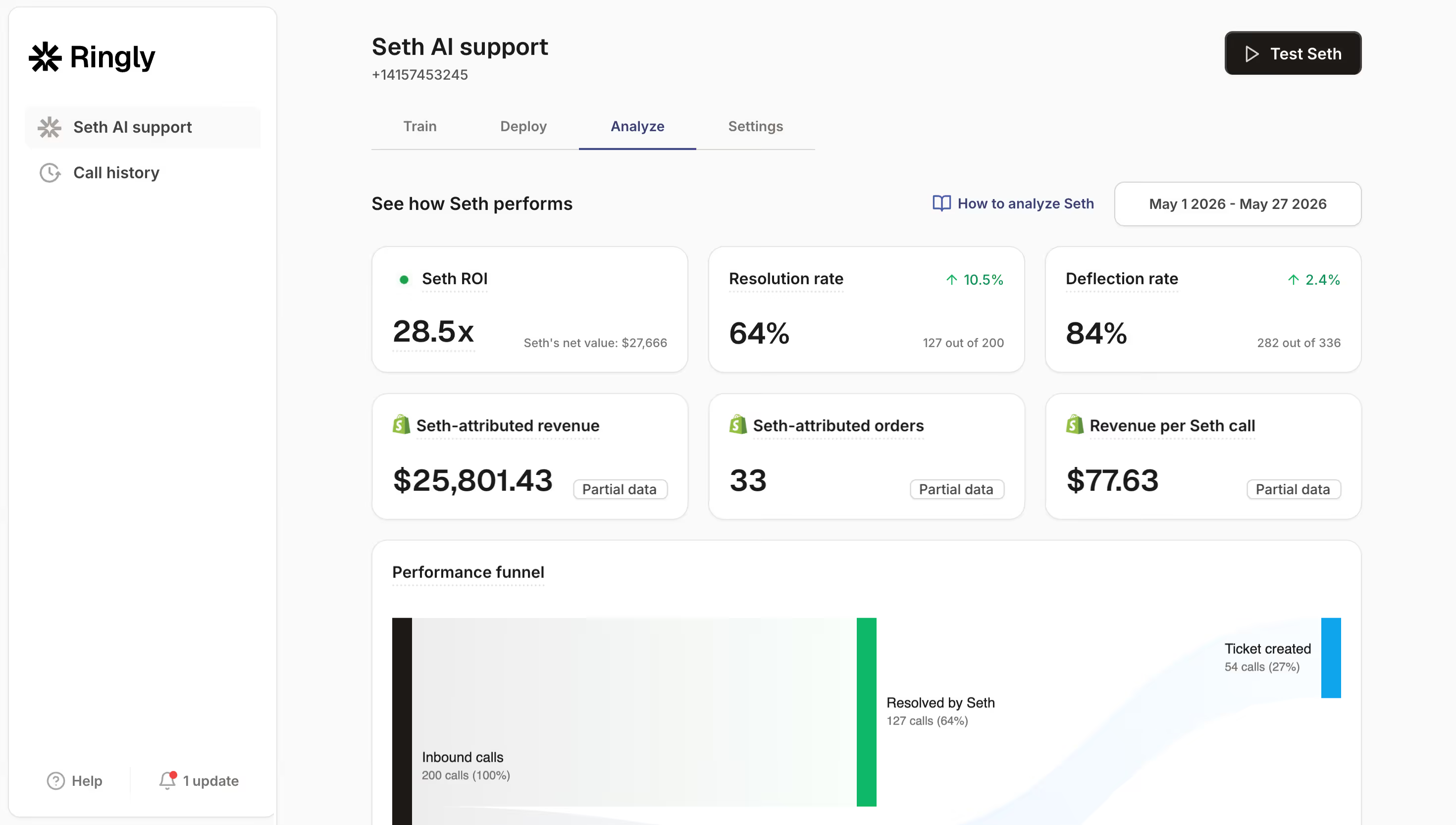
This is the layer Ringly.io covers. Ringly is AI phone support for Shopify brands. Instead of growing your support headcount every renewal cycle, the AI takes the routine inbound calls so your team can focus on the work that actually moves revenue. It answers calls 24/7, finds orders in your Shopify store, answers product questions from your knowledge base, and escalates cleanly to Gorgias or whatever helpdesk you already run. Across 50+ brands, the AI resolves 73% of calls autonomously at roughly $0.42 per resolved call.
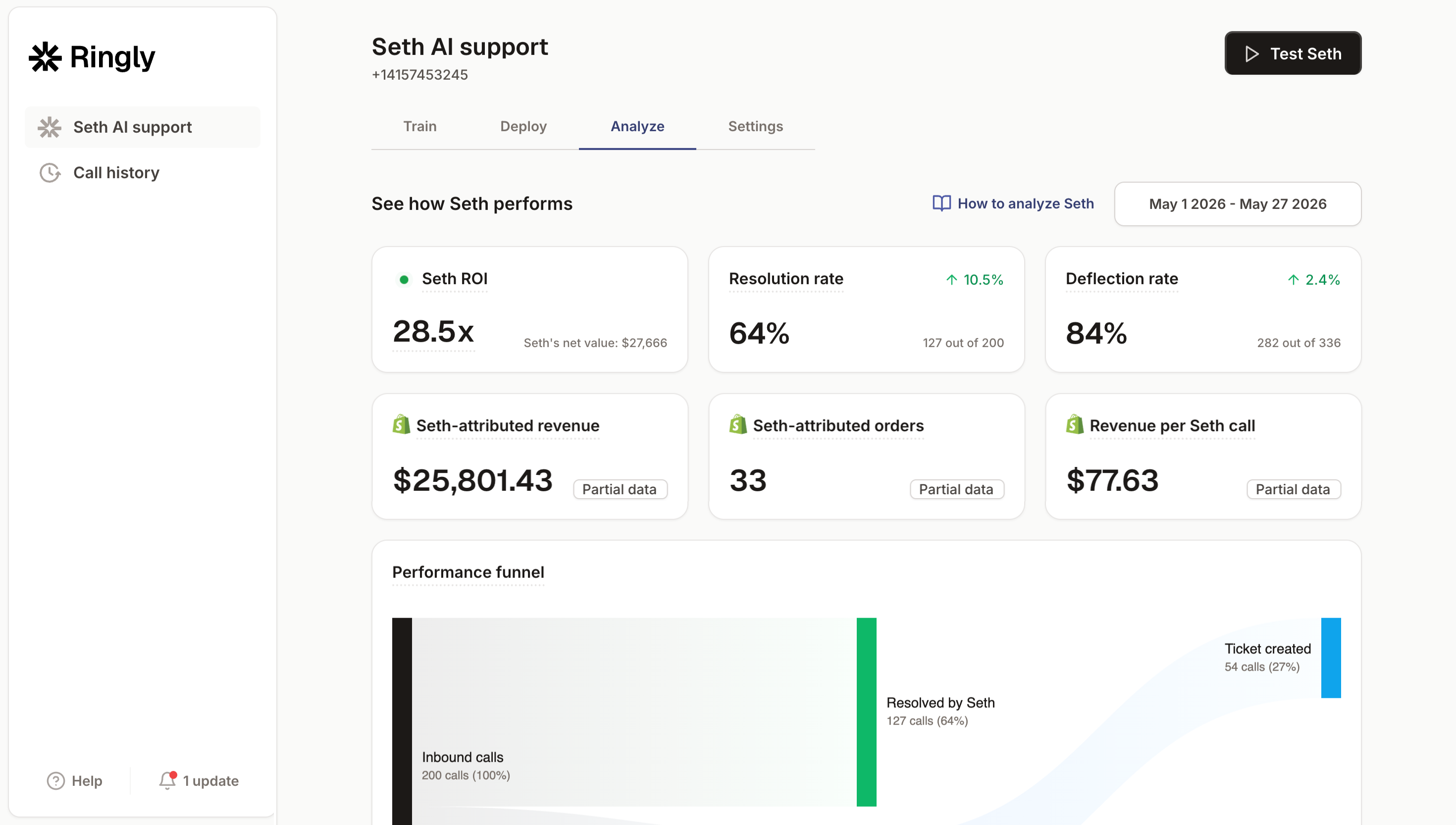
To be honest about scope, since the whole point of this guide is the line between layers: Ringly does not process payments, and cancelling a subscription is a custom action rather than a native button. It sits in front of your billing engine and your helpdesk. It does not replace them. What it replaces is the voicemail box those cancel-and-why-charged calls currently fall into.
"My customers also feel like it's a normal person. They feel like they can communicate if they have questions."
Claudia Droge, TechCraft Studio
If you've ever wondered why a subscriber churned at 11 p.m. on a Sunday, the call log has the answer, and it usually isn't the product.
How to choose
The honest answer is that most $10M-$100M Shopify subscription brands need two things, not one. Pick the engine that fits your stack, then decide who answers the phone it doesn't.
- Choose Stripe Billing if you're already on Stripe and want billing and payments in one place.
- Choose Chargebee if you have complex billing models and can stomach the overage terms.
- Choose Recurly if involuntary churn is your biggest leak and transparent pricing isn't a dealbreaker.
- Choose Zuora if you're a large enterprise with global tax and revenue-recognition needs.
- Choose Maxio if you're B2B SaaS and want billing plus rev-rec together.
- Choose Zoho Billing if you're a smaller brand already in the Zoho suite.
- Choose Recharge if you're a Shopify DTC subscription brand and want subscriptions native to your store.
- Add a phone layer if your renewal cycles fill your queue with cancel-and-why-charged calls, which for a subscription brand they almost always do. That's how brands scale support without hiring through the spike.
For the broader category beyond the billing engine itself, our subscription billing software overview and the ecommerce customer retention guide go deeper. The churn statistics breakdown is worth a read if you want the involuntary-churn numbers in full.
Frequently asked questions
What is online subscription billing software? It's software that charges customers on a recurring schedule and manages the full lifecycle around that charge: retries when a payment fails, dunning emails, proration for plan changes, invoicing, tax, and a self-service portal. The goal is predictable recurring revenue without a human touching each charge.
Does subscription billing software handle failed payments automatically? Partly. It retries the charge and emails the customer to update their card, and a good setup recovers 55-70% of failed payments. The remaining 30-45% needs the customer to act, and many of them call instead, which the software can't answer.
What's the difference between a billing engine and a payment processor? The processor (like Stripe or Shopify Payments) moves the money. The billing engine (like Chargebee or Recharge) decides when and how much to charge, runs retries and dunning, and manages plans. Stripe Billing is unusual because it bundles both.
How much does online subscription billing software cost? It ranges widely. Zoho Billing starts near $15/mo, Recharge runs $99/mo plus 1.49% + 19c per transaction, Chargebee is free under $250K then 0.75% overage, and Zuora is quote-only starting around $50,000 a year. Most DTC brands land on a percentage-of-volume model.
Can subscription billing software cancel a subscription for a customer who calls in? No. It can let a customer cancel in a self-service portal, but it can't answer the phone when they call to do it. That's where WISMO and cancel calls hit a human or a phone agent instead.
Do I need both billing software and phone support? For a subscription brand, usually yes. The billing engine runs the money and recovers most failed payments. Phone support catches the cancel, why-charged, and card-declined calls the engine generates but can't take, which is where you save the subscriptions worth keeping.
Talk to us

If you run a Shopify subscription brand and your phone fills up every renewal cycle with cancel-and-why-charged calls, a 30-min call is the fastest way to see what that's costing you. We'll look at your real numbers, not a deck.
The 3-layer guarantee.
- Live in 14 days or it's free until launched.
- 65% resolution in 90 days or we refund the last 3 months of subscription fees.
- We keep working free until we hit 65%.
Ruben (Ringly co-founder) takes these calls personally.