


Your customers are emailing, chatting, calling, and DMing you on three different platforms. Your team is juggling a shared Gmail inbox, a spreadsheet someone built in 2021, and a phone that nobody picks up after 5 PM.
Sound familiar? You need customer service software. But picking the right one is genuinely hard. Every vendor claims they're the best, pricing pages are designed to confuse, and half the "2026 reviews" online are just rewritten versions of last year's post.
We reviewed 15 platforms across real pricing, feature depth, AI capabilities, and actual user feedback. This guide tells you what each tool does well, where it falls short, and which one fits your business. No fluff, no filler, and no "contact sales for pricing" dodges where we can avoid them.
Hear what AI support calls sound like for your store. Just paste your Shopify URL and get sample calls in under 20 seconds, no email required. Listen to demo calls for my store.
What is customer service software?
Customer service software is any tool that helps your team manage, track, and respond to customer requests. That's the simple version.
In practice, it means a platform where incoming messages (from email, chat, phone, social media, or all of the above) land in one place. Your team can assign conversations, track response times, and make sure nothing falls through the cracks.
There are a few main types:
- Help desk / ticketing systems: Turn every customer request into a trackable ticket. Think Zendesk, Freshdesk, Zoho Desk.
- Live chat platforms: Real-time messaging on your website. Tidio and Intercom are popular picks.
- Phone / voice AI: AI agents that answer calls, look up orders, and handle common requests. Ringly.io leads this category for ecommerce.
- CRM-based service tools: Customer service built into a CRM. HubSpot Service Hub and Salesforce Service Cloud fit here.
- Shared inboxes: Collaborative email tools for teams. Front and Help Scout are good examples.
The AI customer service market hit $15.12 billion in 2026 and is projected to reach $47.82 billion by 2030, according to MarketsandMarkets. That's not hype. It's a sign that businesses are moving fast to automate support, and the tools are getting better every quarter.
How we evaluated these platforms
We didn't just read feature pages. Here's what we looked at for each tool:
- Pricing transparency: What does it actually cost, including AI add-ons? Not just "starting from $19/mo."
- Ease of setup: How fast can a real team go from signup to first resolved ticket?
- Channel coverage: Email, chat, phone, social, self-service. Which channels are included vs. add-on?
- AI capabilities: What's built in vs. what costs extra? Is the AI actually useful?
- Ecommerce fit: Does it integrate with Shopify or BigCommerce? Can agents look up orders without tab-switching?
- Scalability: Does the price stay reasonable as you add agents or tickets?
- User reviews: G2 and Capterra ratings from real users, not just marketing claims.
We also factored in 91% of customer service leaders saying they're under pressure to implement AI in 2026. If a platform doesn't have a clear AI story, it's already falling behind.
Quick comparison: pricing and ratings
Here's every platform side by side. Prices reflect annual billing where applicable.
| Platform | Best for | Starting price | G2 rating | Free plan? |
|---|---|---|---|---|
| Zendesk | Enterprise customization | $55/agent/mo | 4.3/5 | No |
| Freshdesk | Value for money | $15/agent/mo | 4.4/5 | Yes |
| Gorgias | Shopify stores | $10/mo (50 tickets) | 4.6/5 | No |
| Intercom | SaaS + AI chatbot | $29/seat/mo | 4.5/5 | No |
| Help Scout | Simple email support | $50/mo (100 contacts) | 4.4/5 | Yes |
| HubSpot Service Hub | HubSpot users | $15/seat/mo | 4.4/5 | Yes |
| Zoho Desk | Budget-first teams | $8/agent/mo | 4.4/5 | Yes |
| Salesforce Service Cloud | Large enterprises | $25/user/mo | 4.4/5 | No |
| Ringly.io | Ecommerce phone support | $99/mo for the first 50 calls, then $1.99 per call | N/A | No (setup is free) |
| Kustomer | CRM-first support | $89/user/mo | 4.4/5 | No |
| Front | Collaborative email | $19/seat/mo | 4.7/5 | No |
| Tidio | Chat + chatbot | $29/mo | 4.7/5 | Yes |
| LiveAgent | Budget phone support | $9/agent/mo | 4.5/5 | Yes |
| Gladly | Consumer brands | $150/hero/mo | 4.7/5 | No |
| Re:amaze | Ecommerce inbox | $29/agent/mo | 4.2/5 | No |
Now let's break each one down.
The 15 best customer service software platforms
1. Zendesk
Best for: Mid-to-large teams that need deep customization and a massive app marketplace.
Zendesk is the most recognized name in customer service software. It's been around since 2007 and powers support for companies like Uber, Slack, and Shopify. The platform handles email, chat, phone, and social in one dashboard, with strong reporting and over 1,500 integrations.
But recognition comes with a price tag. The median Zendesk customer spends $47,772 per year before AI add-ons, according to a Featurebase analysis of verified purchase data.
Pricing
| Plan | Price (per agent/mo) | Key features |
|---|---|---|
| Suite Team | $55 | Ticketing, email, chat, social |
| Suite Growth | $89 | + self-service portal, SLAs |
| Suite Professional | $115 | + custom analytics, skills-based routing |
| Suite Enterprise | $169 | + sandbox, custom roles, advanced AI |
AI Copilot add-on: $40-50/agent/mo extra. Annual billing required for discounts.
What works
- Massive marketplace: 1,500+ integrations means it connects to almost anything
- Strong reporting: Custom dashboards, real-time analytics, and SLA tracking
- Mature platform: Battle-tested at scale with enterprise-grade security
- Omnichannel: Every channel in one place, including phone (Zendesk Talk)
What doesn't
- Expensive and getting worse: AI features cost extra on top of already high per-agent pricing
- Slow to deploy: Most teams report 3+ months for full deployment
- Steep learning curve: The admin panel can overwhelm non-technical teams
- Support for a support company: Ironically, Zendesk's own support gets mixed reviews
Why it ranks 1st (by market share, not value): Zendesk is the default choice for big teams, and it earned that position. But for small-to-mid businesses, you're likely paying for features you'll never use. Check the Zendesk alternatives before committing.
2. Freshdesk
Best for: Small-to-mid teams that want most of Zendesk's features without the Zendesk bill.
Freshdesk is the value play in customer service software. You get omnichannel support, automation, a free plan, and AI features that keep getting better. The setup is straightforward, and most teams are operational within days, not months.
G2 reviewers give it 4.4/5 across 3,800+ reviews, with "easy to use" being the most common praise.
Pricing
| Plan | Price (per agent/mo) | Key features |
|---|---|---|
| Free | $0 | Email ticketing, knowledge base, up to 2 agents |
| Growth | $15 | + automation, marketplace apps, SLA |
| Pro | $49 | + custom roles, round-robin routing, CSAT surveys |
| Enterprise | $79 | + skill-based routing, audit log, IP whitelisting |
Freddy AI Copilot: $29/agent/mo extra. AI Agent: $49 per 100 sessions (first 500 free on Pro/Enterprise).
What works
- Free plan that's actually usable: Enough to run basic support for a very small team
- Ecommerce vertical agents: Prebuilt AI workflows for Shopify refunds, Stripe cancellations, and more
- Fast setup: Most teams go live within a few days
- Good integration library: Connects to Shopify, Slack, Salesforce, and hundreds more
What doesn't
- AI lags behind Intercom: Freddy is decent but not best-in-class
- Reporting is basic on lower tiers: You need Pro or Enterprise for meaningful analytics
- Feature sprawl: Freshworks keeps adding products, and the naming gets confusing
Why it ranks 2nd: Freshdesk delivers roughly 80% of what Zendesk offers at about half the price. For most growing teams, that's more than enough.
3. Gorgias
Best for: Shopify and BigCommerce stores that handle most support through email and chat.
Gorgias is built exclusively for ecommerce. When a ticket comes in, your agents see the customer's full Shopify profile in the sidebar: order history, tracking info, subscription status. More importantly, they can take action (process refunds, apply discounts, edit orders) without leaving the app.
Nearly 40% of the largest Shopify brands use Gorgias, according to their own data. The ticket-based pricing model means you can add unlimited agents.
Pricing
| Plan | Price | Included tickets | Overage |
|---|---|---|---|
| Starter | $10/mo | 50 | $0.40/ticket |
| Pro | $360/mo | 2,000 | $0.36/ticket |
| Advanced | $900/mo | 5,000 | $0.36/ticket |
| Enterprise | Custom | Custom | Custom |
AI Agent: $0.90 per interaction (annual). Unlimited agents on every plan.
What works
- Native Shopify integration: Order lookups, refunds, and tracking without tab-switching
- Ticket-based pricing: Add as many agents as you want without paying more
- Ecommerce-specific AI: Pre-trained on common ecommerce scenarios
- Revenue tracking: See how much revenue your support team generates
What doesn't
- Limited outside ecommerce: If you sell B2B or services, this isn't for you
- Phone support is an add-on: Voice isn't core to the platform
- Overage costs stack up: High-volume stores can see bills climb fast
Why it ranks 3rd: For Shopify stores, Gorgias is the best email/chat helpdesk, period. But if phone support matters to you, you'll need something else alongside it. Check Gorgias vs Zendesk for Shopify for a detailed comparison.
4. Intercom
Best for: SaaS companies and tech-forward teams that want the best AI chatbot on the market.
Intercom pioneered the messaging-first approach to customer support. Their AI agent, Fin, is genuinely impressive. It resolves conversations, executes workflows, and hands off to humans smoothly. If you're in SaaS, this is probably on your shortlist.
G2 rating: 4.5/5 across 2,840+ reviews. The AI capabilities are consistently praised.
Pricing
| Plan | Price (per seat/mo) | Key features |
|---|---|---|
| Essential | $29 | Shared inbox, basic automation, Fin AI access |
| Advanced | $85 | + workflows, team management, 20 free Lite seats |
| Expert | $132 | + workload management, SLAs, 50 free Lite seats |
Fin AI: $0.99 per resolution. Minimum 50 resolutions/month. Base AI access: $29/mo on all plans.
What works
- Fin AI is the real deal: One of the best AI chatbots available, with strong resolution rates
- Messenger is polished: The in-app chat widget looks and feels premium
- Product tours and onboarding: Great for SaaS user activation, not just support
- Strong automation builder: Visual workflow editor for complex routing
What doesn't
- AI pricing is a wildcard: $0.99/resolution sounds cheap until you hit thousands of conversations
- Expensive at scale: Seat pricing plus AI costs plus add-ons add up fast
- Not built for ecommerce: Limited Shopify integration compared to Gorgias or Re:amaze
Why it ranks 4th: Best AI chatbot in the category. But budget carefully. Intercom pricing can surprise you once AI resolutions start adding up.
5. Help Scout
Best for: Small teams (under 20 people) that want clean, simple email-based support.
Help Scout recently switched to contact-based pricing, which changes the math. Instead of paying per agent, you pay based on how many customers you help. That's great for teams with lots of agents but moderate volume.
The interface is clean. Conversations feel like personal emails, not tickets. For teams that value simplicity over feature count, it's hard to beat.
Pricing
| Plan | Price | Included | Key features |
|---|---|---|---|
| Free | $0/mo | 50 contacts | Shared inbox, knowledge base, AI answers |
| Standard | $50/mo | 100 contacts | + automation, reporting, integrations |
| Plus | $75/mo | 100 contacts | + custom fields, advanced permissions |
| Pro | Custom | 1,000+ contacts | + dedicated onboarding, security features |
AI Answers: $0.75 per resolution. Unlimited users on all plans.
What works
- Contact-based pricing: Unlimited users, pay for volume instead
- Clean, simple UI: Feels like email, minimal learning curve
- Solid knowledge base: Docs feature is one of the best for self-service
- Free plan with AI: Even the free tier includes AI draft assistance
What doesn't
- No native phone support: You'll need a separate tool for calls
- Limited automation: Workflows are simpler than Zendesk or Intercom
- Scales awkwardly: Contact-based pricing gets expensive at high volume
Why it ranks 5th: If your support is mostly email and your team is small, Help Scout is a breath of fresh air. Just know you'll need another tool if phone calls are part of your workflow.
6. HubSpot Service Hub
Best for: Teams already using HubSpot CRM for sales and marketing.
HubSpot Service Hub makes the most sense when you're already in the HubSpot ecosystem. Your sales, marketing, and service data all live in one place. That's genuinely powerful for understanding the full customer journey.
G2 reviewers give it 4.4/5 across 2,300+ reviews. The tight CRM integration is the most-cited benefit.
Pricing
| Plan | Price (per seat/mo) | Notes |
|---|---|---|
| Free | $0 | Basic ticketing, live chat, 2 users |
| Starter | $15 | Removes branding, simple automation |
| Professional | $90 | SLAs, knowledge base, $1,500 onboarding fee |
| Enterprise | $150 | Custom objects, 10-seat min, $3,500 onboarding |
Annual contracts required on Professional and Enterprise.
What works
- CRM integration: See the full customer picture (sales history, marketing interactions, support tickets)
- Free tier is generous: Basic ticketing, chat, and contact management at no cost
- Strong reporting: Service analytics tied to revenue data
- Omnichannel: Email, chat, phone, and Facebook Messenger included
What doesn't
- Expensive onboarding: $1,500-$3,500 one-time fees on higher plans
- Locked to HubSpot: Switching to another CRM means losing your service setup
- Price jumps are steep: $15 to $90 per seat is a big leap
Why it ranks 6th: If HubSpot is already your CRM, this is a no-brainer. If not, the onboarding fees and ecosystem lock-in make it hard to justify.
7. Zoho Desk
Best for: Budget-conscious small businesses that need a full-featured helpdesk without spending much.
Zoho Desk is the cheapest full-featured helpdesk on this list. The free plan supports 3 agents. The Standard plan costs $8/agent/month with annual billing, which is less than most competitors charge for their entry tier.
G2 rating: 4.4/5 across 5,900+ reviews. Volume tells you something about adoption.
Pricing
| Plan | Price (per agent/mo, annual) | Key features |
|---|---|---|
| Free | $0 | 3 agents, email ticketing, basic help center |
| Express | ~$4.20 | 5 agents, social channels, basic reporting |
| Standard | $8 | Automation, SLA, customer satisfaction ratings |
| Professional | $35 | Multi-channel, telephony, blueprint workflows |
| Enterprise | $50 | AI assistant (Zia), multi-department, custom modules |
15-day free trial. Annual billing saves up to 60%.
What works
- Lowest cost of entry: $8/agent/mo for a real helpdesk is hard to argue with
- Zoho ecosystem: Plays well with Zoho CRM, Zoho Analytics, Zoho Projects
- Free plan for 3 agents: Enough for a micro team to start
- Multi-channel at $35: Phone, email, chat, social all included on Professional
What doesn't
- UI feels dated: Not as polished as Freshdesk or Intercom
- AI features are behind: Zia (Zoho's AI) works but isn't close to Fin or Freddy
- Confusing outside Zoho: If you don't use other Zoho products, setup can feel clunky
Why it ranks 7th: When budget is your top priority, Zoho Desk delivers real features at a fraction of the cost. You're trading polish for savings, which is a fair deal for many small businesses.
8. Salesforce Service Cloud
Best for: Large enterprises with complex, multi-department service operations.
Salesforce Service Cloud is the enterprise standard. It has 1,700+ integrations, unmatched workflow customization, and analytics that can track anything. If your company has 100+ support agents and needs to connect service data to sales pipelines, CRM records, and field service teams, this is it.
G2 rating: 4.4/5 across 5,600+ reviews.
Pricing
| Plan | Price (per user/mo) | Key features |
|---|---|---|
| Starter | $25 | Basic case management, knowledge base |
| Pro | $100 | Service console, telephony integration |
| Enterprise | $165 | Omnichannel routing, AI-powered service |
| Unlimited | $330 | 24/7 support, full feature access |
| Einstein 1 | $500 | Agentforce AI, Data Cloud |
Agentforce AI add-on: $125/user/mo. Digital Engagement: $75/user/mo extra.
What works
- Unmatched customization: Build any workflow, any automation, any integration
- Massive integration library: 1,700+ apps in the Salesforce ecosystem
- Strong analytics: Service Cloud Einstein provides predictive insights
- Scale: Built for teams of hundreds or thousands of agents
What doesn't
- You'll need a consultant: Setup and customization require Salesforce expertise (or a partner)
- Very expensive: Entry is $25/user/mo, but most teams need Enterprise ($165+) for real features
- Overkill for SMBs: If you have fewer than 50 agents, you're paying for complexity you don't need
Why it ranks 8th: The right choice for large enterprises. The wrong choice for almost everyone else.
9. Ringly.io
Best for: Ecommerce stores on Shopify that want AI to handle phone calls, not just chat.
Here's the thing most customer service software misses: phone calls. Your customers still call. And when nobody picks up, they don't fill out a form or wait for a chat widget. They leave. According to a Gartner prediction, conversational AI will reduce contact center labor costs by $80 billion by 2026, and Ringly.io is built to capture that shift for ecommerce.
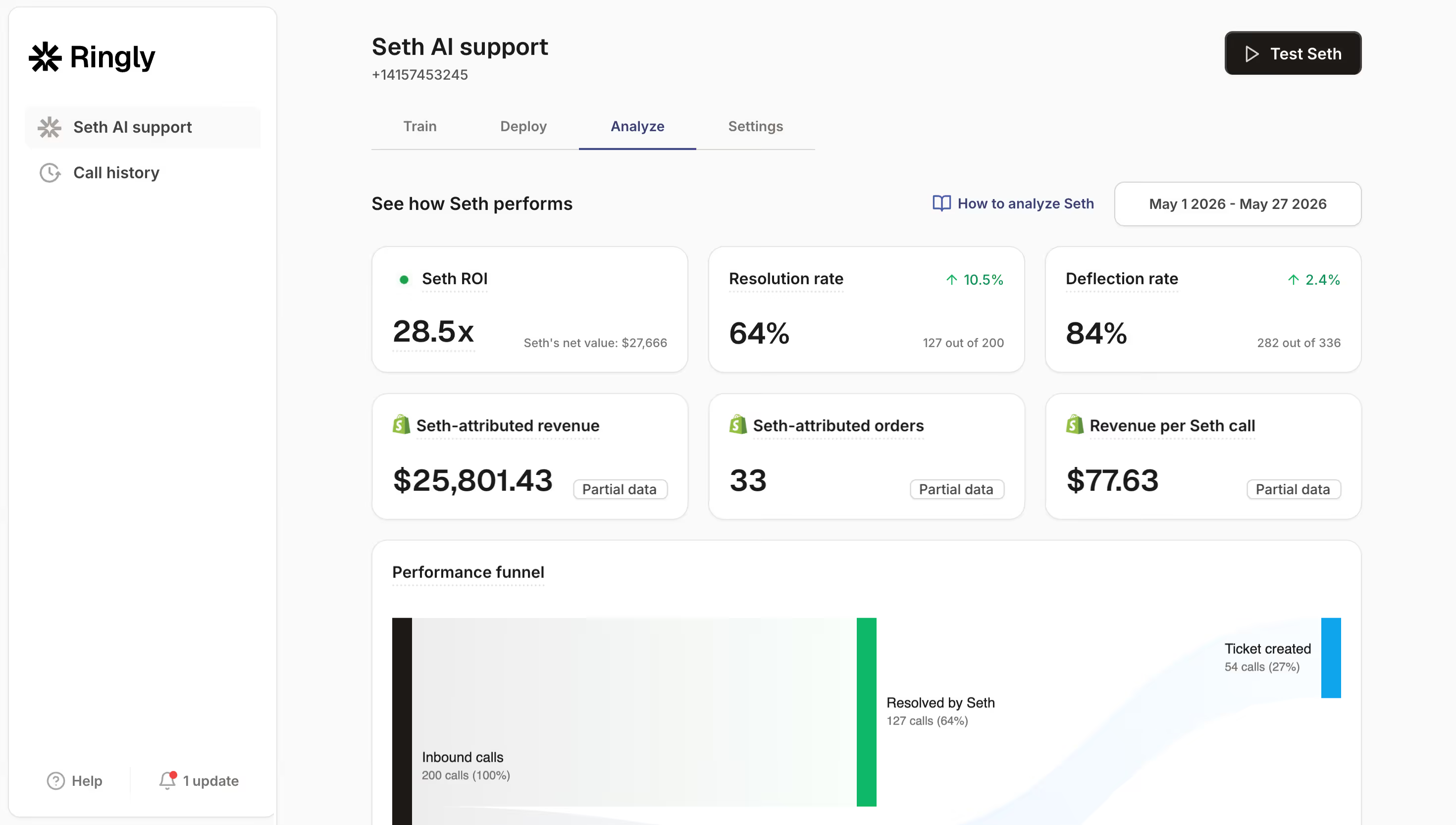
Ringly's AI phone agent, Seth, answers inbound calls 24/7 in 40 languages. It connects to your Shopify store, looks up orders in real time, processes returns, answers product questions, and escalates to your team when needed. Setup takes about three minutes. No code, no consultants, no 3-month deployment.
Trusted by 2,100+ Shopify stores with a 73% resolution rate (meaning nearly three out of four calls are fully handled without a human).
Pricing
| Plan | Price | Included | Above that |
|---|---|---|---|
| Pay per call | $99/mo | First 50 calls | $1.99 per call |
| Custom | Custom | 1,000+ calls a month | Custom |
14-day free trial. No annual contract required.
What works
- Native Shopify integration: Looks up orders, processes returns, checks inventory, all in real time
- 73% resolution rate: Most calls handled without human intervention
- 40 languages: Supports multilingual customer bases without hiring multilingual agents
- 3-minute setup: Connect your Shopify store and Seth starts answering calls immediately
- 24/7 coverage: After-hours calls get answered the same as during business hours
What doesn't
- Phone-focused: Not a full helpdesk for email/chat (pair with Gorgias or Freshdesk for that)
- Ecommerce-first: Best for Shopify stores, not general business use
- Newer platform: Less brand recognition than Zendesk or Freshdesk
Why it ranks 9th: Ringly.io isn't competing with Zendesk or Freshdesk. It fills the gap they all leave open: phone support that actually works for ecommerce. If your Shopify store's phone keeps ringing and nobody answers, try Ringly.io free for 14 days and see what happens.
10. Kustomer
Best for: Customer-centric teams that want a CRM-first approach to support.
Kustomer takes a different approach. Instead of organizing around tickets, it organizes around customers. Every interaction (email, chat, phone, social) lives on one timeline. Agents see the full picture without clicking between tabs.
G2 rating: 4.4/5 across 400+ reviews.
Pricing
| Plan | Price (per user/mo) | Key features |
|---|---|---|
| Enterprise | $89 | Omnichannel, automation, reporting |
| Ultimate | $139 | + real-time dashboards, enhanced routing, sandbox |
Annual billing required. No free plan or trial publicly listed.
What works
- Customer timeline view: See every interaction in one chronological feed
- Omnichannel by default: Email, chat, phone, social, SMS all included
- Strong automation: Build complex workflows with a visual builder
What doesn't
- High entry price: $89/user/mo with no free tier puts it out of reach for small teams
- Stability questions: Acquired by Meta, then spun back off. The back-and-forth raises questions.
- Limited ecosystem: Fewer integrations than Zendesk or Freshdesk
Why it ranks 10th: A solid platform with a smart approach, but the pricing and limited free trial make it hard to test.
11. Front
Best for: Teams that collaborate heavily on customer emails and need a shared inbox that actually works.
Front is the best shared inbox tool on this list. It's not a traditional helpdesk. There's no ticket system in the usual sense. Instead, your team shares email inboxes, assigns conversations, and collaborates with internal comments, all in a clean interface that feels like a better version of Gmail.
G2 rating: 4.7/5 across 2,100+ reviews (one of the highest on this list).
Pricing
| Plan | Price (per seat/mo) | Key features |
|---|---|---|
| Starter | $19 | Shared inbox, basic rules, team channels |
| Growth | $59 | + CRM integrations, analytics, workflows |
| Scale | $99 | + enterprise security, custom roles |
| Premier | $229 | + success manager, custom onboarding |
What works
- Best collaborative inbox: Internal comments, shared drafts, and assignments feel natural
- Clean UI: High G2 rating reflects genuine ease of use
- Good integrations: Works with Salesforce, HubSpot, Asana, Jira, and more
What doesn't
- Not a true helpdesk: Limited ticketing, no built-in knowledge base
- Phone support is limited: You'll need another tool for voice
- Gets expensive fast: $99/seat for Scale features adds up with larger teams
Why it ranks 11th: If your support model is email-first and team collaboration matters, Front is excellent. Just know what it isn't: a full customer service platform.
12. Tidio
Best for: Small businesses that want an easy-to-install live chat and chatbot combo.
Tidio is the "add live chat to your website in five minutes" tool. The chatbot builder is visual and straightforward. For small businesses that want to be available on chat without hiring a support team, it's a solid starting point.
G2 rating: 4.7/5 across 1,500+ reviews.
Pricing
| Plan | Price | Key features |
|---|---|---|
| Free | $0 | Live chat, 50 chatbot conversations/mo |
| Starter | $29/mo | + basic analytics, live visitors list |
| Growth | $59/mo | + advanced analytics, Tidio AI, permissions |
| Tidio+ | $749/mo | + dedicated support, custom limits, premium AI |
What works
- 5-minute setup: Install the widget and start chatting immediately
- Decent chatbot builder: Visual, no-code, with pre-built templates
- Free plan: Enough to test if live chat works for your business
- Affordable: $29-$59/mo is accessible for most small businesses
What doesn't
- Limited beyond chat: No email ticketing system, no phone, no social inbox
- Huge price jump to Tidio+: $59 to $749 is a massive gap
- Basic analytics: Reporting doesn't compare to Zendesk or Freshdesk
Why it ranks 12th: A great entry point for live chat. Not a full customer service platform, but it doesn't pretend to be.
13. LiveAgent
Best for: Budget-conscious teams that want built-in phone support without paying enterprise prices.
LiveAgent is the affordable option that includes a built-in call center, something most competitors charge extra for. At $9/agent/month, you get ticketing, live chat, and phone support. That's unusual at this price point.
G2 rating: 4.5/5 across 1,500+ reviews.
Pricing
| Plan | Price (per agent/mo) | Key features |
|---|---|---|
| Free | $0 | 1 email, 1 chat button, limited history |
| Small Business | $9 | 3 email accounts, chat, phone |
| Medium Business | $29 | + time tracking, IVR, call recordings |
| Large Business | $49 | + knowledge base, advanced automation |
| Enterprise | $69 | + custom roles, senior account manager |
What works
- Built-in call center at $9/mo: Phone support included even on the cheapest plan
- 200+ integrations: Connects to Shopify, WordPress, Slack, and more
- All-in-one: Ticketing, chat, phone, social, and knowledge base in one tool
- Free plan available: Test the basics before committing
What doesn't
- UI feels outdated: The interface hasn't been modernized like Freshdesk or Intercom
- Minimal AI features: No competitive AI chatbot or agent assist
- Support can be slow: Ironically, customer service for the service tool isn't always fast
Why it ranks 13th: The best option if you need phone support on a tight budget. The trade-off is a less polished experience.
14. Gladly
Best for: Consumer brands that want to treat every customer as a person, not a ticket number.
Gladly takes a person-centered approach. There are no ticket numbers. Instead, every channel (voice, email, chat, SMS, social) is one continuous conversation per customer. For brands where repeat customers are the business model, this makes a big difference.
G2 rating: 4.7/5 across 900+ reviews.
Pricing
| Plan | Price (per hero/mo) | Notes |
|---|---|---|
| Hero | $150 | 10-seat minimum ($1,500/mo floor) |
| Superhero | $180 | Custom features, priority support |
No free plan. No public free trial.
What works
- Person-centered model: One continuous conversation per customer, across all channels
- Strong for repeat buyers: Agents see the full customer relationship, not just one ticket
- High G2 rating: 4.7/5 reflects genuine user satisfaction
What doesn't
- Very expensive: $1,500/mo minimum puts it out of reach for most small businesses
- Limited SMB features: Built for mid-market and enterprise consumer brands
- Niche positioning: The person-centered model is great, but not every business needs it
Why it ranks 14th: A premium platform for premium consumer brands. Gladly pricing means it's only worth considering if you have the budget and the customer base to justify it.
15. Re:amaze
Best for: Ecommerce brands that want a solid omnichannel inbox at a reasonable price.
Re:amaze is a quieter player in the ecommerce support space. It includes live chat, email, social, SMS, and a live visitor view that shows you who's on your site right now. The Shopify integration is solid, and the pricing is straightforward.
G2 rating: 4.2/5 across 200+ reviews.
Pricing
| Plan | Price (per agent/mo) | Key features |
|---|---|---|
| Basic | $29 | Shared inbox, live chat, social, FAQ |
| Pro | $49 | + live visitor view, status page, SMS |
| Plus | $69 | + custom roles, departments, performance reports |
What works
- Solid Shopify integration: Order data in-sidebar, similar to Gorgias
- Live visitor view: See who's browsing your store in real time
- FAQ + chat combo: Built-in FAQ that deflects common questions before they become tickets
- Straightforward pricing: No ticket-based surprises, no AI resolution fees
What doesn't
- Smaller team: Fewer developers means slower feature updates
- Limited voice support: Phone isn't a core feature
- Smaller community: Less documentation and third-party content than larger platforms
Why it ranks 15th: A decent pick for ecommerce brands that don't need Gorgias-level depth but want more than a basic helpdesk.
How to choose the right customer service software
Forget feature matrices. Start with what your business actually needs:
- Choose Zendesk if: you're a mid-to-large team that needs deep customization and can afford the price tag.
- Choose Freshdesk if: you want solid features at a fair price, especially with the free tier as a starting point.
- Choose Gorgias if: you're on Shopify and most of your support is email and chat.
- Choose Intercom if: you're a SaaS company and want the best AI chatbot available.
- Choose Help Scout if: your team is small, support is mostly email, and simplicity matters most.
- Choose HubSpot Service Hub if: you're already using HubSpot for sales and marketing.
- Choose Zoho Desk if: budget is your number-one priority and you can live with a less polished UI.
- Choose Salesforce Service Cloud if: you're an enterprise with 100+ agents and complex workflows.
- Choose Ringly.io if: phone calls are eating your team's time and you want AI handling them on your Shopify store.
For many ecommerce businesses, the winning combo is Gorgias or Freshdesk for email/chat plus Ringly.io for phone support. That covers every channel without paying for bloated enterprise features you don't need.
Want to see how AI phone support works for your store? Try Ringly.io free for 14 days. Setup takes three minutes.
Frequently asked questions
What is the best free customer service software?
Freshdesk and Zoho Desk offer the most complete free plans. Freshdesk gives you email ticketing and a knowledge base for up to 2 agents. Zoho Desk supports 3 agents on its free plan. Both are solid starting points for very small teams.
What customer service software do ecommerce stores use?
Most Shopify stores use Gorgias for email and chat support because of its native Shopify integration. For phone support, Ringly.io handles inbound calls with AI. Larger ecommerce operations sometimes use Zendesk or Freshdesk for omnichannel coverage.
How much does customer service software cost?
Pricing ranges from free (Freshdesk, Zoho Desk) to $500+/user/month (Salesforce Einstein). Most mid-market teams spend $50-150 per agent per month. Watch out for AI add-on fees, which can add $30-50 per agent on top of base pricing.
Can AI replace customer service agents?
Not fully, but it's handling more every year. AI chatbots like Intercom's Fin resolve a significant portion of conversations without human help. AI phone agents like Ringly.io's Seth handle 73% of calls automatically. The trend is toward AI handling routine queries while humans focus on complex cases.
What's the difference between a helpdesk and a CRM?
A helpdesk (like Zendesk or Freshdesk) manages support tickets and customer conversations. A CRM (like Salesforce or HubSpot) manages the entire customer relationship, including sales, marketing, and service. Some platforms, like HubSpot Service Hub or Kustomer, blur this line by combining both.
Do I need phone support, or is chat enough?
It depends on your customers. For ecommerce, phone support drives higher satisfaction and conversion. Customers calling about orders tend to have urgent issues or high purchase intent. Chat works well for simple questions, but phone still matters for complex issues, especially in health, beauty, and supplement verticals. AI phone agents can handle this without hiring more people.
How long does it take to set up customer service software?
It varies wildly. Tidio and Ringly.io can be live in under 5 minutes. Freshdesk and Help Scout take a few days. Zendesk typically takes 1-3 months for full deployment. Salesforce can take 3-6 months with a consultant. Choose based on how fast you need to be operational.
The bottom line
There's no single best customer service software. The right choice depends on your team size, channels, budget, and what kind of business you run.
If you're a small team on a budget, start with Freshdesk or Zoho Desk. If you're a SaaS company, look at Intercom or Help Scout. If you're on Shopify and drowning in support tickets, Gorgias handles email and chat while Ringly.io handles the phones.
The companies seeing $3.50 back for every $1 invested in AI customer service aren't waiting. Try Ringly for free and get AI answering your store's calls in under three minutes.