
It's 10 PM on a Thursday. A customer is on your jewelry brand's checkout page, holding a $2,400 engagement ring in their cart, and the proposal is Saturday. They have one question about sizing. Your support inbox is closed until 9 AM. Live chat says "we'll reply in 24 hours."
That sale is gone. Most likely, so is the review.
Jewelry brand customer service isn't generic ecommerce support. You're selling high-emotion, high-price, high-stakes products. The average jewelry order sits at $180 on the low end and pushes past $1,000 for fine pieces, according to WisePIM's 2026 benchmarks. The global jewelry market is projected to grow from $254 billion in 2026 to $387 billion by 2034 (Fortune Business Insights). More shoppers. Higher expectations. And every missed call is a missed proposal, anniversary, or graduation gift.
This is a working playbook. No fluff, no "be empathetic" filler. We'll cover the channels that fit jewelry, why phone still wins for anything over $500, how to fix the sizing returns bleed, the tech stack that actually works, and the metrics to watch.
Hear what AI support calls sound like for your store. Just paste your Shopify URL and hear sample calls for your store, no email required. Listen to demo calls for my store.
Why jewelry customer service is harder than most ecommerce
Jewelry is not tee-shirts. A customer buying a $29 graphic tee on Shopify doesn't need to talk to anyone. A customer buying a $1,200 necklace for their wife's 40th birthday absolutely does.
Here's what makes jewelry support uniquely complicated:
- High AOV, high stakes: Jewelry ecommerce AOV runs $180-$436 on average, with fine jewelry clearing $1,000+. Every support interaction is attached to a meaningful purchase.
- Emotional weight: Engagement rings, anniversary pieces, heirloom restorations. Customers are not just buying product. They're buying a moment.
- Ring sizing: The single biggest operational problem. Returns driven by sizing can push a category's return rate past 20%, per industry benchmarks.
- Ongoing touchpoints: Repairs, warranties, appraisals, insurance paperwork. A jewelry customer isn't done at the buy button. They come back for years.
- Trust: Sourcing, authenticity, metal quality, ethical certifications. If a customer senses a brand is hiding something, they won't call twice.
A 2024 report cited by Retail Minded found that 72% of luxury consumers prioritize personalization, and 94% are loyal to brands that operate with transparency. That's the bar. You either hit it or lose them to a competitor who will.
The other uncomfortable fact: your biggest competitors have 24/7 support. James Allen staffs live chat, phone, and email seven days a week. Brilliant Earth keeps experts on call around the clock. Small and mid DTC jewelry brands can't match that headcount. So they lose trust by default.
The good news is you don't need a 50-person team to catch up. You need the right channels and the right tools.
The customer service channels that actually fit jewelry
Most jewelry brands default to "email us, we'll reply in 1-2 business days." That's where they bleed revenue.
Every channel has a use case. Here's how they actually map to jewelry-specific needs:
| Channel | Best for | Expected response time | When to use |
|---|---|---|---|
| Phone | Orders $500+, pre-purchase doubt, complaints | Under 60 seconds | Anytime trust or urgency is involved |
| Live chat | Pre-purchase FAQs, under-$200 orders | Under 2 minutes | Browsing hours, mobile traffic |
| Video/screen-share | Engagement rings, custom work, diamond selection | Scheduled | High AOV consultations |
| SMS | Order status, repair pickup, appointment reminders | Proactive | Post-purchase updates |
| Repair quotes, appraisals, policy questions | Under 4 hours | Anything needing paper trail |
Phone and chat are not interchangeable. Chat is fine for a $79 hoop earring question. It is not fine for someone deciding between a $1,800 solitaire and a $2,200 halo ring.
Video consultations are underused. Screen-share with an expert, for example, lets customers ask about a specific diamond's inclusions in real time. James Allen built its reputation on this. If you're selling engagement rings or custom pieces, book 20-minute video slots through your site. It's the digital version of walking into a boutique.
SMS is the cheapest retention trick in jewelry. A "your ring is ready for pickup" text converts anxious waiting into happy arrival. Use it for every repair and every shipping milestone.
If your team is small and you're stretched thin, focus on phone and SMS first. You can add chat later. See the ecommerce phone support guide for deeper channel playbooks.
Try Ringly.io for free and get Seth handling sizing and WISMO calls in under 1 hour.
Phone support is the channel most jewelry brands underuse
Here's a stat worth sitting with. A fine jewelry retailer working with HelpFlow added 24/7 live chat coverage and saw revenue from chat-engaged shoppers climb 110X over a single month. Chat users converted at 5.06% versus 0.23% without. AOV for chat users jumped from $982 to $1,166.
Now imagine that same lift applied to phone. Phone converts even higher than chat on considered purchases because voice builds trust faster than text.
What do jewelry customers actually call about?
- Where's my order (WISMO calls). The #1 call type. Especially painful when a gift won't arrive in time.
- Ring sizing and exchanges. "It didn't fit. Can I resize?"
- Returns and refunds. Often emotional. Handled well, these become re-sales.
- Repair status. "Is my ring ready?"
- Appraisals and insurance. Customers need paperwork for homeowner's policies.
- Gift lookup. "My husband ordered something. Can you confirm it ships before our anniversary?"
- Pre-purchase doubt. "Is this stone lab-grown or natural? What's the clarity grade?"
Here's where it gets expensive. According to HelpFlow's data, 55% of jewelry ecommerce traffic happens after business hours. That means more than half of your potential calls land when nobody is picking up.
You have three options for handling this volume:
- Hire in-house. Fully staffed jewelry CS team costs $45K-$70K per agent annually, plus benefits. Small brands can't afford it.
- Outsource to an answering service. Traditional phone answering services cost $1-$3 per minute and agents have no idea what's in your catalog.
- Use an AI phone agent. Trained on your store, available 24/7, handles routine calls (sizing, WISMO, returns) and hands off anything complex to you during business hours.
For most DTC jewelry brands doing under $10M in revenue, the AI phone agent route is the only math that works. It's also the only option that handles the after-hours call volume you're currently losing.
Using AI phone support for jewelry stores
AI phone agents sound like something from 2030. They're actually working right now at thousands of Shopify stores.
Here's what a well-set-up AI phone agent handles for a jewelry brand:
- WISMO calls: Pulls the tracking from Shopify, reads the status back, texts the customer a link.
- Sizing questions: Walks the caller through your sizing guide, offers the free sizer, sets expectations on exchanges.
- Returns and exchanges: Generates the return label, books the exchange, updates your system.
- Repair status: Reads the last note from your repair tracker and texts updates.
- Store hours and policies: Covers FAQ calls without eating your team's day.
- Routing: Hands off to a human for custom work, complaints over a certain ticket size, or appraisal requests.
Ringly.io is built specifically for this. Seth, the AI agent, connects to your Shopify store, reads your order and product data, and resolves up to 90% of support calls without human handoff. Setup takes under 1 hour. Pay per call is $99 a month for the first 50 conversations, then $1.99 each. Compare that to hiring a dedicated after-hours agent at $40K+ annually. The math is obvious.
We've seen it work especially well for mid-sized jewelry brands on Shopify where the founder is also answering emails at 10 PM. That founder should be sleeping or making new pieces, not reading "when will my order ship" for the hundredth time. For jewelry-specific implementations, see the jewelry and luxury industry page and the AI customer support phone agent for Shopify guide.
What AI shouldn't do: handle a customer whose $4,000 custom ring was damaged in shipping. That's a human call. Good setup means the AI recognizes those moments and transfers cleanly. See voice AI for customer service for the full how-it-works.
Ready to see it in action? Try Ringly.io for free. Setup takes under 1 hour.
The sizing and returns playbook
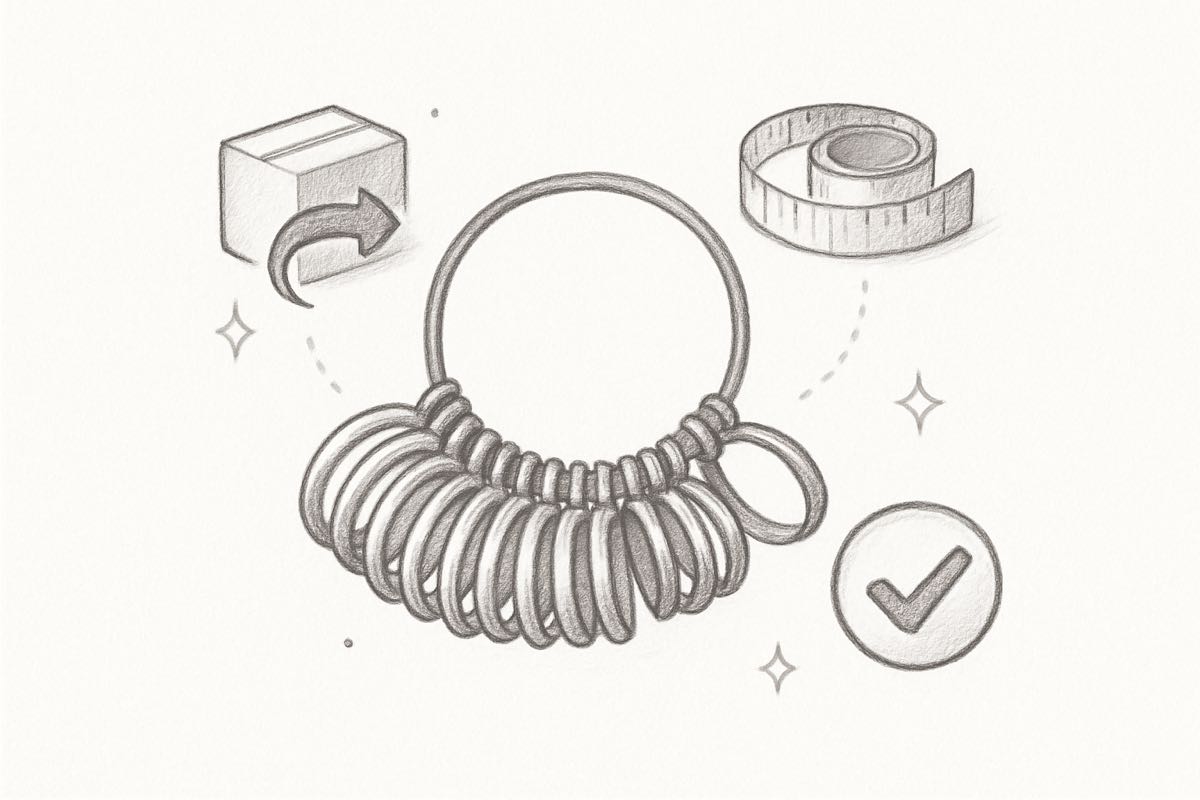
Sizing is the single biggest cost center in jewelry customer service. It drives returns, exchanges, CS volume, and refund losses. You cannot eliminate it. You can reduce it hard.
Here's the playbook, front to back:
Before the sale
- Free sizing kits or printable sizers: Offer a free ring sizer. Budget maybe $1 per kit, way cheaper than a $50 return.
- Detailed size charts: Include mm, US, UK, EU. Show the chart next to the add-to-cart button, not three clicks deep.
- Virtual try-on: For fashion rings and earrings, AR try-on cuts returns. Worth it if your AOV is high enough.
- Live chat or phone nudges: If a customer hovers on a $1,500 product for two minutes, pop a chat. "Need help with sizing? A specialist is free now."
At checkout
- Size confirmation screen: A single confirmation pop-up that asks "Is this size correct? Most customers go up a quarter size for comfort." Reduces returns measurably.
- Gift messaging: If it's a gift, warn the buyer to check size with the recipient's existing ring before ordering. Or offer a gift receipt that allows resize.
Returns and exchanges
- 30-day minimum return window: This is the floor. Anything less signals cheap.
- Exchange-first flow: When a customer enters the returns portal, offer size exchange first. Full refund is option two. Loop Returns and ReturnGO both support this.
- First resize free: Brilliant Earth and James Allen both offer one free resize within the first year. Match it. The loyalty math beats the repair cost.
- Clear process: Customer portal. Prepaid insured shipping label. Status updates via SMS.
For deeper returns design, see ecommerce returns management and how to reduce refund rate on Shopify.
One more thing. When a return call happens, your script should open with "I'd love to help. Are you looking to exchange for a different size or style first, or process a refund?" That one sentence has kept the sale in many exchanges we've analyzed.
Trust, transparency, and warranty communication
Jewelry is a trust business. The moment a customer feels a brand is hiding something, they walk. And they leave the one-star review on their way out.
Trust comes from three habits:
- Plain English policies: Your return, repair, and warranty pages should read like a human wrote them for another human. Avoid legal jargon. Avoid hidden clauses. A two-sentence warranty policy is more trustworthy than two pages of fine print.
- Proactive warranty explanation: Every order confirmation email should recap the warranty in three bullets. Every CS agent should reference it by name during calls. If your support team can't explain the warranty in under 15 seconds, customers can't either.
- Sourcing transparency: Lab-grown vs natural. Metal purity. Ethical mining certifications. Put it on the product page, not in an FAQ. Building trust on your online store is the long version of this.
Repairs are where trust compounds. A customer drops off a ring for resize. They have no idea what happens next. Your job: send an SMS when you receive it, another when the repair is done, and a final one when it ships back. Three touchpoints, zero anxiety.
For the small DTC brand, the hardest part is handling repair inquiries at volume. One repair call can take 15 minutes of back-and-forth on status. An AI phone agent tied into your repair tracker answers "is my ring ready" in ten seconds without bothering your jeweler. See ecommerce customer service best practices for the broader framework.
The jewelry customer service tech stack
You don't need ten tools. You need four or five that cover the channels that matter.
Here's the stack we'd build for a DTC jewelry brand on Shopify doing $1M-$10M in revenue:
| Layer | Tool | Purpose | Price |
|---|---|---|---|
| AI phone support | Ringly.io | 24/7 calls, sizing, WISMO, returns | From $99/mo |
| Helpdesk | Gorgias | Shopify-native ticketing, email, chat | From $10/mo |
| Returns | Loop Returns | Exchange-first returns flow | From $29/mo |
| SMS | Postscript or Attentive | Order updates, repair status | Usage-based |
| Review management | Yotpo or Judge.me | Collect and respond to reviews | From $15/mo |
For full comparisons, check out the best Shopify customer service apps and customer service software options.
Some notes on each layer:
- Phone support (Ringly.io): For jewelry, this should be your first tech hire. It replaces after-hours coverage that nobody else can afford. If you're comparing, see the shopify AI voice support guide. Alternatives: hiring a dedicated support rep ($50K+/yr) or using a generic answering service ($2-3/min with no product knowledge).
- Helpdesk: Gorgias is built for Shopify and integrates cleanly. If Gorgias pricing scales faster than your revenue, look at the Gorgias alternatives list or Zendesk alternatives for leaner options.
- Chat: Tidio works at small scale. Tidio alternatives and Intercom alternatives cover mid-market. Keep in mind: for high-AOV jewelry, chat is secondary to phone.
- Returns: Loop Returns is the category leader for Shopify. Exchange-first flows save more margin than anything else on this list.
- SMS: Postscript and Attentive both have jewelry brand case studies. Use it for transactional updates before marketing.
If you're running a lean team, Ringly plus Gorgias plus Loop is the minimum viable stack. Everything else can wait until you scale.
Try Ringly.io for free and see what AI phone support sounds like for your store.
Metrics every jewelry brand should track
If you're not measuring it, you're guessing. Pick four or five KPIs and review them weekly.
- First response time by channel: Phone under 60 seconds. Chat under 2 minutes. Email under 4 hours. Benchmark and improve. See customer service response time benchmarks.
- First call resolution rate (FCR): Industry average is 70%, per SQM Group's 2025 benchmark. Anything under 60% signals process problems. Read first call resolution for ecommerce.
- CSAT post-interaction: Send a one-question survey after every support contact. Target 90%+ satisfaction.
- Return rate, by reason: Don't just track total returns. Track reasons. If "size" is 40% of your return volume, that's your sizing playbook failing.
- Call abandonment rate: How many callers hang up before reaching anyone? If after-hours abandonment is above 30%, you need AI phone support now.
- Cost per contact: Ecommerce average is $2.70-$5.60. AI-handled calls drop that to under $1. See cost per contact benchmarks.
- Repair turnaround time: From drop-off to ship-back. Target two weeks or better.
- Net Promoter Score (NPS): Quarterly. It's the best single indicator of whether your customers will come back.
For a deeper breakdown of KPIs, see customer service KPIs for ecommerce and our guide to 24/7 customer support for ecommerce.
A quick sanity check: if your FCR is over 70%, your first response time is under 60 seconds on phone, and your return rate is under 15%, you're doing better than most jewelry brands online. If any of those are off, that's your next project.
Related reading
If this helped, these go deeper on adjacent angles:
- candle brand customer service — the full playbook for fragile, scent-based DTC
- Shopify Plus phone support — what Plus gets you and how to offer phone to shoppers
- how to handle angry customer calls — seven-step framework, five scripts, and phrases to avoid
Frequently asked questions
What's the best way to handle after-hours calls for a jewelry brand?
The most cost-effective option is an AI phone agent like Ringly.io that answers 24/7, pulls order data from Shopify, and handles routine calls (WISMO, sizing, returns) without a human. Anything complex gets queued for your team in the morning. It replaces a $40K+ annual after-hours hire.
Should a small jewelry Shopify store offer phone support?
Yes, especially if your AOV is over $100. Jewelry customers want to talk to someone before spending real money. If hiring isn't in budget, an AI phone agent gives you phone coverage for a few hundred dollars a month.
How do I reduce returns driven by ring sizing?
Offer a free sizing kit or printable sizer before purchase, add a size confirmation pop-up at checkout, and make the first resize free within the first year. Exchange-first returns flows also catch customers who'd otherwise refund and leave.
What is a reasonable response time for jewelry customer service emails?
Under 4 hours during business hours. Under 24 hours for complex cases. For high AOV purchases, same-day response is the expectation. Anything slower and customers assume you've ghosted them.
Can AI handle customer service for a luxury jewelry brand?
Yes for routine calls, WISMO, sizing questions, repair status, and basic returns. No for custom design consultations, high-value complaints, or appraisal work. The best setups use AI for the 70% of routine inquiries and route the rest to human experts.
What tech stack does a DTC jewelry brand need for customer service?
For a Shopify store doing under $10M: Ringly.io for phone, Gorgias for helpdesk, Loop Returns for returns, and SMS via Postscript or Attentive. Total monthly cost runs $500-$1,500 depending on volume. That's cheaper than one full-time agent.
How do I manage repair requests without drowning my team?
Automate the status updates with SMS, use AI phone support to answer "is my ring ready" inquiries, and publish clear turnaround expectations on your repair request page. The goal is to eliminate the "is it done yet" follow-up, which is 80% of repair call volume.
The one takeaway
Your customers are spending real money and feeling real emotion. Treat your jewelry brand customer service like it matters that much. Cover phone for high-AOV trust calls. Use AI for the 24/7 coverage you can't afford to staff. Fix your sizing returns. And track the metrics that tell you the truth.
If you're on Shopify and ready to see what AI phone support can do, try Ringly.io for free. Setup takes under 1 hour.