

Running customer service for a candle brand is not the same as running it for a t-shirt shop. Your product arrives in glass, half your customers are buying a gift, nobody can actually smell the thing before they pay, and Q4 swallows 50% of your year in about six weeks.
One founder at Hotel Lobby Candle put it bluntly. During one BFCM, orders poured in faster than the team could ship. November orders didn't go out until January. That's a customer service tsunami most guides don't prepare you for.
This post is the playbook we'd write if we had to set up support for a candle brand from scratch tomorrow. The ticket types you'll actually get, the channels that are worth paying for, the scripts that work, the policies you need published today, and the one tool most small candle brands aren't using yet (that handles the phone without hiring anyone). Real brands, real numbers, no filler.
Hear what AI support calls sound like for your store. Just paste your Shopify URL and hear sample calls for your store, no email required. Listen to demo calls for my store.
Why candle brand customer service is its own thing
Most ecommerce support advice is written for generic DTC: "respond fast, be empathetic, reduce effort." That's fine. But if you run a candle brand, there are four problems baked into your category that nobody else has at the same intensity.
You ship a fragile product. Glass jars, wax that melts in summer heat, packaging that almost always costs more than you want to admit. The industry rule of thumb is 4-8% breakage in DTC shipping. That's one damaged-candle ticket for every 12-25 orders on a good day.
Your product is a scent. Customers can't smell your candles online. That uncertainty turns into refund requests for "no scent throw" or "not what I expected." It also turns into returns from people whose nose just doesn't agree with your fragrance choices.
Half your purchases are gifts. Wrong shipping address, the recipient opens an invoice, the gift-wrap option was missed. Gifting adds a whole extra layer of edge cases that a protein powder brand never has to touch.
Your year is lopsided. The global scented candles market hit $2.24 billion in 2024 and is projected to reach $3.47 billion by 2033, according to Grand View Research. But the revenue inside each brand is wildly seasonal. Q4 commonly represents 50% or more of annual revenue for DTC candle brands. You either prepare for the six-week crush or you get buried by it.
If you lead with this reality instead of fighting it, your ecommerce customer service ends up tuned to the actual job, not copied from a SaaS support playbook.
The 7 tickets you'll actually get
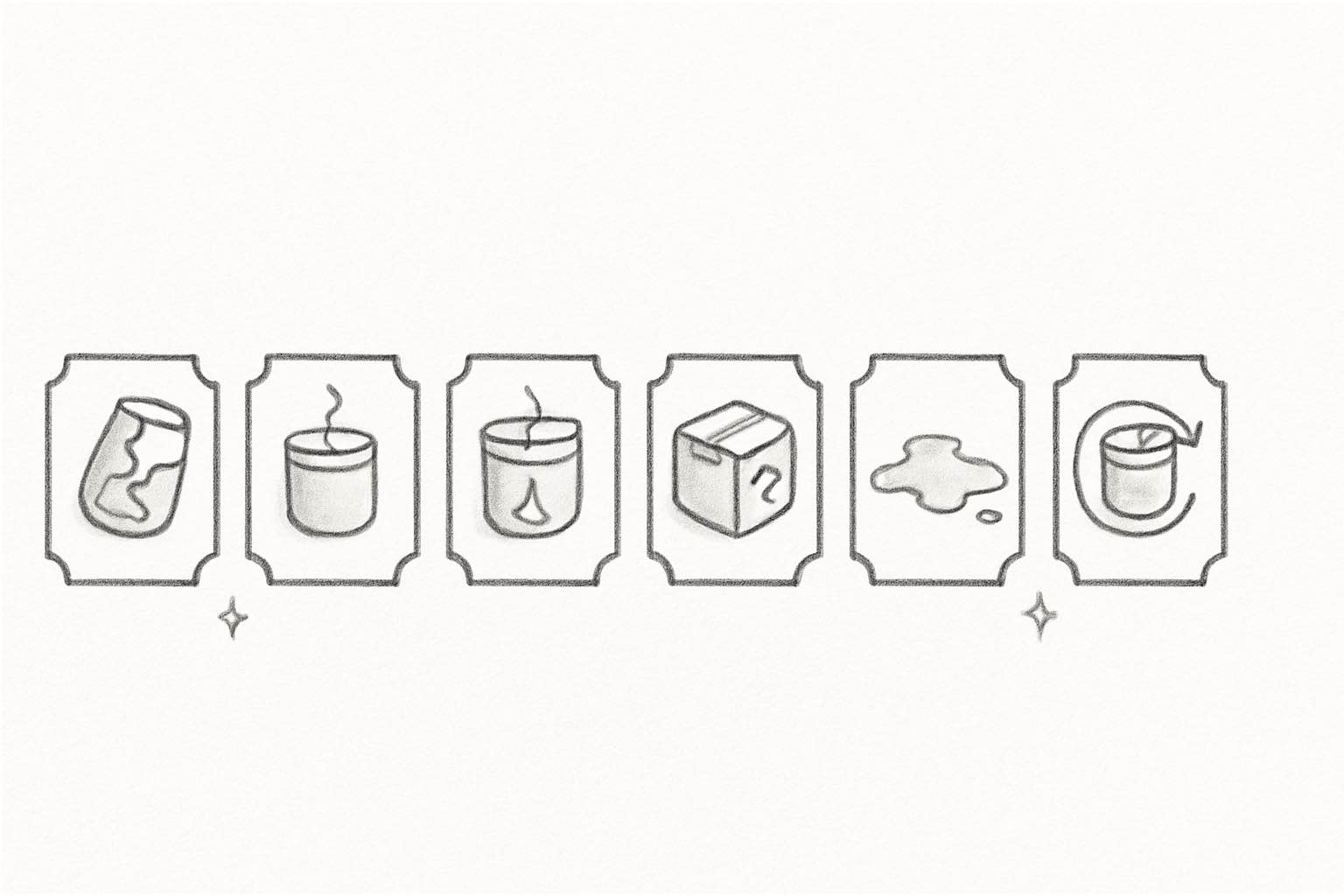
Your support queue is predictable. Build workflows and macros around these seven and you'll handle 90% of volume without thinking.
- Broken on arrival: shattered glass, cracked jar, wax leaking. Request a photo of the box and the broken item within 7 days. Ship a replacement with tracking. Don't make the customer return the broken pieces. Audit the packaging monthly, because breakage rates creeping above 5% usually point to a single SKU or a single carrier.
- No scent throw: "cold throw smells great, doesn't smell when I burn it." Sometimes it's the candle. Often it's room size, short burn sessions, or a cold draft. A short education-first email solves more of these than a refund does. Link to a burn guide and ask a follow-up before refunding.
- Tunneling: wick burns straight down, leaves wax on the sides. Usually a short first burn. Send a wick-trim and full-melt-pool guide. Offer a partial credit if the customer tried and it still happens.
- Wrong gift address: the holiday classic. Reach out to the carrier to intercept. If it's already delivered, ship a second and eat the cost on gifts under $50. The goodwill pays for itself.
- Where is my order: WISMO calls and emails make up 30-50% of ecommerce support tickets normally, and spike to 70-80% during BFCM, according to 17track's WISMO research. Proactive SMS and tracking emails kill most of these before they arrive. For the full call-side picture, see our piece on WISMO calls.
- Wax melt or heat damage: summer orders that arrive as a puddle. Set a refuse-to-ship rule above 85°F for destinations or use cold-pack shipping for premium SKUs.
- Refund for a used candle: the grey zone. Publish a clear policy (Bath & Body Works takes them back, Kringle doesn't). Pick your lane and stick to it.
Most of these tickets cost real money. WISMO alone runs $5 to $22 per contact when a human resolves it. The math of how to reduce your refund rate on Shopify starts with sorting these categories and attacking them in priority order, not treating them like unique problems every time. For the refund side specifically, pair that with a real process for ecommerce returns management.
Channels that actually work for candle brands
Every brand wants to be everywhere. Most small candle brands should pick two channels, staff them properly, and add the third only when they can afford to.
| Channel | Best for | Downside | Realistic cost |
|---|---|---|---|
| Any non-urgent issue, gift orders, returns | Slow, customers expect a reply within hours | $0.50-$2 per ticket (with tool) | |
| SMS | Shipping updates, delivery windows | Easy to get blocked if abused, opt-in required | $0.01-$0.03 per message |
| Live chat | Pre-purchase scent questions, fit-to-gift | Pointless if unstaffed, worse than nothing | Human time ($15-$30/hr) |
| Phone | Premium buyers, anxious gift recipients, complex issues | Expensive to staff, terrible hold times hurt brand | $6-$12 per call, more at peak |
| AI voice agent | 24/7 order lookups, returns, FAQs | New category, brands still evaluating | $0.20-$0.50 per call |
Email is the default, and it's still the workhorse. Aim for first-response under 4 hours during normal season and under 2 hours during Q4. Best-in-class ecommerce teams hit 30-60 minutes, according to 2026 customer service response time benchmarks. Sub-1-hour responses achieve 71% customer retention versus 48% for 24-hour responses.
SMS is underused by candle brands. Shipping updates via SMS kill 30% of WISMO tickets instantly. Keep it to notifications and opt-in order updates, not support conversations.
Live chat converts. Hyggekrog, a Danish boutique candle brand, hit 32.94% click rates on email campaigns, but the brands that layer chat on pre-purchase scent questions convert better than the ones that don't. The catch is staffing. If nobody is answering, it becomes a credibility problem.
Phone support is where candle brands split. The big players all have it. Yankee (877-803-6890), Candles.com (800-942-5736), CandleScience (888-266-3916). The small players skip it and send every caller to email, losing the anxious gift-buyer and the premium shopper in the process. The answer isn't "hire a call center." It's using voice AI for customer service so you can pick up every call without hiring another human. Our deeper breakdown of ecommerce phone support walks through the specifics.
AI voice agents are the new option. A well-tuned AI agent handles order status, returns, scent recommendations, and escalates the hard stuff. If you're deciding between chatbot versus phone support, the honest answer is you probably need both, but AI phone handles the higher-intent buyer at a fraction of the cost. For the full product-category picture, see our guide on AI voice agents for customer support.
If you're on Shopify, Ringly.io gets Seth answering your calls in under 1 hour. Try it for free.
Policies you need published before anything else
Half the fights customers pick start because your policy isn't written down. Get these five on the site this week.
- Returns policy: 30 days minimum, unused and in original packaging. Model after Kringle Candle, which accepts unused returns within 30 days and issues refunds in 1-2 business days. Or go longer: CandleScience offers a 60-day guarantee and covers return shipping on defective items. Pick your lane, publish it clearly.
- Damage policy: photos within 7 days, one-time free replacement, customer keeps the broken pieces (don't make them ship back glass). This is what Kringle does: "email customerservice@kringlecandle.com with photos" and a refund is issued.
- Heat-season shipping: publish a refuse-to-ship rule above 85°F for destinations, or automatic cold-pack shipping for premium SKUs. Customers appreciate the heads-up. It prevents a melted wax nightmare.
- Gift-order policy: who gets the invoice (no price on packing slip, please), how to redirect an incorrect shipping address, gift message handling, return routing back to the buyer not the recipient.
- Shipping cutoff policy: exact date AND time AND timezone for Christmas delivery. Post it on the homepage by November 1. The #1 BFCM complaint across candle brands is "it didn't arrive in time for the holiday," and a vague cutoff date makes it worse.
For the returns side, we have a full breakdown of Shopify return policy best practices that works equally well for candle DTC brands.
Scripts that handle the hard conversations
Canned responses are fine. Scripts that actually save the relationship are better. Keep these close during peak season.
Broken on arrival: "I'm so sorry your [candle name] arrived broken, that's the worst first impression. Can you send a photo of the box and the broken jar? I'll ship a replacement today. No need to return the pieces. We'll also flag this order with our packaging team so we can figure out what went wrong."
No scent throw (educate, don't gaslight): "Thanks for reaching out. A couple quick things before I ship a replacement so we can make sure you actually enjoy the candle. What's the size of the room you're burning in, and how long have you been letting the candle burn in one sitting? Scented wax often needs 2-3 hours to reach a full melt pool and release the fragrance. If you've tried that and it's still not throwing, I'll send a replacement in a different scent you prefer."
Missed holiday delivery: "I know this is the last thing you want to hear and I'm really sorry. [Carrier] marked it [status], which we missed. I'm shipping a second candle overnight at our cost, and I've refunded your shipping. We can't fix that it didn't arrive in time, but I want to make this right."
Used-candle refund request: "Thanks for letting us know. Our return policy covers unused candles within 30 days, so I'm not able to process a full refund for a candle that's been burned. What I can do is offer a 20% credit toward a different scent, on me. Sometimes the first scent isn't the right fit and I'd rather help you find one you love than lose you as a customer."
These lean on the same principles we cover in our customer service scripts guide. For a deeper process on complaint handling specifically, our guide on how to handle customer complaints in ecommerce walks through the 8-step framework.
Planning for Q4 (the six-week crush)
Q4 is not a quarter for candle brands. It's a crisis you schedule. Plan for it like a military op and you'll come out the other side with customers who love you.
- Forecast from last year plus 30%. If you're new, use category benchmarks. Have inventory in place by early October. Wholesale suppliers get slow in Q4, you don't want to find out in mid-November.
- Staff up three to four weeks before BFCM, not after. Temp reps take two weeks to be useful. Hiring on Black Friday is hiring someone who won't know your product until after Cyber Monday.
- Publish shipping cutoffs by November 1. Exact date, exact time, exact timezone. For every destination. Put it on the homepage, in the cart, in the footer.
- Turn on SMS order updates before the rush. This alone kills 30% of the WISMO ticket volume.
- Pre-write canned responses for the top 5 holiday issues: "shipped but not arrived," "gift to wrong address," "didn't come in time," "broken in transit," "item now out of stock."
- Extend support hours or plug in AI phone for after-hours. Customers call at 11pm on December 22nd asking about their gift. Someone needs to answer.
The Hotel Lobby Candle story from Shopify is the cautionary tale. Their BFCM meltdown left orders from November sitting until January. Founder Lindsay Silberman described it simply: "things will come up, there's no time off." The brands that survive Q4 plan for the worst and staff for the volume.
Our full guide on ecommerce customer service during peak season covers the scaling playbook, and the specifics of Black Friday customer service walk through the hour-by-hour prep. If your phone lines are the bottleneck, we've written specifically about how to handle high call volume in ecommerce.
When to add phone support (even as a small brand)
Most small candle brands skip phone. They're wrong, but the reason is understandable: hiring a rep costs $35-50K/year, and covering even 9-5 five days a week means one person, no backup, and a lot of missed calls.
The math shifts the moment your average order value crosses about $35. A premium Nest reed diffuser sells for $68-88. A Yankee holiday gift set pushes $60 easily. At those prices, each missed call is real revenue walking out the door, because the anxious gift-buyer won't email. They'll call your competitor.
Phone still matters for candle brands specifically because:
- Gift buyers are anxious and want to talk to a human (especially in Q4)
- Scent consultations convert higher when done live
- Order status calls want instant answers, not a ticket queue
- Premium brands need to sound like premium brands
The new option is an AI phone agent. Ringly.io is what we build, and Seth (our AI agent) answers your calls 24/7. Seth looks up orders in real time via native Shopify integration, processes returns, answers product questions, and escalates the hard calls to a human on your team. The platform has handled 200,000+ calls, resolves up to 90% of calls without human intervention, speaks 40 languages, and goes live in under 1 hour without code.
Pricing: $99 a month for the first 50 conversations, then $1.99 each. Full Ringly.io pricing is public. A Shopify-native option at that price point beats hiring a single phone rep by about 90% on cost. For the deeper dive on how this works, our guide to AI phone agents for Shopify covers what to look for.
If you want to see how this handles your candle store specifically, paste your Shopify URL and hear sample calls for your store. Try Ringly.io for free.
This matters extra for small teams. We have a full guide on Shopify customer service for small teams that walks through the stack piece by piece, and after-hours customer service on Shopify covers the 24/7 angle. For the full product view, see our AI customer support phone agent for Shopify page.
The KPIs worth tracking
Candle CS should be measured against numbers, not vibes. Here's the short list.
| Metric | Target | Why it matters |
|---|---|---|
| Breakage rate | Under 3% | Higher means packaging or carrier problem |
| First response time (email) | Under 4 hours | Under 1 hour = 71% retention |
| First call resolution | Above 70% | Saves repeat contacts, improves CSAT |
| Full resolution time | Under 24 hours | Customer memory fades after that |
| Refund rate | Under 5% | Higher = product or expectation problem |
| Tickets per 100 orders | Under 10 | Higher = product, shipping, or policy friction |
| Customer effort score | 4+ out of 5 | How hard was it to get help |
Breakage rate deserves extra attention. If you're above 5%, don't hire more support. Fix the packaging. The fix is always cheaper than the tickets.
For deeper measurement frameworks, our guide on customer service KPIs in ecommerce covers the full list and how to implement them. For the first-call-resolution specifically, see first call resolution in ecommerce.
Related reading
If this helped, these go deeper on adjacent angles:
- jewelry brand customer service — sizing, repairs, and high-AOV trust signals
- coffee subscription customer service — pause/skip/cancel policies, WISMO, and peak-season prep
- how to handle angry customer calls — seven-step framework, five scripts, and phrases to avoid
Frequently asked questions
How do candle brands handle broken-in-transit orders? Request a photo of the box and the damaged item within 7 days. Ship a replacement at no cost. Don't make the customer return broken glass, it's a safety issue and they already feel bad. Track breakage rate monthly and fix the packaging if it climbs above 5%.
Should a small candle brand offer phone support? Yes, once your average order value is above $35. Anxious gift-buyers and premium shoppers won't email. The catch is that hiring a rep is expensive. An AI phone agent covers 24/7 at a fraction of the cost and handles 70%+ of calls without human intervention.
What's a fair return policy for scented candles? 30 days for unused candles, in original packaging, with the customer paying return shipping unless it's your error. Longer is better if you can afford it. CandleScience uses 60 days and Kringle uses 30, both work. Damaged items should always be replaced free.
How do candle brands handle Black Friday customer service volume? Forecast last year plus 30%, staff up 3-4 weeks before, publish exact shipping cutoffs by November 1, turn on SMS order updates to kill WISMO volume, and use AI phone support for the hours your humans can't cover. Hotel Lobby Candle's meltdown (November orders shipping in January) is what happens without this prep.
What tools do Shopify candle brands use for customer service? Most brands use Gorgias or Shopify Inbox for email and chat. SMS goes through Klaviyo or Attentive. For phone, the old option is Gorgias Voice or a hosted VoIP. The newer option is an AI phone agent like Ringly.io that plugs into Shopify for real-time order lookups.
Can AI handle candle customer service calls? Yes, for the majority of routine calls. Order status, returns, scent recommendations, store hours, and product questions are well within what modern AI phone agents handle. Complex complaints and emotional gift-buyer situations still benefit from a human escalation, which a good system like Seth at Ringly.io handles automatically.
What should candle brands do when a candle arrives with no scent? Don't refund immediately. Ask about room size and burn duration first. Many "no scent" complaints are short first-burn sessions or oversized rooms. If the customer has burned it for 2-3 hours and still can't smell it, replace the candle in a different scent. During COVID, a Newsweek investigation found that spikes in "no scent" reviews correlated with anosmia waves, not product failure. Ask before assuming.
Bottom line
Candle customer service is niche. The generic ecommerce advice misses the fragility, the scent uncertainty, the gift volume, and the Q4 compression that define this category. Build your workflows around the seven real ticket types. Publish the five policies before you need them. Staff your channels honestly, adding AI phone where the math works. And run Q4 like the operation it actually is.
If you're on Shopify and want AI phone support live in under 1 hour, Ringly.io is where to start. Try it for free.