
Picture this. A creator on TikTok wears your new lip shade at 9 PM on a Wednesday. By midnight, your phone is ringing every 90 seconds. By Thursday morning, your two-person CX team has 47 voicemails, your inbox has 312 unread emails, and the orders that converted off the spike are now stuck behind questions about shade, undertone, and "will this work on me?"
This is the cosmetics phone problem. It is not the same as the apparel phone problem, and it is not the same as the skincare phone problem. Cosmetics is color-led. That means shade matching, gift returns, allergic reaction calls, sample requests, and surge weeks that scale 5-10x normal volume without warning. None of that maps cleanly to a generic call center playbook.
AI phone support is built for exactly this shape of demand. It handles the predictable scripts (shade match, return, order status) without flinching, scales to 50+ simultaneous calls during a drop, and escalates the high-stakes calls (reactions, complaints, wholesale) to a human in seconds. This guide walks through what AI phone support actually does for a cosmetics brand, where it earns its keep, where it breaks down, and which platforms are worth a look in 2026.
Editor's note. If you run a $10M-$100M Shopify cosmetics brand with a paid helpdesk and a visible phone line, the drop-day 5-10x call spikes and the post-holiday gift-return wave are the line items chewing your CX margin. Book a 30-min call and we'll walk through your last 7 days of missed calls live.
Why cosmetics is different from every other Shopify vertical
Cosmetics is the most call-driven e-commerce vertical we work with. The reasons are specific and stack on each other.
Color is high-stakes. Foundation that runs orange in your bathroom mirror gets returned. Lipstick that photographed magenta and shows up coral gets returned. According to Klarna's 2024 beauty returns report, roughly 30% of beauty returns are color or shade-related. That single category is more expensive than every other return reason combined.
Drops break staffing math. A scheduled launch day, a TikTok moment, an influencer wearing your product, any of these can 5-10x your call volume for 24-48 hours. You can't staff for it. You can't unstaff after it. Either you accept the missed calls (and the missed orders that go with them) or you keep a team sized for the spike and burn money the other 28 days of the month.
Gifts complicate returns. Per NRF holiday data, about 25% of November-December cosmetics sales are gifts. The person calling support didn't buy it, has no receipt, may not know the exact shade, and wants something specific in exchange. Your return policy has to flex to handle this, and your phone team has to know exactly when to issue store credit vs. send a replacement.
Reactions are real. Fragrance, parabens, retinol, pigments. Cosmetics has more allergic-reaction call risk than apparel or pet supplies. These calls have to escalate to a human every single time, with the right info captured up front.
The call type breakdown looks like this across the cosmetics DTC brands we work with:
| Call type | % of inbound | Best handler |
|---|---|---|
| Order status / WISMO | 30-40% | AI resolves |
| Returns / exchanges | 15-25% | AI resolves most |
| Shade / product questions | 15-20% | AI resolves with KB |
| Subscription management | 5-10% | AI resolves |
| Cancellations | 3-5% | AI resolves |
| Complaints / refund pushback | 3-5% | AI escalates |
| Allergic reaction | 1-3% | AI escalates |
| Wholesale / B2B | 1-2% | AI escalates |
About 70-80% of the volume is the kind of repeatable call AI was built to handle. The remainder is exactly where you want a human, and the right platform makes that handoff clean.
What AI phone support actually does for a cosmetics brand
The product is simple to describe and harder to do well. A customer calls your business number. Instead of going to voicemail or sitting on hold, an AI voice agent picks up, asks what they need, and handles it.
For cosmetics specifically, the calls AI takes look like this:
- Order status: "Where's my Pat McGrath order? It was supposed to ship Friday." The AI checks Shopify, reads the tracking, gives the customer the answer.
- Returns and exchanges: "I bought shade 220 and it's way too dark, can I exchange for 210?" The AI looks up the order, confirms the policy window, generates the return label, swaps for the new shade.
- Shade and product questions: "I'm NC25 in MAC, what should I order in your foundation?" The AI pulls your shade-finder logic or KB, asks 1-2 qualifying questions, recommends a match.
- Subscription management: "Skip my next box," "swap to a different shade," "pause for 30 days." Pulled straight from Shopify, executed in real time.
- Sample requests: "Can you send samples of foundations 220, 230, and 240?" The AI captures the request, opens a ticket, ships per your policy.
- After-hours catch: Influencer drops a tutorial at midnight, the AI catches every call until your team gets back in the next morning.
And outbound:
- Abandoned cart rescue: Cosmetics has one of the highest cart-add rates and lowest desktop conversion rates in e-commerce. Outbound calls to recover abandoned carts move the needle here.
What it does not do: diagnose skin conditions, replace a makeup artist, or override a hard "no returns on sale items" rule that you set. The AI works inside whatever rules you give it.
The shade-match problem (and how AI handles it)
This is the call that costs cosmetics brands the most money when it goes wrong. Roughly 30% of beauty returns are color-related (Klarna 2024). Every "wrong shade" return costs $10-$25 in reverse logistics, restocking, and reslotting, before you factor in the customer trust hit if you've shipped the wrong shade twice.
AI handles this exactly the way a good agent would. It scripts a short conversation, asks the qualifying questions, then makes a recommendation or escalates.
A typical AI shade-match dialogue looks like this:
Customer: "I'm trying to figure out which foundation to order. I'm pretty light but I get tan in summer."
AI: "Got it. Quick question, what's your undertone, warm, cool, or neutral? If you're not sure, do your veins look more green (warm), more blue (cool), or a mix (neutral)?"
Customer: "Blue, I think. Cool."
AI: "Cool undertone, light-to-medium range. Most customers with that profile go with our Shade 210 in fall and winter, then 220 in summer. We also offer a free sample pack of three shades for $5 shipped, want me to send that instead so you can try first?"
When the call exceeds the AI's confidence (custom shades, redness or melasma, foundation for the darkest or lightest end of the range where matching is hardest), it escalates to your human team with the call context attached. Your team picks up a warm call, not a cold one.
The same logic applies to lipstick (warm vs cool reds), eyeshadow (which finish for which skin tone), blush (peach vs pink), concealer (yellow vs salmon corrector), and any other color-led product where a question is worth asking before the order ships.
Gift returns without a receipt (the holiday landmine)
About 25% of November-December cosmetics sales are gifts (NRF). The post-holiday return wave runs from January 2 through the end of the month, and it is the call type your team dreads.
The recipient doesn't have a receipt. They may not know the exact product name. They want a specific outcome (different shade, different color, store credit) and they're often a little tense about the whole conversation.
AI handles gift returns by working through lookup paths in order:
- Gift recipient email if the gifter included it
- Purchaser email if the recipient knows it
- Gift card code if there is one
- Order number on the packing slip if they still have the box
- Product name + approximate purchase date as a fallback
Once the order is located, the AI executes your policy. If you offer store credit for giftless returns, the AI offers it. If you allow exchanges within 60 days, the AI generates the return label. If the request falls outside policy, the AI explains why and offers the closest alternative.
The reason this matters: post-holiday return calls are about 2-3x normal January call volume for a cosmetics brand. If you handle this with humans only, you're either staffing up for January (expensive) or you're letting customers wait on hold (expensive in churn). AI takes the bulk of it and your team handles the edge cases.
How AI handles allergic reaction calls
This is the highest-stakes call type in cosmetics, and it's the one you need to be most careful about.
The rule, in every cosmetics AI implementation we ship, is the same: AI never diagnoses, always escalates. No exceptions.
A reaction call goes like this:
- AI recognizes the keywords ("rash," "broke out," "reaction," "allergic," "burning," "swelling")
- AI captures the basics: product name, batch number if it's on the packaging, symptoms, customer's contact info, order number
- AI offers an immediate refund per policy
- AI transfers to a human within seconds, or schedules a callback if it's after hours, with the full call context attached
- The case is flagged in your helpdesk for follow-up
Why this matters more in cosmetics than skincare: color cosmetics use fragrance, dyes, mica, and pigments at higher concentrations than most skincare. Reactions are more common with lipstick, blush, and eyeshadow than with a basic moisturizer. The escalation path is non-negotiable.
If you want to see the voice AI rules we apply to customer service calls more broadly, the same logic applies: AI does the resolvable work, humans handle anything with risk or emotional charge.
Holiday drops and launch days (the volume problem AI was built for)
This is the part of the cosmetics CX problem that breaks every other solution.
A Fenty drop, a Rare Beauty launch, a Pat McGrath lip release, a Charlotte Tilbury limited shade. Any of these can 5-10x your phone volume for 24-48 hours. BFCM is a 3-6x week. Mother's Day adds about 2x for the week leading up. Valentine's Day adds another 1.8x with concentration on the 12th to 14th.
Human teams cannot staff for this. A 4-person team can handle 80-120 calls a day comfortably. A drop day can push that to 600-1,200 calls. Hiring temps takes weeks, training them takes longer, and you're stuck with payroll the other 28 days of the month.
Here's the cost math on a 3,000-call surge over 48 hours.
| Approach | Cost | Calls handled | Wait time |
|---|---|---|---|
| BPO at $7/call | $21,000 | 3,000 | Varies, often 5-15 min |
| BPO at $16/call | $48,000 | 3,000 | Varies |
| In-house overtime | $8,000-$15,000 | 800-1,200 | Long, many missed |
| AI at $0.42/call | $1,260 | 3,000+ | None, instant pickup |
The AI number assumes our internal Ringly resolution rate of 73%. The rest escalate to your team. Your team handles a quarter of the calls instead of all of them, and the customer experience stays consistent through the spike.
The other thing AI does on drop day: it answers in 40 languages. If you're shipping globally (which most growth-stage cosmetics brands are), you don't have to staff a French speaker, a German speaker, and a Japanese speaker for a 48-hour window.
Comparing AI phone support options for cosmetics brands
We've reviewed every platform that gets pitched to cosmetics DTC operators in 2026. Here's how they compare.
| Provider | Best for | Starting price | Shopify-native | Free trial |
|---|---|---|---|---|
| Ringly.io | Shopify cosmetics brands | $349/mo | Yes | 14-day on Pro |
| Siena AI | Chat-first AI concierge | Custom (est. $500+/mo) | Partial | Custom demo |
| Smith.ai | Hybrid human + AI | $292.50/mo | No | 14-day trial |
| Gorgias Auto-respond | Existing Gorgias users | Bundled with Gorgias | Yes (helpdesk) | 7-day Gorgias trial |
| Goodcall | Very small businesses | $59/mo | No | 14-day |
| Build-your-own (Retell, Vapi, Bland) | Brands with dev teams | $0.05-$0.15/min infra | No (you build it) | API credits |
1. Ringly.io: AI phone support for Shopify brands
Ringly is AI phone support for Shopify brands. Your team wasn't hired to answer the same shade-match question 50 times a day. Instead of growing your support headcount every time call volume goes up, the AI takes the routine inbound calls so your team can focus on the work that actually moves revenue.
The AI answers inbound calls 24/7. It finds orders in your Shopify store, processes returns and exchanges, answers product questions from your knowledge base, and rescues abandoned carts via outbound follow-up. Across 50+ brands, the AI resolves 73% of calls autonomously at roughly $0.42 per resolved call. Calls that need a human escalate cleanly to Gorgias, Richpanel, Reamaze, or whatever helpdesk you already run.
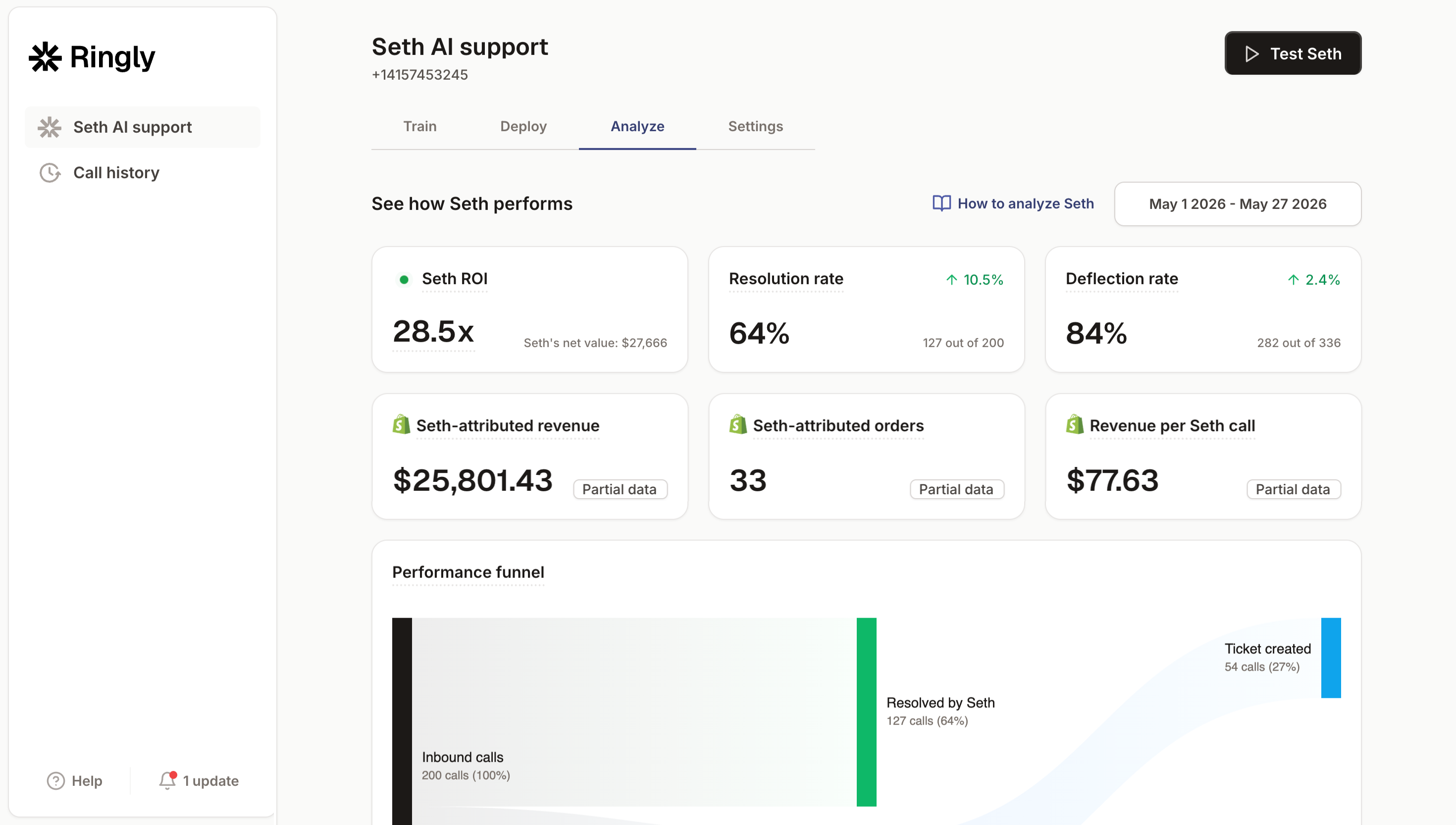
WashCo, a Shopify brand we launched, generated $22,664 in attributed revenue in its first 7 days post-launch. 271 calls handled, 85% deflection, 66% resolution, $0.91 per call vs $2.70 human-handled. WashCo is industrial cleaning, not DTC cosmetics. Treat the $22,664 as proof on AI phone resolution itself, not vertical match.
Pricing
| Plan | Price | Minutes | Best for |
|---|---|---|---|
| Grow | $349/mo | 1,000 (~500 calls) | First-timers, low volume |
| Pro | $799/mo | 2,500 (~1,250 calls) | Growing brands with clear phone volume |
| Enterprise | Custom | 5,000+ | High-volume drops, multi-region |
14-day free trial on Pro. 65% resolution guarantee: if the AI resolves under 65% of your calls in 90 days, we refund the last 3 months.
What works
- Shopify-native: pulls order, fulfillment, and customer data without custom dev
- Live in under an hour: add your site, docs, and KB and you're answering calls
- Helpdesk escalation: Gorgias, Richpanel, Reamaze, Zendesk all supported
- 40 languages: real for cosmetics brands shipping globally
- 65% resolution guarantee: money back if it doesn't perform
What doesn't
- Not built for B2B: wholesale or retailer inquiries need a human
- Cosmetics-specific shade logic requires good KB upfront: the AI is only as good as your shade-finder docs
Why it ranks 1st
Cosmetics is the vertical Ringly was built for. Shopify-native + voice-first + Q4 surge resilient = the closest fit on the market for a growing color brand.
2. Siena AI
Best for: brands that want a chat-first concierge experience and are willing to add voice as a secondary channel. Siena positions itself as an AI customer service concierge across chat, email, and SMS, with voice as a newer add-on. The brand stories on their site lean toward fashion and apparel rather than cosmetics.
Pricing
Not public. Quotes typically land between $500 and $2,500 per month based on volume.
What works
- Conversational chat quality: strong for product Q&A
- Brand-voice tuning: more developed than most competitors
- Email and SMS handling: well-built across both channels
What doesn't
- Voice is the newest channel: less mature than chat
- No published Shopify-native voice integration at the level of Ringly
- Pricing opacity makes budgeting harder
Why it ranks 2nd
Strong chat product. If your phone volume is light and your customers prefer text, Siena fits. For a drop-day phone spike, you want a voice-first platform. Check our take on Siena AI alternatives for a deeper comparison.
3. Smith.ai
Best for: service businesses and law firms that need premium human-AI hybrid answering. Smith.ai pairs AI with real humans. The phone is answered by AI for routine calls and by a human for the rest. It's not Shopify-native and the pricing reflects the human side of the model.
Pricing
| Plan | Price | Calls included |
|---|---|---|
| Starter | $292.50/mo | 30 calls |
| Basic | $747/mo | 90 calls |
| Pro | $1,485/mo | 200 calls |
What works
- Real humans on the other end for the calls AI can't handle
- Good for low-volume premium brands that want a concierge feel
What doesn't
- Per-call pricing is brutal at cosmetics volume: 1,000 calls a month easily clears $5,000
- No Shopify-native commerce logic: the human reads from notes, not your store
Why it ranks 3rd
The human element is genuine. But on a cosmetics DTC volume curve, the math doesn't hold. See Smith.ai alternatives for cheaper options that still cover the use case.
4. Gorgias Auto-respond
Best for: existing Gorgias customers who want AI to take some chat and email load off their queue. Gorgias is a helpdesk first. Their AI add-on, Auto-respond, handles chat and email well and is starting to do more on voice. If you're already paying for Gorgias, this is the lowest-friction option to layer AI in.
Pricing
Bundled into Gorgias plans, which start around $60/mo and run to $960/mo and up.
What works
- Already in your stack if you use Gorgias
- Strong chat + email auto-resolution
- Tight Shopify integration through the helpdesk
What doesn't
- Voice is not their strength: chat-first product, voice is bolted on
- Limited to the Gorgias environment: you can't run it as a standalone phone solution
Why it ranks 4th
Solid for chat. If voice is your main pain, this isn't the answer. Worth comparing in our Gorgias alternatives write-up if you're rethinking the whole helpdesk.
5. Goodcall
Best for: very small local businesses with under 200 calls/month. Goodcall is built for plumbers, salons, and small service businesses. It's affordable and easy to set up, but it isn't built for e-commerce.
Pricing
| Plan | Price |
|---|---|
| Pro | $59/mo |
| Growth | $99/mo |
| Premium | $199/mo |
What works
- Cheap: lowest entry point on the list
- Fast setup for simple use cases
What doesn't
- No Shopify integration: can't look up orders, can't process returns
- No surge capacity for drops: built for steady low-volume small businesses
Why it ranks 5th
If you're a 1-person cosmetics brand doing $5K/month, Goodcall is fine. Above that, you'll outgrow it in a quarter.
6. Build-your-own (Retell, Vapi, Bland)
Best for: brands with an in-house dev team and a 3-6 month timeline. These are infrastructure platforms. You get APIs, you build the voice agent, you wire it to Shopify yourself, you handle the prompt engineering. Cheap on raw inference, expensive on engineering time.
Pricing
$0.05-$0.15 per minute of voice infrastructure. Dev cost to ship production-grade typically runs $20K-$80K.
What works
- Maximum control: every prompt, every flow, every integration is yours
- Cheapest per-minute rate on the list
What doesn't
- You build it: no Shopify-native logic out of the box
- Long timeline: months to ship, weeks to iterate
- Maintenance is yours: model changes, voice quality, integrations all sit with your dev team
See Retell AI alternatives, Vapi alternatives, and Bland AI alternatives for the same workflow with less engineering lift.
Why it ranks 6th
Powerful, but the wrong tool for a cosmetics brand that wants to be live before the next drop. If you have engineers to spare, fine. If you don't, pick a Shopify-native platform.
What to look for when picking AI phone support for a cosmetics brand
The list of features that actually matter is shorter than the marketing pages suggest.
- Shopify-native integration: the AI has to read order data, customer data, and fulfillment status without custom dev work. Anything else is just a fancy voicemail.
- Shade-finder and product Q logic: the platform needs to handle a structured product conversation, not just FAQ retrieval. Test it on three of your toughest shade-match scripts before signing.
- Smart escalation paths: the AI needs to recognize reaction keywords, wholesale inquiries, and complaints and route them to a human within seconds. Test the escalation in your trial.
- Helpdesk integration: Gorgias, Richpanel, Reamaze, Zendesk. Whichever you use, the AI should feed escalations in with full context.
- Surge capacity: ask the platform what concurrent call limit your plan supports. For cosmetics, plan for 50+ simultaneous calls during drops.
- Holiday-ready setup time: can you go live in days, not months? If you're picking in October for a November launch, this is the gate.
- Multilingual: 40 languages covers most global brands. Verify the languages you actually need.
- Transparent pricing: flat-monthly with predictable overage beats per-minute or per-call when volume is spiky.
For a broader feature checklist that applies beyond cosmetics, see our Shopify voice agents and AI phone agents for Shopify guides.
How fast can you go live for a cosmetics brand?
Ringly is live in under an hour for most brands. You connect your Shopify store, point the AI at your shade-finder doc and FAQ, set your escalation rules, and you're answering calls. The other platforms take longer: Siena and Smith.ai run multi-week onboarding, build-your-own takes months, Gorgias Auto-respond is a few hours but only handles part of the workflow.
What you want ready before setup, regardless of platform:
- Current return policy in plain text
- Shade-finder logic or product mapping doc
- Top 50 FAQ questions with answers
- Escalation rules (reaction = always escalate, wholesale = always escalate, etc.)
- Helpdesk credentials for the handoff
If you have those five pieces ready, a Shopify-native platform can be answering your calls the same afternoon. See our broader Shopify customer service app and Shopify call center write-ups for more on integration patterns.
The call makes sense if you're feeling this
The call makes sense if:
- You're a Shopify (or Shopify Plus) brand doing $10M-$100M
- You run a paid helpdesk (Gorgias, Zendesk, Gladly, Re:amaze, or Intercom)
- You have a visible phone number on your store
- Your CS team is 3-12 people, and drop-day spikes blow past your staffed capacity
What happens on the call.
- We pull your last 7 days of missed calls live, on the call. No homework for you.
- We show you the recovered revenue at typical resolution rates for color-led drop-driven brands.
- You decide if it's worth a deeper conversation. No deck, no follow-up sequence.
If that's you, book a 30-min call and we'll run the numbers on your actual call volume.
FAQ
Can AI phone support handle shade-matching conversations?
Yes, if the platform supports structured product flows. The AI asks 1-2 qualifying questions (undertone, finish, current product), pulls from your shade-finder doc, and recommends. Edge cases (custom shades, darkest/lightest end of range) escalate to a human.
How does AI handle gift returns without a receipt?
The AI works through lookup paths in order: gift recipient email, purchaser email, gift card code, order number on the packing slip, then product name and approximate date as a fallback. Once the order is found, the AI executes your policy: store credit, exchange, or denial with explanation.
What happens when a customer reports an allergic reaction?
The AI captures the basics (product, batch, symptoms, contact info), offers an immediate refund per policy, and transfers to a human within seconds. AI never diagnoses or downplays. The case is flagged in your helpdesk for follow-up.
How does AI cope with a launch-day call spike?
It handles 50+ concurrent calls instantly with no wait time. A 3,000-call surge that would cost $21K-$48K with a BPO costs about $1,260 with Ringly at the published $0.42 per resolved call. Your team handles the 20-30% that escalates, not the full 3,000.
Will customers know it's AI?
Modern voice quality is good enough that most callers don't immediately notice, but many will figure it out. Brands that introduce the AI up front (and back it with real resolution) see higher trust than brands that try to hide it. The thing that matters most is whether the AI actually solves the call.
How much does it cost for a $5M cosmetics brand?
Most $5M cosmetics brands land on Pro ($799/mo, 2,500 minutes) for steady months and bump to Enterprise during drop quarters. Compare that to roughly $45K/year for a single full-time CX hire and the unit economics usually favor AI for routine call work.
Does it integrate with Gorgias, Re:amaze, or Zendesk?
Yes. Calls that need a human escalate cleanly to whichever helpdesk you already use. The AI passes the full call context (transcript, customer info, attempted resolution) so your team picks up a warm call, not a cold one.
How long does setup take?
Under an hour for Ringly if you have your knowledge base, return policy, and Shopify connection ready. Other platforms range from a few days (chat-first AI with a phone add-on) to several months (build-your-own infrastructure).
Talk to us
Cosmetics is the vertical AI phone support was built for. Predictable scripts, color-driven returns, gift-season volume, and drop-day surges all map cleanly to what AI does well.
If you run a $10M-$100M Shopify cosmetics brand and your team can't staff for drop days, a 30-min call is the fastest way to see what you're leaving on the table.
The 3-layer guarantee.
- Live in 14 days or it's free until launched.
- 65% resolution in 90 days or we refund the last 3 months of subscription fees.
- We keep working free until we hit 65%.
Ruben (Ringly co-founder) takes these calls personally.