
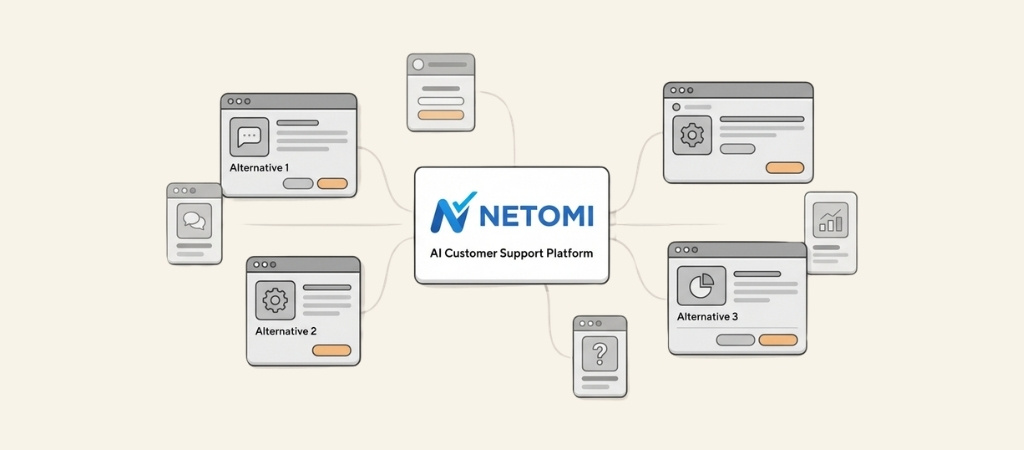
Netomi has built a reputation as an enterprise AI platform for customer service, but it's not the right fit for every business.
Whether you're looking for more transparent pricing, different channel support, or easier setup, there are plenty of alternatives to consider.
This guide breaks down seven of the best Netomi alternatives, with real pricing and feature comparisons to help you find the right match for your needs.
Editor’s note: Want to hear some sample AI support calls made for your Shopify store?
- Just paste your store URL
- Hear sample calls for your store (no email required)
- Listen to demo calls for my store
What is Netomi?
Netomi is an AI-powered customer service platform designed for enterprise businesses. It automates support across email, chat, and social channels, working alongside human agents to handle repetitive issues. The platform integrates with business systems to enable proactive support, alerting customers about issues before they reach out.
Netomi targets larger organizations with complex support needs. Pricing is custom and enterprise-focused, which means smaller businesses often find themselves priced out or dealing with lengthy sales cycles. The platform excels at handling sophisticated customer interactions but may be overkill if you need something simpler or more budget-friendly.
How we evaluated these Netomi alternatives
We looked at several factors to determine which platforms qualify:
- AI capabilities How advanced is the automation, and what percentage of queries can it handle without human intervention?
- Channel support Does it cover email, chat, phone, social, or specialized channels?
- Pricing transparency Can you see actual prices upfront, or is everything "contact sales"?
- Ease of setup How long does it take to get up and running?
- Integrations Does it connect with your existing tech stack?
Here's how the top alternatives stack up:
| Platform | Starting Price | Best For | Key Channels | Setup Time |
|---|---|---|---|---|
| Zendesk | $19/agent/month | Mid-market to enterprise | Email, chat, phone, social | 1-2 weeks |
| Freshdesk | $19/agent/month | Small to mid-sized businesses | Email, chat, phone, social | Days |
| Ada | Custom | High-volume enterprises | Chat, messaging, email | Weeks |
| Intercom | $29/seat/month + $0.99/resolution | SaaS and digital businesses | Messaging, email, chat | Under an hour |
| Ringly.io | From $99 a month (50 conversations included) | E-commerce phone support | Phone (primary) | Under 1 hour |
| Cognigy | Custom | Large contact centers | Voice, chat, messaging | Weeks |
| LivePerson | Custom | High-volume enterprises | Messaging, voice, social | Weeks |
1. Zendesk Suite

Zendesk has been a dominant force in customer service software for years, and their AI capabilities have evolved significantly. The platform now offers comprehensive omnichannel support with AI agents that can resolve over 80% of interactions autonomously.
Key features
- AI agents that reason, adapt, and take action independently across any channel
- Zendesk Copilot for real-time agent assistance ($50/agent/month add-on)
- Voice AI agents that handle calls without scripts or handoffs
- Generative replies powered by AI for faster responses
- 80+ languages with automatic language detection
Pricing
| Plan | Annual Price | Key Features |
|---|---|---|
| Support Team | $19/agent/month | Email ticketing, basic automations, 1000+ integrations |
| Suite Team | $55/agent/month | AI agents (Essential), messaging, help center, voice |
| Suite Professional | $115/agent/month | Copilot, up to 5 help centers, skills-based routing |
| Suite Enterprise | $169/agent/month | Sandbox, up to 300 help centers, custom roles |
AI agents include 5-15 automated resolutions per agent monthly, depending on your plan. Additional resolutions cost $1.50 committed or $2 pay-as-you-go.
Pros and cons
Pros:
- Extensive integration ecosystem (1,200+ apps)
- Proven reliability at scale
- Comprehensive feature set across all channels
- Strong enterprise security and compliance
Cons:
- Can get expensive as you add features
- Complex setup for advanced configurations
- Steeper learning curve than simpler tools
How it compares to Netomi
Zendesk offers a more established ecosystem compared to Netomi's AI-first approach. While Netomi focuses specifically on AI-driven automation, Zendesk provides integrated service management where AI enhances traditional support workflows. For businesses needing reliable, scalable customer service with intelligent assistance, Zendesk delivers operational breadth that Netomi's specialized approach cannot match.
2. Freshdesk

Freshdesk positions itself as a modern helpdesk with AI enhancement rather than AI replacement. It's particularly popular among small to mid-sized businesses that want solid features without enterprise complexity.
Key features
- Freddy AI for automated ticket routing and response suggestions
- AI-powered knowledge base with content suggestions
- Omnichannel support across email, chat, phone, and social
- Mobile app for agents on the go
- Collision detection to prevent duplicate agent work
Pricing
| Plan | Annual Price | Key Features |
|---|---|---|
| Free | $0 | 1-2 agents for 6 months, basic ticketing, knowledge base |
| Growth | $19/agent/month | Ticketing, customer portal, basic AI features |
| Pro | $55/agent/month | Custom portals, advanced ticketing, custom reporting |
| Enterprise | $89/agent/month | Audit logs, approval workflows, skills-based assignment |
Freddy AI Agent includes 500 sessions with Pro and Enterprise plans. Additional sessions cost $49 per 100.
Pros and cons
Pros:
- User-friendly interface with minimal training required
- Quick setup compared to enterprise alternatives
- Good value for the feature set
- Strong mobile support
Cons:
- Advanced features require higher-tier plans
- AI capabilities not as sophisticated as premium competitors
- Limited customization on lower tiers
How it compares to Netomi
Freshdesk provides more traditional helpdesk functionality with AI enhancement compared to Netomi's automation-first approach. While Netomi focuses on automating complex customer interactions through advanced AI, Freshdesk delivers proven ticketing and collaboration tools where AI assists rather than dominates the support process. For businesses seeking reliable, cost-effective support with intelligent assistance, Freshdesk offers proven capabilities that Netomi's experimental approach cannot guarantee.
3. Ada

Ada takes an AI-first approach similar to Netomi but with a focus on making automation accessible through a no-code platform. It's designed for enterprises that want high automation rates without requiring technical expertise to build and maintain bots.
Key features
- Unified Reasoning Engine for centralized intelligence across channels
- No-code platform for building AI agents without developers
- Omnichannel deployment across chat, messaging, email, and voice
- Multilingual support for global operations
- Advanced analytics for continuous optimization
Pricing
Ada uses custom enterprise pricing only. They target companies with at least 300,000 annual customer service conversations. You'll need to contact their sales team for specific pricing.
Pros and cons
Pros:
- Strong AI accuracy and automation rates
- Easy bot building without coding
- Good analytics and performance tracking
- Handles complex conversational flows well
Cons:
- No transparent pricing
- Limited phone support capabilities
- Minimum volume requirements exclude smaller businesses
How it compares to Netomi
Ada and Netomi share a similar AI-first philosophy, but Ada emphasizes no-code accessibility. Both target enterprise clients with high conversation volumes, but Ada makes it easier for non-technical teams to build and maintain automation. If you want sophisticated AI without a dedicated technical team, Ada may be the better choice.
4. Intercom
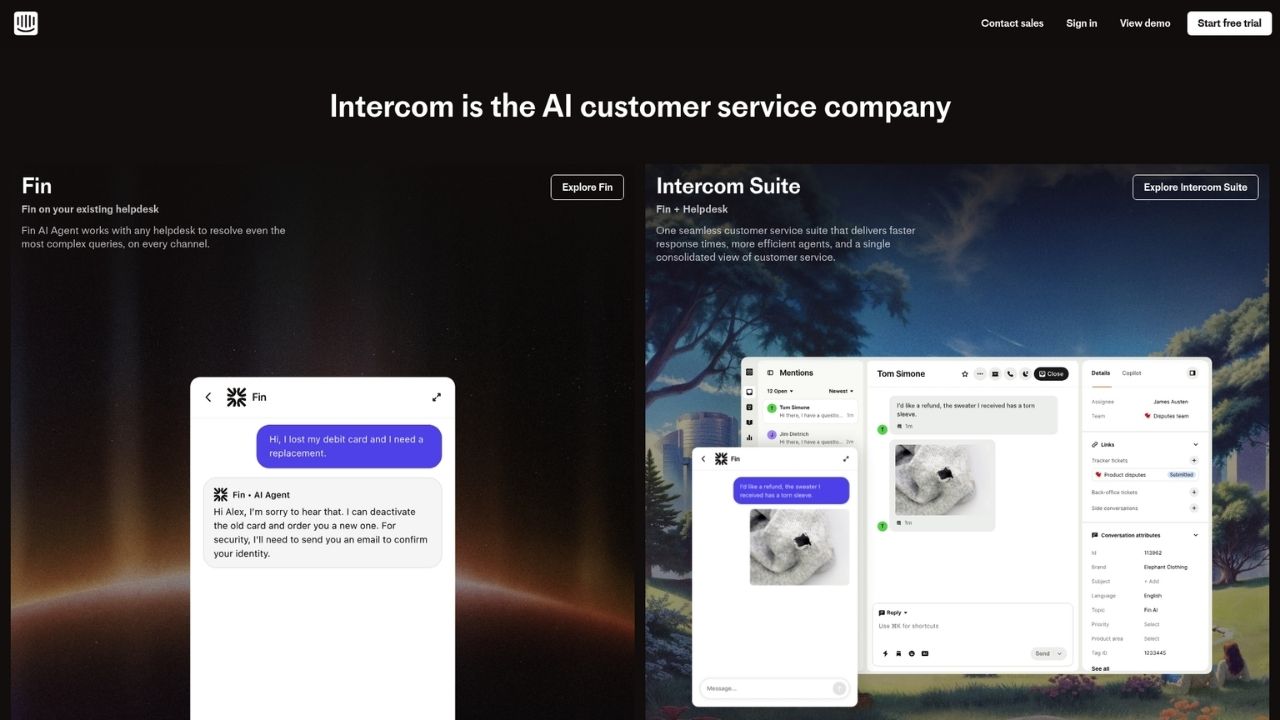
Intercom has repositioned itself around Fin AI Agent, which they claim is the highest-performing AI agent for customer service. The platform combines AI automation with human support across messaging, email, and voice channels.
Key features
- Fin AI Agent with $0.99 per resolution pricing
- Fin AI Engine with proprietary architecture for accuracy
- Omnichannel support including voice, email, chat, and social
- Proactive messaging to reach customers before they contact you
- Resolution-based pricing so you only pay for results
Pricing
| Plan | Annual Price | Key Features |
|---|---|---|
| Essential | $29/seat/month | Fin AI Agent ($0.99/resolution), messenger, shared inbox, help center |
| Advanced | $85/seat/month | Multiple inboxes, workflow automation, round-robin assignment |
| Expert | $132/seat/month | SSO, HIPAA support, SLAs, multibrand support |
Fin AI Agent costs $0.99 per resolution across all plans. You can also use Fin standalone with existing helpdesks like Zendesk or Salesforce.
Pros and cons
Pros:
- Beautiful, modern interface
- Strong personalization capabilities
- Excellent for customer onboarding and engagement
- Resolution-based pricing aligns costs with value
Cons:
- Gets expensive at scale
- Limited phone capabilities compared to voice-focused platforms
- Per-resolution costs can add up with high volume
How it compares to Netomi
Intercom provides more comprehensive customer engagement capabilities compared to Netomi's automation-focused approach. While Netomi emphasizes automating complex customer interactions through AI, Intercom delivers personalized messaging solutions that combine automation with human relationship building. For businesses prioritizing customer engagement and relationship development, Intercom offers capabilities that Netomi's technical approach cannot provide.
5. Ringly.io

Ringly.io takes a different approach from most alternatives on this list. Instead of competing directly on chat and email automation, it specializes in AI phone support specifically for e-commerce businesses. If phone calls are a significant channel for your store, this is worth serious consideration.
Key features
- AI agent Seth resolves up to 90% of calls without human intervention
- quick setup with no technical expertise required
- Native Shopify integration for order lookups and returns
- 30 languages supported for global customers
- Call analytics with transcripts and recordings
Pricing
| Plan | Monthly Price | Included | Key Features |
|---|---|---|---|
| Pay per call | $99 a month | 50 conversations, then $1.99 each | Seth on your support line 24/7; spam, hang-ups and wrong numbers are free |
Additional phone numbers run about $5 per month each.
Pros and cons
Pros:
- Live in under 1 hour
- Specialized for e-commerce use cases
- Resolves the majority of calls without human agents
- Multilingual support for international customers
Cons:
- Phone-focused (not a full chat/email solution)
- E-commerce specialization limits appeal for other industries
- Per-minute pricing requires volume monitoring
How it compares to Netomi
Ringly.io and Netomi serve different primary channels. While Netomi focuses on chat and email automation, Ringly.io specializes in AI phone support. For e-commerce stores where phone calls represent a significant portion of customer inquiries, Ringly.io offers a purpose-built solution that Netomi cannot match. The quick setup and Shopify integration make it particularly appealing for online retailers who need phone automation without enterprise complexity.
6. Cognigy

Cognigy targets large enterprises with complex contact center needs. The platform provides sophisticated conversational AI for both customer-facing automation and agent assistance.
Key features
- Cognigy.AI Platform for enterprise conversational AI
- Agentic AI for autonomous complex interactions
- Knowledge AI for unified knowledge management
- Voice Gateway for advanced voice automation
- Agent Copilot for real-time agent assistance
Pricing
Cognigy uses custom enterprise pricing. Their pricing page returned a 404 during our research, indicating they require direct contact for all pricing inquiries.
Pros and cons
Pros:
- Highly customizable for complex use cases
- Strong security standards and compliance
- Advanced voice capabilities
- Good for large-scale deployments
Cons:
- Complex setup requiring technical expertise
- No transparent pricing
- Overkill for smaller businesses
How it compares to Netomi
Cognigy and Netomi both target enterprise clients with sophisticated AI needs. Cognigy offers deeper voice capabilities and more extensive customization options, but comes with added complexity. If your organization has the technical resources to implement and maintain an enterprise-grade solution, Cognigy provides powerful tools. For businesses wanting similar capabilities with less implementation overhead, Netomi may be simpler to deploy.
7. LivePerson

LivePerson offers an enterprise conversational AI platform with a focus on messaging and voice channels. The platform serves high-volume businesses needing extensive customization and integration capabilities.
Key features
- Conversational Cloud for unified messaging
- Intent Manager for building and optimizing intent models
- Conversation Builder for no-code bot creation
- KnowledgeAI for unified knowledge base management
- 50+ APIs for extensive customization
Pricing
LivePerson offers three tiers (Bronze, Silver, Gold) with custom pricing for each. No public price points are available; you'll need to request a quote.
Pros and cons
Pros:
- Handles complex queries across channels
- Strong analytics and reporting
- Proven at enterprise scale
- Extensive integration options
Cons:
- Expensive with custom pricing only
- Complex implementation process
- Requires dedicated technical resources
How it compares to Netomi
LivePerson and Netomi compete directly for enterprise customers with high conversation volumes. Both offer sophisticated AI capabilities across multiple channels. LivePerson has been in the market longer and has more extensive integration options, while Netomi may offer more modern AI architecture. The choice between them often comes down to specific feature requirements and existing technology investments.
Which Netomi alternative should you choose?
The right choice depends on your specific situation:
Choose Zendesk if: You need a proven, comprehensive platform that covers all channels with enterprise reliability. Best for mid-market to large organizations that want extensive integrations and don't mind paying for them.
Choose Freshdesk if: You're a small to mid-sized business wanting solid AI features without enterprise pricing. The user-friendly interface and quick setup make it ideal for teams that need to get running fast.
Choose Ada if: You have high conversation volumes (300K+ annually) and want sophisticated chat automation without coding. The no-code platform makes AI accessible to non-technical teams.
Choose Intercom if: You're a SaaS or digital business focused on customer engagement and onboarding. The resolution-based pricing model aligns costs with actual value delivered.
Choose Ringly.io if: You run an e-commerce store and need automated phone support. The quick setup and Shopify integration make it uniquely suited for online retailers.
Choose Cognigy or LivePerson if: You're a large enterprise with complex contact center needs, dedicated technical resources, and budget for custom implementations.
Getting started with AI customer support
Most platforms offer free trials, so you can test before committing. Start with a clear use case in mind rather than trying to automate everything at once. Many businesses find success by starting with one channel and expanding as they learn what works.
If phone support is your priority and you run an e-commerce store, try Ringly.io for free. the AI can be handling calls in under 1 hour, with a 65% resolution guarantee behind it.
Frequently Asked Questions
Do you need enterprise volume to justify switching to Netomi alternatives?
Not necessarily. While some alternatives like Ada target companies with 300,000+ annual conversations, others like Freshdesk and Ringly.io cater to smaller businesses. Freshdesk starts at $15 per agent monthly, and Ringly.io starts at $99 a month for the first 50 conversations. Match the platform to your volume and growth plans.
Which Netomi alternative offers the fastest setup time?
Ringly.io claims a quick setup for e-commerce phone support, while Intercom's Fin AI Agent can be configured in under an hour on existing helpdesks. Traditional platforms like Zendesk and Freshdesk typically require days to weeks for full implementation depending on complexity.
Are there Netomi alternatives with transparent pricing?
Yes. Zendesk, Freshdesk, Intercom, and Ringly.io all publish pricing on their websites. Ada, Cognigy, and LivePerson require custom quotes. If pricing transparency matters for your budgeting process, stick to the platforms that disclose rates upfront.
Which Netomi alternative works best for phone support specifically?
For phone-focused automation, Ringly.io specializes in AI phone support for e-commerce, resolving up to 90% of support calls. Zendesk and Freshdesk include phone support in their broader omnichannel offerings. Cognigy and LivePerson offer enterprise voice capabilities but require more complex implementation.
Can you use multiple Netomi alternatives together?
Yes. Many businesses use different tools for different channels. For example, you might use Intercom for chat and email while using Ringly.io for phone support. Intercom's Fin AI Agent even works standalone with existing helpdesks like Zendesk and Salesforce, allowing you to layer AI on top of your current setup.
How do resolution-based pricing models compare to per-agent pricing?
Resolution-based pricing (like Intercom's $0.99 per resolution) aligns costs with outcomes, which can save money if your AI handles most queries. Per-agent pricing (like Zendesk's $19-169 per agent) works better if you have high conversation volumes that would make per-resolution costs prohibitive. Calculate based on your expected volume and resolution rates.
Also read: