
Finding the right conversational AI platform can feel overwhelming.
Pypestream has earned recognition for secure, enterprise-grade customer engagement, but it's not the right fit for everyone.
Whether you're looking for more transparent pricing, better e-commerce integrations, or stronger phone support capabilities, there are plenty of good alternatives worth considering.
I spent time evaluating seven of the top Pypestream alternatives to see how they stack up. Here's what I found.
Editor’s note: Want to hear some sample AI support calls made for your Shopify store?
- Just paste your store URL
- Hear sample calls for your store (no email required)
- Listen to demo calls for my store
What is Pypestream?
Pypestream is an AI-driven customer engagement platform built primarily for enterprises in regulated industries like banking, healthcare, retail, and telecommunications. It offers secure messaging, natural language processing, and multi-channel automation.
The platform excels at handling complex, compliance-heavy use cases. But that specialization comes with trade-offs: pricing is quote-based and opaque, and the enterprise focus can make it feel like overkill for smaller teams or simpler use cases.
How I evaluated these Pypestream alternatives
I looked at each platform through a practical lens:
- Pricing transparency - Can you actually see what you'll pay before talking to sales?
- Ease of setup - How quickly can you get up and running?
- AI capabilities - What's the actual resolution rate, not just marketing claims?
- Channel support - Does it cover chat, email, phone, and social?
- Integrations - Will it play nicely with your existing stack?
Here's how the seven alternatives compare at a glance:
| Tool | Starting Price | Free Plan | AI Resolution Rate | Phone Support | Best For |
|---|---|---|---|---|---|
| Tidio | $24.17/mo | Yes (50 conversations) | Up to 67% | No | E-commerce |
| Zendesk | $15/agent/mo | No | Varies by plan | Yes | Enterprise |
| Intercom | $29/seat/mo | 14-day trial | Industry-leading | Yes (add-on) | SaaS |
| Freshworks | $15/agent/mo | Yes (limited) | Basic | No | SMBs |
| LiveAgent | $15/agent/mo | 30-day trial | AI assistant | Yes (built-in) | Phone-heavy |
| Birdeye | Contact sales | No | Not specified | No | Multi-location |
| Twilio Flex | $1/hour or $150/user | 5,000 hours | Agent Copilot | Yes | Developers |
1. Tidio

Tidio stands out as the best option for e-commerce businesses. The platform combines live chat, ticketing, and AI automation in one workspace, with native Shopify integration that makes setup straightforward.
The star feature is Lyro AI Agent, which Tidio claims can solve up to 67% of customer problems automatically. Unlike basic chatbots that follow rigid scripts, Lyro uses machine learning to understand questions and generate human-like responses based on your support content.
Pricing:
| Plan | Annual Price | Key Limits |
|---|---|---|
| Free | $0 | 50 conversations, 50 Lyro AI conversations (one-time) |
| Starter | $24.17/mo | 100 conversations, 50 Lyro conversations |
| Growth | $49.17/mo | From 250 conversations |
| Plus | $749/mo | Custom limits, departments, OpenAPI |
Pros:
- Free plan available
- Strong Shopify integration
- Up to 67% resolution rate with Lyro
- Easy visual Flows builder for automation
Cons:
- No native phone support
- Social channel integrations limited on lower tiers
- Lyro conversation limits can get expensive at scale
2. Zendesk

Zendesk is the established giant in customer service software, serving over 130,000 global brands. The platform has evolved significantly with AI, now offering AI agents, Copilot assistance, and workforce management tools.
What sets Zendesk apart is depth. The platform covers every channel imaginable, offers extensive customization, and has a massive app marketplace with over 1,000 integrations. For large organizations with complex needs, this comprehensiveness is hard to beat.
Pricing:
| Plan | Annual Price | Key Features |
|---|---|---|
| Support Team | $15/agent/mo | Email, social, basic automations |
| Suite Team | $45/agent/mo | AI agents, messaging, phone support |
| Suite Professional | $89/agent/mo | Copilot, 5 help centers, skills routing |
| Suite Enterprise | $139/agent/mo | 300 help centers, sandbox, audit logs |
Pros:
- Comprehensive feature set
- 1,000+ integrations
- Robust reporting and analytics
- Strong enterprise security and compliance
Cons:
- Can feel complex and overwhelming
- Pricing adds up quickly with add-ons
- Steeper learning curve than newer competitors
3. Intercom
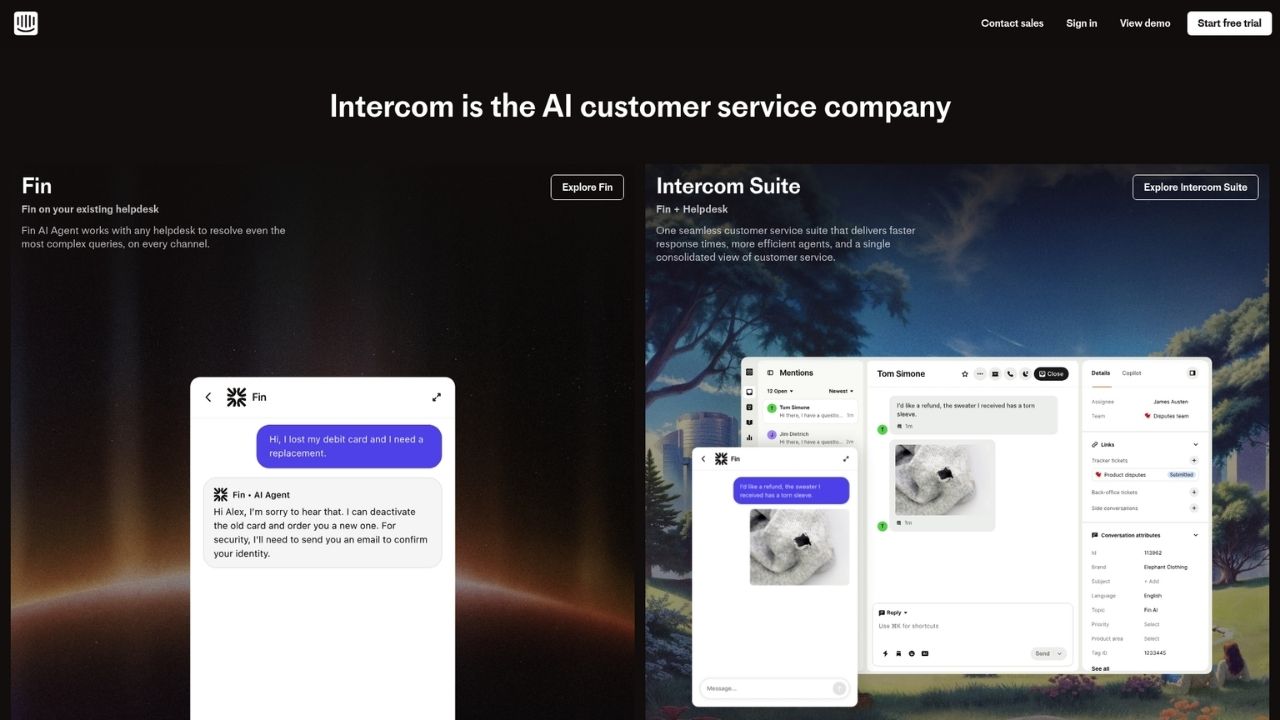
Intercom has repositioned itself as an AI-first customer service platform, with Fin AI Agent at the center of everything. The pricing model is unique: you pay $0.99 per resolution rather than per seat, which can be more cost-effective for teams handling high volumes of repetitive inquiries.
Fin integrates with existing helpdesks like Zendesk and Salesforce, so you don't need to rip and replace your current setup. The AI is genuinely impressive, handling complex queries that would stump most chatbots.
Pricing:
| Plan | Annual Price | Key Features |
|---|---|---|
| Essential | $29/seat/mo | Fin AI ($0.99/resolution), messenger, help center |
| Advanced | $85/seat/mo | Multiple inboxes, workflows, 20 Lite seats |
| Expert | $132/seat/mo | SSO, HIPAA, SLAs, 50 Lite seats |
Pros:
- Pay-per-resolution model aligns costs with value
- Works with existing helpdesks
- Beautiful, modern interface
- Strong automation and proactive messaging
Cons:
- Expensive at scale for seat-based plans
- Phone support requires add-ons
- Less suitable for teams wanting traditional ticketing
4. Freshworks (Freshchat)

Freshworks offers some of the most affordable entry points into AI-powered customer support. Their free plan supports up to 100 agents, making it accessible for growing teams.
Freshchat, their messaging platform, includes AI chatbots through Freddy AI and integrates seamlessly with the broader Freshworks ecosystem (Freshdesk, Freshsales). The interface is clean and intuitive, with less complexity than Zendesk.
Pricing:
| Plan | Annual Price | Key Features |
|---|---|---|
| Free | $0 | 100 agents, 30-day chat history |
| Growth | $15/agent/mo | Chatbots, canned responses, basic reports |
| Pro | $39/agent/mo | Advanced automation, multilingual |
| Enterprise | $69/agent/mo | IP whitelisting, skill-based routing |
Pros:
- Generous free plan
- Affordable paid tiers
- Easy to use and set up
- Good for teams already using Freshworks
Cons:
- AI capabilities less advanced than competitors
- No native phone support
- Reporting less robust than enterprise tools
5. LiveAgent
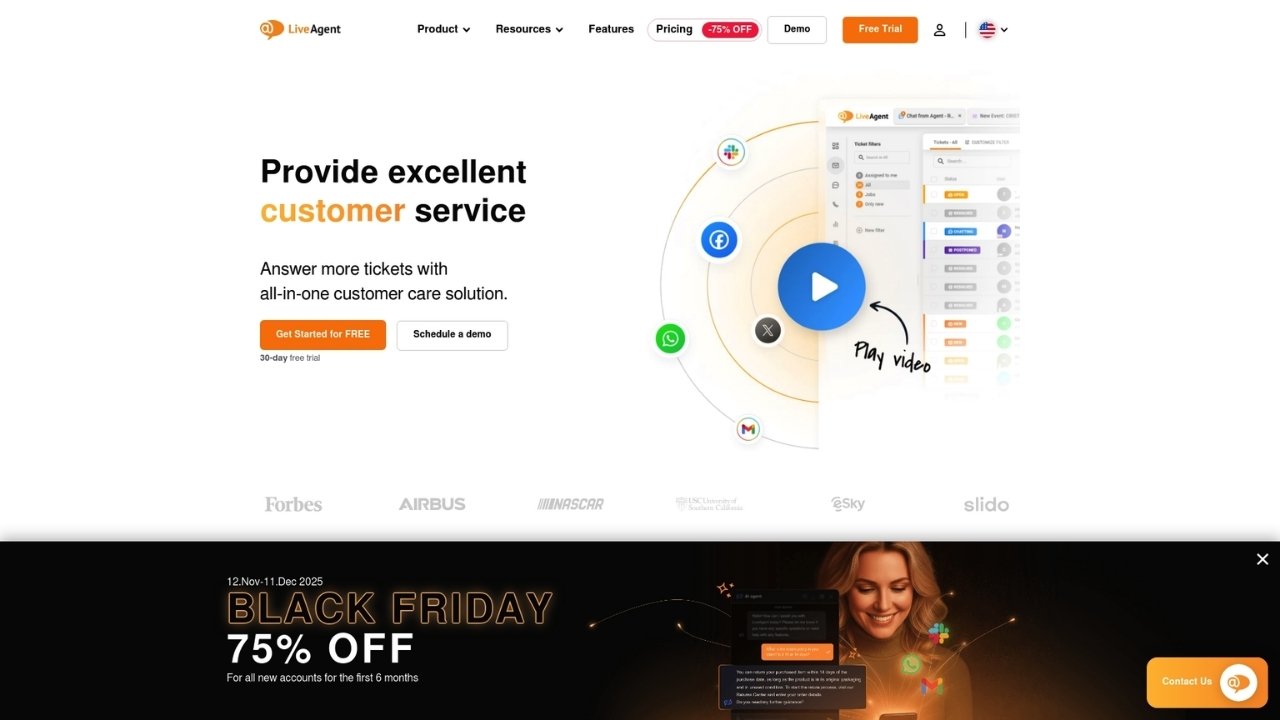
LiveAgent is the only alternative on this list with built-in call center capabilities at affordable prices. While competitors treat phone as an afterthought or expensive add-on, LiveAgent includes IVR, call routing, and recording in their standard plans.
The platform also claims to have the fastest chat widget on the market, which matters for conversion rates. Companies like BMW, Yamaha, and Oxford University use LiveAgent for their customer support.
Pricing:
| Plan | Annual Price | Key Features |
|---|---|---|
| Small Business | $15/agent/mo | Ticketing, live chat, knowledgebase, AI features |
| Medium Business | $29/agent/mo | Call center, IVR, reports, proactive chat |
| Large Business | $49/agent/mo | Social channels, WhatsApp, Telegram |
| Enterprise | $69/agent/mo | Dedicated account manager, priority support |
Pros:
- Built-in phone support at all tiers
- Fastest chat widget (claimed)
- 30-day free trial, no credit card required
- AI Answer Assistant included
Cons:
- Interface feels dated compared to newer tools
- Social channels cost extra on lower tiers
- AI capabilities more limited than specialized platforms
6. Birdeye

Birdeye takes a different approach, focusing on multi-location businesses that need reputation management alongside customer messaging. If you're managing dozens or hundreds of locations, Birdeye's ability to centralize reviews, listings, and customer conversations is valuable.
The platform uses AI agents for reviews, listings, messaging, and social media. Over 150,000 businesses trust Birdeye, particularly in healthcare, retail, and home services.
Pricing:
| Plan | Pricing | Key Features |
|---|---|---|
| Starter | Contact for quote | Reviews AI, Listings AI, Messaging AI |
| Growth | Contact for quote | + Social AI |
| Dominate | Contact for quote | + Chatbot AI |
Pros:
- Purpose-built for multi-location businesses
- Strong reputation management features
- Unified inbox across locations
- Integration with 3,000+ apps
Cons:
- Pricing not transparent (contact sales)
- Overkill for single-location businesses
- Not ideal for pure customer support use cases
7. Twilio Flex

Twilio Flex is the most flexible option on this list, which makes sense given Twilio's developer-first DNA. It's a fully programmable contact center that you can customize to do almost anything.
This power comes with complexity. You'll need technical resources to get the most out of Flex. But if you have unique requirements that off-the-shelf solutions can't handle, Flex is worth considering.
Pricing:
| Plan | Pricing | Notes |
|---|---|---|
| Free Trial | $0 | 5,000 active user hours |
| Per-hour | From $1.00/active hour | Pay for what you use |
| Per-user | From $150/named user/mo | Predictable spend, requires contract |
Pros:
- Unlimited customization potential
- 400+ integrations
- Works with any channel Twilio supports
- Bring Your Own Carrier option
Cons:
- Requires technical expertise
- Complex setup and configuration
- Not suitable for teams wanting out-of-the-box functionality
Tips for choosing the right Pypestream alternative
With seven solid options, how do you pick? Here are a few considerations:
- Start with your primary channel. If phone support is critical, LiveAgent or Twilio Flex make more sense than chat-focused tools.
- Evaluate AI honestly. Don't pay for advanced AI if your use cases are simple. Freshworks or Tidio's basic plans might be plenty.
- Factor in total cost. Seat pricing is just the start. Add-ons, overages, and resolution fees add up quickly.
- Test before committing. Most platforms offer free trials. Use them to test your actual workflows, not just the demo.
- Check integration compatibility. If you're locked into Salesforce or HubSpot, make sure your choice plays nicely.
Which Pypestream alternative should you choose?
Here's my quick take based on common scenarios:
- Best for e-commerce: Tidio, thanks to Shopify integration and Lyro AI
- Best for enterprise: Zendesk, if you need comprehensive features and don't mind the complexity
- Best for SaaS: Intercom, particularly if you want modern AI and pay-per-resolution pricing
- Best budget option: Freshworks, with its generous free plan and affordable tiers
- Best for phone support: LiveAgent, with built-in call center at reasonable prices
- Best for multi-location: Birdeye, if reputation management matters as much as support
- Best for customization: Twilio Flex, assuming you have the technical resources
What about AI phone support?
One gap I noticed in most of these alternatives: phone support is often an afterthought. Even platforms that offer it typically treat voice as secondary to chat and messaging.
If phone support is a priority for your business, you might want to consider a specialized solution. At Ringly.io, we built the AI specifically for AI-powered phone support. The AI handles inbound calls 24/7, resolves up to 90% of calls without human intervention, and integrates directly with Shopify for order lookups and returns.
The setup takes under 1 hour, and the 65% resolution guarantee means if Seth resolves under 65% of your calls in a month, that month comes back as credit (after 90 days on Pay per call). For e-commerce businesses drowning in phone support, it's worth a look.
Frequently Asked Questions
What are the best Pypestream alternatives for small businesses?
For small businesses, Tidio and Freshworks offer the best value. Tidio has a free plan with 50 conversations and strong e-commerce features. Freshworks offers a free plan supporting up to 100 agents. Both are easier to set up than enterprise-focused alternatives.
Which Pypestream alternative has the best AI resolution rates?
Tidio's Lyro AI claims up to 67% resolution, while Intercom's Fin AI is widely regarded as industry-leading. Zendesk and other platforms vary by plan and configuration. The actual rate depends heavily on how well you train the AI with your knowledge base.
Are there any Pypestream alternatives with transparent pricing?
Yes, several alternatives offer transparent pricing while Pypestream requires contacting sales. Tidio, Zendesk, Intercom, Freshworks, and LiveAgent all publish pricing on their websites. Only Birdeye follows the quote-based model similar to Pypestream.
What Pypestream alternatives work best for e-commerce stores?
Tidio is the standout choice for e-commerce, with native Shopify integration and AI trained on retail use cases. Zendesk and Intercom also work well but require more configuration. For phone-heavy e-commerce support, consider specialized solutions like Ringly.io.
Which Pypestream alternative is best for phone support?
LiveAgent includes built-in call center features at all pricing tiers, making it the best choice among these alternatives. Twilio Flex offers the most customizable phone solution but requires technical expertise. Most other alternatives treat phone as a secondary channel or expensive add-on.
How do Pypestream alternatives compare on ease of setup?
Tidio and Freshworks are generally easiest to set up, often taking under 30 minutes. Intercom and Zendesk require more configuration but offer more power. Twilio Flex is the most complex, typically requiring developer resources. Most offer free trials to test the setup process yourself.
Can I try these Pypestream alternatives before buying?
Yes, all seven alternatives offer free trials or free plans. Tidio and Freshworks have permanent free tiers with limited features. Zendesk, Intercom, LiveAgent, and Twilio Flex offer 14-30 day trials. Birdeye typically offers demos upon request.