
The short version.
- Shopping Assistant is the sales skill of the Gorgias AI Agent. It chats with shoppers in real time to answer pre-sale questions, recommend products, and nudge them to checkout across chat, email, and SMS.
- It works. Gorgias reports lifts like Arc'teryx at +75% conversion rate. But it never picks up a phone, so the highest-intent shopper of all (the one who calls before buying) goes to voicemail.
- Written for founders, COOs, and Heads of CX at $10M-$100M Shopify brands that still keep a visible phone number.
If you searched "gorgias shopping assistant," you want two answers: what it actually does, and whether it'll move your numbers. I'll give you both, straight. Then I'll show you the one part of the pre-sale conversation it can't see, because we pulled the call data from the 50+ Shopify brands we run phone support for, and a steady slice of inbound calls turns out to be buyers with a half-built cart who just want one doubt removed before they check out. A chat-only assistant never answers that call.
Most teams running a paid Gorgias instance and a phone line don't measure the pre-sale phone caller at all. If you run a Shopify brand between $10M and $100M and your number rings into a queue nobody covers after 6 p.m., book a 30-min call and we'll pull what those callers were trying to buy.
What Gorgias Shopping Assistant actually is
Gorgias has one AI Agent with two skills. The Support Agent handles post-purchase tickets (returns, order status, the same questions over and over). Shopping Assistant is the other skill: the pre-sale one. It engages a shopper who's still deciding, answers product questions, and tries to close the sale before they leave.
It's a chat-native closer that lives inside your helpdesk, not a separate tool you bolt on. It runs across chat, email, and SMS, with chat being where it actually performs. It's trained on your Shopify catalog, your store pages, and any custom product notes you feed it. According to the Gorgias docs, it can answer questions about sizing, availability, and compatibility, recommend products from what a shopper is browsing or has in their cart, and generate unique discount codes on the spot.
If you're already deep in the Gorgias world, this sits next to the rest of the Gorgias AI Agent stack and the broader set of Gorgias features you're paying for. It's part of the same shift every Shopify brand is feeling: chat is becoming the place where AI shopping assistants try to do the job a sales associate used to do on the floor.
How it works: buying intent and selling styles
The clever part is that Shopping Assistant doesn't treat every visitor the same. It reads buying intent from behavior and adjusts in real time.
There are three intent stages, and a shopper moves between them as the conversation goes:
- Discovery. The shopper is browsing with no clear signal. The assistant asks clarifying questions to figure out what they need.
- Interested. They're circling a specific product. The assistant makes suggestions and answers the objections in the way.
- Ready to buy. There's a cart. Now the assistant surfaces a discount or pushes gently toward checkout.
On top of that, you pick one of three selling styles: Educational (information first, few discounts), Moderate (balanced), or Promotional (assertive, discounts early). It tracks what they viewed, the page they're on, cart contents, and purchase history if they're signed in. The whole thing is built to behave like a good floor associate who reads the room before pitching anything.
That's the upside of doing this in chat. It's fast, it's contextual, and it scales to every visitor at once, which is more than your ecommerce customer service team can say on a launch day.
Setting it up so it actually converts
I've watched plenty of brands turn this on and get nothing, because the assistant is only as good as the product data behind it. Here's how I'd set it up if it were my store.
- Connect Shopify first, then check the catalog actually synced. The one-click Gorgias Shopify integration is genuinely quick, but a half-synced catalog means the assistant guesses, and guessing on sizing is how you create a return.
- Feed it the custom product info, not just the catalog. Fit notes, compatibility quirks, "runs small," the stuff your best rep knows. That's what turns a generic recommendation into a confident one.
- Pick the selling style that matches your margin. Promotional burns discount on people who'd have bought anyway. Educational protects margin but converts slower. Moderate is the safe default until you have data.
- Set the guardrails before you set the targets. Decide where it hands off to a human, and where it should never improvise. Then measure conversion on engaged chats against your baseline.
A Shopping Assistant with a thin catalog is a worse experience than no assistant at all, because now the wrong answer comes with your brand's name on it. Treat the data work as the setup itself, not an afterthought. If you already run a Shopify customer service app, most of this knowledge already exists somewhere; the job is getting it into the assistant.
What the results actually look like
Gorgias publishes some strong numbers, and to their credit they name the brands. On the Shopping Assistant page, Arc'teryx is cited at a +75% conversion-rate lift, Bare Minerals at an 8x return, and Caitlyn Minimalist at +11% AOV. They also cite a roughly +10% AOV and a 62% conversion-rate uplift in chat as general figures.
Read those the way you'd read any vendor case study. The "$20 for every $1 spent" line is Gorgias's own marketing math, not an audited benchmark. And the platform's reputation is mixed: Gorgias holds about 2.5/5 on Trustpilot and 4.3/5 on the Shopify App Store, with a notable chunk of one-star reviews citing billing and support, per eesel's review roundup. The tool can convert. It's not a magic wand, and the bill behaves like software that's metered.
One thing the case studies all share: they're measuring people who chose to chat. The shopper who'd rather talk to a person is a different animal, and the most common compliment we hear about voice gets at why.
"My customers also feel like it's a normal person. They feel like they can communicate if they have questions."
Claudia Droge, TechCraft Studio
What it costs (the clear version)
Pricing is where most write-ups get vague, so here's the honest shape of it.
Shopping Assistant runs inside the Gorgias AI Agent, which bills at roughly $0.90 per resolved conversation on top of your helpdesk plan. The on-site campaign add-on, Gorgias Convert, bills differently: on clicks. One click is one shopper interaction with a campaign, capped at three clicks per browser session, and plans run from about $30/mo for 50 clicks up to $2,000/mo for 4,000 clicks. We broke the full math down in our Gorgias Convert cost guide.
Two things to watch. Auto-upgrade is on by default, so blowing past your click ceiling quietly bumps you to the next tier instead of stopping. And the AI Agent resolutions stack on top of the helpdesk ticket, which is the double-billing complaint you'll find in reviews. One Shopify App Store reviewer reported $14,000 in unexpected AI Agent charges on top of their annual plan, per Zipchat's review. The Reddit break-even frame is a good gut check: if 40% or more of your contacts need real Shopify actions, the price earns itself; if it's mostly conversational, a cheaper tool wins.
Here's the part that matters for this article, though. All of that pricing covers chat. None of it covers the phone.
| Pre-sale contact | Shopping Assistant | A phone agent (Ringly) |
|---|---|---|
| Chat question on the product page | Yes | No (phone) |
| Email or SMS follow-up | Yes | No |
| Shopper who calls before buying | No | Yes |
| After-hours / weekend caller | No | Yes, 24/7 |
| Pricing model | Per-click + per-resolution | Flat monthly plan |
The one channel it never touches: the phone
Here's what every Shopping Assistant write-up skips. It's a chat tool. It does not answer phone calls, and it never will, because that's not the channel it lives in.
For a lot of brands that's fine. For a lot of others, it's a real leak. Across the 50+ Shopify brands we run phone support for, a steady slice of inbound calls is pre-sale: not a problem, a question from someone who wants to buy and needs one doubt removed first. Older-demographic brands, supplements, specialty food, and gear get a stream of callers who won't finish a cart online and want to place the order with a person. Higher-AOV stores feel it most: at a $250 AOV, 12-18% of orders generate a phone call, versus roughly 3% at a $40 AOV.
That caller is the highest-intent contact you get all day, and a chat-only assistant treats them like they don't exist. It gets worse after hours. The shopper with a card in their hand at 9 p.m. either reaches someone or buys from whoever does. Research on pre-purchase behavior is blunt about it: 78% of shoppers buy from whoever answers first, and a lot of these are the same pre-purchase product questions Shopping Assistant handles so well in chat, just asked out loud by someone who prefers a voice.
This is where Ringly.io fits, and it's not a swap for Gorgias. Ringly is AI phone support for Shopify brands. It answers your inbound calls 24/7, finds orders, answers product questions from your knowledge base, handles the WISMO calls eating your queue, and escalates cleanly to Gorgias when a human is needed. It sits in front of your helpdesk, not instead of it. Across 50+ brands it resolves 73% of calls autonomously at roughly $0.42 per resolved call. WashCo, a Shopify brand we launched, recovered $22,664 in its first 7 days on the phone.
So Shopping Assistant closes the chat shopper, and a phone agent closes the one who calls. You want both covered, not just the channel your helpdesk happens to live in. If your phone goes quiet after 6 p.m., that's the gap.
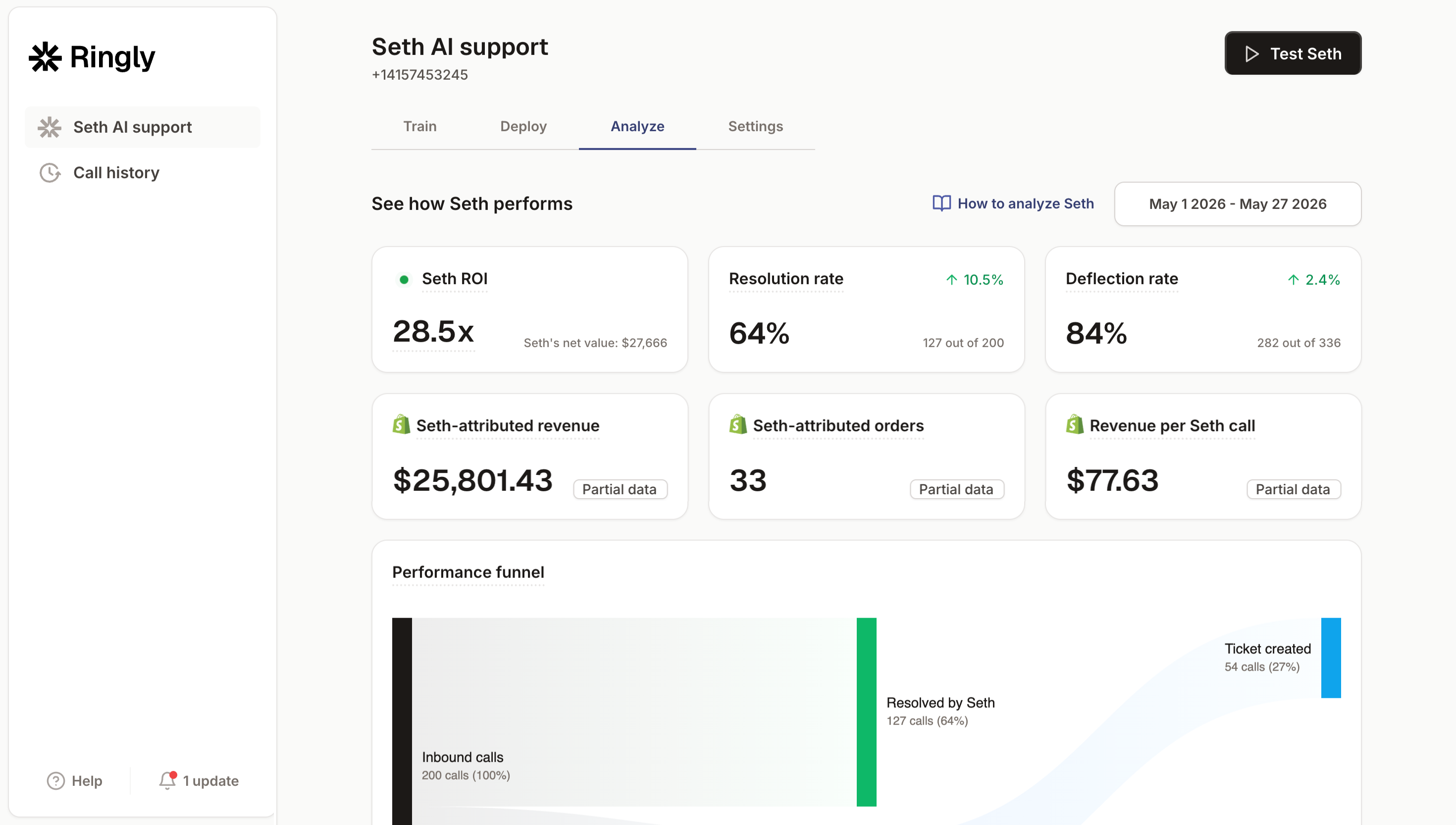
If you keep a 24/7 ecommerce phone support line, book a 30-min call and we'll show you what your callers were trying to buy last week.
What this costs you vs what it costs to cover the phone
The chat side has a clear ROI: more conversion on engaged shoppers. The phone side has one too, and most brands never run the numbers because the calls quietly roll to voicemail.
Take a typical $50M Shopify brand running a 6-rep CS team to cover both the ecommerce phone support line and the helpdesk:
| Line item | Today | With a phone agent |
|---|---|---|
| 6 reps x $4K loaded per rep | $24,000/mo | n/a |
| AI phone agent (~$5K/mo) | n/a | $5,000/mo |
| Net monthly phone + CS spend | $24,000/mo | $5,000/mo |
| Monthly savings | n/a | $19,000/mo |
| Annual savings | n/a | $228,000/yr |
That's roughly 70% of repeatable calls (order status, returns, the same five product questions over and over) handled by the AI, while your Shopify customer service team takes the genuinely hard ones. The pre-sale callers that Shopping Assistant can't reach get answered instead of going to voicemail. If you've been weighing chat vs phone support as an either-or, that's the wrong frame. It's chat for the chatters and phone for the callers.
Want the math on your actual call volume? Book a 30-min call and we'll do it live.
Frequently asked questions
Is Shopping Assistant the same as the Gorgias AI Agent? No. The AI Agent is the engine, and it runs two skills. The Support Agent handles post-purchase tickets, and Shopping Assistant is the pre-sale sales skill. They share the same billing but do different jobs.
What does Gorgias Shopping Assistant cost? It runs inside the AI Agent, which bills about $0.90 per resolved conversation on top of your helpdesk plan. The Convert add-on is separate and bills on clicks, from roughly $30/mo to $2,000/mo, with auto-upgrade on by default. Budget for it as a metered line item, not a flat fee.
Does Gorgias Shopping Assistant answer phone calls? No. It works on chat, email, and SMS only. A shopper who calls your store before buying never reaches it, which is the gap an AI phone agent like Ringly fills.
What channels does it work on? Chat, email, and SMS, with chat being where it performs best. There's no voice or phone channel. If a real share of your buyers prefer to call, you'll need separate phone coverage.
How do I set it up? Connect your Shopify store through the one-click integration, confirm the catalog synced, feed it your custom product details, and pick a selling style that fits your margin. Then measure conversion on engaged chats against your baseline before you scale it up.
Does it replace my support team? Not really. Gorgias and most reviewers agree it's best used alongside humans for nuanced cases. It takes the high-volume pre-sale chats so your team can handle the hard ones.
Shopping Assistant or a phone agent like Ringly? It's not either-or. Shopping Assistant converts the shopper who chats; Ringly answers the one who calls, 24/7, and escalates to Gorgias when a human is needed. Brands with a real phone-calling audience want both. See how an AI receptionist for ecommerce covers the calls chat can't.
Talk to us

If you run a $10M-$100M Shopify brand and you've got Shopping Assistant closing chats but a phone line nobody covers after-hours, a 30-min call is the fastest way to see what those callers were worth.
The 3-layer guarantee.
- Live in 14 days or it's free until launched.
- 65% resolution in 90 days or we refund the last 3 months of subscription fees.
- We keep working free until we hit it.
Ruben (Ringly co-founder) takes these calls personally.