


This post in 30 seconds.
- A straight rundown of every Gorgias feature a Shopify brand actually uses: the inbox, Shopify actions, rules, macros, the AI Agent, the Voice and SMS channels, and reporting.
- Gorgias is the best ecommerce inbox there is. Its own AI Agent docs list email, chat, and SMS as the channels it runs on. Voice isn't one of them.
- Written for the founder, COO, or Head of CX at a $10M-$100M Shopify brand already running Gorgias with a visible phone number on the site.
Gorgias is the helpdesk most $10M-$100M Shopify brands are already running, and for good reason. It's Shopify's only Premier Partner for CX, it powers roughly 40% of the top 1,500 Shopify brands, and it holds a 4.6 out of 5 across nearly 1,900 G2 reviews. If you run customer experience at a brand that size, you didn't pick it by accident. You picked it because it does the inbox better than anything else built for ecommerce.
This is an honest feature rundown, not a takedown. I'll walk every tool Gorgias gives your team, what each one is genuinely good for, and where each one stops. Then I'll name the one thing it doesn't do, the call your reps are still picking up by hand. If you've watched your CS team get pulled off email to answer the phone, or you've seen calls roll to voicemail after 6 p.m., that gap is the whole reason this post exists. Book a 30-min call and we'll show you what's slipping through on the phone line.
In this post:
Gorgias features at a glance
Before the deep dive, here's the whole feature set in one table, with the honest "what it's for" and "where it stops" read on each.
| Feature | What it does | Where it stops |
|---|---|---|
| Unified inbox | Pulls email, chat, social, SMS, voice into one ticket view | Voice shows up as a ticket, not an answered call |
| Shopify actions | Edit orders, refund, cancel, check inventory in-helpdesk | Agent has to be in the ticket to act |
| Rules | If/then routing, tagging, intent + sentiment | Rules don't answer, they sort |
| Macros | Templated replies with order variables | A human still has to send them |
| AI Agent | Resolves tier-1 email, chat, SMS autonomously | Email, chat, SMS only. Not voice |
| Voice channel | Routes and logs phone calls into tickets | Needs a human to actually take the call |
| SMS channel | Two-way texting, AI Agent supported | Add-on, priced per ticket |
| Reporting | Ticket volume, response time, CSAT, revenue | Reports the calls you missed, doesn't catch them |
The pattern in that right column is the point: Gorgias is excellent at organizing and resolving the written channels, and it leaves the live phone call to a person. That's not a flaw. It's a design choice. It just happens to be the most expensive channel to staff.
How I read every Gorgias feature
I'm Ruben, co-founder of Ringly. We run AI phone support for 50+ Shopify brands, which means I'm in and out of Gorgias accounts constantly, usually sitting next to a Head of CX who's trying to get their phone volume off their reps' plates.
For this rundown I didn't read the marketing pages. I set up a Gorgias account, pushed test tickets through it, and went through the AI Agent documentation line by line to see exactly which channels it covers. Then I did the thing nobody writing about Gorgias seems to do: I called the phone lines of a few brands running it, at 7 p.m. on a weekday, to hear what actually happens to an inbound call.
Here's what I scored each feature on:
- Does a real Shopify operator use it daily? Not "is it in the feature list," but does it earn its keep on a Monday.
- Does it resolve, or just organize? Macros and rules sort work. The AI Agent removes work. Big difference for your payroll.
- Which channel does it actually cover? This is where the voice gap shows up, and it's straight from Gorgias's own docs, not my opinion.
- What does it cost when volume spikes? The billable-ticket model behaves very differently in a quiet month versus a launch week.
One thing I'll say upfront, because it sets the tone: nothing below is me telling you to leave Gorgias. I'm not. The honest read is that Gorgias should stay your inbox, and the phone is a separate problem.
The helpdesk inbox
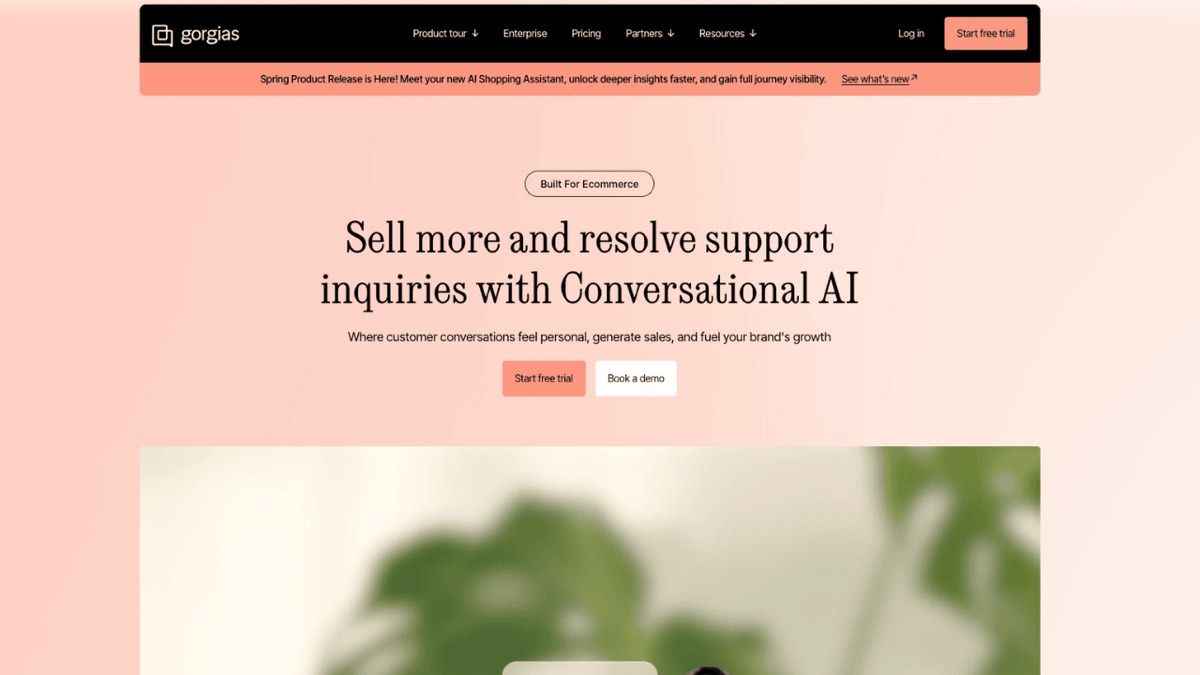
The inbox is the core of Gorgias and the reason it wins for ecommerce. It pulls every written channel your customers use into one ticket view: email, live chat, Instagram DMs and comments, TikTok, Facebook, X, and SMS. Your reps work one queue instead of jumping between six tabs.
For a brand fielding the same WISMO and return questions across five channels, a single unified queue is the difference between a 30-minute response time and a four-hour one. Internal notes, ticket assignment, and conversation tagging all live here too, so a handoff between reps doesn't lose the thread.
What it's good for: keeping your written support organized and fast. What it doesn't do: it logs a phone call as a ticket, but the call itself still needs a person on the line. More on that below.
Shopify actions
This is the feature that makes Gorgias feel native instead of bolted on. Gorgias is Shopify's only Premier Partner for CX, so the sync goes both ways. Your reps can edit an order, issue a refund, cancel a subscription, or check order status and inventory without ever leaving the ticket.
For WISMO tickets, which Salesforce pegs at 30 to 40% of all ecommerce support volume, that in-ticket order context saves real minutes per conversation. The same WISMO automation logic is what an AI agent uses to resolve the call before a rep ever sees it.
The catch is small but worth naming: the actions live inside the ticket, so a human has to be in the ticket to use them. The depth is real, the convenience is real. It still assumes a person is doing the work.
Rules and automation
Rules are Gorgias's if/then engine. They auto-assign tickets, detect intent and sentiment, route VIP or urgent cases to the right rep, and tag conversations so your reporting stays clean. Set up well, Rules quietly remove a layer of manual triage that used to eat a rep's first hour every morning.
Rules sort the work. They don't do the work. That's the honest framing. A rule can route a frustrated customer to your best agent and flag a high-value order, but it can't compose the answer or resolve the ticket. For that, Gorgias points you at the next two features.
If you're building out routing logic, our guide to ecommerce call routing covers the same escalation thinking for the phone channel.
Macros
Macros are templated replies with dynamic variables, so a single saved response auto-fills the customer's name, order number, and tracking link. For the same five questions you get over and over, macros turn a two-minute reply into a two-click one.
Here's the nuance most feature lists miss: macros are for your human team, not the AI Agent. Per Gorgias, the AI Agent generates its own responses from your knowledge and skills, not from your macro library. So macros speed up the reps you have. They don't reduce the reps you need. That's a meaningful distinction when you're staring at a headcount budget.
The AI Agent: what it resolves, and where it stops
This is the feature Gorgias has leaned its whole 2026 story on, and it's genuinely good. The Gorgias AI Agent plays two roles: a support agent that handles post-purchase issues like returns, order tracking, cancellations, and missing items, and a shopping assistant that helps pre-purchase shoppers find products.
It doesn't just draft. It resolves. It reads the customer's question, pulls the order data, takes the action in your connected tools, and closes the ticket in your brand voice. Gorgias markets it as handling up to 60% of tier-1 tickets, though published case studies land more in the 26 to 56% range. It hands off to a human when it can't confidently respond, hits a sensitive topic, or detects frustration.
Here's the line that matters, and it's straight from Gorgias's own documentation: the AI Agent runs on email, chat, and SMS. Voice is not on the list. The AI Agent docs state it plainly: "AI Agent can handle conversations over email, chat, and SMS." So when a customer picks up the phone instead of opening a chat, the AI Agent isn't in the conversation at all. That call goes to a rep, or it goes to voicemail.
For a brand whose customers skew older or prefer to call, that's not a small carve-out. Hrag at Henry's House of Coffee put it well on one of our calls: most of his inbound is phone calls from people who don't feel comfortable ordering on the website. The AI Agent doesn't touch any of that.
Voice and SMS channels
Gorgias does have a Voice channel, so this needs to be precise. The Voice add-on routes and logs inbound calls as tickets inside Gorgias, and gives your human agents a place to handle them. It's call management, not call answering. Priced per ticket, roughly $0.40 to $1.20 depending on volume.
The SMS channel is the brighter spot: it's a two-way texting add-on, the AI Agent does support it, and it's priced around $0.41 to $0.80 per ticket. If your audience texts, that channel earns automation.
So put the two together honestly. Gorgias gives you a phone line that creates tickets and a person to answer it. It does not give you an agent that resolves the call on its own. When 38% of inbound business calls go unanswered to a live person and the rest roll to voicemail, "we log the call as a ticket" doesn't recover the revenue. The call already got missed. An after-hours answering service is one fix; an AI agent that just answers is another.
Reporting and the pricing reality
Gorgias reporting is solid: ticket volume, first response and resolution times, agent performance, CSAT, and revenue statistics tied back to support conversations. You can see exactly how your written channels are performing.
The part that trips up brands is the billing. Gorgias charges by billable ticket, and the tiers run from $10/mo Starter (50 tickets) up through $360/mo Pro (2,000 tickets) and $900/mo Advanced (5,000 tickets), with overage at roughly $36 per 100 tickets. The AI Agent is billed separately, at about $1.00 per resolution.
Here's the mechanic that surprises people: when the AI Agent resolves a ticket on its own, you pay the helpdesk ticket fee AND the AI fee on the same conversation. One Shopify App Store reviewer reported roughly $14,000 in unexpected AI Agent charges. None of this makes Gorgias a bad buy. It makes the bill hard to predict, especially during a launch or a seasonal spike. Worth modeling before you turn the AI Agent fully on.
If your CS payroll is the line item under pressure, book a 30-min call and we'll do the math on what the phone channel is costing you in reps.
The one feature Gorgias doesn't have: an AI agent that answers the phone
Gorgias is AI phone support for Shopify brands' written channels. Ringly is the AI phone agent for the channel Gorgias hands back to your team.
Here's the cleanest way to think about it. Your reps were not hired to answer the same WISMO call 50 times a day. Gorgias took most of that off them in email, chat, and SMS. The phone is the one place it couldn't, so the call still lands on a person, or after-hours, on a voicemail nobody returns.
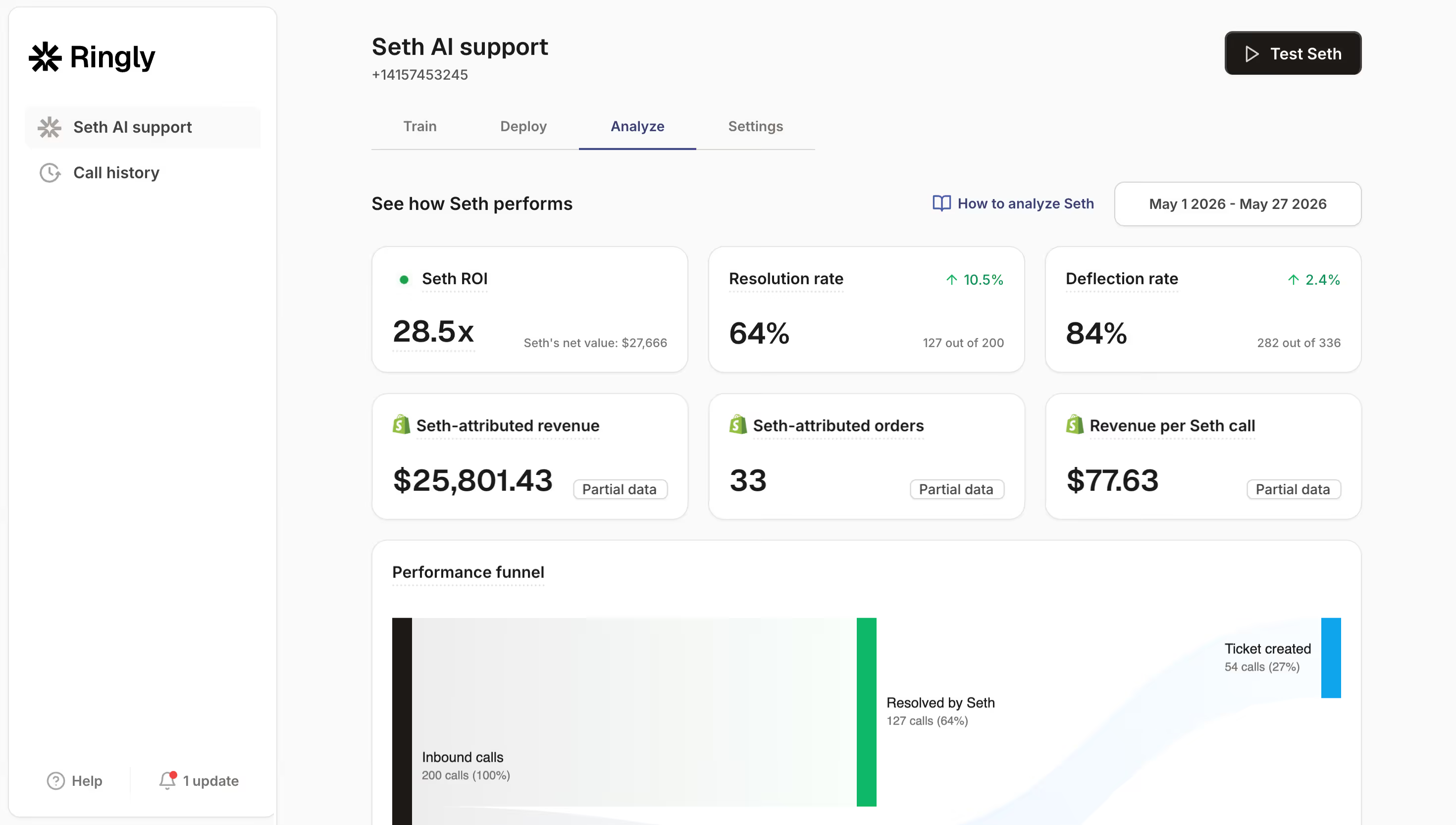
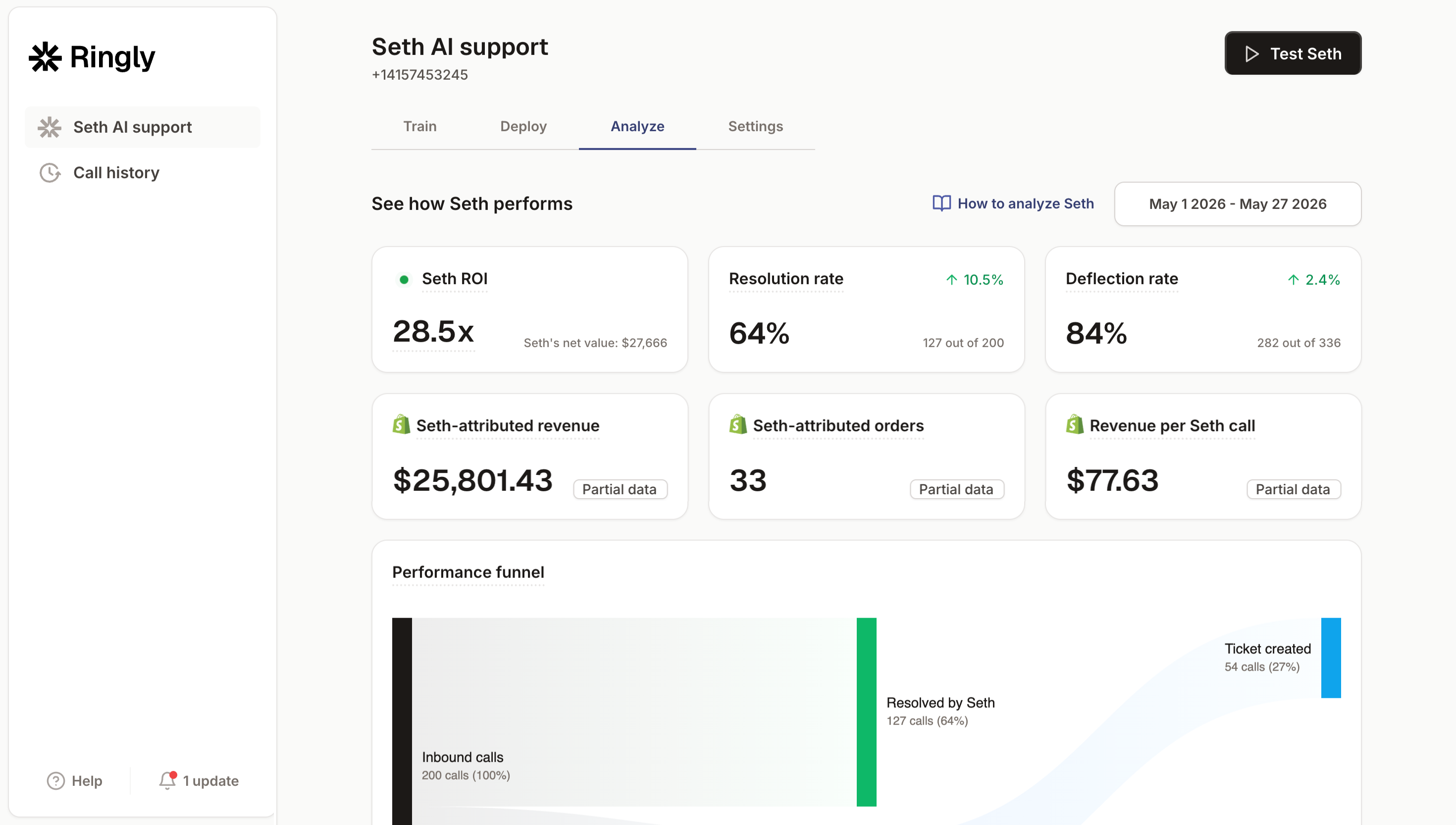
Ringly sits in front of Gorgias, not on top of it. The AI answers your inbound calls 24/7, finds the order in your Shopify store, processes returns and exchanges, answers product questions from your knowledge base, and uses a smart call transfer to escalate the genuinely complex calls cleanly into Gorgias so your team picks them up with full context. Across 50+ brands, the AI resolves 73% of inbound calls on its own, at roughly $0.42 per resolved call, versus $7 to $16 per call for a human BPO.
WashCo, a Shopify brand we launched, recovered $22,664 in its first 7 days on the phone. That's revenue from calls that, on a Gorgias-only stack, would have hit voicemail.
You keep your inbox. You keep your phone number. You keep your helpdesk and your workflows. You add an agent that actually takes the call.
"My customers also feel like it's a normal person. They feel like they can communicate if they have questions."
Claudia Droge, TechCraft Studio
Plans: Grow $349/mo (1,000 minutes, ~500 calls), Pro $799/mo (2,500 minutes, ~1,250 calls), Enterprise custom. 14-day free trial on Pro. Live in under an hour. If you want to compare the full phone-support picture, our breakdown of 24/7 ecommerce phone support and the AI phone agent for Shopify goes deeper.
How to choose: it's not either/or
The mistake is treating this as Gorgias versus a phone tool. It isn't.
- Keep Gorgias if your written-channel support is working and your team lives in the inbox. It's the best ecommerce helpdesk for a reason. Don't rip it out.
- Add an AI phone agent if you have a visible phone number, your reps keep getting pulled off email to answer it, or calls go to voicemail after hours.
- Do both if you're a $10M-$100M brand with 3-12 CS reps and a real phone line. Gorgias handles the written queue, Ringly handles the live calls, and they escalate into each other. For Shopify Plus customer service teams at scale, that split is the cleanest setup we see.
If you're weighing Gorgias against other helpdesks entirely, that's the inbox side of the decision. This post is about the phone side, the part none of them automate.
Frequently asked questions
What are the main features of Gorgias? A unified inbox across email, chat, social, SMS, and voice; deep two-way Shopify actions like refunds and order edits; Rules for routing and tagging; Macros for templated replies; an AI Agent that resolves tier-1 tickets; and reporting on volume, response times, and CSAT.
Does Gorgias have phone support? It has a Voice channel that routes and logs inbound calls as tickets for human agents to handle. It's call management. A human still answers the call.
Can the Gorgias AI Agent answer phone calls? No. Per Gorgias's own documentation, the AI Agent runs on email, chat, and SMS only. Voice isn't a supported channel, so phone calls still go to a rep or to voicemail.
How is Gorgias priced? Gorgias charges by billable ticket, from $10/mo (50 tickets) up to $900/mo (5,000 tickets), with overage around $36 per 100 tickets. The AI Agent is billed separately at about $1 per resolution, on top of the ticket fee.
Does Gorgias integrate with Shopify? Yes, deeply. Gorgias is Shopify's only Premier Partner for CX, so the sync is bi-directional: edit orders, refund, cancel, and check inventory inside the helpdesk.
How does Ringly work with Gorgias? Ringly sits in front of Gorgias as the AI phone agent. It answers inbound calls, resolves the routine ones, and escalates complex calls into Gorgias with full context. You keep your inbox and your number.
Talk to us

If you run a $10M-$100M Shopify brand on Gorgias and your phone line is still landing on your reps, a 30-min call is the fastest way to see what those calls are costing you and what they could recover.
The 3-layer guarantee.
- Live in 14 days or it's free until launched.
- 65% resolution in 90 days or we refund the last 3 months of subscription fees.
- We keep working free until we hit it.
Ruben (Ringly co-founder) takes these calls personally.