
This post in 30 seconds.
- Gorgias AI Agent is good at what it's built for: email and chat. It resolves WISMO and routine tier-1 questions on its own, 24/7.
- Its real automation rate is 26-56% (Gorgias's own case studies), not the "up to 60%" on the marketing page, and each resolution also bills as a helpdesk ticket.
- Built for the founder, COO, or Head of CX at a $10M-$100M Shopify brand who already runs Gorgias and still has a phone line a human has to answer.
Most teams I talk to assume "Gorgias AI Agent" means the whole support stack now runs itself. It doesn't. The AI Agent is real, it works, and it carries a meaningful slice of your email and chat tickets without a person touching them. But the moment a customer picks up the phone, you're back to staffing a human, because the autonomous part of Gorgias was never built for voice.
If you run customer experience at a Shopify brand doing $10M to $100M, you already feel this split. Gorgias quietly clears a chunk of your inbox while your reps still sit on a phone line that goes to voicemail after 6 p.m. This post is the honest version of what Gorgias AI Agent does, where it stops, and what to do about the calls. If you want to see your own phone numbers on a call, book a 30-min call and we'll do the math live.
What Gorgias AI Agent actually is
Gorgias AI Agent is the autonomous layer inside the Gorgias helpdesk. It works over email and chat, the two channels most ecommerce customers use to reach you.
It's agentic, which is the part Gorgias gets right. Instead of matching a question to one canned knowledge-base article, it reads your knowledge and your instructions, then makes ongoing decisions to satisfy the actual intent behind the message. According to Gorgias's own documentation, it handles "where's my order" requests in seconds, manages routine tier-1 questions, and asks clarifying questions to collect details before it hands a harder case to a person.
There's a feedback loop too. The Optimize page and performance reports let you see where the AI is doing well and where it's missing, so you can widen its coverage over time. That's a genuinely useful setup, and the deep Shopify connection means it can answer order-level questions without a rep digging through tabs.
The honest number to hold onto: Gorgias markets "up to 60%" automation, but its own published case studies land at 26-56%. That's not a knock. It's just the real ceiling you should plan your headcount around, not the brochure figure.
What it handles well
For email and chat, Gorgias AI Agent earns its place. Here's where it's strong:
- WISMO in seconds. Order-status questions are the single biggest, most repeatable ticket type, and the AI clears them without a rep. If 30-40% of your inbox is "where's my order," that's real time back. (See our breakdown of WISMO calls.)
- Routine tier-1, off the queue. Return windows, shipping policies, "did my order go through," sizing basics. The repeatable stuff your team answers 50 times a day.
- 24/7 instant text answers. Email and chat don't sleep, and neither does the AI Agent. A customer at 11 p.m. gets a real answer instead of a "we'll get back to you in 24 hours."
- Deep Shopify context. It can see the order and the customer, so the WISMO answer is specific, not a generic "check your tracking link."
- An optimization loop. The Optimize page is a real lever. Most AI tools hand you a black box. Gorgias lets you watch coverage and push it up.
If your support pain is mostly an overflowing email inbox, this is a solid tool and you're already paying for the helpdesk underneath it. The trouble starts when you look at the channel it doesn't touch.
What it does not cover: the phone, autonomously
Here's the line nobody draws clearly. Gorgias AI Agent automates email and chat. It does not autonomously answer your phone.
Gorgias does sell a Voice add-on, and it's a competent piece of software. Customers call your number, the call logs as a Voice ticket, and your agents make and receive calls inside the app with full Shopify order context. You get IVR menus, call queues, voicemail, forwarding, recording, AI summaries, and transcripts. But as eesel's breakdown of Gorgias Voice puts it plainly: Gorgias Voice is not automated. A human has to answer the calls every time the line rings.
So the AI Agent resolves your inbox, and your reps still pick up the phone. That's the split most operators don't see until they map it.
I read more than 50 real Shopify call logs while building Ringly, and the AI Agent in those brands' helpdesks had never touched a single one, because every one of them came in by voice. The phone is where the calls Gorgias can't autonomously handle pile up: the after-hours order changes, the "I want to talk to a person" escalations, the weekend voicemails nobody returns.
The reason this stays a human cost is that voice is a harder problem than text. Email and chat let the AI take its time, read the full thread, and post a clean answer. A live call has no buffer. It has to understand a customer mid-sentence, pull the order while they're still talking, and respond in a second without an awkward pause. That's why most helpdesk AI stops at the inbox, and why the phone line is still a rota of reps and a voicemail box for everyone who calls outside business hours.
The phone is also the channel your customers most want. Salesforce data via our support-stats roundup shows 76% of consumers prefer phone for support and phone scores the highest satisfaction of any channel at 91%, especially for complex cases. And the cost of dropping those calls is brutal: 78% of buyers abandon a brand after one unanswered call (PCN), while the average business answers only about 37.8% of inbound calls (AmbsCallCenter). If you want the deeper version, we wrote a full guide to Gorgias phone support.
The real automation rate and the real bill
Two numbers matter before you decide what Gorgias AI Agent does for your P&L: how much it actually resolves, and what each resolution costs.
On resolution, the honest figure is 26-56%, and on G2's performance data Gorgias shows a response accuracy of 59%, which sits about 12 points under the 71% category average. On cost, each fully automated resolution runs $1.00 on a monthly contract or $0.90 on an annual one, and here's the part that surprises people: each AI resolution also counts as a helpdesk ticket, so you pay the ticket fee and the AI fee on the same conversation (myaskai's pricing breakdown).
Stacked on the base plans, the bill climbs faster than the sticker:
| Gorgias plan | Monthly price | Tickets included | Overage |
|---|---|---|---|
| Starter | $10 | 50 | included only |
| Basic | $60 | 300 | $0.36-$0.40/ticket |
| Pro | $360 | 2,000 | $0.36-$0.40/ticket |
| Advanced | $900 | 5,000 | $0.36-$0.40/ticket |
Source: Gorgias pricing 2026 via Lindy. We also keep a running tally on our own Gorgias pricing breakdown.
None of that buys you an answered phone. Every dollar above goes to email and chat resolution. The calls are a separate line item, and right now that line item is your reps' time. If you're weighing the build-vs-buy on the voice side, our take on in-house vs outsourced support is a fair starting point.
How to set expectations if you run Gorgias
So you don't rip anything out. Gorgias AI Agent is doing real work on email and chat, and the Optimize loop is worth pushing. The move is to set expectations correctly and stop pretending the phone is covered.
- Keep Gorgias for email and chat tier-1. That's its lane, and it's a good one. Don't expect it past the 26-56% band, and budget your headcount on the real number.
- Treat the phone as its own problem. Gorgias Voice gives you the rails, but it needs a human on every call. Either staff that, or put an actual AI agent on the line.
- Route the after-hours and complex calls deliberately. The weekend voicemails and the "I need a person" calls are where the revenue leaks. Decide who, or what, picks those up.
One more billing nuance worth knowing while you plan: if a customer talks to a human within 72 hours of an AI resolution, Gorgias bills that case as a ticket only, not as a resolution on top. So the resolutions you pay the AI fee for are the ones the AI fully closes alone. That's the right way to think about coverage in general. Count the conversations that end without a person, on every channel, and staff for the rest. On the phone today, "the rest" is almost everything, because the autonomous AI never picks up.
The cleanest version of this is the omnichannel split most strong CX teams already run: let AI close the routine, route the complex to a human, and make sure every channel has a real owner. Gorgias gives you that on email and chat. The phone is the one channel still missing its AI owner.
If you want, book a 30-min call and we'll pull your last week of missed calls and show you what fell through.
Ringly: the AI agent for the phone channel Gorgias leaves open
Ringly.io
Best for: Shopify brands that run Gorgias for email and chat and still have a visible phone line a human has to answer.
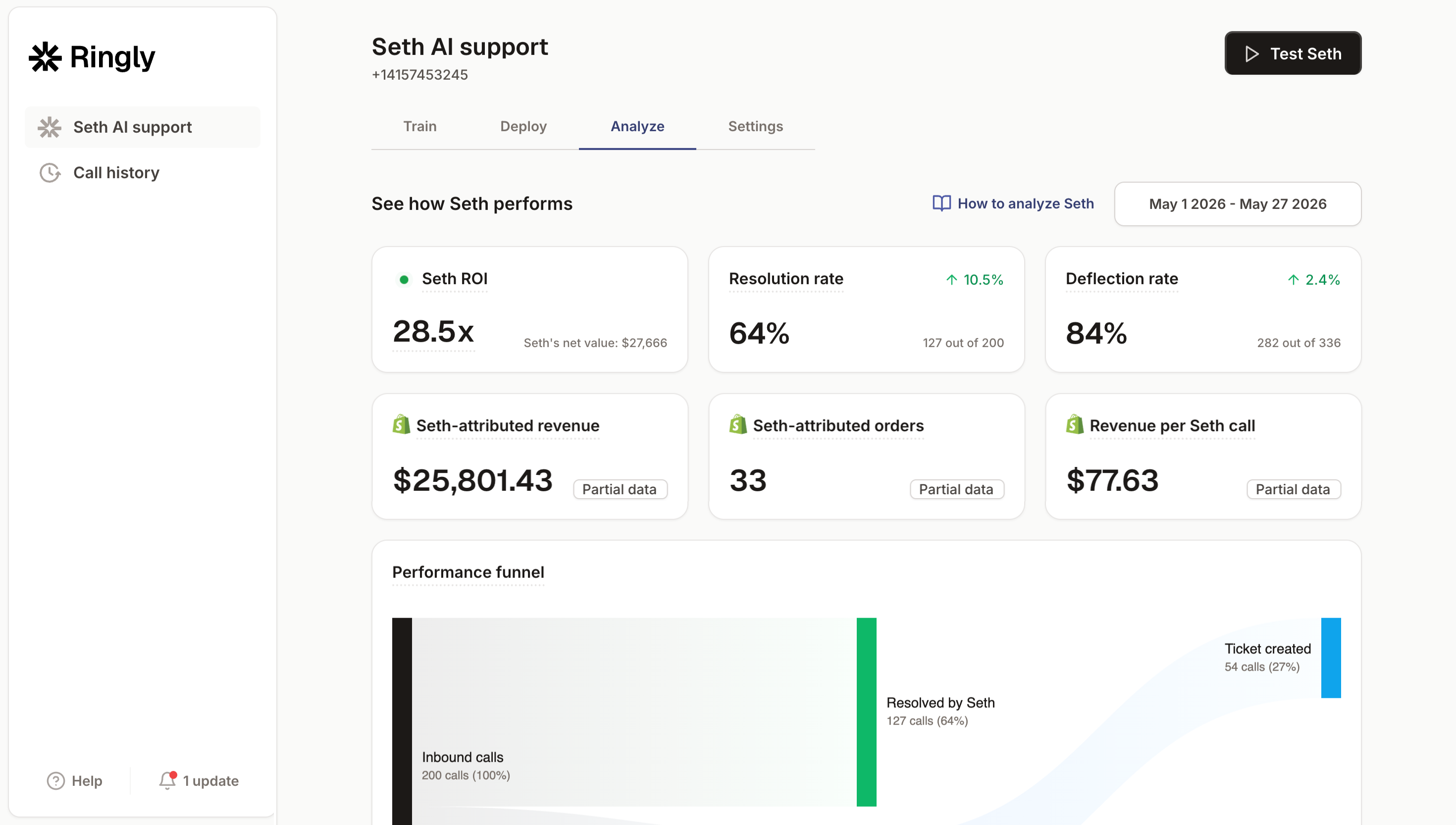
Ringly.io is AI phone support for Shopify brands. It's the voice agent that picks up the calls Gorgias AI Agent doesn't autonomously handle, and it answers them 24/7 without a rep. It finds orders in your Shopify store, processes returns and exchanges, answers product questions from your knowledge base, and rescues abandoned carts on outbound calls. The calls that genuinely need a person escalate cleanly back into Gorgias, so your team keeps one queue.
Across 50+ brands, the AI resolves 73% of inbound calls on its own at roughly $0.42 per resolved call. WashCo, a Shopify brand we launched, recovered $22,664 in attributed revenue in its first 7 days on the phone. It sits in front of your helpdesk, not on top of it, which is the part that matters if you've been burned by an AI tool that promised to replace everything.
Pricing
| Plan | Price | Minutes | Best for |
|---|---|---|---|
| Grow | $349/mo | 1,000 (~500 calls) | First phone-volume |
| Pro | $799/mo | 2,500 (~1,250 calls) | Clear, steady call volume |
| Enterprise | By call | Custom | $10M-$100M brands, 3-12 reps |
What works
- It's voice-first, not voice-bolted-on. This is an AI phone agent, not a chat tool with a phone tab. The thing Gorgias Voice doesn't automate is the thing Ringly does.
- It escalates into your stack. Hard calls hand off cleanly to Gorgias, Richpanel, or Reamaze with smart call transfer. You keep your helpdesk.
- It does the order work live. Real-time order status, returns, and exchanges, pulled from your knowledge base.
- Done-for-you build. We build and tune it, not you. Live in under an hour for self-serve, with a full launch sprint on Enterprise.
What doesn't
- It's phone-only. Ringly doesn't do email and chat tickets. If you need those, that's exactly what Gorgias AI Agent is for. The two are complementary, not competitors.
- It's not a fit under $10M with no phone line. No visible number means no problem for us to solve.
Why it's the right tool for the phone
Gorgias AI Agent owns your inbox. Ringly owns your phone. Run both and the channel that leaks the most revenue stops leaking. See the AI phone agent for $10M+ Shopify brands if you want the longer case.
"My customers also feel like it's a normal person. They feel like they can communicate if they have questions."
Claudia Droge, TechCraft Studio
What this costs you today vs with an AI phone agent
Put real numbers on the phone line. Take a typical $50M Shopify brand running a 6-rep CS team to cover calls:
| Line item | Today | With Ringly |
|---|---|---|
| 6 reps × $4K loaded per rep | $24,000/mo | n/a |
| Ringly Enterprise (~$5K/mo) | n/a | $5,000/mo |
| Net monthly CS spend | $24,000/mo | $5,000/mo |
| Monthly savings | n/a | $19,000/mo |
| Annual savings | n/a | $228,000/yr |
That's roughly 70% of repeatable calls (order status, returns, the same five questions over and over) handled by the AI. The genuinely complex 30% still go to your team, who now have time to actually solve them instead of reading tracking numbers aloud all day. Exact Enterprise pricing is set on a call. These are the savings shapes we see across 50+ Shopify brands.
Frequently asked questions
Does Gorgias AI Agent handle phone calls? Not autonomously. The AI Agent works over email and chat. Gorgias Voice logs and routes calls, but a human has to answer every one.
What automation rate should I actually expect from Gorgias AI Agent? Plan for 26-56%, the range in Gorgias's own case studies, not the "up to 60%" marketing figure. G2's performance data also shows a 59% response accuracy, below the 71% category average.
How much does a Gorgias AI Agent resolution cost? $1.00 per resolution on a monthly contract, $0.90 on an annual one. Each resolution also counts as a helpdesk ticket, so you pay both fees on the same conversation.
Do I have to replace Gorgias to add AI phone support? No. Ringly sits in front of your helpdesk and escalates hard calls back into Gorgias, Richpanel, or Reamaze. You keep your inbox tooling and your one queue.
Is the AI obvious to customers on the phone? The most repeated thing customers say after a call is "you don't sound like AI." You also keep full control of what escalates to a human.
Does Ringly offer a guarantee? Yes. If the AI resolves under 65% of your calls in 90 days, we refund the last 3 months of subscription fees.
Talk to us

If you run a $10M-$100M Shopify brand on Gorgias and your phone still goes to voicemail after-hours, a 30-min call is the fastest way to see what those missed calls are costing you. We'll map which calls Gorgias handles and which ones need the phone agent.
The 3-layer guarantee.
- Live in 14 days or it's free until launched.
- 65% resolution in 90 days or we refund the last 3 months of subscription fees.
- We keep working free until we hit it.
Ruben (Ringly co-founder) takes these calls personally.