
This post in 30 seconds.
- What it is: Gorgias is the Shopify-native helpdesk. It pulls every email, chat, and social message into one inbox and lets your reps refund, edit, and look up orders without leaving the screen.
- What it costs: billable-ticket pricing that runs $10 to $900/mo before AI, and AI conversations get billed twice. The $360 plan commonly lands near $960 in real use.
- Who this is for: founders, COOs, and Heads of CX at $10M-$100M Shopify brands running 3-12 reps and a phone number that still goes to voicemail after 6pm.
Last Tuesday at 9pm I dialed the published support line of a roughly $20M Shopify apparel brand running Gorgias. Four rings, then voicemail. I did the same on a brand running an AI phone agent in front of their helpdesk. It answered in two rings, found my order, and read me the tracking. Same stack underneath. Two completely different outcomes for the customer who called.
That gap is the whole reason this post exists. Gorgias is a good helpdesk, and if you run support at a $10M-$100M Shopify brand it's likely on your shortlist already. But a helpdesk organizes the tickets you receive. It doesn't pick up the phone when your reps are offline. If your store has a visible phone number and you're tired of voicemails you never return, book a 30-min call and we'll show you what's happening on the calls your team misses.
Here's the honest version of what Gorgias does well, what it costs, and the one channel where a helpdesk alone leaves money on the table.
What a helpdesk actually does (and what it doesn't)
A helpdesk is the system that turns messy inbound support into trackable work. Every email, chat, social DM, SMS, and call gets converted into a "ticket" your team can assign, prioritize, tag, and close.
According to Whale's glossary of helpdesk systems, the core job is to act as a single point of contact between the customer and your support staff, so nothing falls through the cracks. The standard feature set is consistent across every tool in the category:
- Unified inbox. Email, chat, social, SMS, and sometimes voice land in one queue instead of five tabs.
- Routing and tagging. Tickets get sent to the right rep, flagged when urgent, and tagged so you can report on what people actually contact you about.
- Macros and canned replies. Reps answer the same question fast without retyping.
- Knowledge base. A self-serve library that deflects the easy questions before they become tickets.
- Reporting. Volume, response time, resolution rate, and cost per ticket, so you can see where payroll is going.
A helpdesk makes the work you already receive easier to manage. It does not reduce the work, and it does not answer a channel where no human is sitting. That distinction matters more than any feature comparison, and it's the thread running through the rest of this post.
Worth being precise about one more thing: a helpdesk is reactive by design. It waits for a customer to reach out, then routes what they sent. Email and chat tolerate that, because the customer is fine waiting an hour for a reply. The phone doesn't work that way. A caller wants an answer in the moment, and if the queue your helpdesk built has no human in it, the ticket never opens. So the same tool that makes your email backlog manageable can quietly leave your single most time-sensitive channel uncovered, and you won't see it in the dashboard because the call never became a ticket.
Why Gorgias is the Shopify-native pick
Best for: Shopify and Shopify Plus brands where a real chunk of support means doing something to an order, not just answering a question.
Gorgias is a customer support platform built specifically for ecommerce, and it's the deepest on Shopify of any helpdesk in the category. It's Shopify's only Premier Partner for CX and, per eesel's 2026 Gorgias overview, it powers roughly 40% of the top 1,500 Shopify brands. That's not a vanity stat. It tells you the Shopify integration is the product, not a bolt-on.
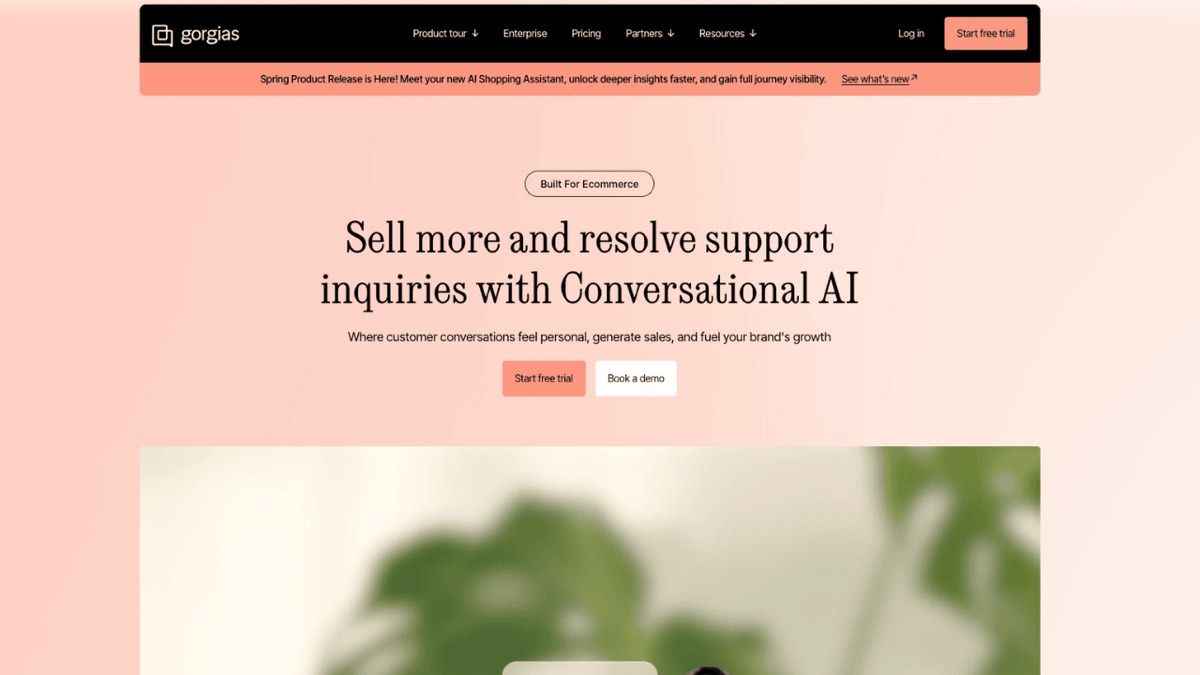
The thing Gorgias does that a generic helpdesk can't: a bi-directional sync with Shopify that lets a rep refund, cancel, edit an order, or manage a subscription without ever leaving the ticket. When a "where's my order" message comes in, Gorgias grabs the tracking straight from Shopify and can answer it automatically. Given that WISMO runs 30-40% of tickets in normal periods and north of 50% at peak (per Salesforce), that one capability carries a lot of the value.
On pricing, the short version is that Gorgias bills per ticket with AI billed on top. The next section breaks down the full math.
Here's what works well in day-to-day use:
- Deepest Shopify sync in the category. Order actions happen inside the ticket. No tab-switching, no copy-pasting order numbers.
- WISMO auto-answer. The single highest-volume question type gets handled without a rep touching it.
- AI Agent for the routine stuff. Gorgias markets up to 60% automation, though published case studies land closer to 26-56% in practice. Still real deflection on the repeatable questions.
- Strong reviews. G2 rates Gorgias 4.6/5 across 547 reviews as of early 2026, with 74% at five stars.
And here's where it falls short:
- It's priced for stores doing order actions, not conversations. The Reddit consensus is blunt: if 40%+ of your tickets need a Shopify action (refund, cancel, edit), Gorgias earns its price. If your volume is mostly conversational, a cheaper tool wins.
- Live chat customization is limited and the app can feel slow under heavy load, per recurring G2 and Shopify App Store reviews.
- Phone is an afterthought. More on that below. It's the channel where a helpdesk's model breaks down.
Verdict: if you're on Shopify and your support is order-heavy, Gorgias is the right helpdesk. It's the most defensible pick in the category for exactly the ICP reading this. The catch isn't the helpdesk. It's what sits in front of the phone line.
What Gorgias actually costs (the billable-ticket reality)
Gorgias doesn't charge per seat. It charges per billable ticket, and that changes the math in a way that surprises a lot of operators.
| Plan | Price/mo | Billable tickets/mo |
|---|---|---|
| Starter | $10 | 50 |
| Basic | $60 | 300 |
| Pro | $360 | 2,000 |
| Advanced | $900 | 5,000 |
| Enterprise | Custom | 5,000+ |
A ticket becomes billable the moment one message goes out from the helpdesk, whether a rep, the AI, or an automation rule sent it (per Gorgias's own billing docs). Reopened tickets often re-bill. A conversation that moves across two channels can count as two tickets.
Then there's the AI. Gorgias charges $1.00 per fully resolved AI interaction monthly, or $0.90 annually, and each one also counts as a helpdesk ticket. So an AI-handled conversation gets billed twice: once as a ticket, once as automation. Pricing breakdowns from Lindy and others show a $360 Pro plan climbing toward $960 once AI runs at a normal share of 2,000 tickets.
The model that organizes your busiest months is the same model that makes your busiest months your most expensive. Overage runs $0.32 to $0.40 per extra ticket with no hard cap, so a launch or a BFCM spike scales your bill right alongside your volume. We broke the full math down in our Gorgias pricing guide, and it's worth reading before you commit to a tier.
If the per-ticket model worries you, it's also worth scanning the Gorgias alternatives that price differently. None of them change the phone problem, though, which is the part of this we keep coming back to.
Setup realities nobody warns you about
Gorgias is powerful, and powerful tools have a learning curve. Several four-star reviewers dock a star for exactly this: it takes some getting used to and the initial setup isn't a one-afternoon job.
Budget real time for these:
- Rules and macros. The automation that makes Gorgias feel magic is automation you have to build. Routing logic, tag taxonomy, canned responses, and the conditions that trigger them.
- Integrations. Shopify connects cleanly, but a heavier stack (a third-party ERP, a returns app, a subscription tool) takes configuration, and some reviewers report friction syncing those reliably.
- Knowledge base. The AI Agent is only as good as the docs behind it. Thin KB, weak deflection.
- Team training. A 3-12 rep team needs onboarding on the inbox, the macros, and the escalation paths before the resolution numbers move.
None of this is a knock. It's the honest cost of a helpdesk that does this much. Just don't expect the automation numbers from the marketing page on day three. Most teams report it takes a few billing cycles of tuning rules and KB articles before the AI Agent earns its keep, which is worth planning for because every month of weak deflection is a month of tickets you're paying a human to close.
Where Gorgias stops: the phone channel
Here's the part the review posts gloss over. Gorgias does have a phone product, Gorgias Voice, but it's a subscription add-on that works like a desk phone wired into your helpdesk, not an autonomous answerer.
Pull the Gorgias Voice docs and the shape is clear. Voice lets your reps answer inbound and place outbound calls from inside Gorgias. Useful. But:
- A human still has to pick up. Voice routes the call to a rep at a desk. When nobody's sitting there, after 6pm or during an overflow, it goes to voicemail like any other line.
- No mobile answering. You can't take or place calls from the Gorgias mobile app or mobile web. Desktop browser only (you can forward to ring a phone, but that's a workaround).
- Outbound is +1 only, the max call length is four hours, and you can't attach multiple numbers to one Voice integration.
So the phone channel inside your helpdesk has the same fundamental limit as your old phone line: it needs a person. And the data on what an unanswered phone costs a DTC brand is rough. Businesses answer only 37.8% of inbound calls on average (per AmbsCallCenter). When callers can't reach a person, 85% never call back and 62% switch to a competitor (per PCN's missed-call study). And 80% of the ones routed to voicemail hang up without leaving a message (per Eden).
Every one of those is a billable ticket you never even got to bill, and a customer your reps never got to help.
There's a second-order cost too. A phone call that does get answered and logged in Voice becomes a billable ticket like any other, so the channel that's hardest to staff is also adding to the per-ticket meter. You're paying for the call twice: once in rep time, once on the invoice. And the calls that matter most, the pre-purchase question at 8pm or the angry "where is my order" on a Sunday, are exactly the ones a desk-bound phone tool can't catch. A helpdesk is built to organize a queue. A phone line that rings out doesn't generate a queue. It generates a competitor's new customer.
If your phone goes to voicemail after hours and you don't actually know what you're losing, book a 30-min call and we'll review your missed calls live.
How to keep the phone from ringing out
The fix isn't replacing Gorgias. It's putting something in front of the phone line that answers every call, resolves the routine ones, and hands the rest to your reps as a clean Gorgias ticket.
That's what Ringly.io is. AI phone support for Shopify brands. Instead of growing your phone team every time call volume climbs, the AI takes the routine inbound calls so your reps can focus on the work that actually moves revenue.
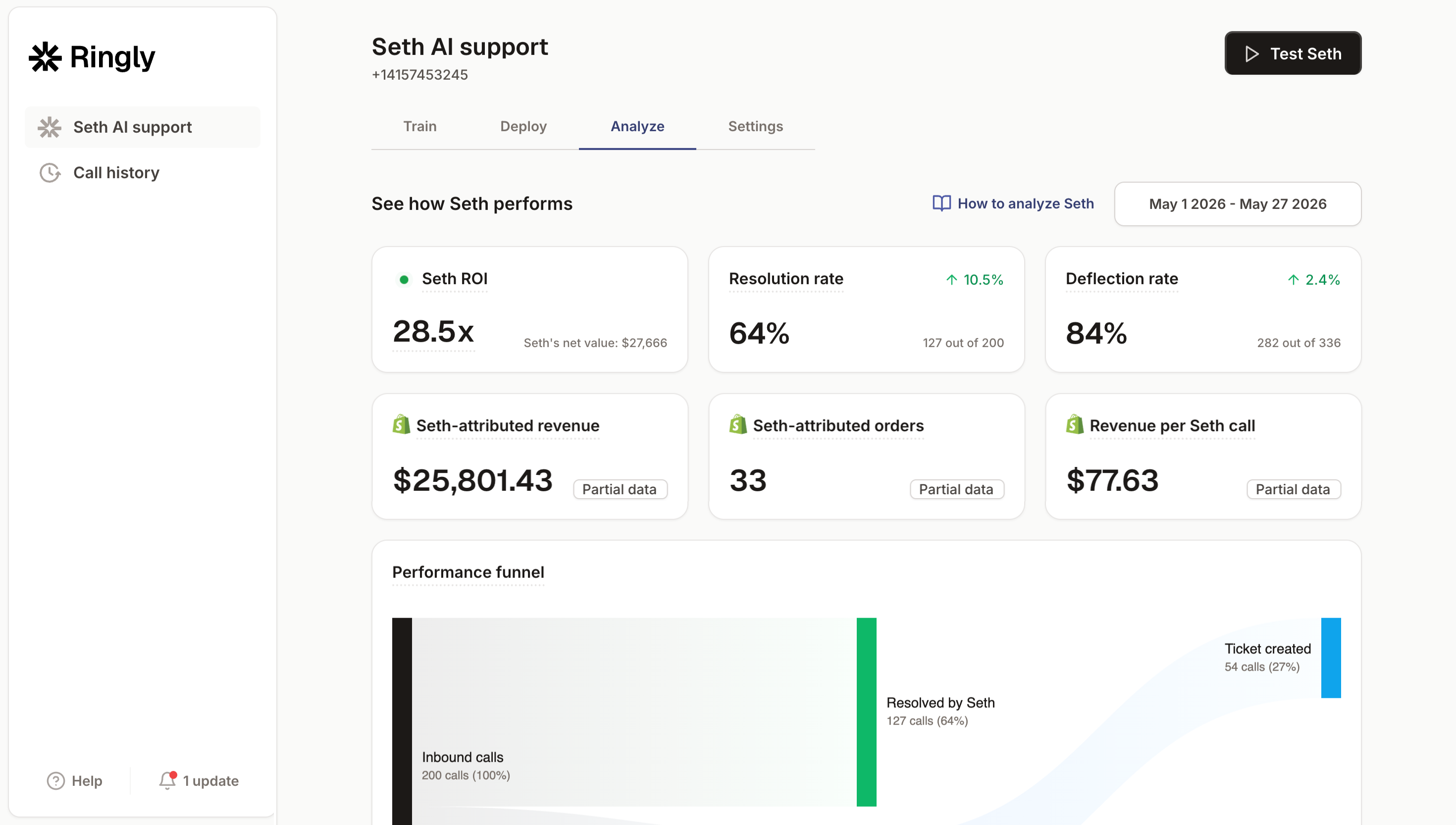
The AI answers inbound calls 24/7 in 40 languages. It finds orders in your Shopify store, processes returns and exchanges, answers product questions from your knowledge base, and rescues abandoned carts. Across 50+ brands, it resolves 73% of calls autonomously at roughly $0.42 per resolved call. The calls that need a person escalate cleanly into Gorgias, Richpanel, or whatever helpdesk you already run, so a phone call becomes a ticket with full context instead of a missed voicemail.
WashCo, a Shopify brand we launched, recovered $22,664 in its first 7 days on the phone. That's revenue from calls that, on a voicemail line, would have rolled to a competitor.
And the quality holds up, which is the objection every operator has first.
"My customers also feel like it's a normal person. They feel like they can communicate if they have questions."
Claudia Droge, TechCraft Studio
What this costs vs another phone rep
Picture a $50M Shopify brand running a 6-rep CS team and trying to staff the phones into the evening.
| Line item | Today | With Ringly in front |
|---|---|---|
| 6 reps × $4K loaded per rep | $24,000/mo | $24,000/mo |
| The phones after-hours | voicemail | answered 24/7 |
| Calls resolved without a human | 0% | ~73% |
| Cost per resolved call | n/a | ~$0.42 |
You don't fire the team. You stop paying them to do the same five calls over and over, and you stop losing the after-hours ones entirely. Plans start at $349/mo with a 65% resolution guarantee, and you're live in under an hour.
Want to compare this to your current setup? Book a 30-min call and we'll do the math live on your real call volume.
For more on the phone side specifically, see our guides to 24/7 ecommerce phone support, WISMO calls, and ecommerce customer service at scale. If you run on Shopify Plus, our Shopify Plus customer service breakdown covers the higher-volume version of this.
Frequently asked questions
Is Gorgias a helpdesk?
Yes. Gorgias is a customer support helpdesk built for ecommerce, with the deepest native integration for Shopify of any tool in the category. It centralizes email, chat, social, SMS, and voice into one ticketed inbox.
Does Gorgias do phone support?
It offers Gorgias Voice as a paid add-on, which lets reps answer and place calls from inside the helpdesk. But a human still has to be at a desk to pick up, so after-hours and overflow calls roll to voicemail. It's a phone channel, not an autonomous phone agent.
How much does Gorgias cost?
Plans run from $10/mo (Starter, 50 tickets) to $900/mo (Advanced, 5,000 tickets), billed per ticket. AI conversations cost $0.90-$1.00 each on top and are also counted as tickets, so real bills run higher than the sticker. See our Gorgias pricing guide for the full math.
Is Gorgias worth it for a Shopify brand?
If 40% or more of your tickets need a Shopify action like a refund, cancel, or order edit, yes. If your volume is mostly simple conversational questions, a cheaper helpdesk may serve you better. The honest test is your order-action ratio.
Does Gorgias replace my phone team?
No. Gorgias organizes the tickets your team works, including calls a rep answers in Voice. It doesn't answer the phone on its own. To handle calls without growing headcount, you pair the helpdesk with an AI phone agent for Shopify.
Can Ringly work alongside Gorgias?
Yes. Ringly answers your inbound calls, resolves the routine ones, and escalates the rest into Gorgias as a ticket with full call context. You keep your helpdesk, your number, and your workflows. The AI just stops the phone from going to voicemail.
Talk to us

If you run a $10M-$100M Shopify brand on Gorgias and your phone still rolls to voicemail after-hours, a 30-min call is the fastest way to see the revenue sitting in your missed calls.
The 3-layer guarantee.
- Live in 14 days or it's free until launched.
- 65% resolution in 90 days or we refund the last 3 months of subscription fees.
- We keep working free until we hit 65%.
Ruben (Ringly co-founder) takes these calls personally.