
This post in 30 seconds.
- A pre-purchase question is a customer with their card out, asking you for one reason to click buy. Answer speed decides whether they do.
- The data nobody quotes: a one-minute response can lift conversions by up to 391%, and 78% of shoppers buy from whoever answers first.
- Built for $10M-$100M Shopify brands with a real support team and a visible phone line, where pre-sale calls roll to voicemail after 6 p.m.
A pre-purchase question is a customer with their card out, asking you for one reason to click buy. "Is this in stock?" "Will it fit me?" "Which one should I get?" Every one of those is someone leaning in, not complaining. And across the 50+ Shopify brands we run phone support for, a real slice of inbound contact is exactly this: not problems, questions from people who want to buy and need one doubt removed first. The brands that answer fast turn those into orders. The ones that route them through the same slow queue as a return request watch them drift to a competitor's open tab. If your phone goes to voicemail after 6 p.m., book a 30-min call and we'll show you what your pre-sale calls are worth.
Most $10M-$100M Shopify brands treat pre-purchase questions as support tickets, so they land in the same backlog as WISMO and refunds and get answered hours later. That is the mistake this post is about fixing. We've launched AI phone agents for 50+ brands trying to stop the after-hours leak. Book a 30-min call and we'll map where your store is losing the sale before it happens.
What counts as a pre-purchase product question (and why it's not a support ticket)
A pre-purchase question is anything a shopper asks before they buy, to close the last gap between interested and sold. Post-purchase questions are about an order that already exists. Pre-purchase questions are about an order that hasn't happened yet, which is exactly why they're worth more.
A pre-purchase question is a buying signal that got mislabeled as a support request. The person asking is further down the funnel than anyone browsing your ads, and they've raised their hand. According to Saleslion, 81% of consumers research online before they buy, which means by the time someone asks you directly, they've already done their homework and they're down to one or two open questions.
Here's the set that comes up over and over, across pretty much every vertical:
| What they're really asking | The question you actually hear | Where it spikes |
|---|---|---|
| Is this right for me? | "Which one should I get?" | supplements, gear, electronics |
| Will it fit? | "What size am I in this?" | apparel, footwear |
| Can I get it in time? | "Is it in stock, and how fast does it ship?" | every store |
| What if it's wrong? | "What's your return policy?" | higher-AOV |
| Is it legit? | "Is this authentic, will it work for X?" | beauty, supplements |
| Is now the time to buy? | "Any discount running?" | every store |
| Can you even ship to me? | "Do you deliver to my area?" | every store |
| How do I use it? | "How do I care for this?" | beauty, specialty food |
| Can I skip the website? | "Can I just order over the phone?" | older demos |
That last one matters more than most teams think. Older-demographic brands, supplements, specialty food, gear, get a steady stream of callers who won't finish a cart online and want to place the order with a person. Treating that call as a ticket, or worse, letting it hit voicemail, throws away the easiest sale you'll get all day. It's the inverse of a WISMO call: same caller, same phone line, but this one is trying to give you money instead of chase an order.
Why answer speed is the whole game
You can have the best answer in the world. If it lands two hours later, the sale is gone.
The shopper who asks a pre-sale question is buying in the next few minutes, from whoever responds first. The numbers here are blunt. Rogue Digital reports that responding within the first minute can lift conversions by up to 391%, drawing on the long-running lead-response research summarized by Rework. And Kixie puts it even more simply: 78% of customers buy from the company that responds first.
The decay is steep. Per Setter AI, the odds of qualifying a lead drop roughly 10x once you go past five minutes, and 21x once you cross half an hour. Now sit with the other half of that data: the average first-response time in ecommerce is around 42 hours. Most stores are answering the highest-intent question they get two days after the moment passed.
It doesn't take a 42-hour fix to move the needle. Even pulling pre-purchase first response from four hours down to under one hour has been shown to raise conversion on those inquiries meaningfully. Speed isn't optional on pre-sale. It is the product.
If you want to see what your own pre-purchase response speed is costing you, that's a 30-minute conversation.
The four channels, and where each one wins
Shoppers ask pre-purchase questions wherever it's easiest for them, which means you're answering across four channels at once. Each one is good at something and bad at something else.
No single channel covers every pre-sale question, but only one of them is regularly left unstaffed. Here's the honest breakdown:
| Channel | Best for | Latency | Where it falls down |
|---|---|---|---|
| FAQ / product page | The predictable questions, at scale | Instant | Static. Can't answer the specific one. |
| Live chat | On-site shoppers, quick back-and-forth | Seconds, if staffed | Business hours only, needs people |
| Complex or detailed questions | Hours to days | Far too slow for a buying moment | |
| Phone | Highest intent, higher AOV, older buyers | Instant, if answered | Nobody staffs it after-hours |
Your FAQ and product-page content should absorb the questions you can predict: sizing charts, shipping windows, return policy, materials. That's the cheapest answer you'll ever give, because you give it once and it serves everyone. But a static page can't tell a specific caller whether the blue one is back in stock or which formula fits their situation.
Live chat is fast and it keeps the shopper on the page, which is why so much of the pre-purchase conversation has moved there. The catch is the same as always: it's only as fast as the person on the other end, and most teams turn it off at night. Email is the worst place for a pre-sale question to land, because the answer almost always arrives after the decision's been made.
The mistake isn't picking the wrong channel. It's running each one as a separate island, with a different person, a different answer, and a different set of hours. The shopper who got told one thing in chat at noon and something else on the phone at night doesn't think "inconsistent staffing." They think "I don't trust this store," and they close the tab. Treating the four channels as one system, fed by one set of facts, is what separates the brands that convert pre-sale customer service contact from the ones that leak it.
Which leaves the phone. The channel with the highest buying intent, and the one most brands quietly let leak.
The phone is where pre-purchase questions quietly die
Chat and FAQ get all the attention. The phone is where the money actually leaks, because the pre-sale phone call is the one nobody plans for after 6 p.m.
A pre-purchase call that hits voicemail is a sale you've already lost, you just don't see it on the dashboard. The behavior is well documented. Per Eden, 80% of voicemail-routed callers hang up without leaving a message. And PCN found that 85% of callers who can't reach a person never call back, with 62% switching to a competitor. So the after-hours pre-sale caller doesn't leave a note for your team to follow up on. They buy somewhere else.
This is where I'll be specific, because it's the part the rest of the internet skips. When we read through real call logs from the brands we work with, a large share of inbound calls aren't problems at all. They're people asking "is this the right one for me," "is it in stock," "can I order this over the phone." Those calls convert at a much higher rate than a WISMO call ever will, because the person is mid-decision. WashCo, a Shopify brand we launched, recovered $22,664 in its first 7 days on the phone, mostly from calls a voicemail box would have eaten.
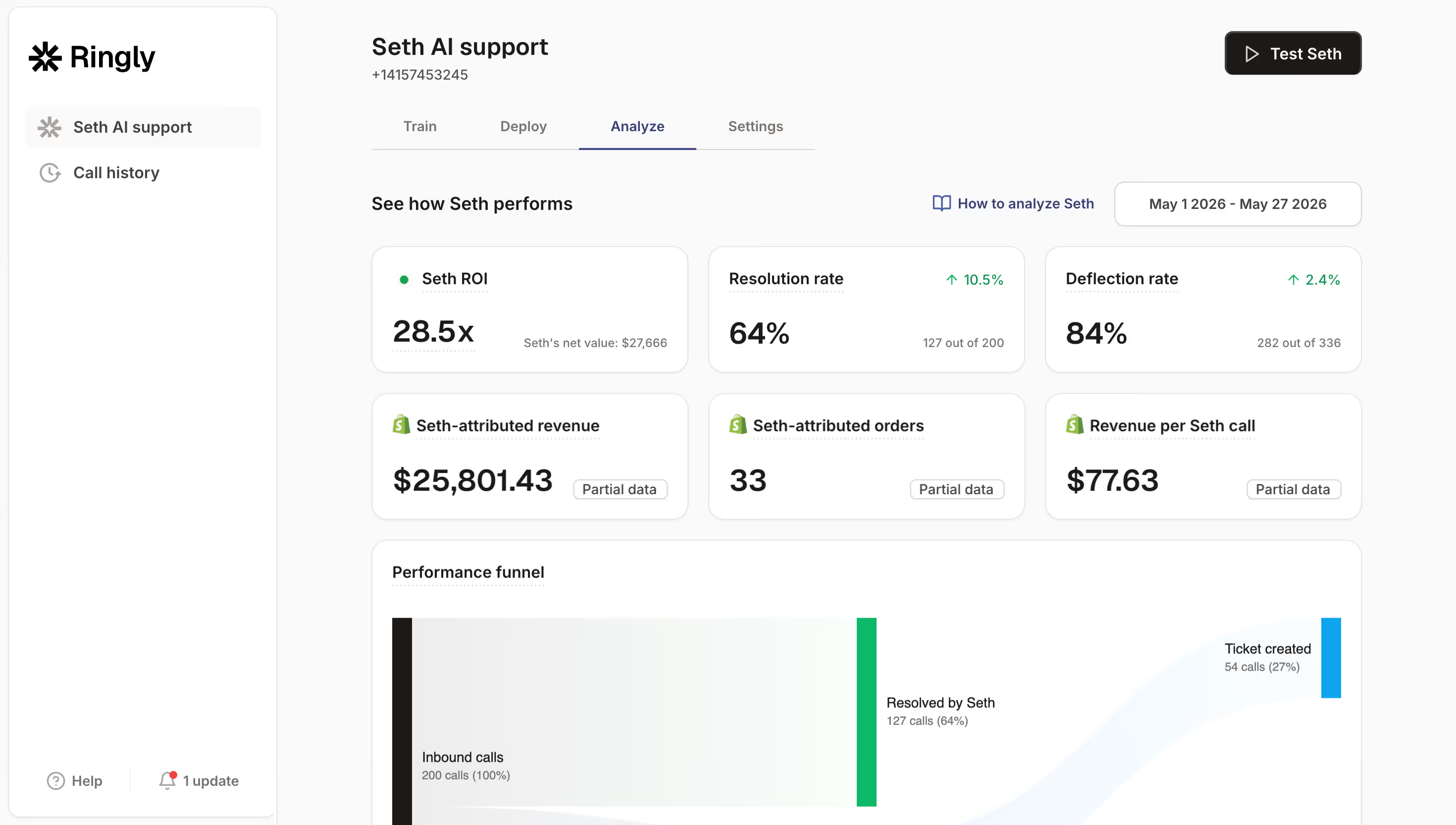
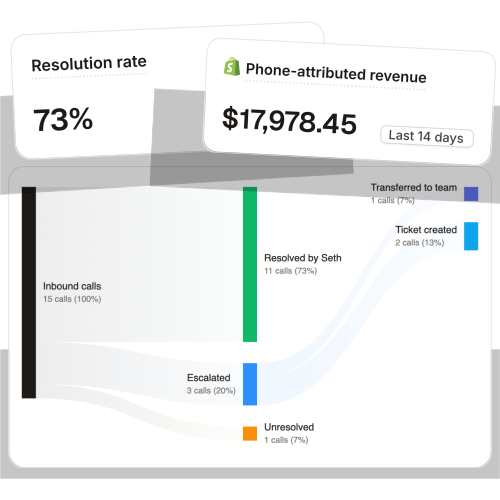
This is the gap an AI phone agent is built to close. Ringly.io is AI phone support for Shopify brands. It answers inbound calls 24/7, pulls live stock and product info from your knowledge base, and handles the pre-sale questions the same way a good rep would, at 2 p.m. or 2 a.m. It can also recover the abandoned cart on the back of that call. The calls it can't close, the genuinely complex ones, escalate cleanly to your team in Gorgias, Zendesk, or whatever helpdesk you already run. Across 50+ brands, the AI resolves 73% of calls autonomously.
If your pre-sale calls roll to voicemail after-hours, book a 30-min call and we'll pull a week of your missed calls and show you what was in them.
Answer it once, reuse it everywhere
The reason pre-purchase questions feel endless is that most teams answer them one at a time, by hand, across four channels that don't talk to each other. The fix is structural, not heroic.
Build the answer once, in one knowledge base, and let every channel pull from it. Your sizing guidance, your stock logic, your return policy, your "which formula for which goal" decision tree: write it down once, in a single source of truth. Then your FAQ, your chat replies, and your phone agent all answer from the same place, so a caller and a chatter never get two different stories.
This is also where the repeatability shows up. Most brands tell us 70-80% of their pre-sale questions are the same handful, asked over and over. Once those live in a knowledge base, they stop costing your team time and start running themselves. The complex 20-30%, the calls that need judgment, get handed to a person who now has the room to handle them well.
"My customers also feel like it's a normal person. They feel like they can communicate if they have questions."
Claudia Droge, TechCraft Studio
That's the bar for a pre-sale answer. Fast, correct, and human enough that the shopper trusts it. It's the same standard whether the question comes in through chat, an order-status check, or a phone call at midnight. Get the knowledge base right and the channel stops mattering.
What this costs you today vs answering every pre-sale question
Pre-purchase questions are the work your team does that most directly makes money, and they're buried under the work that doesn't. Here's the math on freeing them up.
Take a typical $50M Shopify brand running a 6-rep CS team:
| Line item | Today | With Ringly |
|---|---|---|
| 6 reps x $4K loaded per rep | $24,000/mo | n/a |
| Ringly Enterprise (~$5K/mo) | n/a | $5,000/mo |
| Net monthly CS spend | $24,000/mo | $5,000/mo |
| Monthly savings | n/a | $19,000/mo |
| Annual savings | n/a | $228,000/yr |
That's roughly 70% of the repeatable contact, the stock checks, the "which one" questions, the same five things over and over, routed to the AI. The other 30%, the genuinely complex sale, still goes to your reps, who now have time to actually win it. The difference shows up twice: lower support cost and more pre-sale calls converting because somebody finally picks up.
Want the numbers run on your actual call volume? Book a 30-min call and we'll do the math live.
Frequently asked questions
What is a pre-purchase question in ecommerce? It's any question a shopper asks before they buy, to remove the last doubt standing between them and checkout. Common ones cover sizing, stock, shipping speed, returns, and "which one is right for me." They're buying signals, not support tickets.
How fast should you answer a pre-purchase question? As close to instant as you can manage. Responding within a minute can lift conversions by up to 391% per Rogue Digital, and 78% of buyers go with whoever answers first. Past five minutes, your odds drop sharply.
What are the most common pre-purchase product questions? Sizing and fit, stock and delivery time, return policy, product authenticity or suitability, current promotions, and whether you ship to the customer's area. Older-demographic brands also field a lot of "can I order over the phone" calls.
Should pre-purchase questions go to chat, email, or phone? All three, plus a strong FAQ. Chat wins for on-site shoppers, the phone wins for high-intent and older buyers, and email is best left for complex cases. The key is answering all of them from one knowledge base so the answers never contradict.
Can AI answer pre-purchase product questions on the phone? Yes. An AI phone agent pulls product, stock, and policy info from your knowledge base and answers pre-sale calls 24/7, escalating anything complex to your team. Across 50+ Shopify brands, Ringly resolves 73% of calls autonomously.
How do you stop losing after-hours pre-sale calls? Cover the phone around the clock. Voicemail doesn't work here: 80% of voicemail-routed callers hang up without leaving a message, so the after-hours caller just buys elsewhere. An after-hours answering setup that actually picks up is the only fix that recovers those sales.
Talk to us

If you run a $10M-$100M Shopify brand and your phone goes quiet after 6 p.m., that is the leak. A 30-minute call is the fastest way to see how many pre-purchase calls you're sending to voicemail, and what they're worth.
The 3-layer guarantee.
- Live in 14 days or it's free until launched.
- 65% resolution in 90 days or we refund the last 3 months of subscription fees.
- We keep working free until we hit it.
Ruben (Ringly co-founder) takes these calls personally.