

Running a Shopify store means you become a support team whether you wanted that job or not. One viral TikTok, one late shipment, one product issue, and suddenly your inbox, DMs, and phone are on fire.
Here's the thing: 89% of customers expect a reply within an hour, and the average Shopify store takes 12. That gap is where loyal customers decide to leave.
I've spent the last two years building Ringly.io and watching Shopify stores handle their customer service. I've seen what works, what breaks under real volume, and which tools are honest with you about pricing.
This guide is everything I've learned. What "good" Shopify customer service actually looks like in 2026, which apps are worth the money, how fast you need to respond on each channel, and how to scale your support without hiring a team you can't afford.
Hear what AI support calls sound like for your store. Just paste your Shopify URL and hear sample calls for your store, no email required. Listen to demo calls for my store.
What "Shopify customer service" actually means in 2026
Shopify customer service covers everything from pre-purchase product questions to post-purchase returns and everything in between. Pre-sale: "does this ship to Germany?" Post-sale: "where's my order?" and "I want to return this."
In 2026, the game has changed in three big ways.
First, 24/7 is now the baseline expectation. If a customer messages at 11 PM on a Saturday, they expect a response. Not necessarily from a human, but a response.
Second, speed matters more than ever. According to Shopify's own data, stores that respond within one hour see 71% retention. Stores that take 24 hours see 48%. That's a 23-point swing just from being faster.
Third, customers are willing to walk after one bad experience. PwC's Future of CX research shows 32% of customers will leave a brand they love after a single bad interaction. One slow response can cost you a customer for life.
So the real question isn't "am I doing customer service?" The question is: "am I doing it fast enough, in enough channels, without burning out my team?" Most Shopify stores aren't. That's the opportunity.
For a deeper primer on the fundamentals, we've got a full breakdown in our ecommerce customer service guide.
The 4 channels every Shopify store needs
You can't be everywhere, but you can't be nowhere either. Here are the four channels most Shopify stores actually need, ranked by priority.
Email (still the backbone)
Email is where 50-70% of your customer tickets will live. It's asynchronous, so customers can send at 2 AM and not expect an instant reply. But you still need to be fast.
Benchmark: respond in under 1 hour. Shopify's research found 89% of customers expect an email reply within 60 minutes. The average store takes 12 hours.
Tools: a proper helpdesk (Gorgias, Help Scout, Freshdesk, Zendesk). Gmail is fine at zero volume but becomes a nightmare at scale.
For templates you can actually use, check our customer service email templates for ecommerce.
Live chat (the high-conversion channel)
Chat is where you close pre-purchase questions. "Does this fit a US size 8?" "Is this dishwasher safe?" If you answer in the next 30 seconds, you might just make the sale.
Benchmark: under 1 minute. Chat is expected to be fast.
Data point: 17% of pre-purchase conversations through Shopify Inbox convert to sales. That's a higher conversion rate than your paid ads.
Phone (the channel everyone ignores)
This is where most Shopify stores drop the ball. They think phone support is a relic from 1998. It's not.
McKinsey & Company found 71% of Gen Z still prefer phone for customer service. Not millennials. Gen Z.
And BIA/Kelsey research on call commerce found phone calls convert 10-15x better than web leads (29% of inbound calls lead to a sale, appointment, or reservation versus 2% for web). If you're not answering calls, you're leaving money on the table.
Benchmark: answer within 3 rings. Pick up within 30 seconds.
The old objection was "phone is too expensive." In 2026, an AI phone agent like Ringly costs $99 a month for the first 50 conversations, then $1.99 each, and handles the majority of calls without a human. We'll cover this in depth below, but check our ecommerce phone support guide and Shopify call center breakdown for the full picture.
Self-service (the deflection play)
20-40% of your tickets will be WISMO. "Where is my order." During peak season, that number can hit 50%.
These tickets are pure deflection opportunities. If you have a good FAQ page, an order tracking portal, and a returns self-service flow, you can redirect half of your ticket volume away from your inbox entirely.
Tools: Shopify's native order status page, a public FAQ, Richpanel or Gorgias self-service portals, an AI agent on your homepage.
More on this in our WISMO call playbook.
8 best Shopify customer service apps compared
These aren't ranked 1-to-8 by quality. Each tool has a lane. What you pick depends on your store size, your team size, and which channels matter most.
Here's the quick comparison, then we'll go deep on each.
| App | Starting price | Best for |
|---|---|---|
| Gorgias | $10/mo (50 tickets) | Scaling DTC brands $250K+/yr |
| Zendesk | $19/agent/mo | Shopify Plus + enterprise |
| Shopify Inbox | Free | Solo founders, <$10K MRR |
| Help Scout | $21/user/mo | 3-10 agent teams |
| Tidio | $29/mo | Conversion-focused stores |
| Richpanel | $29/agent + $9-99 | High WISMO volume |
| Freshdesk | $15/agent/mo | Budget-conscious growth |
| Ringly.io | From $99 a month (50 conversations included) | Any store taking phone calls |
For a deeper breakdown of apps specifically, we've got a dedicated Shopify customer service app roundup.
1. Gorgias
Best for: growing Shopify stores doing $250K+/yr with real ticket volume.
Gorgias is the ecommerce-first helpdesk that's backed by Shopify itself. 15,000+ DTC brands use it, and the native Shopify integration is the deepest in the category. You can process refunds, edit orders, and pull customer history without ever leaving Gorgias.
Pricing
| Plan | Price | Tickets/mo |
|---|---|---|
| Starter | $10/mo | 50 |
| Basic | $60/mo | 300 |
| Pro | $360/mo | 2,000 |
| Advanced | $900/mo | 5,000 |
Overage runs $0.36-$0.40 per ticket. Annual billing saves about 16%.
What works
- Native Shopify actions: refund, edit, cancel orders directly from the ticket view. No tab switching.
- Revenue attribution: see exactly how much revenue each support conversation generated. Great for justifying the spend.
- Fast setup: most stores are fully live in 2-3 days.
- Automation rules: genuinely good for deflecting WISMO and refund requests.
What doesn't
- Ticket-based pricing gets unpredictable: one viral moment or seasonal spike and you're over your cap. Bills can jump 2-3x overnight.
- AI resolutions double-charge: each AI auto-resolve is $0.90-$1.00 AND counts toward your ticket cap. Most pricing pages don't make this clear.
- Overkill for tiny stores: if you're under 100 tickets/month, the setup investment isn't worth it.
Why it's the pick for scaling Shopify brands: nothing else has this level of Shopify-native actions, and the revenue tracking turns support from a cost center into something you can actually measure. Rated 4.6/5 on G2 across 600+ reviews. For full pricing math, see our Gorgias pricing breakdown and Gorgias alternatives list.
2. Zendesk
Best for: Shopify Plus stores and teams of 10+ agents.
Zendesk is the enterprise incumbent. Not Shopify-specific, but scales to massive teams. If you've got multiple brands, international ops, and a support team that looks more like a call center than a startup, Zendesk is built for you.
Pricing (per agent, annual billing)
| Plan | Price |
|---|---|
| Support Team | $19/agent |
| Suite Team | $55/agent |
| Suite Growth | $89/agent |
| Suite Professional | $115/agent |
| Suite Enterprise | $169/agent |
Monthly billing adds 20-25%. Add-ons (Advanced AI, workforce management, QA) can add another 20-40%.
What works
- Massive ecosystem: 1,500+ integrations. Whatever your tech stack, Zendesk connects.
- Serious reporting: enterprise-grade analytics that Gorgias can't match.
- Multi-brand support: run 5 stores under one roof if you need to.
- Proven at scale: if you're doing 50,000+ tickets/mo, Zendesk handles it.
What doesn't
- Shopify integration is read-only: you can view orders, but you can't refund or edit without jumping to Shopify in a separate tab.
- Per-agent pricing kills small teams: $55/agent × 5 agents = $275/mo minimum, and that's before add-ons.
- Setup is brutal: plan for weeks, not days.
Why it's the Plus pick: Zendesk wins when scale and compliance matter more than Shopify-native convenience. Rated 4.3/5 on G2 across 6,000+ reviews. Dig deeper in our Zendesk Shopify integration guide, Zendesk pricing breakdown, and Zendesk alternatives.
3. Shopify Inbox
Best for: solo founders and stores under $10K MRR.
Shopify Inbox is free, native, and honestly fine if you're just getting started. It handles website chat, Instagram DMs, and Facebook Messenger in one view. Setup takes 10 minutes.
Pricing: free with any Shopify plan.
What works
- Actually free: no upsells, no hidden fees.
- Native setup: installs in a click, pulls in your product catalog automatically.
- Good enough at low volume: if you're doing under 30 chats/week, this is all you need.
- Instant Answers and Quick Replies: basic automation for FAQs.
What doesn't
- No ticket assignment or routing: if two people are in the inbox, expect overlap or dropped messages.
- No analytics: you won't know which chats converted, how fast you responded, or how individual agents performed.
- Rule-based only: the "AI" suggestions are generic and often feel robotic. It's not Lyro or Gorgias AI.
- Passive: it won't proactively engage browsing visitors.
- Chat and DM only: no email, no phone, no real helpdesk features.
Why it's the starter pick: for a brand new store trying to validate product-market fit, Shopify Inbox removes every excuse not to offer customer support. Just know you'll outgrow it around $20-30K MRR.
4. Help Scout
Best for: teams of 3-10 people who want a real helpdesk without paying Zendesk prices.
Help Scout is the Goldilocks option. Cleaner than Zendesk, cheaper than Gorgias, and the UX is genuinely pleasant to use. Popular with SaaS companies and DTC brands that value email as their primary channel.
Pricing (per user, annual billing)
| Plan | Price |
|---|---|
| Free | $0 (5 users, 1 inbox) |
| Standard | $21/user |
| Plus | $38/user |
| Pro | $63/user |
AI Answers (their chatbot add-on) costs $0.75 per AI-resolved conversation.
What works
- Clean UX: support agents actually enjoy using it. That matters for retention.
- Genuinely free plan: 5 users, 1 inbox, no trial clock.
- Transparent per-user pricing: no ticket caps, no surprises.
- Docs knowledge base included: build a public FAQ without a separate tool.
What doesn't
- Not as Shopify-deep as Gorgias: fewer native actions, more tab switching.
- Automation is lighter: if you need complex ticket routing and rules, you'll hit the ceiling.
- AI Answers is an add-on: $0.75/resolution isn't bad, but it's extra on top of seats.
Why it's the balanced pick: Help Scout hits the sweet spot for teams that want a mature helpdesk without enterprise complexity. Rated 4.4/5 on G2 across 400+ reviews. See Help Scout alternatives for more options in this tier.
5. Tidio
Best for: conversion-focused stores that want chat to drive revenue.
Tidio is a live chat and chatbot combo that leans hard into pre-purchase conversion. Their Lyro AI agent handles product questions well, and the proactive engagement triggers can pull in browsing visitors before they bounce.
Pricing
| Plan | Price |
|---|---|
| Free | $0 (50 conversations/mo) |
| Starter | $29/mo |
| Growth | $59/mo |
| Plus | $749/mo |
Lyro AI add-on: $39-$289/mo based on conversation volume.
What works
- Strong free plan: 50 conversations/mo is enough to validate.
- Easy setup: 30 minutes and you're live.
- Lyro AI: genuinely good at product Q&A and order lookups.
- Proactive triggers: fire messages when a visitor idles or scrolls to checkout.
What doesn't
- Advertised price doesn't include AI: real cost with Lyro is usually 2-3x the sticker price.
- Agent cap kicks in: most plans capped at 10 agents.
- More chat than helpdesk: not a full replacement for Gorgias or Help Scout if email is your main channel.
Why it's the chat pick: rated 4.7/5 on G2 across 1,500+ reviews. If you're focused on chat-driven conversion more than ticket triage, Tidio is a strong bet. See Tidio alternatives for comparison.
6. Richpanel
Best for: stores drowning in WISMO tickets.
Richpanel's calling card is their self-service portal. Instead of answering the same "where is my order" question 200 times a week, you point customers to a branded portal where they can track, return, or exchange on their own. Deflection is the name of the game.
Pricing
- Agent seats: from $29/agent/mo
- Self-service portal: $9-$99/mo based on order volume
- Total spend typically: $200-$500/mo
What works
- Self-service portal deflects 30-50% of tickets: customers love it, your team loves it.
- Per-agent pricing: no ticket caps, no surprises.
- Clean Shopify integration: pulls order and customer data natively.
- Good for DTC brands: especially supplements, cosmetics, and apparel where repeat purchase drives ticket volume.
What doesn't
- Smaller ecosystem than Gorgias or Zendesk: fewer integrations.
- Portal is priced separately: easy to miss that in the marketing.
- Less detailed reporting than Zendesk.
Why it's the deflection pick: rated 4.5/5 on G2 across 250+ reviews. If WISMO is eating your team alive, Richpanel's portal pays for itself in a month.
7. Freshdesk
Best for: small stores wanting a full helpdesk at budget pricing.
Freshdesk is the Gorgias alternative that costs half as much. It's general-purpose, so the Shopify integration isn't as deep, but it does 80% of what you need for 40% of the price.
Pricing (per agent, annual)
| Plan | Price |
|---|---|
| Free | $0 (2 agents) |
| Growth | $15/agent |
| Pro | $49/agent |
| Enterprise | $79/agent |
Freddy AI Copilot: $29/agent/mo. Freddy AI Agent: $100 per 1,000 sessions.
What works
- Free plan for 2 agents: solid starter option.
- Per-agent pricing stays predictable: no ticket cap surprises.
- Full helpdesk features: tickets, automation, reporting, collaboration.
- Decent Shopify app: viewing orders, basic actions.
What doesn't
- Shopify integration is shallower than Gorgias: fewer native actions.
- AI is an add-on: $29/agent/mo for Copilot adds up.
- UX feels older: not as polished as Help Scout or Gorgias.
Why it's the budget pick: rated 4.4/5 on G2 across 3,000+ reviews. More detail in our Freshdesk alternatives and Freshdesk Shopify integration posts.
8. Ringly.io
Best for: any Shopify store taking phone calls. Even a few per week.
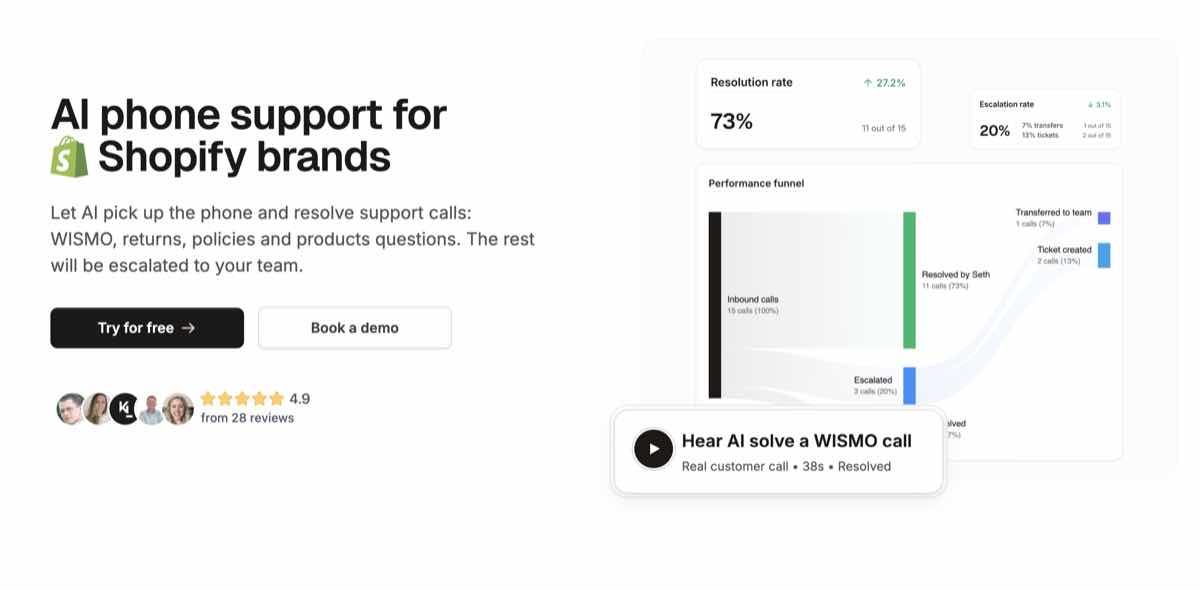
Full disclosure: I built this one. Ringly.io is AI phone support for Shopify stores. Seth (the AI agent) picks up your phone 24/7, looks up orders in real time via the native Shopify integration, handles returns and product questions, and escalates complex calls to a human when needed. Setup takes under 1 hour.
Pricing
| Plan | Price | Included |
|---|---|---|
| Pay per call | $99 a month | 50 conversations, then $1.99 each |
Each conversation after the first 50 costs $1.99. 65% resolution guarantee: if Seth resolves under 65% of your calls in a month, that month comes back as credit (after 90 days on Pay per call). Ringly.io is free to try.
What works
- Up to 90% autonomous call resolution: Seth resolves up to 90% of support calls without a human. No hiring.
- Native Shopify order lookups: real-time, no training required.
- 24/7 coverage: in 40 languages.
- Live in under 1 hour: paste your Shopify URL, Seth trains itself.
- Per-minute pricing: predictable, no per-call surcharges.
- Smart transfer: escalates complex calls to your team, never drops a high-value caller.
- Call analytics: every call transcribed, searchable, and scored.
What doesn't
- Phone only: you still need a helpdesk for email and chat.
- Not for zero-volume stores: if you get one call a month, this is overkill.
- AI escalates the weird stuff: Seth knows when to hand off to a human. Good, but it means you still need humans in the loop.
Why it's the phone pick: nothing else on this list handles phone at all. If your Shopify store is getting any calls, you either ignore them (losing revenue), send them to voicemail (worse), or you automate with AI (what most modern stores are doing). For a deeper dive, see our Shopify AI voice support post and AI phone agents for Shopify.
Response time benchmarks that actually matter
Everyone tells you to "respond fast." Nobody tells you the actual numbers. Here they are.
| Channel | Ideal response | Customer expectation |
|---|---|---|
| Phone | 3 rings (~15s) | Answer or auto-agent |
| Live chat | Under 1 minute | 30 seconds |
| SMS | Under 5 minutes | Same hour |
| Under 1 hour | Same day | |
| Social DM | Under 2 hours | Same day |
Miss these and your CSAT craters. Hit them and you join the top 10% of ecommerce support.
Here's the retention math. Stores that respond within one hour see 71% customer retention. Stores that take 24 hours see 48%. One bad hour costs you a quarter of your returning customers.
The trick isn't hiring more people to hit these numbers. The trick is picking the right automation for each channel. AI handles chat and phone 24/7 for under $500/mo. Humans handle the hard stuff.
For deeper benchmarks by channel, see our Shopify customer service response time breakdown and customer service response time benchmarks. For the first-call resolution angle, check first call resolution for ecommerce.
If you're trying to hit phone response time without hiring, Ringly.io answers calls in 3 rings 24/7. Try it for free.
What Shopify customer service actually costs in 2026
I'll give you the honest breakdown. Most articles dance around this, but here's what you'll actually spend at each stage.
New store (<$10K MRR)
- Shopify Inbox: $0
- Gmail or Help Scout Free: $0
- Total: $0/mo
At this stage, you're the support team. Tools are free. The real cost is your time.
Growing ($10K-$100K MRR)
- Helpdesk: Help Scout Standard ($21/user) or Gorgias Basic ($60/mo)
- Phone AI: Ringly.io (from $99/mo)
- Self-service: free (Shopify native)
- Total: $150-$300/mo
This is where most stores should upgrade. Response times start to slip as volume climbs, and a basic stack keeps you sane.
Scaling ($100K-$1M MRR)
- Helpdesk: Gorgias Pro ($360/mo) or Help Scout Plus ($38/user × 3 users = $114/mo)
- Phone AI: Ringly.io (from $99/mo, then $1.99 per conversation after the first 50)
- Self-service portal: Richpanel add-on ($29/mo)
- Total: $500-$800/mo
You're past the "I can handle it" stage. A real stack pays for itself in CSAT and retention.
Shopify Plus ($1M+ MRR)
- Zendesk Suite Professional: $115/agent × 5-10 agents = $575-$1,150/mo
- Phone AI: Ringly.io ($1.99 per conversation after the first 50)
- Workforce management + QA add-ons: $500+/mo
- Total: $2,000-$5,000+/mo
At this scale, it's no longer about tool costs. It's about uptime, compliance, and multi-region support.
The hidden costs to watch for
- Per-ticket overages: Gorgias, Tidio, and others will auto-bill over your cap.
- Per-resolution AI charges: Help Scout, Gorgias, Freshdesk all charge for AI resolutions on top of the plan.
- Per-agent seat fees: Zendesk and Freshdesk scale with team size.
- Your own time: the biggest cost at small scale. Every hour on email is an hour not on growth.
Full details in our Shopify customer service cost breakdown and voice AI pricing guide.
How to choose the right Shopify customer service setup
Simple decision framework based on store stage and channel mix.
Choose Shopify Inbox if: you're solo, doing under 50 tickets/month, and chat is your only real channel. Free, native, done.
Choose Help Scout if: you're a 3-10 person team, email is primary, you want clean UX, and you don't need Gorgias-level Shopify actions.
Choose Gorgias if: you're a DTC brand doing $250K+/yr, your team lives in the ticket queue, and you need native Shopify actions (refund, edit, cancel) without tab switching.
Choose Richpanel if: your ticket volume is dominated by WISMO and you want a self-service portal doing the deflection heavy lifting.
Choose Zendesk if: you're Shopify Plus, multi-brand, multi-region, or you need enterprise-grade reporting and compliance.
Choose Tidio if: you're conversion-obsessed and chat is where you want to convert browsers to buyers.
Choose Freshdesk if: you want Gorgias-like features at Help Scout pricing and you can live with a shallower Shopify integration.
Choose Ringly.io if: you're getting any phone calls at all. Even a few a week. This is a separate channel from your helpdesk and you need a dedicated tool.
The best setup for most growing Shopify stores is actually two tools: a helpdesk for email and chat, plus Ringly.io for phone. Trying to force one tool to handle everything is how you end up paying for features you don't use.
How to scale support without hiring
Here's the playbook I've seen work across hundreds of stores. The goal isn't to hire. The goal is to automate the 80% of support that's repetitive and only use humans for the 20% that's actually hard.
Layer 1: Self-service for the repetitive stuff
- Public FAQ page with your top 20 questions
- Shopify native order status page (or a Richpanel portal)
- Returns self-service flow
- Impact: deflects 30-40% of ticket volume
Layer 2: AI for the common stuff
- Gorgias AI Agent, Lyro, Freddy, or Help Scout AI Answers on email and chat
- Ringly.io on phone (resolves up to 90% of support calls)
- Macros and templates for the questions your team still handles
- Impact: handles another 30-40% of remaining volume
Layer 3: Humans for the hard stuff
- Complex returns, damaged shipments, angry customers, VIP accounts
- Quality control on AI responses
- Relationship building on high-value orders
- Impact: 20-30% of volume that actually needs a human
This layered approach means a 2-person team can cover the same volume that would have needed 5-8 people three years ago. That's not hype. That's what the stores in our network are doing.
When should you finally hire your first support person? Our rule of thumb: when you're doing $20-30K MRR AND your layer 1 + 2 are fully set up. If you hire before automating, you'll just hire again in 6 months.
Deeper playbooks in our workflow automation post, small team playbook, and outsourcing guide.
Ready to see how AI phone support fits into your stack? Try Ringly for free. Setup takes under 1 hour.
Frequently asked questions
What's the best customer service app for a small Shopify store? For stores under $10K MRR, start with Shopify Inbox (free) for chat and Gmail or Help Scout's free plan for email. Once you hit $20-30K MRR or 100+ tickets/month, upgrade to Help Scout Standard or Gorgias Basic plus a phone option like Ringly.io.
Is Shopify Inbox enough for customer service? Shopify Inbox is enough if you're solo, under $10K MRR, and chat is your main channel. It has no ticket routing, no analytics, and rule-based automation only. You'll outgrow it fast, but it's a great zero-cost starting point.
How fast do I need to respond to customer inquiries? Email: under 1 hour. Chat: under 1 minute. Phone: 3 rings. SMS: under 5 minutes. Social DM: under 2 hours. Stores hitting these benchmarks see 71% retention versus 48% for stores taking 24 hours.
Do Shopify stores need phone support in 2026? Yes, if you want to capture the 71% of Gen Z buyers who still prefer phone (McKinsey) and convert at 10-15x the rate of web (BIA/Kelsey data). Modern AI phone agents like Ringly start at $99 a month and handle 70%+ of calls autonomously, so the old cost objection is dead.
How much should I budget for Shopify customer service tools? Under $10K MRR: $0. $10K-$100K MRR: $150-$300/mo. $100K-$1M MRR: $500-$800/mo. Shopify Plus: $2,000-$5,000+/mo. The biggest hidden cost at small scale is your own time.
Can AI actually handle customer service for my Shopify store? For repetitive questions (WISMO, product Qs, return requests), yes. Ringly.io resolves up to 90% of phone calls autonomously. Gorgias AI, Lyro, and Help Scout AI Answers hit similar numbers on chat and email. Keep humans for complex cases and VIP accounts.
What's the difference between Gorgias and Shopify Inbox? Shopify Inbox is free chat and DM only, no ticket management or analytics. Gorgias is a full helpdesk with email, chat, SMS, social, ticket routing, automation rules, and revenue attribution, starting at $10/month. Use Inbox under $10K MRR, upgrade to Gorgias once volume scales.
The bottom line
Good Shopify customer service in 2026 isn't about adding more tools. It's about picking the right 2-3 for your stage and channel mix.
If you're just starting out, Shopify Inbox plus Gmail is all you need. Once volume hits, add a helpdesk (Help Scout or Gorgias) and a phone option (Ringly.io). At Plus scale, graduate to Zendesk for the depth of reporting.
The stores winning at support in 2026 aren't the ones with the biggest teams. They're the ones who picked three tools, automated the repetitive 80%, and used humans only for the complex 20%. That's the whole game.
If you're getting phone calls at all and haven't tried AI phone support, Ringly.io gets Seth answering your calls in under 1 hour. Try it for free.