
This post in 30 seconds.
- The best practices that matter at scale are operational, not motivational: tag tickets to Shopify objects, build macros off your real volume, set SLAs by ticket type, and kill WISMO before it becomes a ticket.
- We read 200,000+ real Shopify support calls. The same five questions are 70-80% of phone volume, and most of the WISMO slice never needed to exist.
- Written for founders, COOs, and Heads of CX at $10M-$100M Shopify brands running a paid helpdesk and a phone line that gets answered.
Most "Shopify customer support best practices" guides hand you the same advice: be empathetic, reply faster, pick a good helpdesk, use canned replies. None of it is wrong. None of it is enough once you're doing real volume and your CS team is drowning in the same questions over and over.
This is the operating playbook instead. It comes from reading 200,000+ real support calls and tagging what customers actually wanted, not what a CX framework says they should want. When you look at that much real volume, support stops being a feelings problem and becomes a measurement problem. The brands that run support well at $10M-$100M aren't the ones that care more. They're the ones that count better.
Below are the nine practices that separate a support operation that scales from one that just gets more expensive every quarter. Channel niceties and scripts come last, because they barely move the number that matters.
If you run customer experience at a $10M-$100M Shopify brand and your headcount line keeps climbing with call volume, book a 30-min call and we'll pull the pattern from your real call logs.
The 9 practices at a glance
Here's the whole playbook in one screen. The rest of the post is the detail behind each row.
| # | Best practice | What good looks like | The metric it moves |
|---|---|---|---|
| 1 | Tag every ticket to a Shopify object | Every contact maps to an order, customer, or subscription | Volume visibility |
| 2 | Build macros off your real top five | Macros pull live Shopify data, not generic boilerplate | Handle time |
| 3 | Set SLAs by ticket type, not just channel | WISMO, complaints, and VIPs run on different clocks | First response time |
| 4 | Kill WISMO at the source | Proactive shipping comms before the customer asks | Ticket volume |
| 5 | Design the escalation path on purpose | You decide what never touches a human and what always does | Resolution quality |
| 6 | Staff for the surge, not the baseline | Peak gets absorbed without a hiring spree | CS cost per order |
| 7 | Answer the phone, especially after-hours | No routine call rolls to voicemail | Recovered revenue |
| 8 | Keep one knowledge base, not five | One source feeds reps, macros, and any automation | Answer accuracy |
| 9 | Measure resolution, not ticket count | You track what got solved and what it cost | Repeat purchase rate |
How we built this playbook
I'm Ruben, co-founder of Ringly. This isn't pulled from other people's blog posts. It comes from the 200,000+ real support calls we've handled, which gives us a view of Shopify support volume that most operators never get to see.
Here's what we did to build it:
- Tagged every call to a Shopify object. We mapped each contact to an order, a customer record, or a subscription so we could count what people actually called about, not what we assumed.
- Counted the question patterns. We ranked the reasons customers picked up the phone and watched how stable that ranking is across verticals.
- Separated preventable from unavoidable. We split the routine calls (the same five things) from the ones that genuinely need a person.
- Tracked resolution, not just response. We measured what share of calls got fully solved without a human, and what each one cost.
- Pressure-tested it against peak. We watched the same brands through launches and Q4 to see which practices held when volume tripled.
One number anchors everything: the same five questions make up 70-80% of phone volume at almost every brand we see. That's the practical center of gravity for this whole playbook, and it's something no support guide built from secondary sources can tell you.
1. Tag every ticket to a Shopify object so volume stops being a guess
Ask most Shopify support leads what their team handles all day and you'll get a shrug and a guess. "Mostly order stuff, some returns." That guess is why support budgets feel impossible to plan. You cannot fix a volume problem you've never actually counted.
The fix is boring and it works: tag every contact to a Shopify object. Is this about an order, a customer, or a subscription? Then tag the reason inside that: order status, return, exchange, subscription change, product question, complaint. Your helpdesk already supports this, whether you run Gorgias, Zendesk, or anything else. Most teams just never enforce it.
Once you do, the picture gets uncomfortable fast. Take a $35M brand fielding roughly 11,000 contacts a month. Tagged properly, it usually breaks down something like this: 41% where's my order, 18% returns and exchanges, 12% subscription changes, 9% product and fit questions, and the rest a long tail. The top four are 80% of the load. (Those proportions are illustrative, but the shape is what we see again and again in the 200,000+ call dataset.)
That breakdown is the whole reason this playbook exists. Every practice below targets a specific slice of it. You can't prioritize macros, automation, or staffing until you know which slice is eating your hours.
2. Build your macros off the real top five, not a template pack
Macros are the most underused lever in Shopify support. Shopify's own data puts the time saved at two to three hours per rep per day when they're done right. Most teams either don't build them or build them once, off a generic template pack, and never touch them again.
The mistake is treating a macro as a script. A good macro is a script plus live Shopify data. A "where's my order" macro that just says "let me check on that" saves nobody any time. One that pulls the order status and tracking link straight from the order record and drops it into the reply turns a three-minute task into a ten-second one.
Build them in this order, off the tags from practice one:
- Start with the top five tags. WISMO, returns, exchanges, subscription changes, product questions. Those macros cover 80% of volume.
- Merge the Shopify fields. Order number, tracking, return label, subscription next-charge date. The data does the personalizing, not a fake-friendly intro line.
- Leave room for the human. Each macro should be a starting draft a rep edits in one line, not a send-and-forget robot reply.
- Review them quarterly. A macro pack built last year is sending last year's return policy. Stale macros are worse than no macros.
The macro is only as good as the data it merges, which is exactly why your tagging and your knowledge base have to be clean first. Get those two right and macros stop being canned replies and start being a real productivity multiplier.
3. Set SLAs by ticket type, not just by channel
Most teams set one response-time target per channel and call it a policy. That's a start, but it treats a "where's my order" the same as "my package arrived smashed and I'm furious." They are not the same ticket and they should not run on the same clock.
The smarter move is a service target per ticket type. The bar customers hold you to keeps rising: Lorikeet's 2026 benchmark found 88% of customers now expect faster responses than they did a year ago, and 60% of them define "immediate" as ten minutes or less. So tier the urgency on purpose:
| Ticket type | Target first response | Why |
|---|---|---|
| Complaint or damaged order | Minutes, top of queue | Anger compounds while it waits |
| VIP or high-value customer | Minutes, named rep | These relationships carry your repeat revenue |
| Phone, any reason | Answered live, no hold | A ringing phone is a customer about to give up |
| WISMO and order status | Same day, often instant | High volume, low complexity, mostly automatable |
| General product question | Under 4 hours | Real but rarely urgent |
Notice that the routine high-volume types (WISMO, order status) get a fast clock precisely because they're the ones you can answer instantly without a human. The complex types get your people's full attention because they're not competing with a queue of tracking questions. If you want the deeper version of this with response and resolution templates, we broke it down in the Shopify support SLA guide. An SLA set by type, not just channel, is what lets a small team feel premium to the customers who matter most.
4. Kill WISMO at the source before it becomes a ticket
If 30-50% of your volume is where's my order, the best practice is not to handle WISMO faster. It's to stop generating most of it. Salesforce pegs WISMO at 30-40% of tickets and 50%+ at peak, and Forrester research cited by ShippyPro found that 73% of those tickets are entirely preventable.
Preventable how? With proactive shipping communication that gets to the customer before their anxiety turns into a contact. The same research shows proactive shipment alerts cut WISMO inquiries by up to 75%, that 96% of shoppers track an order when tracking is offered, and that 43% check it daily until it lands. People want to know where their stuff is. Tell them before they ask.
The math is worth saying out loud. At an average cost of roughly $6 per support interaction, a brand fielding 500 WISMO contacts a week is spending over $100,000 a year answering a question the shipping carrier already knew the answer to. So the WISMO best practice has two halves:
- Prevent the 73%. Branded order, shipped, out-for-delivery, and delivered notifications by email or SMS, plus a self-serve tracking page. This is the cheapest support win on this list.
- Answer the rest instantly. Some customers will always call instead of tapping a link, especially older demographics and high-AOV buyers. Those calls should resolve in seconds against live Shopify order data, not sit in a queue.
WashCo, a Shopify brand we launched, recovered $22,664 in its first 7 days once the routine calls got answered around the clock instead of rolling to voicemail. WISMO handled at the source plus WISMO answered instantly is the single biggest dent you can put in your ticket count.
5. Design the escalation path on purpose
The teams that automate support well don't automate everything and hope. They decide, in advance and in writing, exactly what should never touch a human and exactly what always should. Everyone else automates by accident and gets burned when a bot fields a call it had no business answering.
Draw the line explicitly:
- Never needs a human: order status, tracking, return label requests, exchange initiation, subscription pause and skip, in-stock checks. The routine 70-80%.
- Always needs a human: a grief or safety call, a damaged or wrong product, a high-value VIP who asks for a person, anything legal or compliance-sensitive, a customer who's already angry.
Then build the handoff so it's clean. The customer should never repeat themselves, and the rep should land on the ticket with the full Shopify context already attached. A smart call transfer that passes the order and the conversation along is the difference between automation that helps and automation that infuriates. The goal isn't to remove humans from support. It's to make sure the only calls reaching them are the ones that actually deserve a person. TechCraft Studio handles 88% of its calls without a human, and the 12% that escalate get a rep with full context instead of a tired one buried in tracking questions.
If you're trying to draw that line for your own store, book a 30-min call and we'll map which of your calls should never reach a rep.
6. Staff for the surge, not the steady state
Here's where most Shopify support budgets break. Volume isn't flat. It spikes hard on launches, sales, and through Q4, then drops back. The seasonal spike is the real staffing problem, and hiring is the worst tool for it.
If you staff for the peak, you're paying a full team to be idle nine months a year, and customer service already runs 30-45% annual turnover, so half that team churns before the next peak anyway. If you staff for the trough, your BFCM queue melts down and you lose the exact orders you spent the most ad money to win. Neither works.
The brands that handle peak gracefully size their human team for the steady-state complex work and absorb the surge with automation that scales instantly. A typical setup looks like this:
| Line item | Staff for peak | Steady team plus AI for the surge |
|---|---|---|
| 6 reps x $4K loaded per rep | $24,000/mo | n/a |
| Lean team plus AI phone support (~$5K/mo) | n/a | $5,000/mo |
| Net monthly CS spend | $24,000/mo | $5,000/mo |
| Monthly savings | n/a | $19,000/mo |
| Annual savings | n/a | $228,000/yr |
That assumes the routine 70-80% routes to automation while your team owns the complex 30%. The point isn't to cut your team. It's to stop hiring the rep you only need for six weeks in November, then carry them all year. Automation's real job in Shopify support is to make your peak look like your average.
7. Answer the phone, especially after-hours
Plenty of Shopify guides quietly write off the phone as a legacy channel. That's a mistake, and it's most expensive after 6 p.m. and on weekends, when the queue is empty of reps and full of customers.
Phone volume scales with order value. At a $40 AOV store, roughly 3% of orders trigger a call. At a $250-AOV store, that climbs to 12-18% of orders. The bigger the basket, the more a customer wants a human voice before and after they buy. And when they call after hours and hit a recording, a chunk of them hang up and buy elsewhere. You never see the lost order because it was never placed.
A real after-hours plan isn't a voicemail promising a Monday callback. It's coverage that answers the routine 11 p.m. call the same way it would at 11 a.m. and flags anything urgent for your team the next morning. You can't afford a night shift, but you can afford phone coverage that doesn't need one. The voicemails you never return are some of the most expensive things on your support floor.
8. Keep one knowledge base, not five
Most growing Shopify teams accumulate answer sources like junk drawers. A help center for customers, a Notion doc for reps, a pinned Slack thread, the founder's memory, and a return policy that lives in three places and contradicts itself in two. Then they wonder why answers are inconsistent.
The best practice is one canonical knowledge base that feeds everything: your reps, your macros, your self-serve help center, and any automation you run. When the return window changes, you change it once and every surface updates. When it lives in five places, you change it once and four of them keep lying to customers.
This matters more the more you automate. Macros and AI both answer from the same source, so a clean, single KB is what keeps automated answers accurate and on-brand. A messy KB doesn't just slow your reps down. It teaches every automated reply to be wrong at scale.
9. Measure resolution and cost per resolution, not ticket count
The last practice ties the other eight together. Most Shopify support dashboards lead with ticket volume, which tells you how busy your team is, not how good your support is. Busy was never the goal.
Two numbers actually tell you whether the playbook is working:
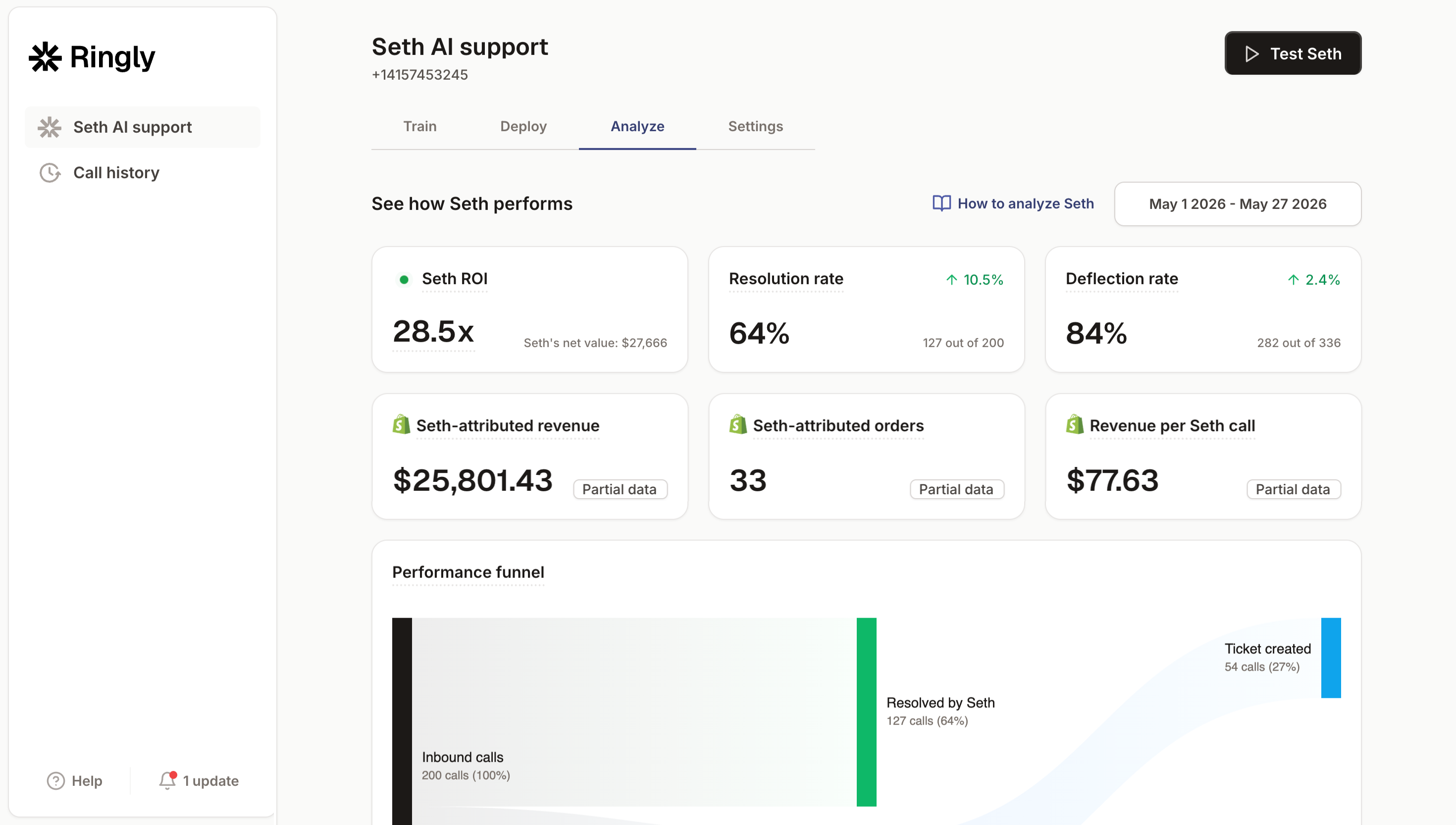
- Resolution rate. What share of contacts get fully solved without bouncing around or escalating. A fast response with a low resolution rate just means you're quick at not helping. Seth resolves up to 90% of calls on its own.
- Cost per resolved contact. The number your CFO cares about and the one that proves automation paid off. In-house phone runs about $2.70 per call loaded. AI on Ringly runs $1.99 a call after the first 50, versus $7-$16 for a human BPO. Track it and the case writes itself.
The fear is always that leaning on automation makes support feel cold. The most repeated thing real callers say is the opposite.
"My customers also feel like it's a normal person. They feel like they can communicate if they have questions."
Claudia Droge, TechCraft Studio
If a number on your dashboard doesn't connect to resolution or to cost, it's a reporting habit, not a KPI. For the full breakdown of which metrics predict repeat purchases, our Shopify support KPI guide goes number by number.
Frequently asked questions
What are the most important Shopify customer support best practices?
Start operational, not motivational: tag every ticket to a Shopify object so you can count your volume, build macros that merge live order data, set SLAs by ticket type, and prevent most WISMO with proactive shipping comms. Then design your escalation path on purpose and measure resolution rather than ticket count. Empathy and scripts matter, but they barely move the numbers until the operations underneath are right.
How do I reduce WISMO tickets on Shopify?
Prevent them at the source with branded order, shipped, out-for-delivery, and delivered notifications plus a self-serve tracking page. Forrester found 73% of WISMO tickets are preventable, and proactive alerts cut them by up to 75%. For the customers who still call instead of tapping a link, answer them instantly against live Shopify order data rather than putting them in a queue.
What customer support metrics should a Shopify brand track?
Resolution rate and cost per resolved contact are the two that matter most, because they connect directly to whether support is actually working and what it costs. First response time per ticket type and CSAT segmented by issue are useful supporting numbers. Ticket volume alone tells you how busy your team is, not how good your service is.
Should a Shopify store automate customer support?
Yes, but only the right layer. Automate the identical, repeatable contacts (order status, returns, stock checks, subscription pauses) that make up 70-80% of volume, and route anything needing judgment or empathy to a human. The common mistake is automating the wrong layer and letting a bot field calls it can't handle. Done right, AI resolves up to 90% of calls on its own and frees your team for the complex 30%.
How fast should a Shopify store respond to customers?
Set the target by ticket type, not just by channel. Complaints and VIPs need a response in minutes, phone calls should be answered live with no hold, WISMO and order-status questions should resolve same-day or instantly, and general product questions can run to four hours. The bar keeps rising: 88% of customers now expect faster responses than they did a year ago.
Do macros actually save time for Shopify support teams?
Yes, when they merge live Shopify data instead of being generic scripts. Shopify's own data puts the time saved at two to three hours per rep per day. A WISMO macro that pulls the real tracking link from the order record turns a multi-minute task into a ten-second one, but a stale macro pack sending last year's policy does more harm than good, so review them quarterly.
How should a Shopify brand staff support for Black Friday and Q4?
Staff your human team for the steady-state complex work, then absorb the seasonal spike with automation that scales instantly instead of hiring for the peak. Hiring for peak means paying a full team to be idle most of the year, and with 30-45% support turnover, much of that team churns before the next peak anyway. Automation's job is to make your peak volume look like your average.
Is phone support still worth it for Shopify brands?
Yes, especially at higher AOVs. At a $250 AOV roughly 12-18% of orders generate a call versus 3% at $40, and the phone is where your most urgent and highest-value conversations happen. Abandoning it, particularly after hours when calls roll to voicemail, sends buyers to competitors and quietly costs more than it saves.
Talk to us

If you run a $10M-$100M Shopify brand and your support spend climbs every time call volume does, a 30-min call is the fastest way to see what's actually moving your costs. We'll tag the pattern in your real call logs and show you which contacts should never touch a human.
Our 3 promises.
- Live in under 1 hour. Setup and test calls are free.
- 30-day money back on the $99 plan fee.
- 65% resolution guarantee: if Seth resolves under 65% of your support calls in a month, that month comes back as credit (after 90 days on Pay per call).
Ruben (Ringly co-founder) takes these calls personally.