
Omnichannel retail statistics tell a clear story: shoppers who buy across multiple channels spend more, come back more often, and stick around longer. If your brand only shows up on one or two channels, you're leaving money on the table. These 50 stats break down where the market is heading, what shoppers actually expect, and why the gap between omnichannel leaders and laggards keeps getting wider.
Hear what AI support calls sound like for your store. Just paste your Shopify URL and get sample calls in under 20 seconds, no email required. Listen to demo calls for my store.
Key highlights
- 73% of consumers use multiple channels during their shopping journey, using 6+ touchpoints before purchasing (Harvard Business Review)
- Omnichannel customers spend 16% more per order and have a 30% higher lifetime value than single-channel buyers (Capital One Shopping)
- Brands with strong omnichannel engagement retain 89% of customers, compared to just 33% for weak strategies (Aberdeen Group)
- U.S. click-and-collect sales are projected to hit $177.9 billion in 2026, up 15.3% year over year (eMarketer)
- 95.4% of B2C marketers now use AI in their omnichannel strategy, up from 77.2% in 2024 (MoEngage)
- Multi-channel campaigns generate a 494% higher order rate than single-channel campaigns (Omnisend)
Omnichannel market size and growth
1. Global retail e-commerce sales are projected to reach $8.1 trillion by 2026. That's the total addressable market for anyone selling online, and omnichannel strategies capture a growing share of it. (Statista)
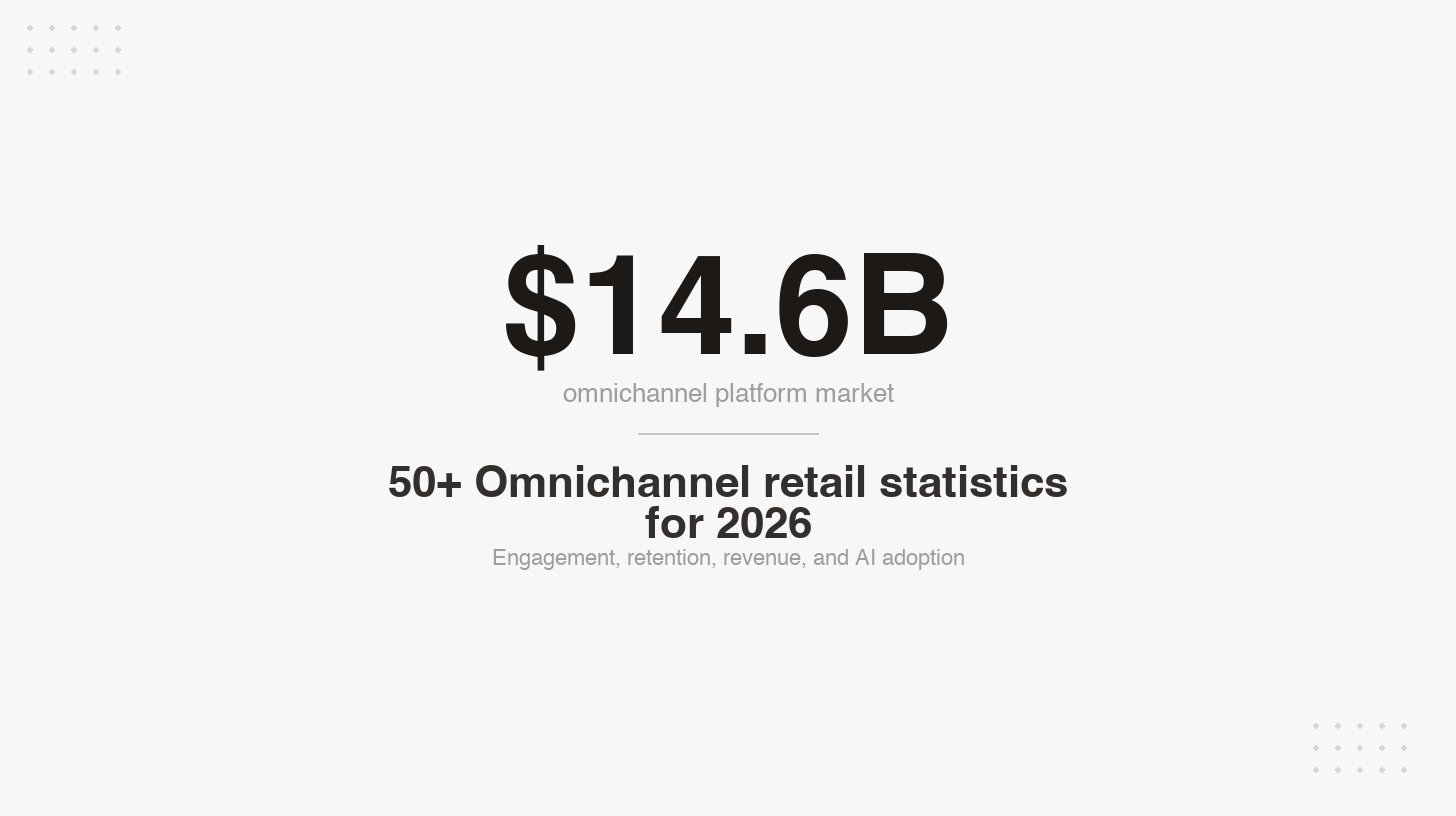
2. The omnichannel retail commerce platform market is projected to reach $14.6 billion by 2026. This covers the software and infrastructure that powers cross-channel selling. (Research and Markets)
3. Multichannel e-commerce sales hit $775.7 billion in 2025, up 15.7% year over year. Growth is accelerating, not slowing down. (Capital One Shopping)
4. The social commerce market is projected to reach $2.9 trillion by 2026. Social selling is now a core piece of the omnichannel puzzle, not a side project. (Insider Intelligence)
5. The omnichannel retail solutions market is projected to grow from $29.13 billion (2023) to $82.9 billion by 2032, at a 12.3% CAGR. Retailers are investing heavily in the tech stack to make cross-channel work. (Market Research)
6. 76% of brands now consider omnichannel essential for long-term growth. Three out of four brands treat it as a requirement, not a future initiative. (SAP Emarsys)
The market numbers don't lie. Omnichannel is growing at double-digit rates across every segment, and the platforms powering it are scaling right alongside. If you're not investing in cross-channel infrastructure now, catching up later will cost more.
Consumer behavior and shopping patterns
7. 73% of consumers use multiple channels during their shopping journey. A Harvard Business Review study of 46,000 shoppers confirmed that most people don't stick to one channel. (Harvard Business Review)
8. 91% of retail consumers are omnichannel shoppers. The single-channel buyer is nearly extinct. (Capital One Shopping)
9. Omnichannel consumers shop 70% more frequently than single-channel shoppers. More touchpoints means more trips, more carts, more revenue. (Capital One Shopping)
10. Shoppers use 6+ touchpoints on average before making a purchase decision. That could be your website, Instagram, email, a phone call, a store visit, and a review site. (Capital One Shopping)
11. 83% of customers research products online before visiting a store. Even foot traffic starts with a search bar. (Marketing LTB)
12. 98% of Americans switch between devices in the same day. Your customer starts browsing on their phone, compares prices on a laptop, and finishes the order on a tablet. (Aspect Software)
13. 60% of shoppers blend online and offline channels during a single purchase. The line between "online shopper" and "in-store shopper" doesn't exist anymore. (Envive.ai)
These numbers tell you something important about how your ecommerce customer service needs to work. Customers don't think in channels. They think in problems they want solved. Your job is to show up wherever they are.
Revenue, spending, and lifetime value
14. Omnichannel customers spend 16% more per order than single-channel shoppers. That's an immediate lift on every transaction, not a long-term projection. (Capital One Shopping)
15. Customer lifetime value is 30% higher for omnichannel shoppers. They buy more often and stay loyal longer. (Capital One Shopping)
16. Omnichannel customers spend 10% more online and 4% more in-store than single-channel customers. The lift shows up everywhere, not just on one side. (Harvard Business Review)
17. Companies with strong omnichannel engagement see a 9.5% annual revenue increase, compared to 3.4% for weak strategies. That's nearly 3x the growth rate. Over five years, the gap becomes massive. (Aberdeen Group)
18. Omnichannel leaders see up to 3.5x higher revenue growth year over year. The top performers aren't just winning. They're pulling away from everyone else. (Capital One Shopping)
19. Average order value for multi-channel campaigns is $66.31, compared to $58.70 for single-channel. That's a 13% AOV increase. More channels means bigger carts. (Omnisend)
20. Brands that excel in personalization across channels can increase revenue by 10% to 30%. Personalization isn't just a buzzword when the numbers are this clear. (McKinsey)
If you want to boost your ecommerce AOV, omnichannel is one of the most reliable ways to do it. More touchpoints, more context, bigger orders. The math works in your favor every time.
Thinking about how to keep those high-value customers coming back? Try Ringly.io free for 14 days and make sure every phone call gets answered, even at 2 AM.
Customer retention and loyalty
21. Brands with strong omnichannel engagement retain 89% of their customers. Brands with weak omnichannel retain just 33%. That gap is the difference between a growing business and one fighting constant churn. (Aberdeen Group)
22. Businesses with omnichannel strategies see a 91% greater year-over-year customer retention rate. Retention compounds. Even small improvements add up fast. (Aspect Software)
23. Within six months of an omnichannel experience, customers log 23% more repeat shopping trips. They don't just come back. They come back faster. (Harvard Business Review)
24. Purchase frequency is 250% higher on omnichannel vs. single channel. That's not a typo. Omnichannel shoppers buy 2.5x more often. (Omnisend)
25. 83% of consumers say personalized experiences increase brand loyalty. When you remember their preferences across channels, they remember to buy from you. (Envive.ai)
Retention is where omnichannel really earns its keep. Acquiring a new customer costs 5 to 7x more than keeping an existing one. If you want to dig deeper into the numbers, check our full breakdown of customer retention statistics.

Marketing campaign performance
26. Multi-channel campaigns generate a 0.83% order rate vs. 0.14% for single-channel. That's a 494% increase. Adding just one or two channels to your campaign can transform its performance. (Omnisend)
27. Marketers using 3+ channels earn a 287% higher purchase rate than single-channel campaigns. The more channels you use, the more you sell. (Omnisend)
28. Average engagement rate of 3+ channel campaigns is 18.96%, versus 5.4% for single-channel. That's 3.5x more engagement from the same audience. (Omnisend)
29. The top 5 B2C marketing channels in 2025: email (82.4%), social media (66.7%), mobile website (58%), desktop website (52.7%), and mobile app (51.6%). Email still leads, but the real power is in using all five together. (MoEngage)
30. The #1 challenge for B2C marketers in driving engagement is delivering personalized experiences (52.6%). Everyone knows personalization matters. Actually doing it across channels is the hard part. (MoEngage)
31. 95.4% of B2C marketers now use AI in their omnichannel marketing strategy, up from 77.2% in 2024. AI adoption in marketing went from "early adopter" to "everyone" in about 12 months. (MoEngage)
These ecommerce marketing numbers make the case pretty clearly. If you're only running email campaigns, you're leaving huge performance gains on the table. Mix in SMS, social, web push, and phone to get the full effect.
Want to add phone as a channel without the overhead? See what AI phone support looks like for your store. It takes 20 seconds to hear a demo call.
BOPIS, click-and-collect, and fulfillment
32. U.S. click-and-collect retail sales are projected to hit $177.9 billion in 2026, up 15.3% year over year. BOPIS isn't a pandemic trend anymore. It's permanent. (eMarketer)
33. Click-and-collect will account for 11.0% of U.S. e-commerce sales in 2026. That's more than one in ten online orders fulfilled through pickup. (eMarketer)
34. BOPIS sales hit $154.3 billion in 2025, up 16.2% year over year. The growth rate is actually accelerating. (Capital One Shopping)
35. 85% of BOPIS shoppers make additional purchases when picking up their order in-store. Free foot traffic that converts. That's the BOPIS advantage. (FitSmallBusiness)
36. Offering curbside pickup increased conversion rates by 25.8% among the Top 1,000 retailers. Just having the option makes people more likely to buy. (Digital Commerce 360)
37. Shoppers are 14.5% more likely to purchase from stores that offer omnichannel pick-up services. Convenience drives conversions. Period. (Capital One Shopping)
38. 65.5% of Top 1,000 retail chains provided in-store stock status online in 2024, up from 64.4% in 2023. Real-time inventory visibility is becoming the norm, not the exception. (Digital Commerce 360)
Fulfillment flexibility is a huge piece of the ecommerce conversion rate optimization puzzle. When customers can choose how they get their order, they're more likely to complete the purchase.
Customer experience and expectations
39. 90% of customers expect consistent experiences across channels. This is basically universal. If your website says one thing and your phone agent says another, you have a problem. (Salesforce)
40. 79% of customers expect consistent interactions across departments. They don't care about your org chart. They want one experience, not a different one depending on who picks up. (Salesforce)
41. 56% of customers say they have to repeat information because channels are disconnected. This is the most common frustration with multi-channel support. And it's fixable. (Salesforce)
42. Customer satisfaction (CSAT) hits 67% with smooth omnichannel support, versus just 28% for disconnected multi-channel. Connected channels don't just feel better. They measurably perform better. (Plivo)
43. 69% of consumers still prefer phone support for certain issues. Chat and email are great for simple questions. But when something's complicated or urgent, people want to talk to someone. (Nextiva)
44. 71% of Gen Z customers say live phone calls are the quickest way to solve service issues. Yes, even Gen Z wants to call sometimes. That surprised a lot of people. (Nextiva)
45. 61% of customers say being placed on hold is their top frustration with phone support. The problem isn't phone support. The problem is making people wait. (Nextiva)
Phone is still a critical channel in any omnichannel strategy. The challenge is making sure calls get answered fast. If you run a Shopify store, AI phone agents can pick up instantly, 24/7, in 40 languages, so no customer gets stuck on hold.
AI, personalization, and unified commerce
46. 71% of retailers are already using or planning to use AI for personalized product recommendations. AI-powered personalization is the standard now, not the experiment. (Grant Thornton)
47. Retailers using AI at scale report 15% operational cost reduction and 10% revenue growth. AI doesn't just improve the customer experience. It improves the bottom line. (McKinsey)
48. 87% of shoppers who have tried GenAI tools report a positive impact on their shopping experience. Shoppers aren't scared of AI. They're embracing it. (Envive.ai)
49. Only 5% of retailers have achieved unified commerce leadership. Despite 99% of retail executives agreeing it improves profitability and sales growth. The opportunity is massive for brands that get it right. (Manhattan Associates)
50. Retailers implementing unified commerce see 18% lower cart abandonment rates. When the experience is connected, fewer people bail at checkout. (Manhattan Associates)
The ecommerce personalization data makes the case clearly: AI is the engine that makes true cross-channel personalization possible at scale. And it's still early days, since only 5% of retailers have cracked unified commerce.
For a deeper look at how AI is shaping support, check out our AI customer service statistics for 2026.
What this means for ecommerce brands
The data points in one direction: customers don't shop in channels. They shop across channels. And the brands that meet them everywhere (website, email, social, phone, in-store) win on every metric that matters: higher AOV, better retention, faster growth, and stronger loyalty.
The gap between omnichannel leaders and laggards is widening, not closing. Companies with strong cross-channel strategies retain 89% of customers while weak ones keep just 33%. That kind of difference compounds over time. In three to five years, the brands that invested in omnichannel infrastructure now will be the ones dominating their categories.
One channel that often gets overlooked is phone. The stats are clear: 69% of consumers still want phone support for complex issues, and even 71% of Gen Z prefers calls for quick resolution. But 61% hate being put on hold. The solution isn't ditching phone support. It's making it instant. AI voice agents can answer every call in seconds, look up orders, process returns, and escalate when needed. That's how you cover the phone channel without hiring a full call center.
If you run a Shopify store, Ringly.io handles 73% of support calls automatically with AI. Setup takes three minutes, and it works 24/7 in 40 languages. Try it free for 14 days and make sure phone is a strength in your omnichannel strategy, not a gap.
Frequently asked questions
What is omnichannel retail?
Omnichannel retail means giving customers a connected experience across every channel: website, app, social media, email, phone, and physical stores. The key difference from multi-channel is that all channels share data and context, so a customer who starts on your website and calls your support line doesn't have to repeat themselves.
How many channels do omnichannel shoppers use?
The average omnichannel shopper uses 6+ touchpoints before making a purchase. These can include browsing your website, reading reviews, checking social media, visiting a store, calling support, and comparing prices on their phone. A Harvard Business Review study of 46,000 consumers confirmed that 73% use multiple channels during their shopping journey.
How much more do omnichannel customers spend?
Omnichannel customers spend 16% more per order and have a 30% higher lifetime value than single-channel shoppers. They also spend 10% more online and 4% more in-store. The ecommerce customer support statistics back this up with similar findings on how support quality impacts spend.
What is BOPIS and why does it matter?
BOPIS stands for Buy Online, Pick Up In-Store. It's projected to be a $177.9 billion market in the U.S. by 2026. What makes it powerful for retailers is that 85% of BOPIS shoppers make additional purchases when they come in to pick up their order. It bridges online and offline in a way that directly drives incremental revenue.
Does omnichannel improve customer retention?
Yes, significantly. Companies with strong omnichannel engagement retain 89% of their customers, compared to 33% for brands with weak strategies. They also see 91% greater year-over-year retention rates. For more on this, see our guide on ecommerce customer retention.
Is phone support still important in omnichannel?
Absolutely. 69% of consumers prefer phone support for complex issues, and 71% of Gen Z say calls are the fastest way to resolve problems. The catch is that 61% of customers hate being placed on hold. AI phone agents solve this by answering instantly, around the clock. Check our call center statistics for more data on this trend.
How does AI fit into omnichannel retail?
AI is now used by 95.4% of B2C marketers in their omnichannel strategy. The most common application is personalized product recommendations (71% of retailers). Retailers using AI at scale report 15% lower operational costs and 10% revenue growth. For voice specifically, AI voice agents handle support calls, look up orders, and process returns without putting anyone on hold.
What is unified commerce?
Unified commerce takes omnichannel a step further by putting all channels, data, and operations on a single platform. Only 5% of retailers have achieved it, even though 99% of executives agree it improves profitability. Retailers that do implement it see 18% lower cart abandonment. The ecommerce trends for 2026 cover this shift in more detail.