

Your conversion rate is the single number that determines whether your store makes money or bleeds ad spend. And most store owners have no idea how theirs compares to the rest of the industry. We pulled together 45 ecommerce conversion rate statistics from Statista, Baymard Institute, Shopify, and other reliable sources so you can benchmark your store and spot the biggest opportunities to improve.
Hear what AI support calls sound like for your store. Just paste your Shopify URL and get sample calls in under 20 seconds, no email required. Listen to demo calls for my store.
Key highlights
- The global average ecommerce conversion rate is 2.5% as of Q3 2025, up 0.4% year over year (Smart Insights)
- Food and beverage leads all industries at 6.22%, while luxury goods barely hit 1% (Speed Commerce)
- Desktop converts at 3.9% vs. 1.8% on mobile, even though mobile accounts for 78% of all retail site visits (Statista)
- The average cart abandonment rate is 70.19% globally (Baymard Institute)
- Stores converting above 3.2% are already in the top 20% of all ecommerce sites (Shopify)
- Better checkout design alone could recover $260 billion in lost orders across the US and EU (Baymard Institute)
Overall ecommerce conversion rate benchmarks
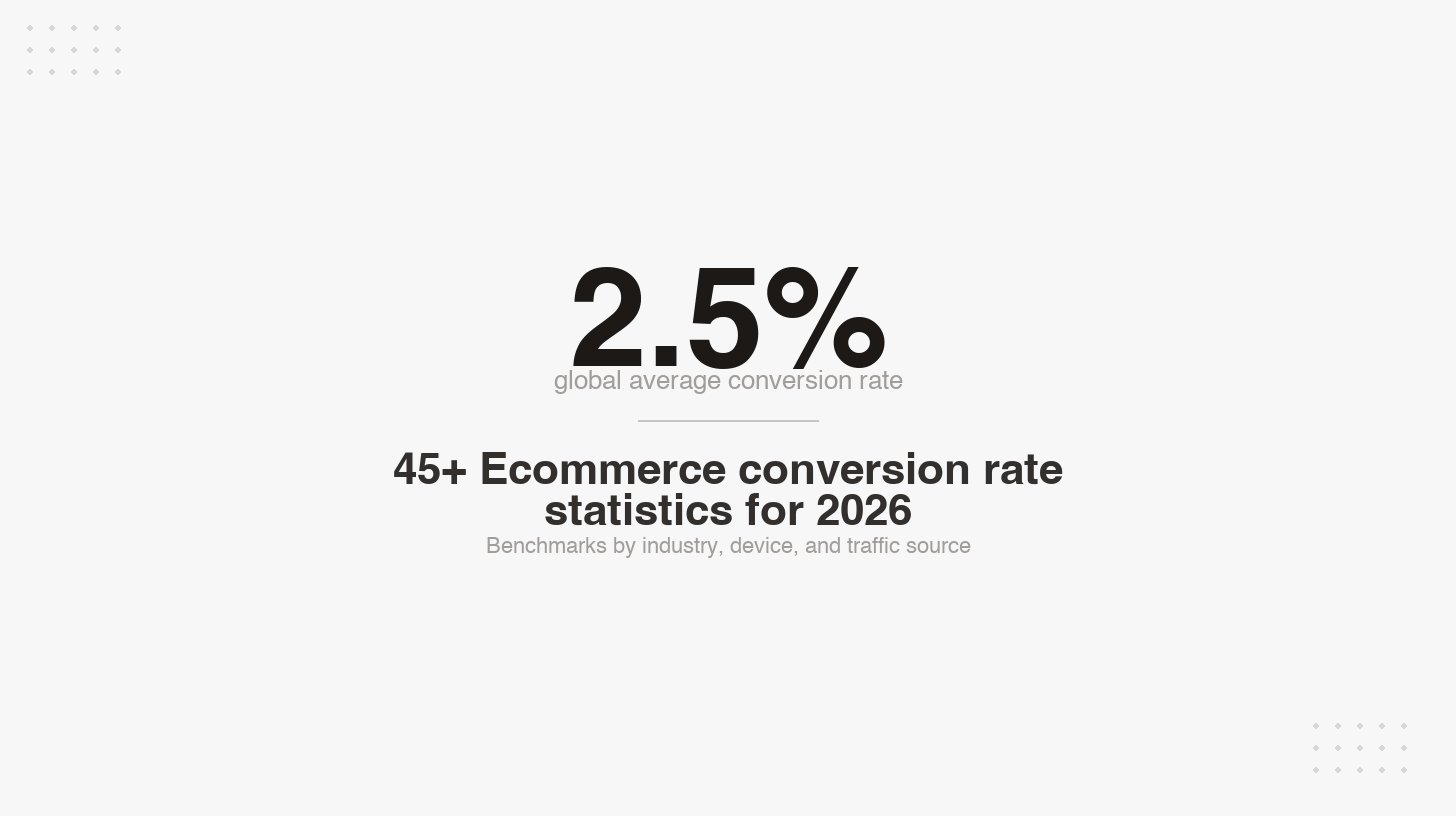
The global average ecommerce conversion rate reached 2.5% in Q3 2025, up 0.4% year over year. This blended number covers every industry, traffic source, and store size. (Smart Insights)
Statista reports that just 1.6% of global ecommerce visits converted into purchases in Q3 2025. The lower figure reflects their broader methodology, which includes single-page bounces and non-buying visits. (Statista)
Stores converting above 3.2% rank in the top 20% of all ecommerce sites. If you're hitting 4.7% or higher, you're in the top 10%. That's the benchmark to chase. (Shopify)
The Americas region leads globally at 3.14%. Germany tops the country rankings at 2.22%, followed by the US at 1.96% and the UK at 1.88%. (Statista)
Direct traffic converts best at 3.3%, while social media traffic sits at just 0.91%. Email marketing falls somewhere in the 2.8% to 10.3% range depending on how targeted the campaign is. (Opensend)
The big takeaway here: if your store is at 2.5%, you're average. Not bad, not great. The gap between average and top 10% is massive in revenue terms, and most of that gap comes down to conversion rate optimization basics like page speed, checkout flow, and product pages.
Ecommerce conversion rate by industry
Food and beverage tops all industries at 6.22%. Repeat purchases of low-cost consumables make this the easiest vertical to convert in. (Speed Commerce)
Multi-brand retail converts at 4.97%. Stores carrying multiple brands benefit from broader appeal and comparison shopping happening on-site. (Statsig)
Beauty and personal care averages 3.46% to 4.94%. This is one of the strongest verticals for ecommerce, driven by loyal repeat buyers and subscription models. (Statsig)
Pet care and veterinary services convert at 4.17%. Pet owners are some of the most loyal online shoppers, and most pet products are consumable or recurring. (Statsig)
Home and furniture sits at just 1.4%. High price points and the desire to see products in person push conversion rates down. (Envive AI)
Luxury and jewelry barely reaches 0.9% to 1.19%. Extended consideration periods and in-store preferences suppress online buying. (Skailama)
If you sell supplements, cosmetics, or pet products, your conversion rate should be above average. If it's not, the problem is almost certainly your product pages or checkout, not your traffic.
Conversion rates by device
Desktop shoppers convert at 3.9%, while mobile converts at just 1.8%. That's a 2.1 percentage point gap, and it's been stubbornly consistent for years. (Smart Insights)
Mobile accounts for 78% of all retail site visits and roughly 70% of online shopping orders. So even though mobile converts worse, it's where most of your revenue comes from. (Statista)
Mobile cart abandonment hits 80.02%, compared to 66.41% on desktop. Smaller screens, harder-to-fill forms, and slower connections all contribute. (Baymard Institute)
A good mobile ecommerce conversion rate in 2026 is 2.5% to 3%. Anything above 5% on mobile is exceptional. (ConvertCart)
Shopify stores average 1.2% on mobile and 1.9% on desktop. These are lower than the broader market because Shopify's data includes many newer, less-optimized stores. (Uptek)
Here's the thing: most brands still treat mobile as an afterthought. If 78% of your traffic comes from phones and your mobile conversion rate is below 2%, that's the first place to focus. Simplify your mobile checkout, cut form fields, and make sure your product images load fast. For Shopify stores, that means checking your theme's mobile performance first.
Cart abandonment and checkout optimization
The average global cart abandonment rate is 70.19%, based on 48 separate studies. This number has barely moved since 2014, hovering between 68% and 70%. (Baymard Institute)
$260 billion in lost orders across the US and EU could be recovered through better checkout design. That's not a typo. Baymard calculated this based on combined ecommerce sales and the potential for a 35.26% conversion lift from fixing checkout usability. (Baymard Institute)
The average US checkout flow has 23.48 form elements. That's way too many. Reducing form fields from 16 to 7 boosts completion rates by 20%. (Baymard Institute)
Reducing checkout steps from 5 to 3 decreases abandonment by 27%. Fewer steps, fewer drop-offs. (Swell)
39% of consumers abandon their cart because of unexpected shipping fees. It's the number one reason for cart abandonment, and it's completely avoidable. (Statista)
Cart recovery emails convert at 10.7% with a 41.18% open rate. That's dramatically higher than standard marketing emails. If you're not sending abandoned cart emails, you're leaving money on the table. (Email Vendor Selection)
Shop Pay lifts conversion by up to 50% compared to guest checkout. One-click checkout removes friction entirely. It's 4x faster than a standard guest checkout. (Shopify)
Checkout is where most stores hemorrhage revenue. A shorter checkout with fewer form fields and no surprise fees can realistically lift your conversion rate by 20% to 35%. If you're on Shopify, enabling Shop Pay is one of the easiest wins available.
Want to cut support calls that slow down purchases? Ringly.io handles 73% of customer support calls automatically, so your team can focus on converting buyers instead of answering "where's my order?" Try it free for 14 days.
Page speed and site performance
Sites that load in 1 second convert at 3x the rate of sites that take 5 seconds. Speed directly multiplies your conversion rate. (Cloudflare)
Every 1-second delay in mobile load time reduces conversions by approximately 7%. On an ecommerce site doing $10 million in annual sales, that one-second delay costs around $400,000 per year. (Nostra AI)
63% of visitors bounce from pages that take over 4 seconds to load. This stat comes from Yottaa's 2025 Web Performance Index, which analyzed 500 million visits across 1,300+ ecommerce sites. (Yottaa)
53% of mobile users abandon sites that take more than 3 seconds to display content. Mobile users have zero patience for slow sites. (Google)
Page speed is the easiest ecommerce SEO win that also directly improves conversion rates. Compress your images, use a CDN, and minimize JavaScript. If your site takes more than 3 seconds to load on mobile, fix that before spending another dollar on ads.
Personalization, reviews, and product content
Personalization increases ecommerce conversion rates by 10% to 15%. Companies that excel at personalization generate 10% to 15% more revenue on average. (McKinsey via Involve.me)
Personalized product recommendations boost conversion by up to 30%. When suggestions match shopper intent, the lift is significant. (Wiser Notify)
Visitors who interact with user-generated content convert 102.4% higher than average. Reviews, photos, and videos from real customers build trust faster than any marketing copy. (PowerReviews)
93% of online shoppers actively seek out customer content before buying. And 40% of shoppers refuse to buy products that have no reviews or customer photos at all. (Archive.com)
Product pages with video see 37% more add-to-cart actions than pages without. Video showing the product in use can boost conversion by up to 80%. (Invespcro)
High-quality product images increase conversions by up to 40%. And 67% of consumers say image quality matters more to them than product descriptions or customer ratings. (Spyne)
Your ecommerce personalization strategy doesn't need to be complicated. Start with product recommendations based on browsing behavior. Add customer reviews and photos to every product page. Shoot simple product videos. These aren't expensive changes, but they compound fast.
Curious what AI-powered support sounds like? See how Ringly.io works for your store. Paste your Shopify URL and get sample calls in seconds.
AI, chatbots, and live support
Websites using AI chatbots see a 23% increase in conversion rates. The lift comes from answering buyer questions in real time, right at the moment of purchase decision. (Glassix)
AI-driven proactive chats recover 35% of abandoned carts. Reaching out to shoppers who are about to leave can pull them back into the purchase flow. (Hello Rep)
Chatbots generate $8 in revenue for every $1 invested. That's an 800% ROI, making them one of the highest-returning investments in ecommerce. (Demand Sage)
Adding live chat to your site improves conversions by 12%. And the availability of live chat increases the likelihood of repeat purchases by 52%. (Sixth City Marketing)
89% of marketers see a positive return on personalization campaigns. This includes AI-powered product recommendations, dynamic pricing, and behavior-triggered emails. (Involve.me)
The data is clear: AI customer service tools directly improve conversion rates. This is especially true for ecommerce phone support and voice AI, where shoppers can get instant answers about products, shipping, or returns without leaving the site.
BNPL, shipping, and payment optimization
Buy now, pay later (BNPL) boosts checkout conversion by up to 30%. In Stripe's test across 150,000+ checkout sessions, sessions with a BNPL option saw a 14% increase in revenue. (Stripe)
BNPL users spend 72% more per transaction than other online shoppers. Splitting payments makes higher-priced items feel more accessible. (PartnerCentric)
The global BNPL market hit $560.1 billion in 2025, growing 13.7% year over year. It's no longer a niche payment option. (Chargeflow)
Free shipping increases conversion rates by 20%. And 93% of consumers say they buy more when free shipping is available. (SellersCommerce)
75% of shoppers expect free shipping even on orders under $50. It's become a baseline expectation, not a perk. (NRF via SellersCommerce)
58% of consumers add items to their cart to qualify for a free shipping threshold. Smart threshold pricing doesn't just cover shipping costs. It increases your average order value. (UPS Pulse Study via SellersCommerce)
Payment flexibility is a conversion lever that a lot of brands overlook. If you're selling products over $50, BNPL should be on your checkout. And if you're not offering free shipping (or at least a reasonable threshold), you're losing nearly 40% of shoppers before they complete their order.
CRO investment and testing
Brands with structured CRO programs see an average ROI of 223%. That makes conversion rate optimization one of the highest-returning ecommerce marketing investments you can make. (WordStream)
A/B testing alone lifts conversions by an average of 18% after 6 months. Consistent testing compounds. Top performers hit 5.5%, while average stores sit at 2.5%, and that 3-point gap translates to 120% more revenue on identical traffic. (VWO)
The CRO software market was valued at $10.4 billion in 2024 and is projected to hit $23.64 billion by 2032. Growing at 12.2% CAGR, this is one of the fastest-growing categories in ecommerce technology. (Verified Market Research)
Only 31% of companies have a structured approach to testing and optimization. That means 69% of ecommerce businesses are guessing rather than testing. (Convert)
56% of marketers say it's much easier to improve conversion rates now than it was ten years ago. Better tools, more data, and AI-powered testing platforms have lowered the barrier to entry. (Loopex Digital)
If you're spending money on paid ads but not testing your landing pages, you're wasting budget. A simple A/B test on your product page headline or checkout flow can pay for itself in days. Combine that with ecommerce analytics to track where shoppers drop off, and you'll find more revenue in your existing traffic than in any new ad campaign.
What this means for ecommerce brands
The data tells a consistent story. Most ecommerce stores convert between 2% and 3%, but the gap between average and top-performing stores is enormous. A store at 4.7% makes roughly twice the revenue of a store at 2.5% on the same traffic. That gap is worth fixing.
The biggest conversion killers are well known: slow page loads, complicated checkouts, no free shipping, and missing product content like reviews and videos. None of these are hard to fix. They just require attention. If your mobile conversion rate is below 2% and 78% of your traffic is mobile, start there. If your checkout has 15+ form fields, cut them in half.
Customer support also plays a direct role in conversion. Shoppers who can't get quick answers about sizing, shipping times, or return policies abandon their carts. AI voice agents and chatbots are proving this with hard numbers, recovering 35% of abandoned carts and lifting overall conversion rates by 12% to 23%.
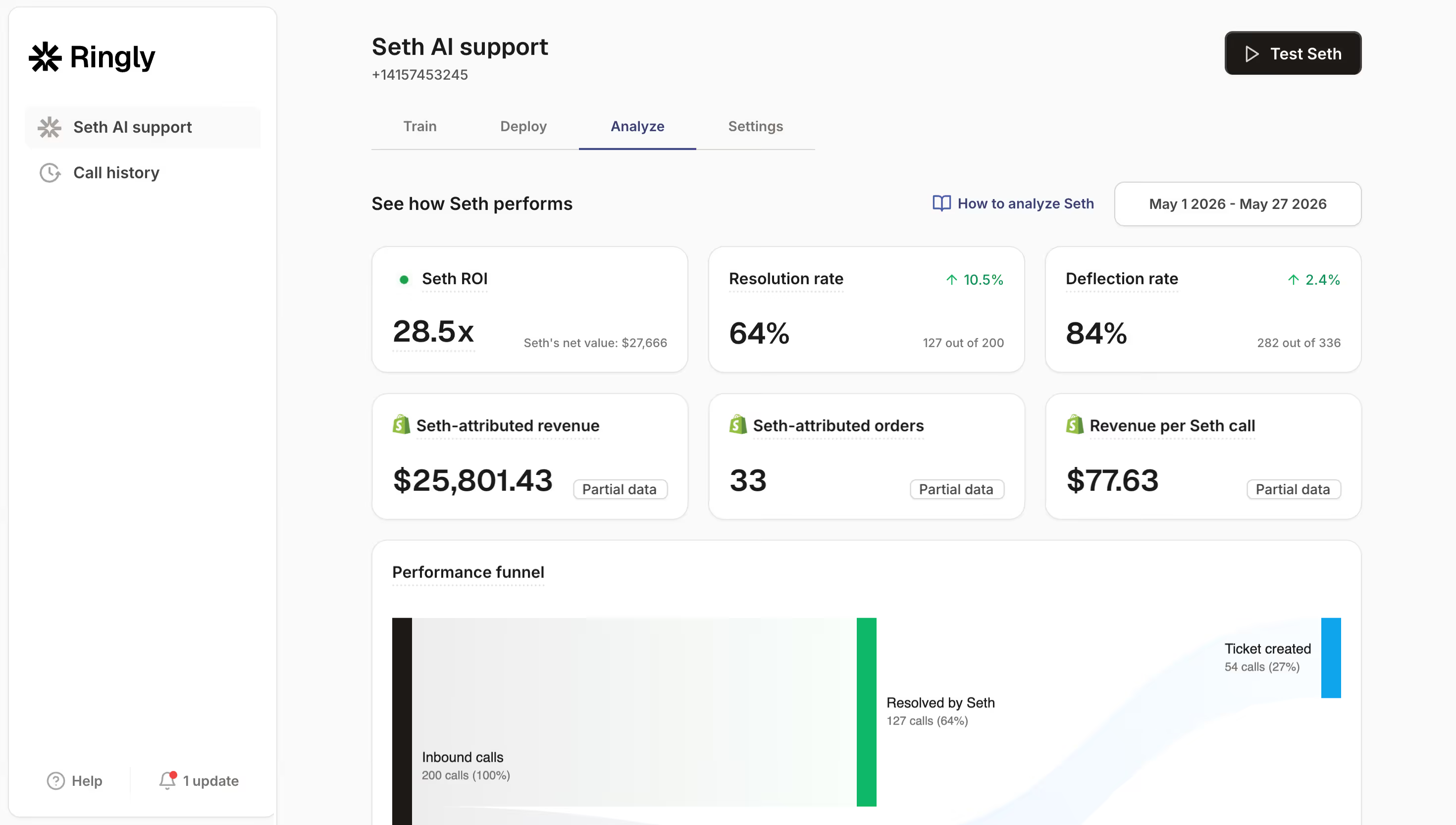
If you run a Shopify store, Ringly.io handles 73% of support calls automatically with its AI phone agent, Seth. That means fewer WISMO calls clogging up your team and faster answers for customers who are on the fence. Try free for 14 days.
Frequently asked questions
What is a good ecommerce conversion rate in 2026?
A good ecommerce conversion rate is 2.5% to 3%. If you're above 3.2%, you're in the top 20% of all ecommerce stores. Top performers hit 4.7% or higher, which puts them in the top 10%.
What is the average Shopify conversion rate?
The average Shopify store converts between 1.4% and 1.8% of visitors. This is lower than the broader ecommerce average because Shopify's data includes many newer stores still building their funnel. Established Shopify stores with optimized checkouts typically hit 2.5% to 3%.
Which ecommerce industry has the highest conversion rate?
Food and beverage leads at 6.22%, followed by multi-brand retail at 4.97% and beauty and personal care at 3.46% to 4.94%. Low-cost, repeat-purchase products consistently convert highest.
Why is mobile conversion rate lower than desktop?
Mobile converts at 1.8% versus 3.9% on desktop because of smaller screens, harder-to-fill forms, and slower load times. Mobile shoppers are also more likely to be browsing rather than buying. Despite lower conversion rates, mobile accounts for 78% of all ecommerce visits.
How much does page speed affect conversion rates?
A lot. Sites loading in 1 second convert at 3x the rate of 5-second sites. Every 1-second delay in mobile load time costs roughly 7% in conversions. For a $10 million per year store, that's $400,000 in lost revenue from a single second of delay.
Does free shipping really increase conversions?
Yes. Free shipping increases conversion rates by about 20%. More importantly, 39% of shoppers abandon their cart specifically because of unexpected shipping costs. It's the single biggest reason for cart abandonment.
How much can CRO improve my conversion rate?
Structured CRO programs deliver an average ROI of 223%. A/B testing alone lifts conversions by 18% on average after 6 months. Even simple changes like reducing checkout form fields from 16 to 7 can boost completion rates by 20%.
Do customer reviews actually improve conversion rates?
Yes, significantly. Visitors who interact with reviews and user-generated content convert 102.4% higher than average. And 93% of shoppers actively look for customer reviews before making a purchase. Stores without reviews lose up to 40% of potential buyers.