

7 out of 10 shopping carts on your store right now will be abandoned before checkout. That's the Baymard Institute average across 50 studies, and it hasn't budged much in years. Most stores try to win those sales back with email. The average recovery rate? Just 3.33%, according to Klaviyo's benchmarks.
There's a faster, more personal channel that barely anyone uses: phone calls. Merchants who call abandoned cart customers report recovery rates between 25% and 55%, depending on their approach. This guide breaks down why calls work, when to make them, what to say, and how AI makes the whole thing affordable at any scale.
Why phone calls recover more abandoned carts than email or SMS
The math here is simple. Email gets around a 50% open rate for abandoned cart flows. SMS hits 98%. But a phone call that gets answered? That's 100% attention. No subject line to ignore, no notification to swipe away.
Here's the real difference, though. An email is static. It says one thing, and if that thing doesn't match why the customer left, it's useless. Maybe they had a question about sizing. Maybe the shipping estimate confused them. Maybe their payment failed and they didn't know why.
A phone call handles all of those in real time. The person on the other end (or the AI agent) can identify the exact friction point and solve it on the spot.
The data backs this up. One Shopify store owner tested phone outreach against their existing email flows and reported a 55% recovery rate from calls versus 10% from emails. That's not a marginal improvement. That's 5x.
There's some psychology behind it too. The Zeigarnik Effect suggests people experience tension from incomplete tasks. A phone call triggers that tension more directly than a passive email sitting in an inbox. It brings the unfinished purchase back to the front of their mind (and gives them a way to finish it immediately).
So why do most stores still rely only on email and SMS for cart abandonment recovery? Mostly because phone calls didn't used to scale. You'd need humans making calls all day, which gets expensive fast. But AI changed that equation entirely, and we'll get into the numbers below.
When to call: the timing framework that maximizes recovery
Timing matters more than almost anything else with abandoned cart recovery. According to Dotdigital's data, 45% of all cart recoveries happen within the first two hours after abandonment. Wait a full day, and you've already lost almost half your potential wins.
But calling too fast feels invasive. Nobody wants a phone call 30 seconds after they close a browser tab. There's a sweet spot.
Here's the framework that works best, broken down by cart value:
| Cart value | First contact | Channel | Follow-up |
|---|---|---|---|
| $150+ (high) | 30-60 minutes | Phone call | SMS checkout link during call |
| $50-150 (medium) | 1-2 hours | Phone call | Email at 4 hours if no answer |
| Under $50 (low) | 15 min SMS, 1 hour email | SMS + Email | Phone call only at 4-6 hours if no response |
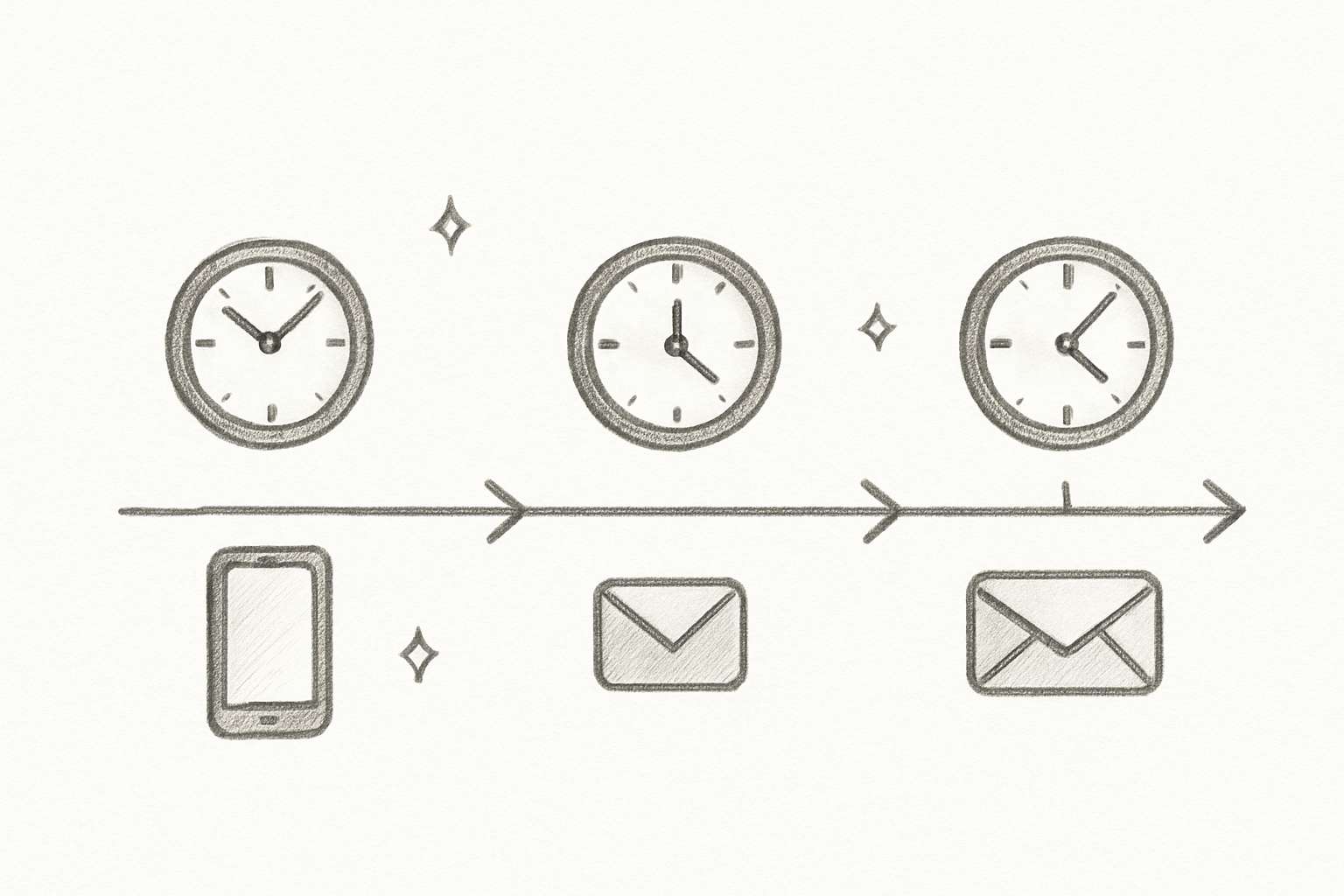
The logic is straightforward. High-value carts justify the immediate personal touch. For a $200 cart, a single recovered sale more than pays for dozens of call attempts. Lower-value carts get the automated channels first, with a phone call as the escalation if those don't work.
A few other timing details worth knowing:
- Best days for calls: Tuesday through Thursday (people are more receptive mid-week)
- Best calling hours: 10am-12pm and 2pm-4pm in the customer's local time zone
- Worst time to call: Anything before 9am or after 8pm (and it's a TCPA violation before 8am or after 9pm)
If you want to understand how average order value affects your recovery strategy, higher AOV almost always justifies more aggressive outreach.
What to say: cart recovery call scripts that convert
This is where most guides get it wrong. They treat cart recovery calls like telemarketing. Don't. The framing matters: you're calling to help, not to sell.
The "checking in" approach
This works best for first-time customers and medium-value carts. The tone is friendly, curious, genuinely helpful.
Opening: "Hi [name], this is [your store]. I noticed you were looking at [product] earlier and wanted to check if you had any questions I can help with."
Key questions to ask:
- "Was there anything about the product you weren't sure about?": Opens up sizing, color, or compatibility concerns
- "Did you run into any issues at checkout?": Catches payment errors, shipping confusion, coupon problems
- "Is there anything I can do to make the decision easier?": Natural transition to offering help without being pushy
Close: "I can send you a direct link to your cart via text right now if you'd like. It'll keep everything saved for you."
The "quick help" approach
Better for repeat customers and high-value carts. More direct, respects their time.
Opening: "Hi [name], quick call from [store]. You had [product] in your cart and I wanted to make sure nothing went wrong on our end."
Key moves:
- Identify the friction fast: "Was it a technical issue, or were you still deciding?"
- Solve it on the spot: "I can apply free shipping right now" or "Let me check if we have that in your size"
- Send the checkout link: "I'll text you a link so you can finish up whenever you're ready"
What to avoid saying
- "I see you didn't complete your purchase": Sounds like surveillance
- "We have a special deal just for you": Feels like a sales trap
- "Your cart is about to expire": Creates false urgency (and often isn't true)
The best customer service scripts for ecommerce all share one thing: they solve a problem first and close a sale second.
When you're wondering whether to offer a discount, here's a good rule: don't lead with it. Ask what's holding them back first. Often, the problem isn't price. It's uncertainty. And answering a question costs you nothing.
AI vs. human agents: which should handle your recovery calls
I think this is where most people get stuck. They assume phone calls mean hiring people, and hiring people means cost. But AI phone agents changed the math completely.
Here's how the two options compare:
| Factor | AI phone agent | Human agent |
|---|---|---|
| Cost per minute | $0.10-0.25 | $0.25-0.42 ($15-25/hr) |
| Speed to first call | Under 5 minutes | Depends on staffing |
| Calls simultaneously | Unlimited | 1 per agent |
| Available hours | 24/7, every day | Business hours only |
| Language support | 40+ languages | Limited to staff |
| Consistency | Same script every time | Varies by agent mood/skill |
| Complex objections | Good, improving | Better for high-emotion cases |
| Setup time | Minutes | Weeks (hire, train, onboard) |
The numbers tell a clear story. AI phone agents from platforms like Ringly.io cost a fraction of human outreach and they call faster. When someone abandons a $120 cart at 11pm on a Saturday, an AI agent calls within minutes. A human agent calls Monday morning (if they remember).
Where do humans still win? Honestly, for very high-value orders ($500+) where the customer needs deep product expertise or has an emotional concern. A luxury jewelry purchase, for example, might benefit from a human touch. But for 90% of ecommerce customer service situations involving abandoned carts? AI handles it fine.
The practical recommendation: use AI for everything under $500 in cart value, and route VIP or enterprise-level orders to a human. Most AI voice agent platforms support this kind of smart routing.
How to set up abandoned cart recovery calls on Shopify
If you're on Shopify, you can get this running surprisingly fast. Here's the step-by-step.
Step 1: Pick your tool
There are a few options in the Shopify ecosystem right now:
- Ringly.io: Full AI phone agent for ecommerce. Handles abandoned carts, order status, returns, and general support. Starts at $349/month for 1,000 minutes. Setup takes about 3 minutes because it plugs directly into your Shopify data. Recovers over 35% of abandoned carts according to their data.
- Callsy AI: Shopify app focused on abandoned cart calls and SMS. Free plan with 10 calls/month, paid plans from $29-199/month. Has a 5.0 rating from 19 reviews on the Shopify App Store.
- Callfy: Newer Shopify app with pay-per-result pricing (free + 15% commission on recovered sales). Launched in late 2025, still early.
For Shopify stores that also want phone support for order inquiries, returns, and general customer service (not just cart recovery), Ringly.io is the strongest option because it handles all of those use cases in one tool. If you only care about abandoned cart calls and want a minimal budget, Callsy AI's free tier is a starting point.
Step 2: Connect to Shopify and set triggers
Once you've picked your tool, connect it to your Shopify store. With most apps, this is a one-click OAuth connection. The trigger is usually "checkout abandoned" (Shopify sends this event when a customer enters their info but doesn't complete payment).
Step 3: Set timing rules and cart value thresholds
Configure when calls should go out based on the timing framework above. Set a minimum cart value (I'd suggest $50+ as a starting point) to avoid burning call minutes on $12 carts.
Step 4: Customize the call script
Most AI platforms let you customize the greeting, product mention style, and whether to offer discounts. Keep it simple. Use the "checking in" script as your default.
Step 5: Test and launch
Place a test order, abandon it, and make sure the call comes through. Check that the SMS checkout link works. Then go live.
The whole process, start to finish, takes under 30 minutes for most Shopify stores. With Ringly.io's Shopify integration, it's genuinely about 3 minutes.
ROI math: what abandoned cart calls actually cost and earn
Let's run some real numbers. This is the part that usually convinces people.
Scenario: 1,000 abandoned carts per month, $85 average order value.
| Recovery channel | Recovery rate | Carts recovered | Revenue recovered | Monthly cost | Net revenue |
|---|---|---|---|---|---|
| Email only | 3.33% | 33 | $2,805 | $30-50 (Klaviyo) | ~$2,760 |
| Email + SMS | 8% | 80 | $6,800 | $100-200 | ~$6,650 |
| Email + SMS + AI phone | 20-25% | 200-250 | $17,000-21,250 | $200-400 | ~$16,800-20,850 |
The difference between email-only and adding AI phone calls is roughly $14,000-18,000 per month in additional recovered revenue. The cost of AI phone calls? Maybe $100-300/month depending on volume.
That's a 50-60x ROI. Even if your numbers are half of these estimates, it's still a no-brainer.
Here's another way to think about it. Baymard Institute estimates that $260 billion in US and EU ecommerce revenue is recoverable through better checkout experiences and recovery efforts. Phone calls tap into a chunk of that $260 billion that email and SMS simply can't reach.
And if you want to track the impact on your broader customer retention metrics, recovered cart customers often become repeat buyers. You're not just saving one sale. You're saving a customer relationship.
Try Ringly.io free for 14 days and see what AI-powered cart recovery calls look like for your store. Setup takes about 3 minutes.
Compliance and best practices for cart recovery calls
Before you start calling, you need to understand the legal side. In the US, the Telephone Consumer Protection Act (TCPA) governs automated calls and texts. Violations cost $500-1,500 per call.
Here's what you need to know:
The basics:
- Consent is required: You need prior express consent before making automated calls. Shopify's checkout already collects phone numbers, but you should include language in your checkout flow that mentions cart recovery outreach.
- Calling hours: 8am-9pm in the customer's local time zone (never call outside this window)
- Opt-out mechanism: Every call must include an easy way to opt out. "Press 1 to stop receiving calls" or similar.
- Process opt-outs fast: New rules effective April 2025 require processing opt-out requests within 10 business days.
What smart stores do:
- Add a checkbox at checkout: "We may call or text you about your order" (checked by default is risky, unchecked is safer)
- Use your privacy policy: Mention cart recovery outreach in your terms
- Log everything: Keep records of consent, call times, and opt-outs
- Use compliant tools: Most AI platforms like Ringly.io handle calling hours, DNC lists, and opt-out processing automatically
The one-to-one consent rule (requiring individual consent per seller) has been delayed to April 2026 in the US. Keep an eye on that if you're planning a multi-brand strategy.
One honest take: if your checkout collects a phone number and your terms mention recovery outreach, you're in a strong legal position for making cart recovery calls. Just don't call at 6am and don't ignore opt-outs.
Combine phone calls with email and SMS for maximum recovery
Phone calls work best as part of a multi-channel stack, not in isolation. Combining channels increases recovery rates by up to 45%, according to industry data.
Here's the ideal abandoned cart recovery sequence:
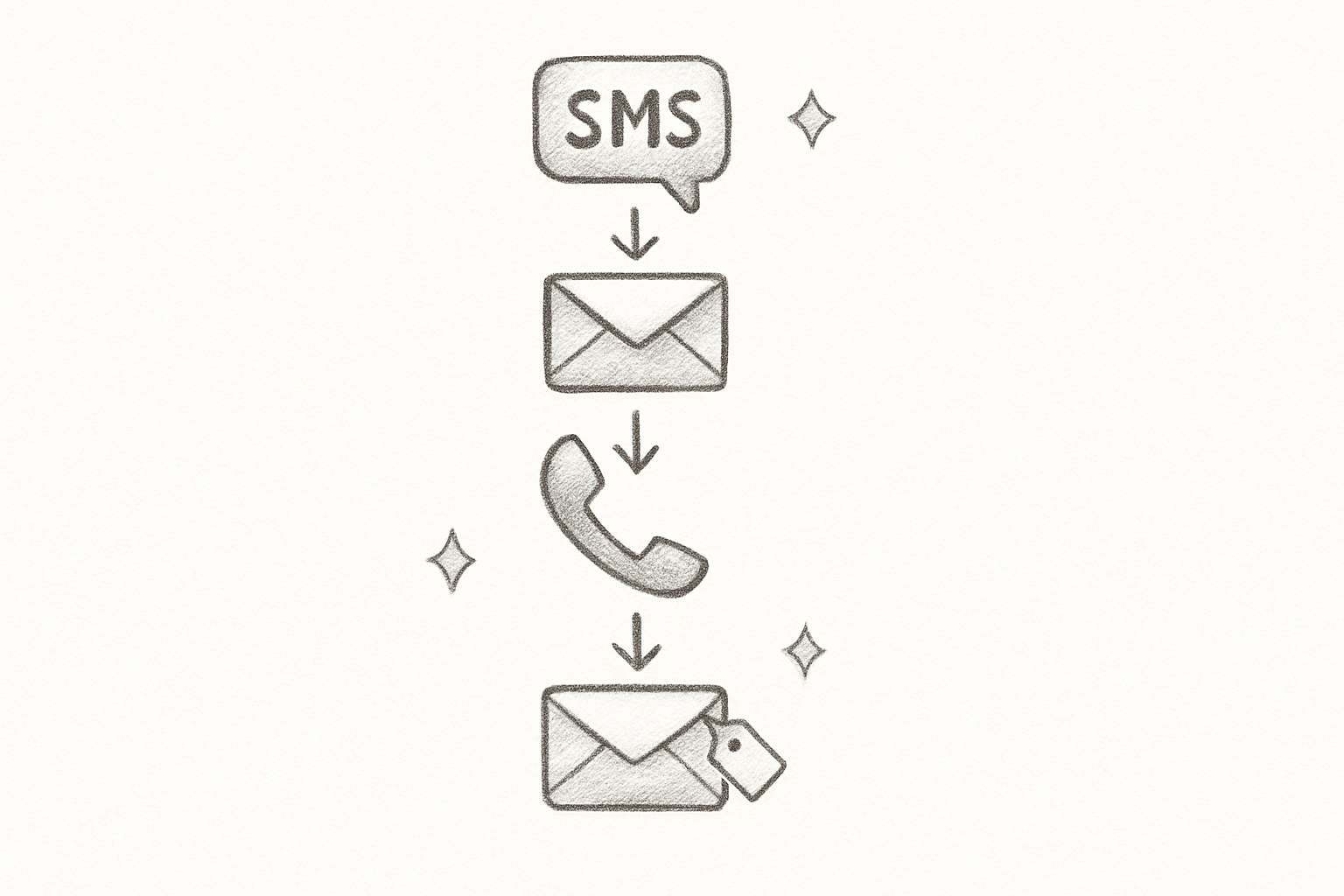
- 15 minutes after abandonment: SMS reminder with cart link. Short, direct, low friction.
- 1 hour: First email with product images and subtle urgency ("your items are still waiting").
- 2-4 hours: AI phone call for carts above your AOV threshold (e.g., $75+). This is where the big wins happen.
- 24 hours: Second email, this time with a small incentive (free shipping or 5-10% off).
- 48 hours: Final SMS with the incentive repeated. Last chance messaging.
The phone call at the 2-4 hour mark is the secret weapon. By that point, the customer has seen your SMS and email. The phone call breaks through whatever made them ignore those. And because it's a conversation, you learn exactly why they didn't complete the purchase (which helps you fix your checkout conversion process for everyone else).
If you're already using Klaviyo or another email platform for your recovery flows, adding phone calls through an AI agent complements what you already have. You're not replacing email. You're filling the gap where email fails.
Frequently asked questions
How many abandoned carts can phone calls recover compared to email?
Email recovers about 3-5% of abandoned carts on average, with top performers hitting 7-8%. Phone calls (especially AI-powered ones) recover between 25-35% at scale. That's roughly a 5-7x improvement. The gap exists because phone calls handle real-time objections that static emails can't address.
Is it legal to call customers who abandoned their cart?
Yes, as long as you have consent. If a customer entered their phone number during checkout and your terms mention recovery outreach, you're generally covered under TCPA. Stick to 8am-9pm calling hours, always offer an opt-out, and process opt-out requests within 10 business days.
What should I say when calling about an abandoned cart?
Frame it as customer service, not sales. Open with "I noticed you were looking at [product] and wanted to check if you had any questions." Identify what stopped them, solve the problem, and offer to send a checkout link via text. Never lead with a discount.
How quickly should I call after a cart is abandoned?
For high-value carts ($150+), call within 30-60 minutes. For medium-value carts, 1-2 hours is the sweet spot. Calling within 5 minutes can feel invasive, but waiting more than 4-6 hours means you've lost nearly half your recovery potential.
Do AI phone agents sound natural enough for cart recovery?
Modern AI voice agents are very convincing. Platforms like Ringly.io use natural language processing in 40+ languages with multiple voice options. Most customers can't tell they're speaking with AI, especially for straightforward conversations like cart recovery.
What's the minimum cart value worth calling about?
For AI calls (at $0.10-0.25 per minute), even $30-40 carts can be worth calling about since the cost per attempt is so low. For human agents, the break-even point is higher, usually $100+ carts. Most stores start with a $50-75 minimum threshold and adjust from there.
Can Ringly.io handle abandoned cart recovery calls automatically?
Yes. Ringly.io connects to your Shopify store, detects abandoned checkouts in real time, and has its AI agent call the customer automatically. It knows the customer's name, what's in their cart, and can answer product questions, offer discounts, and send checkout links via SMS during the call. Setup takes about 3 minutes.
The bottom line
Abandoned cart recovery calls aren't new. But AI made them practical for every ecommerce store, not just the ones with call center budgets.
If you're only using email for recovery, you're capturing maybe 3-5% of abandoned carts. Adding phone calls, particularly AI-powered ones, can push that to 20-35%. The ROI math is almost absurd when you compare the cost of a few hundred AI call minutes against $14,000+ in recovered monthly revenue.
The stores that figure this out early have a serious edge. Everyone else is still sending the same "you left something behind" emails that customers have been ignoring for a decade.
Start your free Ringly.io trial and get AI cart recovery calls running on your Shopify store in under 3 minutes.