

This post in 30 seconds.
- 15 real customer service plays from DTC and retail brands, each with a "how a sub-50-person team actually does this" line.
- The pattern under the famous stories: automate the boring 80%, train humans for the outlier 20%, pre-budget for brand-defining moments.
- Built for Shopify operators trying to deliver Chewy-tier service without hiring a 200-person CS team.
Most "customer service experience examples" articles list Chewy, mention Zappos, name-drop Warby Parker, and then end. If you run an 8-person Shopify brand, that's not useful. You already know Chewy is great. You know Zappos has a 365-day return policy. The question is how a team of 8 actually copies any of it without hiring 200 people.
So this post is different. Below are 15 customer service experience examples skewed toward DTC and Shopify-style brands. For every one, there's a "how a sub-50-person team actually replicates this" line. And there's a section on the channel almost every other article forgets, which happens to be the one where the moves above actually feel different.
If you came here looking for "stuff to bookmark," there's plenty. If you came here looking for things to ship next quarter, that's the goal.
If you want to talk through which moves fit your team and stack, book a 30-min call and we'll walk through it.
Why most "customer service experience examples" posts feel useless
Read enough of these and a pattern shows up. Big brand. Heroic anecdote. Conclusion: "be more like them." No bridge to your reality.
The math doesn't translate. Zappos has 1,500+ reps. You have 4. Ritz-Carlton has a $250,000 average lifetime customer value baked into their $2,000 empowerment rule. Your AOV is $68. Chewy paints 1,000 dog portraits a week. You're trying to figure out how to answer the phone at 6pm without ignoring your inbox.
The headcount problem is real. It also has a real answer, and that answer isn't "try harder." It's a combination of three things: automate the boring 80%, train humans for the outlier 20%, and pre-allocate margin for brand-defining moments. Every example below is filtered through that frame.
For the stakes: 88% of customers say they're more likely to buy again after a great service experience (Zendesk, 2026). And 55% will stop doing business with a brand over long wait times (Nextiva, 2026). Service has gone from "nice to have" to "deal-breaker." The brands below figured this out early. For wider data on this shift, see ecommerce customer support statistics for 2026.
15 customer service experience examples worth copying
These are ordered DTC-first, with three retail legends mixed in where the mechanic is universal. Pick one or two that fit your team size and budget. Don't try to copy all 15.
1. Chewy: hand-painted pet portraits for grieving customers
In 2017, Anna Brose tried to return a bag of unopened pet food to Chewy after her dog died. Chewy refunded her, told her to donate the food to a local shelter, and sent flowers signed by the customer service rep she spoke with. Her tweet about it got over 722,000 likes.
That story isn't a one-off. According to Fortune, Chewy sends over 1,000 commissioned hand-painted pet portraits per week. They started in 2013. Andrew Stein, their senior director of customer service, puts it simply: "The pet space is a very emotive one."
The lesson here is not "buy 1,000 paintings a week." It's that brand-defining service lives in the outlier 1% of contacts. The reps need permission and a small budget to act on those moments without escalation.
How a sub-50-person team copies this: pre-budget $200 to $500 per month for "brand moments." Train one CS person to recognize the trigger (lost pet, recent surgery, life event mentioned in a ticket). Remove all approval friction. The point is speed plus authenticity, not scale. This is also one of the cleaner moves for ecommerce customer retention.
2. Glossier: "editors," not customer service agents
Glossier doesn't call their support team "agents." They call them "editors," and the team is called the gTeam. According to Digiday, editors run Instagram DMs, email, phone, and FaceTime conversations, with each editor focused on a single channel and treated as a product expert.
The title shift sounds cosmetic. It isn't. When you call someone an "editor" or a "product specialist," the role attracts different people, and the conversations they run sound different. The work becomes recommendations, not ticket resolution.
This is a one-day fix any Shopify brand can copy.
How a sub-50-person team copies this: change the title on your CS hire's email signature and LinkedIn first. Rewrite the job description. Train them on product, not just helpdesk software. The role will start to evolve into the title within a quarter.
3. Warby Parker: Home Try-On
Warby Parker's Home Try-On lets customers pick 5 frames online, ships them for free, gives the customer 5 days to decide, then takes back what they don't want. It's a service mechanic that kills the biggest objection for buying glasses online (will they fit my face). Warby reports that customers shopping across online and stores have around 70% higher AOV than single-channel customers.
This isn't really "support" in the helpdesk sense. It's service designed into the buying flow so that support load drops.
How a sub-50-person team copies this: build a "no-questions sizing exchange" or a sample bundle for one product category. Make it as frictionless as possible. The CS team will spend less time on returns and more time on the conversations that build loyalty. If you sell on Shopify, the Shopify returns app ecosystem has options that automate the back end.
4. Allbirds: a 1-hour first-response SLA on a small team
Allbirds is famous for shoes, but their CS operation is interesting because they hit a 1-hour first response SLA without a giant team. According to a Zendesk case study, CS manager Ashley Fattig set up Macros to handle about 80% of incoming volume, leaving the team free to be human on the other 20%.
Her quote: "It's really important for us to make sure that every customer feels like they're being treated individually."
The lesson is the 80/20 split. Most customer service volume is repeat questions (WISMO, returns, sizing, restocks). If you automate the predictable 80%, the team has the time and emotional bandwidth to be human on the 20% that matters.
How a sub-50-person team copies this: spend 90 minutes auditing your last 100 tickets. You'll find 6 to 10 questions that account for 70%+ of volume. Build templated responses or automation (via your helpdesk app) for those today. Re-audit monthly.
If you run a Shopify brand, Ringly.io extends this logic to the phone channel: the AI handles the routine inbound calls (order status, returns, product questions) and resolves 73% of them autonomously, so your CS team can focus on the calls that need a human.
5. Beardbrand: owning the relationship (off Amazon)
Beardbrand founder Eric Bandholz famously pulled the brand off Amazon to own the customer relationship through Beardbrand's own checkout. According to Gorgias, AOV doubled from $25 on Amazon to $50 on the owned channel, and CS quality went up because the team could finally see and serve repeat customers.
The lesson cuts deeper than "use Shopify, not Amazon." It's that customer experience starts with where you sell, not just how you respond to tickets. Marketplaces are easier short-term and brutal long-term for brand-building service.
How a sub-50-person team copies this: keep your own store, your own phone number, your own CRM. Even if a third party offers you "easier" scale, the relationship value compounds when you own it. This is also the argument for Shopify customer service for DTC brands over distributing across channels you don't control.
6. Zappos: the 10-hour customer call (and 365-day returns)
Zappos is the most-cited customer service brand on the internet for a reason. The signature story: one agent spent over 10 hours on a single customer call. The reason they could is that Zappos doesn't measure CS reps on average handle time (AHT). They measure resolution.
This is the metric most teams get wrong. AHT-driven teams cannot have a Chewy moment, cannot have a 10-hour call, cannot empower the rep to do the right thing. The metric makes the behavior.
How a sub-50-person team copies this: kill AHT as a primary metric for at least your senior CS tier. Replace with first call resolution and CSAT. Watch what happens to the way conversations feel. (For more on which metrics actually predict loyalty, see customer service KPIs for ecommerce.)
7. Stitch Fix: AI plus a human stylist
Stitch Fix is one of the cleaner public examples of AI plus human service done right. The customer fills out a style profile. An algorithm filters thousands of SKUs down to a candidate set. A human stylist makes the final picks and writes the personal note that goes in the box.
The interesting part is the division of labor. AI handles the search space and the boring filtering. The human handles the judgment call and the personal touch. Customers feel served, not "served by software."
How a sub-50-person team copies this: use AI for triage, ticket drafting, and routing. Use humans for the final approval and any conversation that needs nuance. Don't let AI write the closing line. That's where the brand voice lives.
8. Patagonia: repair-don't-replace as a service mechanic
Patagonia's Worn Wear program offers on-site repairs at flagship stores and online repair requests. The genius isn't the repairs themselves. It's that Patagonia turned a brand value (don't waste, build to last) into a service offering.
Most brands say their values out loud on their About page. Patagonia operationalizes them in the way the support team interacts with customers. That's a different level of brand integration.
How a sub-50-person team copies this: pick one operating principle that's true about your brand (eco, longevity, fit, repair, founder-led, etc) and build a service mechanic around it. Don't market it. Run it. The story will write itself.
9. Nordstrom: the tire return
The Nordstrom tire story is real. In 1975, employee Craig Trounce was working at the Nordstrom store in Fairbanks, Alaska. A customer walked in with two tires. Nordstrom doesn't sell tires (and never did at that location, beyond the few years immediately after they took it over from Northern Commercial). Trounce called Firestone, got the tires valued at $25, and refunded the customer on the spot. The actual tire is mounted in the flagship Nordstrom store in NYC as a reminder. (Source: Axios, Nordstrom press.)
The lesson isn't "refund tires you don't sell." It's that empowered employees write the brand story. Nordstrom didn't have a policy that said "accept tire returns." They had a culture that said "do right by the customer." That's a culture, not a flowchart.
How a sub-50-person team copies this: give your CS team a written discretionary budget per contact (say, $50 or $100), no manager approval required, no documentation. Trust them with it. The 1-2 times they use it badly are cheaper than the 50 times they use it well.
10. Ritz-Carlton: the $2,000 rule
Every Ritz-Carlton employee, from front desk to housekeeping, has the authority to spend up to $2,000 per incident (not per year) to rescue a guest experience. No approvals. No forms. The rule is famous, and the most interesting part is that it's rarely used. The freedom matters more than the cap.
The business logic checks out. Ritz says their average customer is worth $250,000 lifetime. $2K is a rounding error against that.
How a sub-50-person team copies this: start with $100 or $200 per CS contact, no approval. Track usage for a quarter. You'll see what most operators see: the budget barely gets touched. The behavior shift is the win.
11. Lego: the "stolen by Darth Vader" replacement piece
A LEGO fan named John bought the Mos Eisley Cantina set ($350, 3,000+ pieces). Bag 14 was missing. He contacted LEGO and got this back: "I am so sorry that you are missing bag 14 from your Mos Eisley Cantina! This must be the work of Lord Vader. Fear not, for I have hired Han to get that bag right out to you. Have a bricktastic day and may the force be with you." Delivery promised in less than 12 parsecs (Inside the Magic).
That email is a service moment, sure. It's also a marketing artifact that went viral because it sounded like LEGO, not like a helpdesk. Tone is a service feature when your brand can carry it.
How a sub-50-person team copies this: write a voice document for your CS team. Two pages. What your brand sounds like, what it doesn't sound like, three example replies for hard tickets. Let the brand show up in the support reply. (Speaking of which, these customer service scripts walk through the structure.)
If your phone support sounds robotic, that's the moment the brand evaporates. Ringly.io's AI phone agent is trained on your brand voice so the calls don't feel like an IVR.
12. REI: staffed by people who actually use the gear
REI staffs every department with people who use the products in real life. Climbing department: actual climbers. Camping: actual campers. The result is conversations that feel like advice from a friend, not from a salesperson.
The hiring move is the move. Helpdesk certifications are commoditized. Product passion isn't.
How a sub-50-person team copies this: prefer CS hires who use your product to CS hires with five years of Zendesk experience. The helpdesk knowledge is teachable. The product fluency takes years.
13. Trader Joe's: first-name regulars
Trader Joe's has no loyalty program. No app. No data capture. Crew members recognize regulars by face and greet them by name. The experience is built on human warmth, not algorithmic personalization.
This sounds quaint until you realize how scale-resistant it is. Competitors with billions in CRM data can't copy "the cashier remembers you."
How a sub-50-person team copies this: train the CS team to recognize repeat callers and emailers. Acknowledge them by name. Reference the last order. The CRM does the lookup, but the human delivers the moment.
14. Apple: training for the recovery, not the script
Apple's Genius Bar training uses an acronym (APPLE: Approach, Probe, Present, Listen, End). The structure is simple. What's interesting is what they invest in: judgment for the messy moments. The acronym sets the floor; the training is for everything above it.
Most CS training focuses on what to say. Apple's focuses on how to read the customer first.
How a sub-50-person team copies this: dedicate one hour per week to CS role-play on hard tickets. Pick a real interaction from last week. Have the team debate the right response. The compounding return on judgment training is bigger than any new helpdesk feature.
15. Lululemon: ambassadors as customer service
Lululemon's ambassador program turns local yoga teachers and run-club leaders into brand reps. They host classes, they answer product questions in their community, they become a customer service extension Lululemon doesn't have to hire.
This is a quietly enormous service play. Your top 50 customers are likely already advocating for you. The question is whether you've given them a direct line to your team.
How a sub-50-person team copies this: identify your top 20 advocates (orders, referrals, UGC). Give them a Slack channel or WhatsApp number that goes straight to a senior CS person. Let them flag issues, request product, suggest features. They'll do the rest.
The channel everyone forgets in customer service examples: phone
Read the 15 examples above. Now notice what's almost missing. Phone shows up in two places: Glossier's editors taking calls and Zappos's 10-hour conversation. That's it.
Phone is the channel almost every "customer service experience examples" article skips. It's also the channel where the highest-emotion moments actually happen. A bad call lands differently than a bad chat message. A great call lands differently too.
A few patterns on phone for DTC operators:
- Phone gets killed first when small teams get squeezed. Voicemail, then call forwarding, then no number at all. The guilt builds.
- Customers feel most cared for on phone when it works. And most ignored when it doesn't.
- 89% of customers want a balance of automation, AI, and human touch (Salesforce). And 63% expect agents to know them before the conversation starts. Phone is the hardest channel to deliver this on without help.
- AI changes the math here. Routine phone calls (WISMO, returns, product questions) that used to require 3-5 reps can now run on one AI agent plus a human handoff for the messy stuff. Read more on this in voice AI for customer service and AI receptionist for ecommerce.
So the question for a DTC team isn't "should we offer phone?" It's "can we offer phone in a way that doesn't burn our small team out?"
That's where Ringly fits.
Ringly.io: AI phone support for Shopify brands
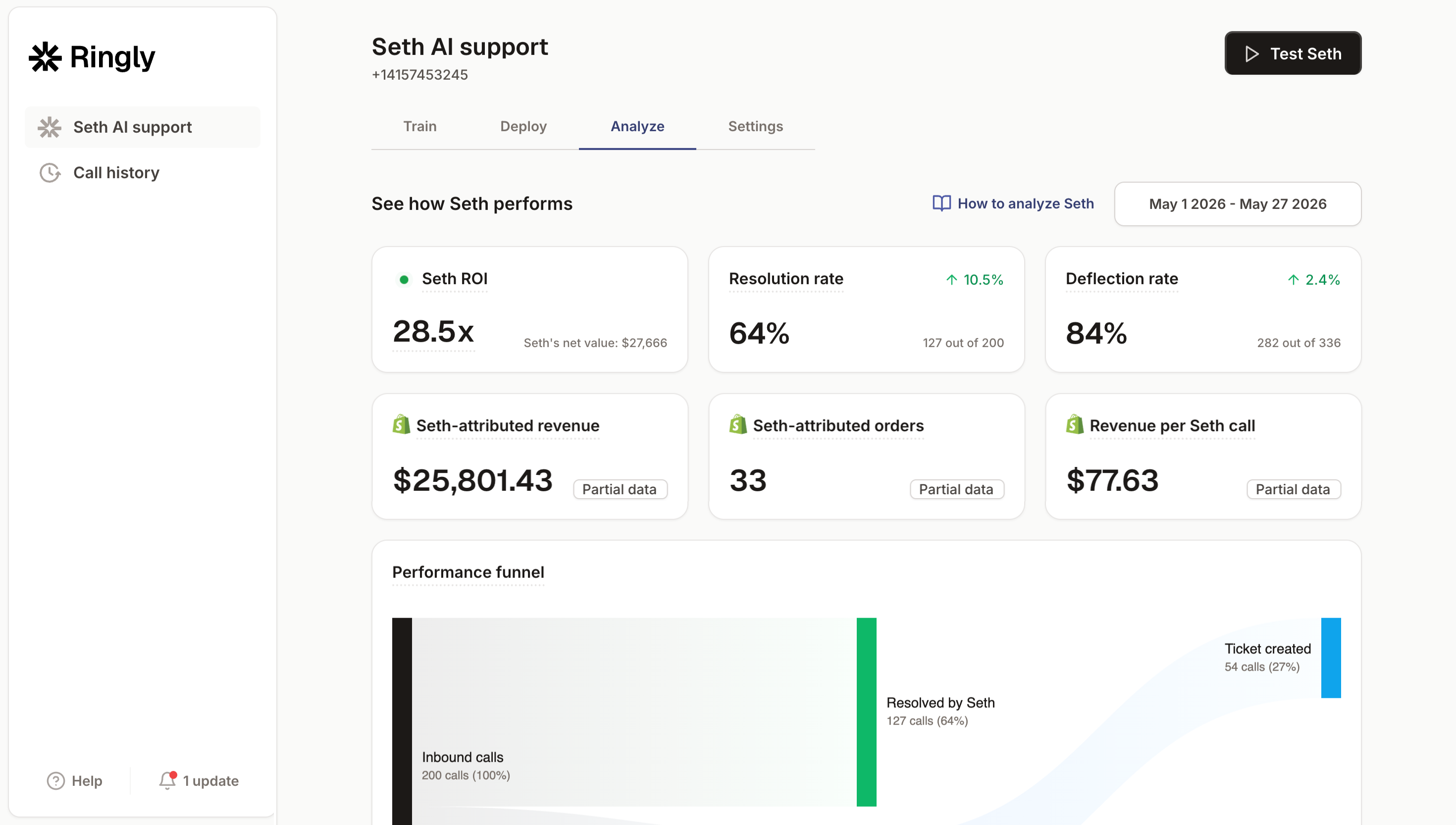
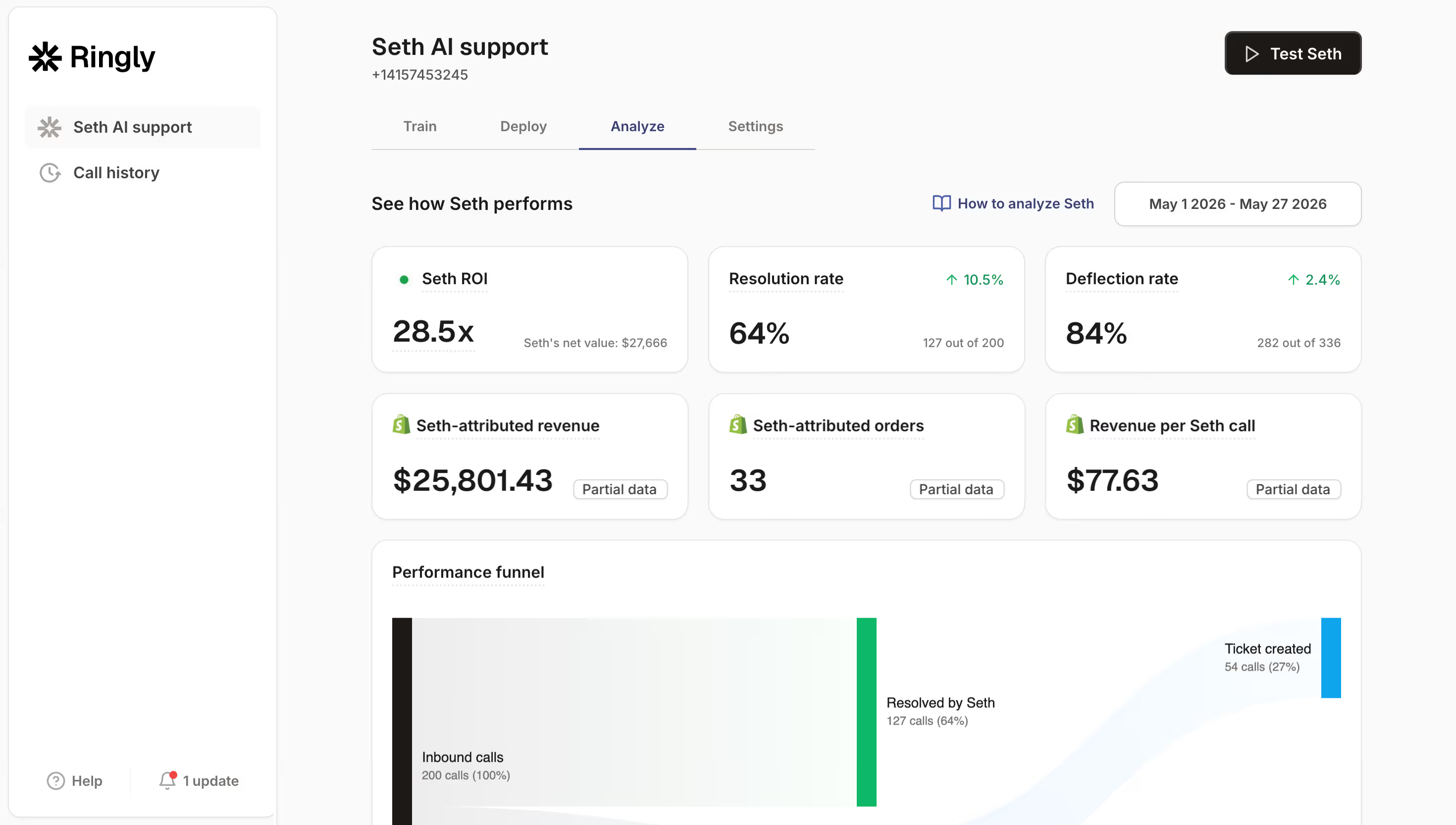
Ringly is AI phone support for Shopify brands. Phone support, without the payroll. Instead of growing your support headcount every time call volume goes up, the AI takes the routine inbound calls so your team can focus on the work that actually moves revenue.
The AI answers inbound calls 24/7. It finds orders in your Shopify store, processes returns and exchanges, answers product questions from your knowledge base, and rescues abandoned carts via outbound follow-up. Across 50+ brands, the AI resolves 73% of calls autonomously at roughly $0.42 per resolved call. Calls that need a human escalate cleanly to Gorgias, Richpanel, Reamaze, or whatever helpdesk you already run.
Plans: Grow $349/mo (1,000 minutes), Pro $799/mo (2,500 minutes), Enterprise custom. Live in under an hour. 65% resolution guarantee: if the AI resolves under 65% of your calls in 90 days, we refund the last 3 months.
For a sense of what this looks like in production: WashCo generated $22,664 in attributed revenue in the first 7 days post-launch with 271 calls handled at $0.91 per call. TechCraft Studio handles 88% of calls without a human. BioLongevity Labs hits 79% resolution autonomously. Different verticals, same pattern.
This is the move that lets a sub-50-person Shopify team actually have phone service that feels like Chewy without hiring 200 reps. Read more on the underlying mechanic at Shopify voice agents or Shopify AI voice support.
What happens on the call.
- We pull your last 7 days of missed calls live, on the call. No homework for you.
- We map which of the 15 plays above actually fit your team size and stack.
- You decide if it's worth a deeper conversation. No deck, no follow-up sequence.
The call makes sense if:
- You're a Shopify (or Shopify Plus) brand doing $10M-$100M
- You run a paid helpdesk (Gorgias, Zendesk, Gladly, Re:amaze, or Intercom)
- You have a visible phone number on your store
- Your CS team is 3-12 people
If that's you, book a 30-min call and we'll talk through what fits.
How to pick which customer service moves to copy first
Fifteen examples is too many to copy. Here's a rough framework based on team size and budget. Pick one or two.
- Choose Allbirds (Macros for the 80%) if you have under 5 CS people and your team is drowning in repeat tickets. Audit the last 100 tickets, build templates for the top 6-10 questions, see WISMO automation.
- Choose Glossier (editor title shift) if you have 1-2 CS hires. Cheapest, fastest move on this list.
- Choose Zappos (kill AHT as a metric) if your team is being measured on call time and your CSAT is flat. The metric is the problem.
- Choose Chewy (brand-moment budget) if you have margin and want a viral story. Pre-budget $200 to $500 per month, train one rep to spot triggers.
- Choose Ritz-Carlton (empowerment budget) if your CS reps escalate too much. Cap-and-trust framework, start at $100 per contact.
- Choose Ringly (AI phone) if phone is either your biggest cost or the channel you've already killed. $349/mo replaces 1-2 phone-only reps at typical volume.
- Choose Lego (voice doc) if your tickets read like a robot wrote them. Two-page voice document, three example replies.
Practical hierarchy if you're going to do more than one: automate the routine first, train humans for the outliers second, budget for brand moments third. Don't try to do brand moments without the first two in place. Your team will burn out before the viral tweet lands.
For more on choosing between in-house and outsourced support, see our piece on outsourcing Shopify customer service and the broader ecommerce customer service guide.
Frequently asked questions
What is a customer service experience example? A customer service experience example is a real-world story of how a brand handled (or mishandled) a customer interaction in a way that's worth studying. The best examples show a specific mechanic, not just a feel-good anecdote, so other teams can learn from it.
Which DTC brand has the best customer service? Chewy is the most-cited because of viral stories like the hand-painted pet portraits and flowers for grieving owners. But Glossier, Warby Parker, and Allbirds are arguably better operational benchmarks for ecommerce teams because they figured out how to deliver high-touch service without 1,000-person teams.
How can a small ecommerce team copy Chewy or Zappos? Don't try to copy the headline gesture (1,000 portraits, 10-hour calls). Copy the structure underneath: pre-budget for brand moments, kill AHT as a metric, give your CS team discretionary spend with no manager approval. The behavior change matters more than the budget.
Should small brands offer phone support? Yes, if you can. Phone is the highest-emotion channel and the one customers remember. The trick for small teams is to not have a human pick up every routine call. AI phone agents like Ringly.io handle the predictable 70-80% so the team can focus on the calls that matter.
Where does AI fit in DTC customer service? AI is great for the routine 80% (order status, returns, restocks, product questions, after-hours coverage). It's bad for the outlier 20% (grieving customer, custom edge case, brand-defining moment). The math works when you let AI do the boring half and humans do the human half.
How much does great customer service actually cost? Less than most operators assume. A two-page voice document costs nothing. An empowerment budget of $100 per contact costs almost nothing because it's rarely used. AI phone coverage starts at $349/mo. The expensive version is hiring 50 reps to do what a smaller team plus the right tooling can deliver.
Talk to us
The 15 examples above aren't a checklist. Pick one move that fits your team this quarter. Then pick another next quarter.
The thing that separates Chewy-tier service from everyone else isn't budget. It's what your team is allowed to do without asking permission. Build the structure that gives them that permission, and the brand moments take care of themselves.
If phone is the channel you've been avoiding because the headcount math didn't work, that's where AI changes things for a sub-50-person team.
The 3-layer guarantee.
- Live in 14 days or it's free until launched.
- 65% resolution in 90 days or we refund the last 3 months of subscription fees.
- We keep working free until we hit 65%.
Ruben (Ringly co-founder) takes these calls personally.