
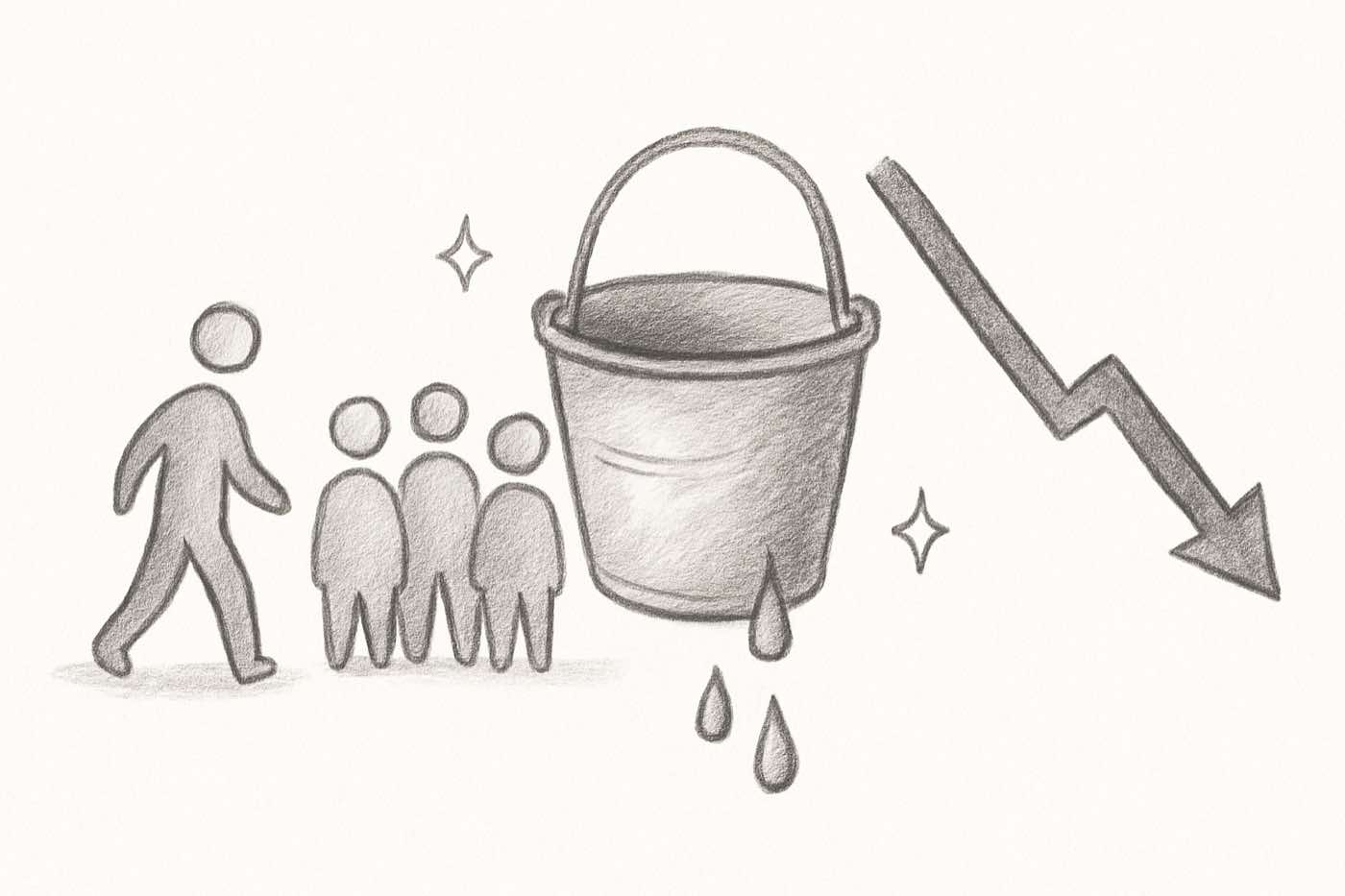
Churn is the silent revenue leak. Most brands spend a fortune to acquire customers, then watch a quarter of them walk out the back door every year without ever asking why.
This page pulls together 67 customer churn statistics from Recurly, Bain, PwC, Forrester, Gartner, Shopify, and industry research reports, so you can benchmark your own numbers and spot where the biggest fixes are.
Hear what AI support calls sound like for your store. Just paste your Shopify URL and hear sample calls for your store, no email required. Listen to demo calls for my store.
Key highlights
- Traditional ecommerce loses roughly 70-75% of customers year over year, while subscription ecommerce averages 3.4% monthly churn.
- B2B SaaS monthly churn averages 3.5%, split between 2.6% voluntary and 0.8% involuntary.
- 32% of customers walk away from a brand they love after one bad experience, and 92% leave after two or three.
- Subscription businesses lose over $440 billion a year to failed payments alone.
- A 5% increase in retention lifts profits by 25% to 95%, according to Bain & Company.
- Companies using AI for support and retention report up to 30-40% churn reduction.
Churn rate benchmarks by industry
Churn varies wildly by industry. A 4% monthly rate is a disaster for enterprise software and a win for a consumer app.
The average annual churn rate across all industries is 20-30%. Roughly one in four customers leaves every year on average. (Source)
Energy and utilities have the lowest B2B churn at 11%. High switching costs and long contracts keep customers locked in. (Source)
Logistics has the highest B2B churn at 40%. Commoditized services and price shopping drive the turnover. (Source)
Telecom sits at 21.5% annual churn and roughly 2.5% monthly. Mobile carriers have turned retention into a science, and it still barely moves. (Source)
Global retail churn sits near 37%. That number makes retail one of the hardest industries to retain customers in. (Source)
The median monthly churn across all industries is 4%. Recurly's benchmark has held steady year over year across 2,200+ brands and 58 million subscribers. (Source)
Most of these numbers hide a bigger truth. The bulk of churn in any category is preventable with better onboarding, better support, and cleaner billing. More on that below.
SaaS and subscription churn
SaaS churn is the most-tracked category in the world, and the benchmarks are surprisingly tight.
B2B SaaS averages 3.5% monthly churn. That splits into 2.6% voluntary and 0.8% involuntary. (Source)
SMB SaaS churns 3-5% monthly, mid-market 1.5-3%, enterprise 1-2%. Best-in-class companies stay under 1% monthly. (Source)
Infrastructure SaaS has the lowest churn at 1.8% monthly. Technical integration lock-in is the moat. (Source)
Marketing and sales SaaS has the highest churn at 4.8-8.1% monthly. Commoditization and easy switching are brutal. (Source)
Healthcare SaaS churn jumped 67% from 2024 to 2025. It now runs at 7.5% monthly. (Source)
EdTech hits 9.6% monthly churn. Seasonal usage and budget cycles work against retention. (Source)
Software bought by the C-suite churns 3.6x slower than tools bought by managers. Buyer seniority is the single strongest predictor. (Source)
Usage-based pricing cuts monthly churn by 46% vs flat-rate. 2.1% vs 3.9% across the same vertical. (Source)
If you run any kind of phone or chat support SaaS, check our cloud contact center software guide for how buyer seniority shapes retention in that category.
Ecommerce and Shopify churn
Ecommerce looks nothing like SaaS. One-time purchases are the norm, which makes "churn" a fuzzy concept.
Traditional ecommerce has ~70-75% annual churn. Three out of four customers don't come back next year. (Source)
The average repeat customer rate in ecommerce is 28.2%. A healthy benchmark for a 1-3 year old store is 30-35%. (Source)
CBD leads all categories with a 36.2% repeat purchase rate. Consumable refills drive the loyalty. (Source)
Grocery hits 65.2% repeat purchase rate. Luxury goods sit at just 9.9%. Category matters more than anything else. (Source)
Supplements average ~29% repeat purchase rate. That's tightly clustered with other consumables. (Source)
Subscription Shopify stores see 55-72% 12-month retention vs 28% for standard stores. The subscription wrapper is worth 2-3x the retention. (Source)
Shopify Plus Beauty and F&B brands aim for 30%+ 30-day RPR and 55%+ 365-day RPR. SMBs in those same categories land closer to 20-25%. (Source)
For more category-specific numbers, see our posts on ecommerce customer retention and customer retention statistics 2026.
Voluntary vs involuntary churn
Not all churn is customers choosing to leave. A big chunk is just broken billing.
20-40% of total churn is involuntary. Failed cards, expired cards, tech errors, not actual cancellations. (Source)
Subscription businesses lose $440 billion a year to failed payments. Most of it comes from customers who intended to stay. (Source)
Subscription brands lose ~10% of top-line revenue annually to involuntary churn. This is the most fixable line item on the P&L. (Source)
34% of failed recurring payments are due to insufficient funds. 15% are expired cards. Dunning, card updates, and retry logic recover most of it. (Source)
85% of failed payments are recoverable with fast follow-up. Speed and a clean update flow decide the outcome. (Source)
B2B SaaS sees 8-10% payment decline rates. Most of that converts to churn if left alone. (Source)
Involuntary churn is the lowest-hanging fruit in any subscription business. A simple phone call or email when a card fails recovers most of it.
Why customers churn
Most churn comes down to three things: bad service, bad onboarding, and the feeling that nobody cares.
Poor customer service drives 14% of churn. Slow replies, transfers, and unresolved tickets compound. (Source)
Ineffective onboarding causes 23% of churn. If they don't get to value in the first week, they rarely do. (Source)
Weak relationships account for 16% of churn. Proactive outreach matters more than most teams think. (Source)
68% of churn happens because customers feel "unappreciated." The single biggest driver in Forrester's research. (Source)
42% of consumers say poor customer service is a decisive reason to quit a brand. One bad ticket often ends the relationship. (Source)
52% of B2B customers will avoid a brand for two years after one bad support experience. Memory is long in B2B. (Source)
Almost 9 in 10 customers have abandoned a business because of a poor experience. CX isn't a nice-to-have, it's the product. (Source)
If you want a deeper breakdown of complaint patterns, our guide on how to handle customer complaints in ecommerce covers the playbook.
The "one bad experience" effect
A single bad interaction can wipe out months of marketing spend.
32% of customers walk away from a brand they love after one bad experience. PwC surveyed 15,000 consumers for this one. (Source)
92% abandon a company after 2-3 negative interactions. There is no third chance for most brands. (Source)
In Latin America, 49% walk after one bad experience. Regional variation is real. (Source)
65% of consumers have cut ties with a brand over a single poor encounter. That's a broader sample than PwC's. (Source)
91% of unhappy customers will never buy from the same company again. Silent churn, no complaint, no second chance. (Source)
96% of unhappy customers don't complain, but they tell 9-15 others. 13% tell 20+ people. (Source)
It takes 40 positive reviews to undo the damage of 1 negative review. The math is brutal. (Source)
Phone support is one of the cleanest ways to catch an angry customer before they spread the word. See our breakdown of missed calls in ecommerce for what happens when nobody picks up.
Response time and call abandonment
Speed of response is the single most underrated retention lever.
Customers who wait more than 10 minutes are 50% more likely to churn within 6 months. Time-to-first-response is a leading churn indicator. (Source)
64% of customers will avoid a brand with 30+ minute hold times. Hold time is a hard wall. (Source)
85% of customers who get a missed call from a business never try them again. Answering the phone is a retention tool. (Source)
27% of consumers abandon calls when they reach an auto attendant. 51% abandon the brand after. IVR is a churn machine. (Source)
82% of customers abandon live chat after 12+ minutes of waiting. Every minute of chat delay costs 10% in conversions. (Source)
US companies lose an estimated $75 billion a year to poor customer service. A huge share of that is response time failure. (Source)
Customers are 2.4x more likely to stay when their problem is resolved on the first contact. FCR is the retention metric most brands ignore. (Source)
Cost of churn
Losing a customer hurts more than the cancelled invoice.
Losing 10 customers worth $50K each costs ~$500K in annual ARR. That's before replacement costs. (Source)
Acquiring a new customer costs 5-25x more than retaining one. The "5x" number is a floor, not a ceiling. (Source)
Probability of upselling an existing customer: 65%. Selling to a new prospect: 13%. Your next dollar is cheapest from current customers. (Source)
Selling to an existing customer: 60-70% success rate. New prospects: 5-20%. Close rates tell the same story. (Source)
A 5% improvement in retention increases profits by 25-95%. Bain's Frederick Reichheld research is still the best-known stat in retention. (Source)
Loyal customers spend 67% more in months 31-36 of the relationship vs months 0-6. The compounding curve is real. (Source)
For how to model this inside a Shopify store, see our customer lifetime value in ecommerce guide. Or try Ringly for free and put an AI agent on your phone lines to claw back the retention revenue you're losing to missed calls.
Retention lifts that actually work
Not every intervention moves the needle. These do.
Annual billing reduces churn by 40-50% vs monthly billing. The easiest lock-in you'll ever deploy. (Source)
Structured onboarding reduces early-stage churn by 50%. Customers who hit the "aha" moment in week one stay 2x longer. (Source)
Companies that act on customer feedback see 15-25% reduction in churn. Gartner and Forrester both land in this range. (Source)
Companies with strong CX grow revenue 1.5-2x faster than competitors. Forrester's 2025 CX Index data. (Source)
Subscription businesses offering pause features keep renewal invoice paid rates at 95.6%. Pause beats cancel almost every time. (Source)
44% of subscription box cancellations happen in the first 90 days. Win the first three months and you've won most of the battle. (Source)
If you run a subscription brand, our ecommerce customer win-back strategy guide has the follow-up playbook. Want to see how AI answers recovery calls for your store? Try Ringly.io for free and have Seth live in under 1 hour.
AI and support's impact on churn
The past 24 months have rewritten what retention teams can do.
AI-powered retention tools cut churn by up to 30-40%. Early detection and automated outreach drive the numbers. (Source)
GenAI customer experience workflows reduce churn by up to 25%. Personalized support at scale is the unlock. (Source)
Telecom providers using AI-driven interventions cut churn by up to 15%. Even in the hardest industry, AI moves the needle. (Source)
Personalized AI experiences drive up to 20% higher retention. Customers stay when brands seem to understand them. (Source)
80% of enterprises plan to adopt AI for customer retention by 2026. Gartner's benchmark for the year ahead. (Source)
85% of customer interactions will be managed without human intervention in 2025. The support layer has already shifted. (Source)
Chatbots are expected to save businesses over $11 billion a year by 2025. Through reduced ticket volume and faster resolution. (Source)
For more context on how the support layer is shifting, see our AI customer service statistics 2026 and how AI is changing call centers posts.
What this means for ecommerce brands
Most ecommerce churn isn't a product problem. It's a support problem.
The data above tells a consistent story. 32% of customers leave after one bad experience. 85% of missed calls never get a second chance. 42% of consumers say poor customer service is the decisive reason to quit a brand. Those numbers don't describe a pricing issue or a product issue. They describe a support gap.
The cleanest way to close that gap in ecommerce is to answer the phone, every time, fast, with someone who can actually help. That's historically been hard. Hiring a call center is expensive, training is slow, and 24/7 coverage is brutal. That's why so many Shopify brands just don't offer a phone number, or worse, let calls go to voicemail.
AI phone agents have flipped the math. Seth, our AI agent, picks up every call, looks up the order, handles returns, and escalates only when it makes sense. For 73% of calls, customers get a clean answer in under two minutes. That's the same response speed that the FCR and response time data above says keeps customers from churning.
If you run a Shopify store, Ringly.io resolves up to 90% of support calls automatically. Try it for free and have Seth answering your calls in under 1 hour.
For a full walkthrough, see our ecommerce phone support ROI post or the reduce customer churn on Shopify guide.
Frequently asked questions
What is a good customer churn rate?
For B2B SaaS, a monthly churn rate under 3.5% is average and under 1% is best-in-class. For subscription ecommerce, 3-4% monthly is a solid benchmark. For traditional ecommerce, the frame shifts to repeat purchase rate, where 30-35% is a healthy number for stores over one year old.
What's the difference between voluntary and involuntary churn?
Voluntary churn is when customers actively cancel. Involuntary churn is when their payment fails because of an expired card, insufficient funds, or a tech error. Involuntary churn is 20-40% of total churn and 85% of it is recoverable with fast follow-up.
How much does customer churn actually cost?
Acquiring a new customer costs 5-25x more than retaining an existing one. A 5% increase in retention increases profits by 25-95%, according to Bain. On the flip side, 10 lost customers at $50K each is a $500K ARR hit, before replacement costs.
Why do customers churn?
The three biggest drivers are ineffective onboarding (23%), weak relationships (16%), and poor customer service (14%). 68% of churn happens because customers feel unappreciated, according to Forrester. And 32% of customers leave after just one bad experience.
Does AI reduce customer churn?
Yes. Companies using AI for retention and support report 25-40% lower churn. AI phone agents, chatbots, and predictive retention models all contribute. 80% of enterprises plan to adopt AI for retention by 2026, according to Gartner.
How does response time affect churn?
Customers who wait more than 10 minutes are 50% more likely to churn within 6 months. 85% of customers who get a missed call from a business never try them again. 64% avoid brands with 30+ minute hold times. Fast first response is one of the highest-ROI retention levers.
What's the churn rate for ecommerce?
Traditional ecommerce loses 70-75% of customers year over year. The average repeat purchase rate is 28.2%. Subscription ecommerce is much stickier at 3.4% monthly churn, and subscription Shopify stores see 55-72% 12-month retention compared to 28% for standard stores.
Can phone support really reduce churn?
Yes, if you actually answer. 85% of missed calls end the customer relationship. First-call resolution makes customers 2.4x more likely to stay. Phone is the channel where complicated issues get resolved and where brand trust is rebuilt or destroyed. For Shopify stores, adding AI phone support is one of the cleanest retention moves available.