

The best AI tools for Shopify in 2026 cover different jobs: Shopify's own Sidekick assistant (now included free), Gorgias for AI support (from $10/month), and dedicated AI for content, support calls, and merchandising. The right pick depends on the task you're automating, not a single all-in-one tool.
30% of Shopify store owners say they are always busy.
You are likely wearing ten different hats, from support agent to content writer, and it feels like you're losing the race against your own to-do list.
And it gets worse.
Trying to manually manage support, marketing, and sales while you scale is a recipe for burnout and lost revenue.
First, I will reveal the top 6 tools that act as a 24/7 team for your store.
Then, I’ll show you exactly how to pick the ones that will save you the most time and money.
Editor’s note: Want to hear some sample AI support calls made for your Shopify store?
- Just paste your store URL
- Hear sample calls for your store (no email required)
- Listen to demo calls for my store
What are the best Shopify AI tools?
In simple terms, they're apps that use artificial intelligence to help automate tasks, personalize the shopping experience, and generally make your store run a bit smoother. They connect to your Shopify admin and work like an extra member of your team.
They usually focus on a few key areas:
- AI for Customer Support: These tools can manage common customer questions over chat or phone, like checking on an order status, explaining your return policy, or even processing an exchange automatically.
- AI for Content Creation: If you've ever stared at a blank page trying to write a product description, these tools are for you. They can help draft everything from product details to blog posts and email campaigns, helping you create content more quickly.
- AI for Marketing & Sales: AI can also look at customer behavior to suggest personalized product recommendations, group your audience for specific campaigns, or build fun on-site experiences like quizzes.

The idea isn't to replace your team. It's about giving them a boost. When AI handles the repetitive stuff, your team can put their energy into solving trickier problems, building real relationships with customers, and making sure everyone has a great experience.
How I chose the best AI tools for Shopify
To compile this list, several criteria were used for evaluating each tool. The goal was to identify apps that bring tangible value to an e-commerce store beyond just their listed features.
- Deep Shopify integration: How well does the tool sync with your store’s data? The top tools pull product, order, and customer info right from Shopify in real time. This is what lets an AI give accurate answers instead of generic ones.
- Ease of setup and use: How quickly can you get it working? I focused on tools with a simple, no-code setup. You shouldn't need to hire a developer just to get started.
- Clear business impact: Does the tool actually make a difference you can measure? I looked for apps that could clearly save time, lower costs, or help bring in more revenue. A solid return on investment was key.
- Intelligent and customizable AI: How smart is the AI from the get-go? And just as important, can you teach it to sound like your brand? Being able to set rules and keep the AI on-script is a must for protecting your brand's reputation.
- Transparent pricing: Is it obvious what you're going to pay? I preferred tools with clear, predictable pricing. No one likes surprise fees at the end of the month.
-

Quick comparison of the best AI tools for Shopify
Here's a quick look at the top contenders to give you an at-a-glance summary.
| Tool | Best For | Key Shopify Feature | Starting Price |
|---|---|---|---|
| Ringly.io | AI phone support automation | "Seth" AI agent for 24/7 order lookups, returns, and multilingual support | $99/mo for the first 50 conversations, then $1.99 per conversation |
| Shopify Magic | Native content & media creation | Built-in product description & AI image background generator | Included with Shopify plan |
| Alia | On-site popups & list growth | AI-driven timing & automated A/B testing for email/SMS opt-ins | $100/month |
| TxtCart | Conversational SMS marketing | AI-powered abandoned cart recovery & human-like text interactions | $29/month |
| Shopify Inbox | Free on-site live chat | Automated "instant answers" for FAQs & real-time customer context | Included with Shopify plan |
| Jasper | Advanced marketing content creation | Brand IQ for consistent voice & multi-step AI marketing agents | $69/user/month (billed monthly) |
| Octane AI | On-site personalization & quizzes | Smart Quiz Builder to create conversion-focused quizzes from a prompt | $50/month |
A detailed look at the 5 best AI tools for Shopify
Here's a closer look at how each tool performed in a real-world Shopify environment.
1. Ringly.io

What it is: Ringly.io offers a specialized AI phone agent called the AI, built specifically to handle customer support calls for Shopify stores. It works around the clock, answering your phone, solving common issues like order lookups and returns, and letting your team focus on more complex problems.
Key Features
- Automated Call Handling: the AI can look up order details, process returns and exchanges, and answer questions from your knowledge base without any human help.
- Deep Shopify Integration: It connects directly to your store's data. If a customer calls from a number you have on file, the AI already knows their latest order details before they even say hello.
- Intelligent Escalation: If a caller gets frustrated or asks something the AI doesn't know, it smoothly transfers the call to a human agent based on rules you set. This keeps the experience positive and protects your brand.
- Multilingual Support: It can chat with customers in over 40 different languages, which is a big help for stores with an international audience.
Pros: Its main benefit is its focused approach. Resolving up to 90% of support calls, it can significantly cut down call volume. This saves time and money, bringing the cost per call down to about $0.38 compared to the industry average of $2.35 for a human. The setup takes under 1 hour to go live, without any code. It's also designed to be brand-safe, so it won't "hallucinate" or make things up.
Cons: Ringly.io is a specialist. It’s built for voice support, but it doesn't do email or text chat. You'll need other tools for those channels.
Pricing
- Pricing: Ringly charges per phone conversation (see Ringly's pricing). It has a unique performance guarantee: If Seth resolves under 65% of calls in a month, that month comes back as credit (after 90 days on Pay per call).
- Spam, hang-ups and wrong numbers are free.
Editor’s note: Want to hear some sample AI support calls made for your Shopify store?
- Just paste your store URL
- Hear sample calls for your store (no email required)
- Listen to demo AI calls for my store
2. Shopify Magic

What it is: Shopify Magic is Shopify's own set of free AI features built right into your admin panel. It's made to help with different creative and operational tasks, with its AI assistant, Sidekick, leading the charge.
Key Features
- Content Generation: It can whip up drafts for product descriptions, email subject lines, and even blog posts, giving you a good place to start.
- Media Editing: A notable feature is its ability to generate or change the background of your product images. You can get professional-looking photos without needing to be a Photoshop wizard.
- Inbox Integration: It also helps with suggested replies and instant answers within Shopify Inbox, helping you reply to customer chats faster.
Pros: A significant advantage of Shopify Magic is that it’s free and integrated into the platform. There's no setup needed. It's useful for overcoming writer's block or quickly touching up product photos.
Cons: While it's convenient, the content can sometimes feel a bit generic. You'll likely need to do some editing to make sure it fits your brand voice and doesn't sound robotic. It's more of a helpful assistant than a full-blown content strategist.
Pricing
- Free and included with all Shopify subscription plans.
3. Alia
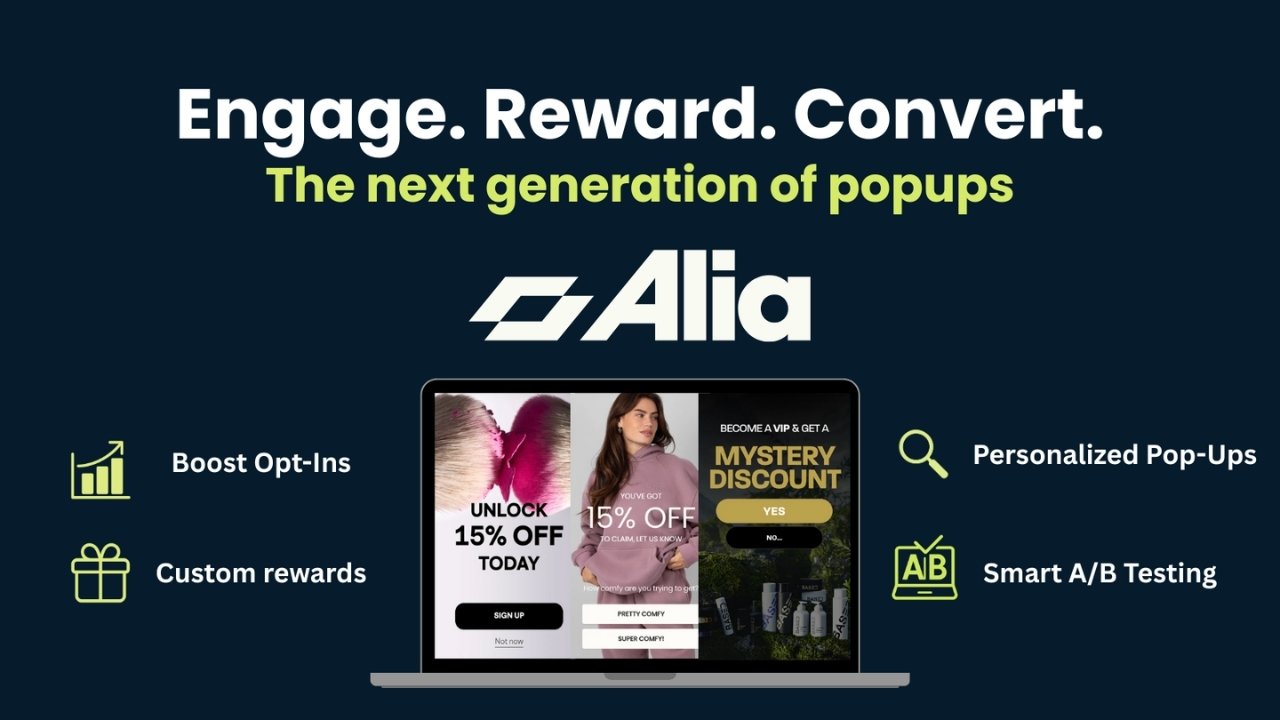
What it is: Alia is an AI-powered popup builder made specifically for Shopify stores. It helps merchants grow their email and SMS subscriber lists and boost conversions by showing popups at the right moment. Using AI-driven timing, automated A/B testing, and visitor behavior insights, Alia displays the most effective popups when shoppers are most likely to engage.
Key Features
- AI Optimization: Continuously tests different popup designs and messages, automatically showing the version that converts best.
- Advanced Targeting: Popups can be triggered based on visitor behavior, location, device type, or intent signals.
- Seamless Integrations: Works with Shopify, Klaviyo, Omnisend, and other marketing tools so subscriber data flows directly into your campaigns.
- Custom Design: Offers templates and styling options to match your brand without any coding.
Pros: Alia makes it easy to grow your email and SMS lists without manually testing popups. AI optimization ensures higher opt-in rates, and integrations with marketing platforms mean your collected data is immediately actionable. Setup is straightforward, so even merchants without technical experience can get started quickly.
Cons: Alia focuses exclusively on popups and list growth. It doesn’t handle full email or SMS campaigns or broader on-site personalization. Pricing is based on monthly visitor volume, which can be expensive for very high-traffic stores.
Pricing
- Starter: $100/month for up to 20,000 monthly visitors
- Growth: $200/month for up to 50,000 monthly visitors
- Enterprise: Custom pricing for larger traffic volumes
Free Trial: 14-day free trial available for new users
4. TxtCart

What it is: TxtCart is an AI-powered SMS marketing platform built for Shopify stores that helps brands recover abandoned carts, run conversational text campaigns, and grow sales through personalized SMS and MMS messages. Its conversational AI engages shoppers in real time and drives conversions with human-like text interactions.
Key Features
- AI-Driven SMS and MMS: Sends automated, human-like text messages that can recover carts, promote sales, or reply to customer replies.
- Popup and Checkout Opt-ins: Built-in popup capture tools help grow your SMS list with high opt-in rates.
- Campaigns and Flows: Launch one-time broadcasts or set up automated flows to reach segments with tailored offers.
- Advanced Segmentation: Target specific customer groups based on behavior and purchase history.
- Analytics and Reporting: Track performance, conversions, and ROI from SMS efforts within the platform.
- Shopify Integration: Syncs seamlessly with Shopify and other marketing tools so data flows into your store without manual setup.
Pros: TxtCart makes SMS marketing accessible even for small and growing stores. Its AI-powered texts and conversational flows can help recover abandoned carts and drive repeat purchases without heavy manual effort. The platform also includes tools for segmenting audiences and launching timed campaigns that feel personal, which can boost engagement and revenue.
Cons: Like most SMS marketing tools, TxtCart focuses on text messaging and list growth rather than a full suite of email or multi-channel marketing features. Costs can rise with higher plan levels, especially for advanced analytics and dedicated support. Some merchants may pair it with email or broader automation platforms to complete their stack.
Pricing:
- Starter Plan: $29/month
- Growth Plan: $79/month
- Pro Plan: $399/month
- Enterprise Plan: Around $1,999/month for custom solutions
5. Shopify Inbox

What it is: Shopify Inbox is Shopify's free messaging tool. It puts a live chat widget on your store so you can talk to customers in real time, and it's now boosted by some of the AI features from Shopify Magic.
Key Features
- Live Chat: This gives you a direct line to shoppers on your site, so you can answer questions and help them with their purchase.
- Instant Answers: Using AI, it can answer common questions automatically about your shipping policy or return process. It can also pull up order status updates for customers.
- Customer Context: When a customer starts a chat, you can see what's in their cart and their recent order history right in the chat window.
Pros: As a free, native tool, it is easy to get started with live chat. If you want to offer real-time support for simple, repetitive questions without another subscription fee, it’s a great place to start.
Cons: The automation is pretty basic. It handles predefined FAQs well, but it can't manage more complex, multi-step problems. It’s also just for on-site chat and doesn't connect to other channels like phone or social media.
Pricing
- Free and included with all Shopify subscription plans.
6. Jasper

What it is: Jasper is a powerful AI content platform built for marketing teams. It does more than just generate text; it helps you create a wide variety of on-brand copy, from SEO articles to social media ads.
Key Features
- Brand IQ: With this feature, you can teach Jasper your company's specific brand voice, style guide, and product details to make sure everything it creates sounds like you.
- AI Agents: Jasper has specialized agents that can automate tasks with multiple steps, like personalizing marketing messages for different customer groups or repurposing content for different channels.
- Extensive Templates: It has over 100 pre-built templates for almost any marketing task you can imagine.
Pros: Jasper's strength is its ability to create on-brand content quickly. The advanced features for brand voice and team collaboration make it a solid choice for marketing teams who need more power than a general tool like Shopify Magic.
Cons: It's a premium tool, and the price reflects that. While the content is good, it's not perfect and will still need a human to check facts and add a final polish. It's also just a content tool, so it can't help with customer support questions about orders or shipping.
Pricing
- Pro Plan: Starts at $69 per seat/month when billed monthly.
- Business Plan: Custom pricing for larger teams that need advanced features like API access.
7. Octane AI

What it is: Octane AI is the go-to quiz platform for Shopify. It uses AI to help you create personalized shopping experiences that lead customers to the right product, while also gathering useful data to improve your marketing.
Key Features
- AI Quiz Builder: Its Smart Quiz Builder can create an entire quiz, including questions, logic, and results, from a single prompt. This allows for quickly building engaging quizzes designed to convert.
- Zero-Party Data Collection: Quizzes are a great way to collect "zero-party data," which is info customers willingly share about what they like and need. This data is incredibly valuable for personalization.
- Deep Integrations: It syncs all the data it gathers with your marketing tools, like Klaviyo, Attentive, and Gorgias, so you can create highly personalized email and SMS campaigns.
Pros: Octane AI is designed to increase conversions and average order value. It acts like a virtual shopping assistant, helping customers feel less overwhelmed by choices and more confident in their purchase. As a Shopify Plus Certified App, you can trust its security and performance.
Cons: The pricing is based on a credit system, where actions like quiz starts consume credits. For stores with a lot of traffic, this can get pricey. It's also a very specialized tool for on-site personalization and doesn't help with support after the purchase.
Pricing
- Octane (Basic): Starts at $50/month for 400 credits.
- Octane Plus: Starts at $200/month for 2,200 credits, with higher tiers available.
How to choose from the best AI tools for Shopify for your store
With so many choices, how do you pick the right one? Here are a few tips to help you decide.
- Start with your biggest pain point: Don't try to automate everything at once. Figure out the single biggest bottleneck in your business. Are you drowning in "where is my order?" calls? Is writing product descriptions eating up all your time? Solve that problem first.
- Prioritize deep Shopify integration: Look for tools that connect directly to Shopify’s real-time data on orders, products, and customers. This is a non-negotiable feature that separates a generic AI from a truly useful e-commerce tool.
- Calculate the potential ROI: Think about the business value, not just the monthly fee. A support automation tool can be measured in hours saved. For instance, if you get a lot of calls, you can figure out the savings pretty easily. Ringly.io costs $1.99 a call after the first 50, while a human agent costs around $2.35 on average. Compare the investment to the cost of not solving the problem.
- Test with free trials: Nearly every reputable tool offers a free trial or a performance guarantee. Use this time to see how the software works with your actual store and customers. Make sure it delivers on its promises before you commit.
-

For a more comprehensive look at how these tools can transform your e-commerce operations, check out this video that explores several powerful AI tools designed to help you grow your Shopify store.
This video from Shopify Success explains how some of the best AI tools for Shopify can help you grow your sales.
How the best AI tools for Shopify give your store superpowers
AI tools are becoming an important component for Shopify stores looking to scale their business while maintaining a positive customer experience.
The right tool depends on the specific task. For content creation, options include Jasper and Shopify Magic. For personalizing the shopping journey, Octane AI offers powerful features. For on-site chat, Shopify Inbox provides a solid starting point.
While many tools focus on text, phone support is a unique challenge and an opportunity to build trust. Answering calls instantly, 24/7, demonstrates availability to customers and can help capture sales that might otherwise be lost.
For stores that receive phone calls, an AI phone agent can be a valuable asset. Ringly.io is a tool built for this purpose, designed to provide a reliable and professional voice for a Shopify store.
Frequently Asked Questions
What are the best AI tools for Shopify for a small business on a budget?
For small businesses, starting with free tools is a great idea. Shopify Magic and Shopify Inbox are included with your Shopify plan and can help with content creation and basic live chat. They're a perfect way to get started without any extra cost.
How do I choose the best AI tools for Shopify to handle customer support?
First, identify your biggest support challenge. If you get a lot of phone calls about order status, a specialized tool like Ringly.io is a great fit. If most of your queries come through on-site chat, Shopify Inbox is a good starting point. Always look for tools with deep Shopify integration so they can give accurate, order-specific answers.
Are the free options really some of the best AI tools for Shopify?
Yes, for certain tasks! Shopify's built-in tools like Shopify Magic are fantastic for getting started with AI-assisted content or basic chat automation. They are convenient and cost-effective. However, for more specialized or high-volume needs, like 24/7 phone support, you'll likely get more value from a dedicated paid tool.
What makes an app one of the best AI tools for Shopify?
The key is deep integration with Shopify. A great AI tool should be able to pull real-time data about your products, orders, and customers to provide relevant and accurate help. Other important factors include ease of setup, a clear impact on your business (like saving time or increasing sales), and the ability to customize the AI to match your brand's voice.
Can the best AI tools for Shopify help with marketing and sales?
Absolutely. Tools like Jasper can help you create high-quality marketing copy at scale, while Octane AI uses personalized quizzes to guide customers to the right products, which can boost conversion rates and average order value. They help you create a more tailored shopping experience for your customers.
Do the best AI tools for Shopify require technical skills to set up?
Not usually. Most of the top tools are designed to be user-friendly with no-code setups. For example, you can get an AI phone agent like Ringly.io running in just a few minutes. The goal of these apps is to save you time, not create another technical headache.
Best AI tools for Shopify by use case (with 2026 pricing)
Rather than one winner, match the tool to the job:
- Store assistant — Shopify Sidekick, now included free with every Shopify plan (no separate fee)
- AI customer support — Gorgias from $10/month (Starter, 50 tickets); Freshdesk's cheapest paid plan is Growth at $19/agent/month
- Live chat / messaging — Crisp from about $95/month; LiveChat from about $49/agent/month
Pricing and plan names change frequently, so confirm the current figure on each vendor's site before committing (verified June 2026).
AI tools for Shopify: common questions
Does Shopify have its own AI tool?
Yes. Shopify Sidekick is an AI assistant built into the admin, and as of 2026 it's included free with every Shopify plan rather than charged as a separate subscription.
What is the best AI customer support tool for Shopify?
Gorgias is the most common pick for Shopify support because it's built around ecommerce tickets and order actions, starting at $10/month. Freshdesk is a lower-cost general option from $19/agent/month.