

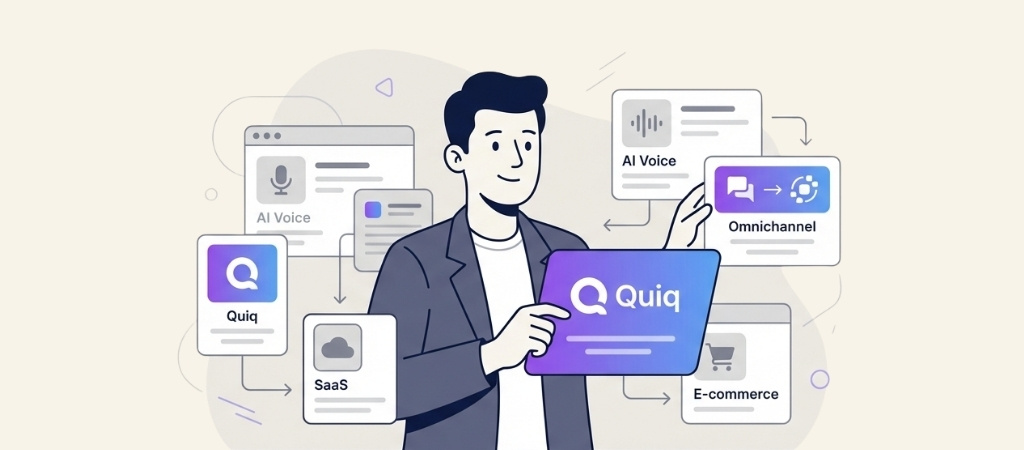
Quiq has built a solid reputation as an enterprise messaging platform, but it's not the right fit for every business.
Whether you need phone support, transparent pricing, or deeper e-commerce integration, there are plenty of alternatives worth considering.
Let's break down 7 of the best Quiq alternatives, comparing their features, pricing, and ideal use cases so you can find the right platform for your needs.
Editor’s note: Want to hear some sample AI support calls made for your Shopify store?
- Just paste your store URL
- Hear sample calls for your store (no email required)
- Listen to demo calls for my store
What is Quiq?
Quiq is an enterprise conversational AI platform founded in 2015. It focuses primarily on messaging channels like SMS, web chat, Facebook Messenger, and WhatsApp. The platform offers AI agents for customer service automation and integrates with major CRMs including Salesforce, Zendesk, and Oracle.
Quiq targets enterprise B2C companies that want to automate customer conversations across digital messaging channels. While it handles text-based support well, businesses looking for phone support or more transparent pricing often find themselves searching elsewhere.
How we chose these alternatives
We evaluated platforms based on four key criteria:
- AI capabilities How advanced is the automation, and what percentage of inquiries can it handle without human intervention?
- Channel support Does it cover messaging, phone, email, or omnichannel needs?
- Pricing transparency Can you see pricing upfront, or is everything "contact sales"?
- Ease of setup How quickly can you get up and running?
We focused on platforms with strong automation features and included options for different use cases: phone-heavy businesses, e-commerce stores, SaaS companies, and large enterprises.
Comparison table
| Platform | Best For | Starting Price | Key Channels | AI Capabilities |
|---|---|---|---|---|
| Ringly.io | Phone support for e-commerce | From $99 a month (50 conversations included) | Phone, SMS | AI voice agent |
| Zendesk | Existing help desk users | £15/agent/mo | Email, chat, phone | AI add-ons |
| Intercom | SaaS in-app messaging | $29/seat/mo | Chat, email | Fin AI agent |
| Kore.ai | Enterprise automation | Custom | Multi-channel | Advanced AI |
| Cognigy | Contact centers | Custom | Voice, chat | Voice-first AI |
| LivePerson | Large enterprises | Custom | Multi-channel | Conversational AI |
| Ada | No-code automation | Custom | Chat, social | No-code bots |
The 7 best Quiq alternatives
1. Ringly.io
Best for: E-commerce businesses needing AI phone support

Ringly.io takes a different approach from most alternatives on this list. Instead of focusing on chat, it specializes in AI-powered phone support for e-commerce stores.
The platform's AI agent, the AI, handles inbound calls 24/7. It can look up orders, process returns and exchanges, answer FAQs, and escalate complex issues to your team. Setup takes under 1 hour, and you don't need technical expertise to get started.
For Shopify stores, the integration is particularly deep. the AI pulls order data directly from your store, so customers get real-time answers about shipping, returns, and product questions. The platform supports 30 languages and provides call recordings, transcripts, and analytics.
| Plan | Price | Included | Key Features |
|---|---|---|---|
| Pay per call | $99 a month | 50 conversations, then $1.99 each | Seth on your support line 24/7; spam, hang-ups and wrong numbers are free |
You can try it for free.
Pros:
- Fast setup compared to enterprise alternatives
- Transparent pricing with no "contact sales" requirement
- Purpose-built for e-commerce workflows
- Handles phone calls (Quiq is messaging-focused)
Cons:
- Phone-focused with limited digital chat features
- Best suited for Shopify stores
2. Zendesk
Best for: Teams already using Zendesk help desk

Zendesk is the established player in help desk software, with over 130,000 global brands using the platform. If your team is already familiar with Zendesk, adding their AI features is a natural next step.
The platform offers omnichannel support across email, chat, phone, and social media. Their AI-powered agent assistance helps your team respond faster with suggested replies and automated responses.
| Plan | Price | Key Features |
|---|---|---|
| Support Team | £15/agent/mo | Basic ticketing, email, social messaging |
| Support Professional | £49/agent/mo | Business rules, custom roles, SLA management |
| Suite Team | £45/agent/mo | Integrated help center, AI agents, live chat |
| Suite Growth | £79/agent/mo | Self-service, custom integrations, light agents |
| Suite Professional | £115/agent/mo | Advanced AI, custom analytics, skills-based routing |
| Suite Enterprise | £169/agent/mo | Advanced data privacy, sandbox, AI insights |
Pros:
- Mature ecosystem with 1,800+ app integrations
- Strong knowledge base and self-service features
- Familiar interface for support teams
Cons:
- AI features require higher-tier plans
- Per-agent pricing gets expensive for large teams
- Implementation can be complex
3. Intercom
Best for: SaaS companies needing in-app messaging
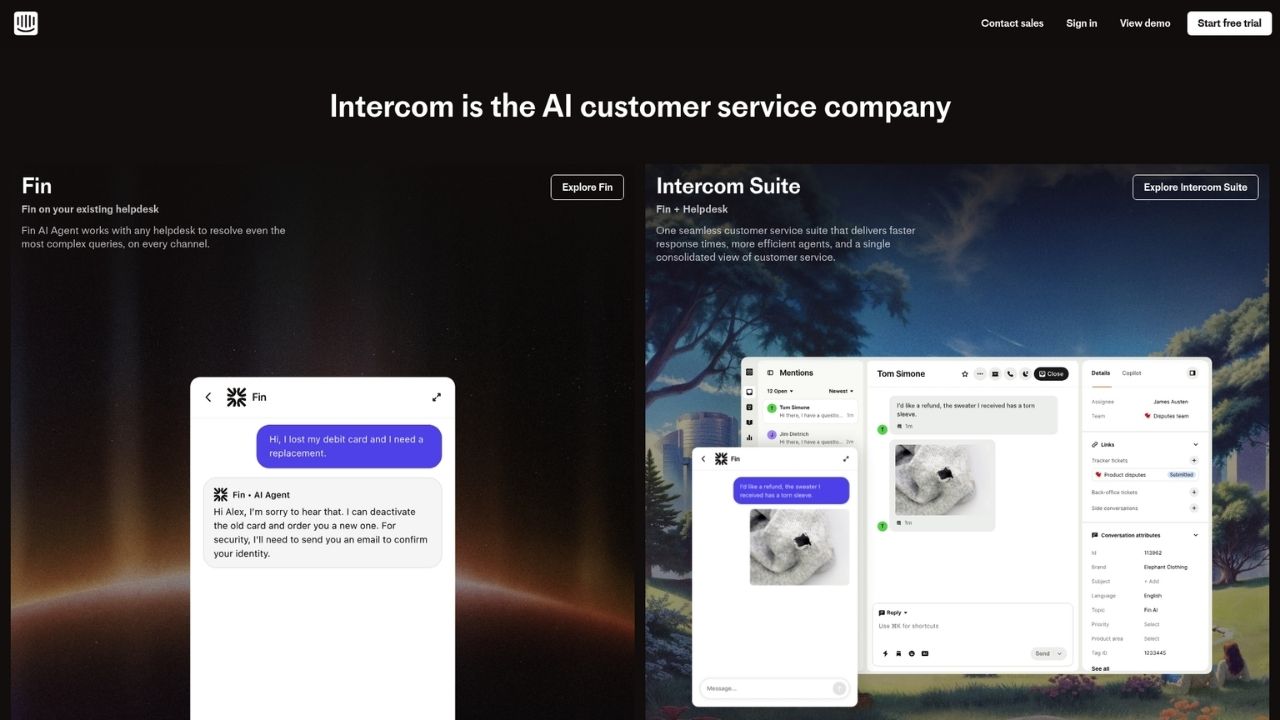
Intercom built its reputation on in-app messaging and product tours. If you're running a SaaS business, Intercom lets you engage users directly inside your product.
The platform's Fin AI agent handles automated responses, while the shared inbox keeps your team coordinated. The help center and knowledge base features are solid, and the product tours help with user onboarding.
| Plan | Price | Key Features |
|---|---|---|
| Essential | $29/seat/mo | Shared inbox, basic chat, help center |
| Advanced | $85/seat/mo | Multiple inboxes, workflows, basic automation |
| Expert | $132/seat/mo | Advanced permissions, workload management, custom reports |
Fin AI costs $0.99 per resolution on the Essential plan. It's included in Advanced and Expert.
Pros:
- Excellent for onboarding and user engagement
- Fast to implement for SaaS products
- Strong automation for common questions
Cons:
- Costs scale quickly with volume
- Limited phone support capabilities
- Best for digital products, not phone-heavy businesses
4. Kore.ai
Best for: Large enterprises needing broad AI automation
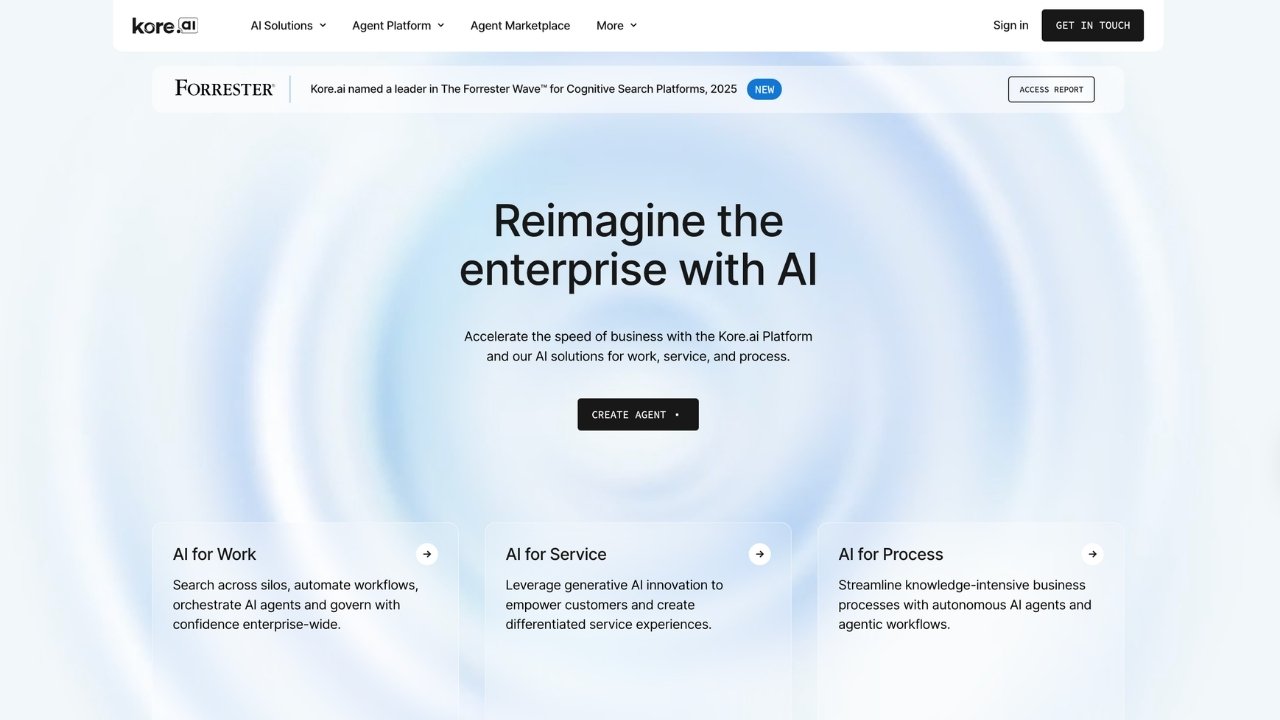
Kore.ai is an enterprise AI platform that goes beyond customer support. Their XO Platform offers no-code and low-code bot building for customer service, employee support, IT helpdesk, HR, and recruiting.
The platform supports multi-agent orchestration, where AI agents collaborate and share memory to handle complex tasks. With 100+ pre-built connectors and agentic RAG (Retrieval Augmented Generation), Kore.ai integrates deeply with enterprise systems like Salesforce, SAP, and Epic.
Kore.ai was named a Leader in the 2025 Gartner Magic Quadrant for Conversational AI Platforms. They serve Global 2000 companies across banking (Morgan Stanley, Deutsche Bank), healthcare (Johnson & Johnson, Pfizer), and telecom (AT&T).
Pricing is custom only. You'll need to contact sales for a quote.
Pros:
- Broad use cases beyond customer support
- Strong enterprise security features (HIPAA, SOC2, GDPR)
- Flexible deployment options
Cons:
- Custom pricing with no public rates
- Requires more upfront configuration
- May be overkill for smaller teams
5. Cognigy
Best for: Contact centers with heavy voice requirements

Cognigy (now part of NICE) is a voice-first conversational AI platform. If your primary need is replacing or augmenting your IVR system, Cognigy is worth a close look.
The platform processes over 1 billion interactions annually with 99% routing accuracy. Cognigy's voice AI agents handle phone conversations with natural language understanding, while their Agent Copilot assists human agents in real-time.
Notable deployments include Lufthansa (16M+ automated conversations per year), Toyota (25+ AI agents with 98% customer satisfaction), and Henkel (5M customer interactions across 12 languages).
Pricing is custom only.
Pros:
- Excellent for IVR replacement
- Mature voice automation capabilities
- Enterprise-grade reliability
Cons:
- Voice-focused with digital experiences secondary
- Requires technical expertise to customize
- Custom pricing only
6. LivePerson
Best for: Large enterprises with complex needs

LivePerson has been in the conversational AI space for over 20 years. Their Conversational Cloud platform handles over 1 billion messages monthly for enterprise clients in retail, telecom, and financial services.
The platform recently launched Syntrix, an AI conversation simulator that lets you test AI agents before they interact with real customers. LivePerson also offers digital adoption tools, voice integration, and unified conversational analytics across all channels.
The company claims 30% reduction in operating costs, 90% automation rates, and 25% customer satisfaction boosts for their clients. Notable customers include Bankwest, Burberry, HSBC, and Zurich.
Pricing is custom and requires contacting sales.
Pros:
- Mature platform with extensive features
- Strong enterprise client base
- Comprehensive analytics
Cons:
- High upfront investment required
- Complex implementation
- Mixed user reviews on ease of use
7. Ada
Best for: Teams wanting no-code automation

Ada focuses on making AI automation accessible to non-technical teams. Their no-code platform lets you build and modify chatbots without writing code.
The platform supports multiple channels including chat, social media, and email. Ada claims up to 83% autonomous resolution rates and emphasizes industry-specific solutions for e-commerce, fintech, SaaS, and gaming.
Case studies show impressive results: Tilt achieved 84% automated resolution, Monday.com reduced average handle time by 42%, and IPSY saw 943% ROI in four months.
Ada maintains HIPAA, SOC2, GDPR, and AIUC-1 compliance with built-in safeguards to minimize AI hallucinations.
Pricing is custom only.
Pros:
- Easy to build and modify bots
- Good for non-technical teams
- Strong automation capabilities
Cons:
- Custom pricing
- Limited phone support
- Can struggle with complex multi-step issues
Which Quiq alternative should you choose?
The right choice depends on your specific needs:
- Choose Ringly.io if: You need phone support automation for your e-commerce store, especially if you use Shopify. The quick setup and transparent pricing make it accessible for growing businesses.
- Choose Zendesk if: You already use their help desk and want to add AI capabilities. The ecosystem is mature, but costs scale with team size.
- Choose Intercom if: You're a SaaS company focused on in-app messaging and user onboarding.
- Choose Kore.ai if: You're a large enterprise with broad automation needs across customer support, IT, HR, and other departments.
- Choose Cognigy if: Voice automation and contact center integration is critical to your operations.
- Choose LivePerson if: You need a mature platform for complex enterprise requirements and have the resources for a longer implementation.
- Choose Ada if: You want easy no-code bot building and your support needs are primarily chat-based.
Key takeaways
Quiq alternatives vary widely in focus. Some specialize in phone support, others in messaging or omnichannel experiences. Pricing models differ significantly too: per-agent, per-conversation, or custom enterprise quotes.
Consider your primary channel first. Phone-heavy businesses should look at Ringly.io or Cognigy. E-commerce stores benefit from Shopify-integrated solutions like Ringly. Enterprise teams with complex needs may prefer Kore.ai or LivePerson.
The best platform is the one that fits your specific workflows, team size, and budget. Take advantage of free trials where available to test before committing.
Try AI phone support for your store
If you're running an e-commerce store and phone support is eating up your team's time, Ringly.io can help. Our AI agent The AI handles inbound calls 24/7, resolves up to 90% of calls without human intervention, and integrates directly with your Shopify store.
Try Ringly.io for free and see how AI phone support can reduce your support costs while keeping customers happy.
Frequently Asked Questions
What are the best Quiq alternatives for small businesses?
For small businesses, Ringly.io offers transparent pricing starting at $99 a month for phone support, while Intercom starts at $29/seat/month for chat. Both are easier to set up than enterprise-focused alternatives.
Which Quiq alternative is best for e-commerce?
Ringly.io is purpose-built for e-commerce with deep Shopify integration for order lookups, returns, and exchanges. Ada also works well for e-commerce but focuses on chat rather than phone support.
Do any Quiq alternatives offer phone support?
Yes. Ringly.io specializes in AI phone support for e-commerce. Cognigy offers enterprise voice automation. Zendesk and LivePerson also support phone channels.
Which Quiq alternatives have transparent pricing?
Ringly.io, Zendesk, and Intercom publish their pricing publicly. Kore.ai, Cognigy, LivePerson, and Ada require contacting sales for custom quotes.
What is the easiest Quiq alternative to set up?
Ringly.io claims quick setup with no technical expertise required. Intercom is also known for fast implementation, particularly for SaaS products.