
This post in 30 seconds.
- 70% of inbound support email is four ticket types: WISMO, returns and refunds, order edits, product questions. Each needs different mechanics.
- Honest production deflection lands at 55-70%, not the 80-89% vendor decks promise. Hallucinations come from skipping the live-data fetch, not from a weak model.
- Built for Shopify operators trying to automate the support inbox without tanking CSAT. Phone is the channel email automation doesn't touch.
Most Shopify brands hire to handle inbound support email. The same four ticket types over and over. "Where is my order." "Can I return this." "Can you change my shipping address." "Does this work with my hair type."
Your team wasn't hired to answer the same email 50 times a day. But hiring scales linearly with order volume, and the queue never gets shorter.
This post is about inbound support email automation. Not marketing email automation (Klaviyo flows, abandoned cart, newsletters). Those are different problems with different tools. I'm talking about the support inbox. The one that fills up overnight.
I run Ringly.io, AI phone support for 50+ Shopify brands. We see the cross-channel reality every day. The same customer who can't get through on the phone emails you 4 hours later. Email automation alone doesn't fix that. Phone + email together does.
Here's what we'll cover: the four ticket types that drive 70% of support email volume, how AI auto-resolution actually works, the six tools that handle it on Shopify, the ROI math, and how to roll it out without tanking your CSAT score.
If you want to talk through your specific support stack, book a 30-min call and we'll walk through where automation actually pays back for your volume.
The four ticket types that drive 70% of inbound support email
Most "support inbox" volume looks like 100 unique problems. It's not. It's four problems wearing different costumes.
WISMO (Where Is My Order): 30-40% of all support volume during normal periods, and over 50% during peak. Per Crisp and ShippyPro data, this is the single largest bucket on every Shopify store, regardless of category. It's also the easiest to automate because the answer lives in your carrier's API, not in someone's head. See our deep dive on WISMO automation for Shopify for the four-layer stack.
Returns and refunds (sometimes called WISMR): 15-25% of volume. "Where is my return." "Where is my refund." "Can I exchange this for a different size." These need policy logic on top of data fetch. Different mechanics from WISMO.
Order edits: 10-15% of volume. Wrong address. Wrong variant. "Can you cancel my order and re-order." These need write access to Shopify, which raises the stakes if the AI gets it wrong.
Product questions: 10-15% of volume. "Does this work for sensitive skin." "What size for a 6-month-old." "How long does it last." Knowledge base questions. Different mechanics again: the AI needs a vector-indexed product catalog, not API access.
The remaining 20-30% is judgment work. Damaged product photos. Genuinely complicated complaints. Anything subjective or sensitive. Humans handle that. AI handles the 70%.
The four-bucket framing matters because the automation strategy is different per bucket. WISMO needs live shipping API. Returns need policy logic and refund caps. Order edits need write access and confirmation flows. Product questions need a knowledge base. One tool that handles all four well is rare. Most teams end up with one main tool plus a sit-on-top action layer. More on that below.
If you want the same framing for the rest of your support stack, our guide to ecommerce customer service walks through the team-and-tool side.
How AI auto-resolves a support email (the four-step chain)
Most articles wave their hands at "AI reads the email and replies." That's not what good email automation actually does. Here's the real chain:
Step 1: Classify intent. The AI reads the inbound email and maps it to one of your buckets. Is this WISMO? A return request? An angry complaint that needs a human? Classification is the cheapest part and the most reliable.
Step 2: Fetch live data. This is the part most articles skip. The AI queries Shopify for the order, queries the carrier API for tracking, queries the helpdesk for the customer's history. Without this step, the AI is guessing. With it, the reply is grounded in real facts.
Step 3: Apply policy logic. Is the return inside your window? Is the refund under the auto-refund cap? Is the model's confidence above threshold? If yes to all three, act. If no to any, escalate to a human with all the context attached.
Step 4: Take the action and reply. Issue the refund. Edit the address. Mark the return. Send the email reply in your brand voice with the actual data filled in. Don't send a templated paragraph. Send a paragraph that mentions the actual order number, the actual carrier, the actual delivery date.
The reason this chain matters is that step 2 is what separates real automation from a chatbot. A reply that says "your order should arrive in 5-7 business days" is useless. A reply that says "your order #4521 shipped Tuesday via FedEx 7720-XXXX, it's currently in Memphis, projected delivery Thursday by 8pm" is the real product.
It also explains why hallucinations happen. Skip step 2 (no live data fetch) and the model invents an answer. It promises a return window it doesn't know. It quotes a refund amount that's wrong. The fix isn't a smarter model. The fix is connecting it to your data first. Our breakdown of AI customer service automation integration tips goes deeper on this.
Will it sound like a robot? The voice and escalation discipline
This is the number one fear, and the number one reason people still hate auto-replies. So let's just say it: most auto-replies suck because they're static templates. They can't pull customer data, can't adapt tone, can't reference the actual order. "Your order will arrive in 5-7 business days" reads like a form letter because it is one.
Good email AI sounds different. Here's what changes:
- Restates the customer's actual question in the opening line. "Got your message about the lost package from order #4521."
- Names the specific order, item, and date. Real specifics beat generic phrasing every time.
- Matches your brand voice. Trained on past tickets plus a short style prompt. Some brands lean warm, some dry, some witty. The AI learns whichever you give it.
- Always has a way out. A one-click path to a human if the answer doesn't help. No dead ends.
What to escalate (the discipline):
- Sentiment-flagged emails: angry, threatening, distressed, anything that should not get a bot reply.
- Confidence below threshold: the model itself signals "I'm not sure." Trust the signal.
- High-dollar refunds: set a cap (we recommend $50-100 for most stores), escalate anything above.
- Anything with a backstory: emails referencing prior conversations, names, history the bot can't see in this thread.
Voice on phone follows the same logic. The replies that land are the ones grounded in live order data, with a one-click human handoff when the bot is unsure.
The six tools that actually handle Shopify support email
Here's the shortlist. Six tools that handle one or more of the four ticket types, with honest verdicts. Pricing is current as of May 2026; check each pricing page before you commit.
| Tool | Best for | Pricing model | Real deflection range | Setup time |
|---|---|---|---|---|
| Gorgias Automate | Brands already on Gorgias | $0.90/resolved (annual) | 26-56% | Days |
| Re:amaze | Mid-volume brands wanting unified inbox | Seat-based + AI add-on | 30-50% | Days |
| Siena AI | Brands obsessed with brand voice | $750/mo + $0.90/conv | 45-65% | 4-6 weeks |
| Ada | Enterprise multi-language | $30K-$300K/year | 50-70% | 4-8 weeks |
| Yuma AI | Action-taking on an existing helpdesk | ~$0.65/resolved | 50-70% | 1-2 weeks |
| Ringly.io (email handoff) | Phone AI brands pairing email + voice | Flat $349-799/mo | Phone-first | Under 1 hour |
1. Gorgias Automate
Best for: brands already on Gorgias who want to start automating without changing helpdesk.
Gorgias is the largest Shopify-native helpdesk. Their AI Agent (formerly called Automate) is the bolt-on automation layer that handles email, chat, and now voice plus SMS in the same stack.
Pricing: Helpdesk tiers run $10 (Starter, 50 tickets) to $900 (Advanced, 5,000 tickets) plus Enterprise custom. AI Agent is $1.00 per resolved conversation monthly, $0.90 annually. Voice $0.40-$1.20 per ticket, SMS $0.41-$0.80. 7-day free trial. See Gorgias pricing for the full breakdown.
What works:
- Native Shopify pull: order data, returns, customer history all in one view
- No migration: if you're already on Gorgias, this is the path of least resistance
- Macros still work: legacy templates carry over while you build automation
- Multi-channel: email, chat, voice, SMS in one stack
What doesn't:
- Real deflection 26-56%: per Gorgias own published case studies, not the "up to 60%" marketing line
- Per-resolution pricing scales fast: at 5,000 resolved/mo that's $4,500/mo on top of the helpdesk tier
- AI Agent less mature: than purpose-built tools like Yuma or Siena
Why it ranks first for "already on Gorgias": zero migration risk and the data sits where you already work. See Gorgias alternatives if you're not on it yet.
2. Re:amaze
Best for: mid-volume brands wanting a unified inbox without the Gorgias price tag.
Re:amaze is the Shopify-friendly helpdesk that competes with Gorgias on a cleaner UI and a lower per-seat price. The AI Agent comes built in across all tiers.
Pricing: Basic $29/seat (20 resolutions, then $0.85/each), Pro $49/seat (50 resolutions), Plus $69/seat (100 resolutions). Starter $59/mo flat with 500 conversations. 14-day free trial, no card. See Re:amaze on the Shopify ecosystem for the full helpdesk landscape.
What works:
- Cleaner unified inbox: email, chat, social, SMS, voice in one feed
- Seat-based predictability: easier to forecast cost at small team size
- Solid Shopify pull: not as deep as Gorgias but enough for the 4 buckets
What doesn't:
- AI is "good enough" not category-leading: deflection 30-50% range in our tests
- Per-seat penalizes larger teams: 10 agents on Plus = $690/mo before AI overage
- Bring your own automation layer: most serious Re:amaze users add Yuma on top
Why it ranks second: the helpdesk is great, the AI is mid. Pair it with Yuma or another action layer if you want serious automation.
3. Siena AI
Best for: brands obsessed with how their AI sounds.
Siena AI built its product around "AI conversations that feel human." The pitch is brand voice fidelity, not raw deflection rate. Connects to Gorgias, Zendesk, and other major helpdesks.
Pricing: $750/mo platform fee plus $0.90 per automated conversation. A team handling 3,000 conversations/mo = $3,450 total. No free trial. Custom enterprise tier.
What works:
- Voice fidelity: the best in the category for matching brand tone
- Empathy tuning: explicitly designed for emotionally-loaded tickets
- Multi-channel: email, SMS, Instagram DM, comments
What doesn't:
- 4-6 week setup: not a same-day install
- Expensive at low volume too: $750 platform fee hits whether you process 200 or 2,000 conversations
- No free trial: demo-gated
Why it ranks third: pick this if brand voice is your religion. Otherwise the price-to-deflection ratio is hard to justify. See Siena AI alternatives for the comparison set.
4. Ada
Best for: enterprise brands operating in multiple languages at multi-million-dollar support spend.
Ada is the legacy enterprise pick. 50+ languages, mature plumbing, multi-channel (email, messaging, voice).
Pricing: Custom only. Public signals suggest $30,000/year entry, rising to $300,000+ for large deployments. Resolution-based pricing $1-$3.50 at some tiers. Annual escalation clauses 3-7%.
What works:
- 50+ language support: real translation, not just localization
- Enterprise plumbing: SSO, audit logs, compliance, the whole package
- Multi-channel coverage: deeper than most
What doesn't:
- 4-8 week setup: enterprise rollout pace
- Designed for $10M+ support spend: overkill for typical Shopify
- No transparent pricing: every quote is bespoke
Why it ranks fourth: real enterprise only. Most Shopify brands shouldn't even be on this list.
5. Yuma AI
Best for: action-taking on top of an existing helpdesk, with no migration.
Yuma's pitch is "we sit on top of your helpdesk and execute actions end-to-end." Works with Gorgias, Re:amaze, Zendesk, Salesforce Service Cloud, Kustomer, Front, Gladly. The product is the action layer, not the inbox.
Pricing: ~$0.65 per resolved ticket. No public free trial; demo-gated. Custom enterprise.
What works:
- No helpdesk swap: this is the killer feature
- End-to-end actions: refunds, address edits, subscription changes, cancellations
- Claims 89% top-end: real Shopify brand reports more like 50-70%, but that's still strong
What doesn't:
- Per-resolution scales scary: at 10,000 resolved/mo that's $6,500
- No free trial: you have to commit to a demo + setup before you see real performance
- Setup quality depends on Yuma's team: their account manager configures it
Why it ranks fifth: the right pick if your helpdesk is fine and you just want execution. See Yuma AI alternatives for the side-by-side.
6. Ringly.io (the phone side that pairs with email)
Best for: Shopify brands automating phone first, with email as the cross-channel handoff.
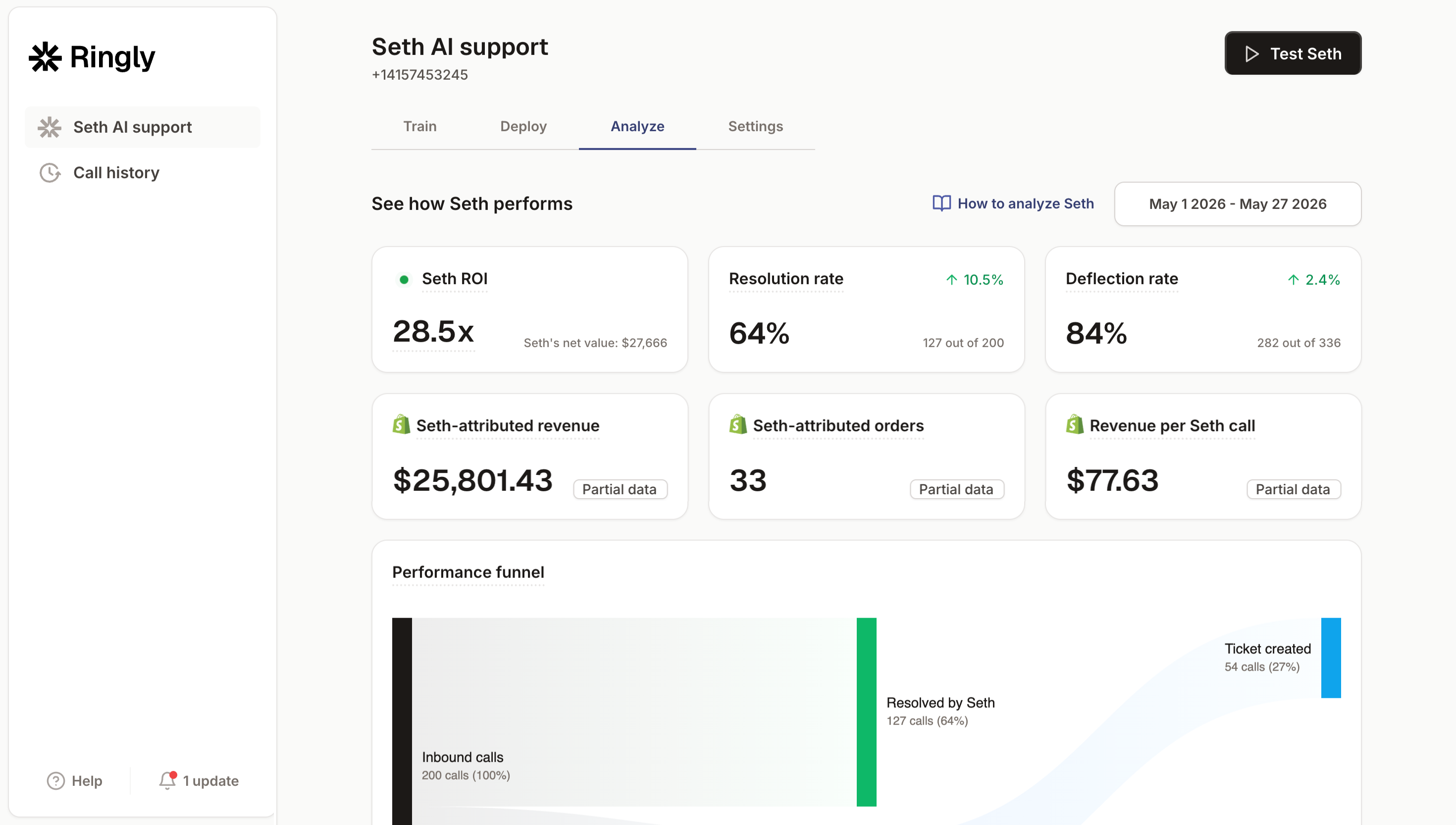
Ringly.io is AI phone support for Shopify brands. Your team wasn't hired to answer the same call 50 times a day. Instead of growing your support headcount every time call volume goes up, the AI takes the routine inbound calls so your team can focus on the work that actually moves revenue.
The AI answers inbound calls 24/7. It finds orders in your Shopify store, processes returns and exchanges, answers product questions from your knowledge base, and rescues abandoned carts via outbound follow-up. Across 50+ brands, the AI resolves 73% of calls autonomously at roughly $0.42 per resolved call. Calls that need a human escalate cleanly to Gorgias, Richpanel, Re:amaze, or whatever helpdesk handles your email automation.
Pricing: Grow $349/mo (1,000 minutes), Pro $799/mo (2,500 minutes), Enterprise custom. Live in under an hour. 65% resolution guarantee: if the AI resolves under 65% of your calls in 90 days, we refund the last 3 months.
Why it ranks sixth (and why it's here at all): this is the phone side. It's not a standalone email tool. But 30-40% of "support email" volume is customers who couldn't get through on the phone, so automating the phone drops your email queue at the source. Pair Ringly with any of the five above for the full cross-channel stack. More on the cross-channel angle in the section below.
The ROI math (cost per ticket, deflection rate, payback)
Real numbers, not vendor decks.
The cost stack for a manual support ticket:
- Agent time: 6-12 minutes per ticket on average
- Loaded agent cost: $25-$40 per hour US BPO range; in-house typically higher
- Per-ticket cost: $4.50-$7.50 manual
Industry benchmarks land higher. Multiple sources report $15-$22 per ticket fully loaded when you include training, tooling, and overhead. AI brings the marginal cost to about $2.
The cost stack for AI resolution:
- Per-resolution pricing: $0.65 (Yuma) to $0.90 (Gorgias annual, Siena)
- Per-conversation pricing: $0.30-$0.60 at some platforms
- Flat tiers (Gorgias Helpdesk, Re:amaze): predictable, scales with seat count
Sample math for a typical Shopify brand doing 100 orders/day:
- Volume: 100 orders/day x 30 days = 3,000 orders. At 1 ticket per 5 orders, that's 600 tickets/mo.
- Without AI: 600 x $5.50 = $3,300/mo
- With 60% deflection at $0.75/resolved: (360 x $0.75) + (240 x $5.50) = $270 + $1,320 = $1,590/mo
- Savings: ~$1,700/mo, or about 50%
For a brand doing 500 orders/day:
- Volume: 3,000 tickets/mo
- Without AI: $16,500/mo
- With 60% deflection: ~$7,950/mo
- Savings: ~$8,500/mo
Real deflection rates documented in production:
- Manawa: 40 min to 1 min response time, 80% inquiry automation
- Crocus: 86% deflection, 84% CSAT maintained
- Decathlon: 30% to 50% deflection year-over-year, 4.6 CSAT score
Be honest about deflection: production rates for typical Shopify support land in the 55-70% range, not the 80-89% vendor claims. The 80-89% numbers are usually best-case categories (WISMO-only) or measure "deflection" (customer didn't escalate) rather than "resolution" (issue actually solved).
If you want to model the phone side of the same math, our voice AI pricing breakdown walks through cost-per-resolved-call.
What happens on the call.
- We pull your last 7 days of missed calls and inbound email volume, on the call. No homework for you.
- We map which ticket types are eating the most hours and what auto-resolution rates we typically see at your volume.
- You decide if it's worth a deeper conversation. No deck, no follow-up sequence.
The call makes sense if:
- You're a Shopify (or Shopify Plus) brand doing $10M-$100M
- You run a paid helpdesk (Gorgias, Zendesk, Gladly, Re:amaze, or Intercom)
- You have a visible phone number on your store
- Your CS team is 3-12 people
If that's you, the math usually works. Book a 30-min call and we'll run it live on your store.
How to roll it out without breaking your CSAT (4-step rollout)
The implementation order matters more than the tool you pick.
Step 1: Shadow mode first. The AI drafts replies, humans send them. Run this for 2 weeks. You'll catch voice issues, missing data, and any hallucinations before customers see them. Most setup disasters happen because teams skip this step.
Step 2: Turn on WISMO only, high confidence threshold. Set the model to auto-send only when it's 95%+ confident, which mostly means tickets where the live data fetch returned clean. WISMO is the safest starting category because the data is unambiguous (carrier API). You'll see volume drop 25-30% in week one.
Step 3: Add returns and refunds with caps. Hard cap on auto-refunds ($50-$100 for most stores), daily action cap (e.g., 50 auto-refunds per day), anything above caps escalates to a human. Run this layer for 2-4 weeks before adding the next.
Step 4: Add order edits and product questions. Order edits need write-access discipline. Product questions need your knowledge base loaded and reviewed. Don't skip the KB pass: this is where hallucinations come from. A bot that "forgets what you sell" is a bot with no KB.
What NOT to do:
- Don't turn on every category at once. The disaster comes from category #4 (product questions) without a clean knowledge base.
- Don't set "creative" voice without confidence thresholds. A creative bot at low confidence will invent return policies.
- Don't skip the macro and policy doc review. The AI inherits whatever policy you give it. Garbage in, garbage out.
What to measure:
- Auto-resolution rate (real resolution, not deflection)
- CSAT delta (track first 30 days vs prior 30)
- Escalation rate (target: 30-40% of all tickets escalate)
- Customer reply rate to AI emails (high reply rate = the AI didn't actually answer)
Our guide to customer support strategy goes deeper on the metrics side.
The cross-channel reality (email + phone is one queue)
Here's the angle the email-only tools can't own.
The same customer asks the same question on two channels. Friday at 5pm:
- 6:02pm: calls your support number, gets a queue, hangs up
- 6:08pm: emails support
- 6:14pm: hits live chat
Three tickets. One person. One question. The email automation didn't reduce volume. It just routed it. The customer still asked three times.
If you automate email only, you still have:
- Phone queues people hang up on: most Shopify stores route to voicemail after hours, or to a queue during peak
- Chat queues that drop: chat widgets that disappear when traffic spikes
- Email auto-replies after the customer already moved channels: now they're getting three answers to one question
The fix is automating phone AND email AND chat in parallel. Same data layer (Shopify, helpdesk, KB), same policy logic, same brand voice. The customer who would have called and then emailed never has to email. The phone resolved it.
Where Ringly fits: AI phone support for Shopify brands. Across 50+ active brands, the AI resolves 73% of inbound calls autonomously at roughly $0.42 per resolved call. Calls that escalate hand off cleanly to Gorgias, Re:amaze, or whatever helpdesk handles your email side.
If your support email queue is mostly WISMO and after-hours backlog, that's a phone-side problem showing up in email.
For the broader picture on phone, see our 24/7 ecommerce phone support guide and the Shopify call center playbook.
Frequently asked questions
What is email support automation?
Software that reads inbound customer support emails, classifies them by intent (WISMO, return, refund, order edit, product question), and either drafts or sends a reply with live data fetched from your store. The best tools also take actions like issuing refunds or editing orders end-to-end.
What percentage of support emails can AI actually handle?
In real production, 55-70% for typical Shopify support volume. Vendor claims of 80-89% are usually best-case categories or measure "deflection" (customer didn't request a human) rather than "resolution" (issue was actually solved). WISMO-only categories can hit the higher end; product questions and edge cases drop the average.
Which ticket types should I automate first?
WISMO first. It's the highest volume, the most data-driven, and the lowest emotional stakes. Then returns and refunds with action caps. Then order edits once you trust the write access. Product questions last, after your knowledge base is loaded and reviewed.
Will it sound like a robot?
Only if you set it up that way. Tools that pull live order data and let you set a brand voice prompt produce replies that read more personal than most agents' macros. Static templates are what sound robotic; live-data replies don't.
How long does setup take?
Anywhere from same-day (Tidio, Yuma's sit-on-top mode) to 6 weeks (Siena, Ada at enterprise scale). Most Shopify brands are live in 1-2 weeks if their helpdesk is already clean and the knowledge base is documented.
What about hallucinations?
Real risk. The fix is quality control architecture: confidence thresholds, refund caps, daily action limits, and escalation logic for anything below the threshold. Pick tools that publish their guardrails, not just their deflection rates. AI that "forgets what you sell" or invents return windows is a quality-control failure, not a model failure.
Does Ringly.io do email support automation?
Ringly.io is AI phone support for Shopify brands. We pair with whatever email tool you run (Gorgias, Re:amaze, Yuma sitting on top). Phone-first because 30-40% of "email volume" is customers who couldn't get through on the phone. Automate the phone and the email queue drops at the source.
Talk to us
Support email automation is bucket-by-bucket work, not a one-size tool decision. Four ticket types drive 70% of volume. Each one has different mechanics, and the right tool depends on which buckets matter most for your store.
The honest deflection range is 55-70% in production, not the 80-89% vendor decks promise. Roll it out in shadow mode first, WISMO-only with confidence thresholds, then layer in returns and order edits with action caps.
And remember the cross-channel point. Email + phone is one queue, not two. Automating email only means the customer who couldn't get through on the phone now waits longer on email. Automating both means the volume actually drops at the source.
If you run a $10M-$100M Shopify brand and you want to talk through where automation pencils out across email and phone, a 30-min call is the fastest way to scope it.
The 3-layer guarantee.
- Live in 14 days or it's free until launched.
- 65% resolution in 90 days or we refund the last 3 months of subscription fees.
- We keep working free until we hit 65%.
Ruben (Ringly co-founder) takes these calls personally.