

Most "customer support strategy" guides on the internet are written for B2B SaaS or generic SMB businesses. If you sell physical product on Shopify, the playbook is different. Different ticket mix, different cost structure, different channels that actually move the needle.
I run Ringly.io, which is AI phone support for Shopify brands. Over the last year I've seen the support strategies of 50+ DTC stores up close, from $1M ARR scrappy founders answering DMs themselves to $25M brands with a head of CX. The good ones aren't following the HubSpot template. They've made a small number of sharp decisions and stuck to them.
This post is the framework I wish I'd had: 5 components that actually matter, the channel mix to pick by ARR stage, real cost-per-ticket numbers, the 5 KPIs worth tracking, and the 3 strategic mistakes I see most DTC teams make.
Hear what AI support calls sound like for your store. Just paste your Shopify URL and get sample calls in under 20 seconds, no email required. Listen to demo calls for my store.
What a customer support strategy actually is (and isn't)
A customer support strategy is a documented set of decisions about which channels you support, to what SLA, with which team, measured against which KPIs, and which problems you actively try to deflect before a human gets involved.
That's it. Five components. Not 50.
Here's what doesn't count as a strategy, even though founders sometimes call it one:
- A Zendesk login
- A Notion doc nobody reads
- "Be human" as a tagline
- Hiring more support reps when the queue grows
- A vague commitment to "respond fast"
If you can't open a single page and answer "which channels do we support, with what SLA, measured how, and what do we deflect", you don't have a strategy yet. You have a habit.
The 5 components, in the order they should be decided:
- Channel mix
- Coverage and SLAs
- Deflection philosophy
- Team and cost model
- Measurement loop
The rest of this post walks each one with the trade-offs and the numbers. If you want a deeper foundation on ecommerce support first, the ecommerce customer service guide covers the basics in more depth.
Component 1: Channel mix (by ARR stage)
This is where most founders get bad advice. Every helpdesk vendor blog tells you "be omnichannel". For a $2M DTC brand, omnichannel is a way to spread two part-time agents across six surfaces and serve none of them well.
The honest answer is stage-gated. Here's what to prioritize at each revenue level:
| Stage | Prioritize | Add only if | Skip |
|---|---|---|---|
| ~$1M ARR | Email + self-service help center | Chat (if paid traffic + first-time buyers) | Phone (use AI line if any), social DM, SMS support |
| ~$5M ARR | Email + chat + phone | SMS support if you have repeat buyers | Heavy social-channel staffing |
| ~$10M+ ARR | Email + chat + phone + proactive (SMS/email triggers) | Social + community moderation | Nothing, but consolidate tools |
A few specifics:
- At $1M ARR, your single biggest lever is a good help center. Stand it up before you hire a second rep. Returns policy, shipping windows, common product questions. Ungated, well-indexed, written in plain language. Done well, this deflects 30-50% of email tickets at near-zero marginal cost.
- At $5M ARR, phone becomes a real cost. You can't ignore it because callers are usually your highest-AOV or most upset customers. But hiring a 24/7 phone team is overkill. This is where AI voice agents earn their keep (more on this further down).
- At $10M+, proactive trumps reactive. A delivery delay SMS triggered from Shopify removes a "where is my order" call before it happens. Cheaper than answering it, better experience for the customer.
For a deeper breakdown of how DTC support patterns shift across stages, see our ecommerce customer support statistics for 2026.
Component 2: Coverage and SLAs
An SLA is just a written promise about how fast you respond and resolve. If you don't have one, you can't tell whether your team is winning or losing.
Realistic targets by channel:
| Channel | First response | Resolution | Coverage |
|---|---|---|---|
| <4 business hours | <24 hours | Business hours, 1 weekend check | |
| Chat | <2 minutes | Same session | Business hours minimum |
| Phone | <30 seconds | First call resolution >=70% | 24/7 if possible, otherwise extended hours |
| Social DM | <1 hour | <4 hours | Business hours |
Two notes most strategy guides skip:
24/7 is a real cost trade. A full overnight team adds $80K-$150K/year per channel covered. For most $1M-$5M brands, the math doesn't work. The realistic options are: extended hours (8am-10pm), weekend coverage only, or AI coverage overnight. Pick one, write it down, stop apologizing for the rest.
SLAs only count if you measure against them weekly. A target on a page no one looks at isn't an SLA. Put first response time on a dashboard your support lead checks every Monday. If you're not hitting the target two weeks in a row, either staff up or move the target.
If you want the deeper version of this, our ecommerce customer service SLA guide walks through how to write one. The customer service response time benchmarks post has the channel-by-channel numbers in more depth. For the 24/7 question specifically, 24/7 customer support for ecommerce covers the cost math.
Component 3: Deflection-first vs human-first
This is the strategic decision most founders never explicitly make. They just drift into one.
Two valid philosophies. Pick one.
Deflection-first. Push customers toward self-service and AI before a human touches the ticket. Help center first, AI chat second, human last. Lower cost per resolved issue, higher scale. Risk: if your AI or help center is weak, customers feel stonewalled and you get "let me talk to a human" frustration on review sites.
Human-first. Route to a real person fast. Deflect only the most repetitive, low-stakes questions. Higher CSAT for high-AOV brands where the customer expects white-glove treatment. Harder to scale, more expensive.
Neither is wrong. What's wrong is doing both halfway.
Here's the hybrid most DTC brands accidentally land on, and why it's broken:
| Channel | What most DTC teams do | Why it's backwards |
|---|---|---|
| Help center | Deflection-first | Correct |
| Mostly human-first | Often correct | |
| Chat | Deflection-first (chatbot) | Often correct, depends on quality |
| Phone | Effectively no support (voicemail) = accidental deflection-first | Wrong. Phone is where deflection has the biggest cost win AND callers expect a fast answer. |
The 2026 update: voice AI quality has crossed the threshold where deflection-first phone is now realistic. Five years ago, "AI phone bot" meant a press-1-for-X menu that customers hated. Today, brands report 65-75% autonomous resolution on inbound calls with no human involved. The cost gap is roughly 20x lower than a human call.
If your strategy is human-first on phone but you only staff 9-5, you're not actually human-first. You're "voicemail-first", which is the worst of both worlds. More on this in the phone section below. The WISMO call breakdown covers the deflection opportunity on phone in more detail.
Component 4: Cost model (the numbers founders don't run)
If you're going to make hiring decisions, you need to know the real cost of each channel. Here are the benchmarks I see across DTC brands.
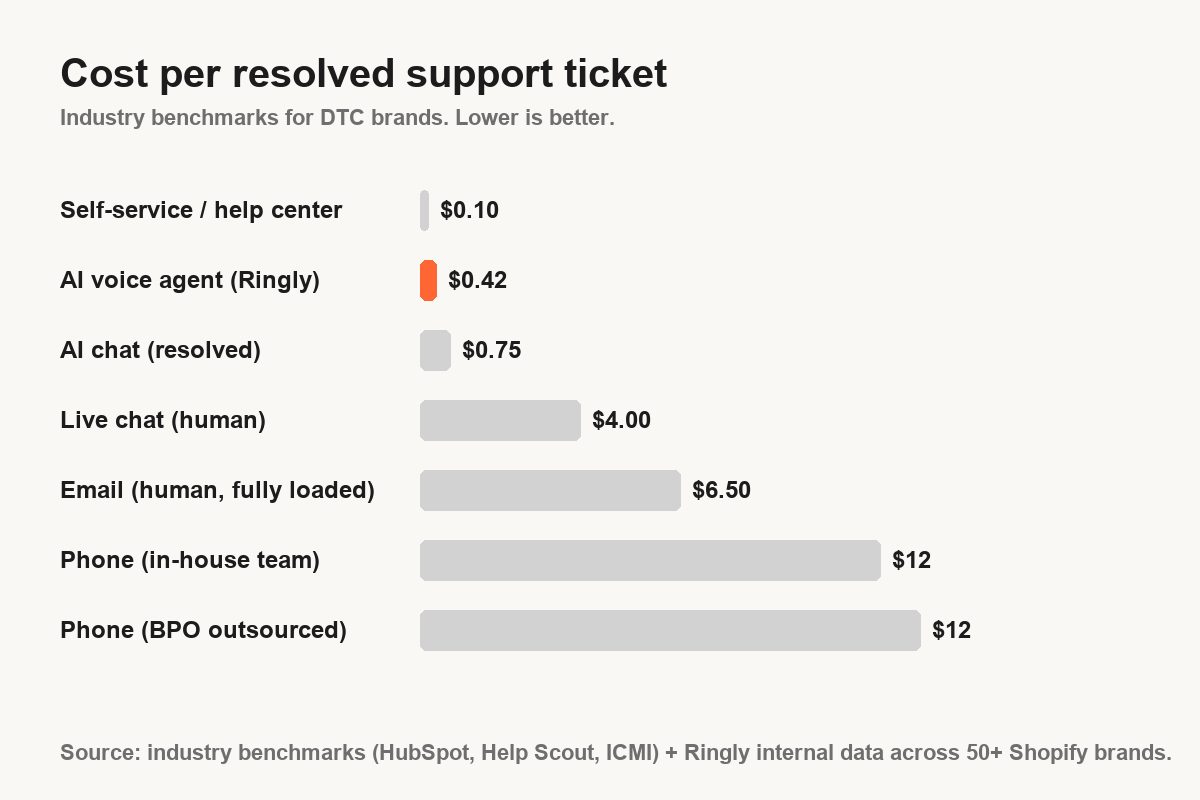
| Channel | Cost per resolved interaction |
|---|---|
| Self-service / help center | ~$0.10 |
| AI chat (resolved) | $0.50 to $1.00 |
| Live chat (human) | $3 to $5 |
| Email (human agent, fully loaded) | $5 to $8 |
| Phone (in-house team) | $7 to $16 |
| Phone (BPO outsourced) | $10 to $15 |
| Phone (AI agent, Ringly internal data) | ~$0.42 |
A few things this table makes obvious:
- Self-service has a 50-150x cost advantage over a human channel
- Live chat is cheaper than email per interaction (agents handle 2-3 concurrent chats)
- Phone is by far the most expensive human channel
- AI voice has closed almost the entire cost gap with self-service
Quick headcount math
Take your weekly ticket volume by channel. Divide by industry productivity benchmarks:
| Channel | Tickets per agent per day |
|---|---|
| 40-60 | |
| Chat | 30-50 |
| Phone | 30-50 |
| Mixed omni | 30-40 |
A worked example. Say you do 1,200 tickets a week split: 600 email, 300 chat, 300 phone.
- Email: 600 / 50 / 5 working days = 2.4 FTE
- Chat: 300 / 40 / 5 = 1.5 FTE
- Phone: 300 / 40 / 5 = 1.5 FTE
- Total: about 5.5 agents, plus a lead
At $55K fully loaded per agent in the US, that's roughly $300K/year of support payroll for a $3M-$5M brand. Tight but workable.
Now run the same math with AI handling 60-70% of phone and 30-40% of email/chat as Tier 1 deflection. You drop to about 2.5 humans plus a lead. The savings pay for the tooling 5x over.
If outsourcing is on the table, the Shopify customer support outsourcing guide and BPO for Shopify breakdown cover the trade-offs in detail.
Component 5: Measurement (5 KPIs that matter, and the 10 you can ignore)
Most strategy templates list 15 metrics. You don't need 15. Here are the 5 that matter, with the targets I see top-quartile DTC brands hit.
| KPI | What it tells you | Target (industry good / great) |
|---|---|---|
| First Contact Resolution (FCR) | Are you fixing it the first time? | 65-70% / 75%+ |
| First Response Time (FRT) | How long until a customer hears back? | See SLA table above |
| CSAT | Are customers happy after the interaction? | 80-85% / 90%+ |
| Cost per resolved ticket | What does support actually cost you? | Track per channel, trend it |
| Repeat contact rate | Same customer back within 7 days = something broke | <20% / <10% |
Five numbers. Put them on a dashboard. Look at them weekly.
The ones you can ignore (or at least de-prioritize) until you're above $10M:
- NPS for support specifically. Use CSAT instead, it's more direct and lower friction.
- Average Handle Time (AHT) in isolation. Faster isn't better if FCR drops.
- Ticket volume as a KPI. It's a leading indicator of demand, not a quality measure.
- Agent occupancy. Useful at 50+ agents, irrelevant at 5.
- Legacy "call quality" scorecards. Too subjective. Use CSAT + FCR + cost.
For deeper coverage of which KPIs matter in DTC, see customer service KPIs for ecommerce and the first call resolution deep dive. The CSAT statistics for 2026 post has the benchmark data backing the targets above.
The channel you're under-investing in: phone
If you only change one thing about your support strategy after reading this post, change how you think about phone.
Three reasons phone has become the single biggest lever in DTC support:
- It's still the highest-intent channel. When a customer calls, they have a high-AOV order, an urgent issue, or are about to churn. According to Microsoft's State of Global Customer Service research, 65% of consumers still pick up the phone for urgent or high-value issues, even when chat and email are available.
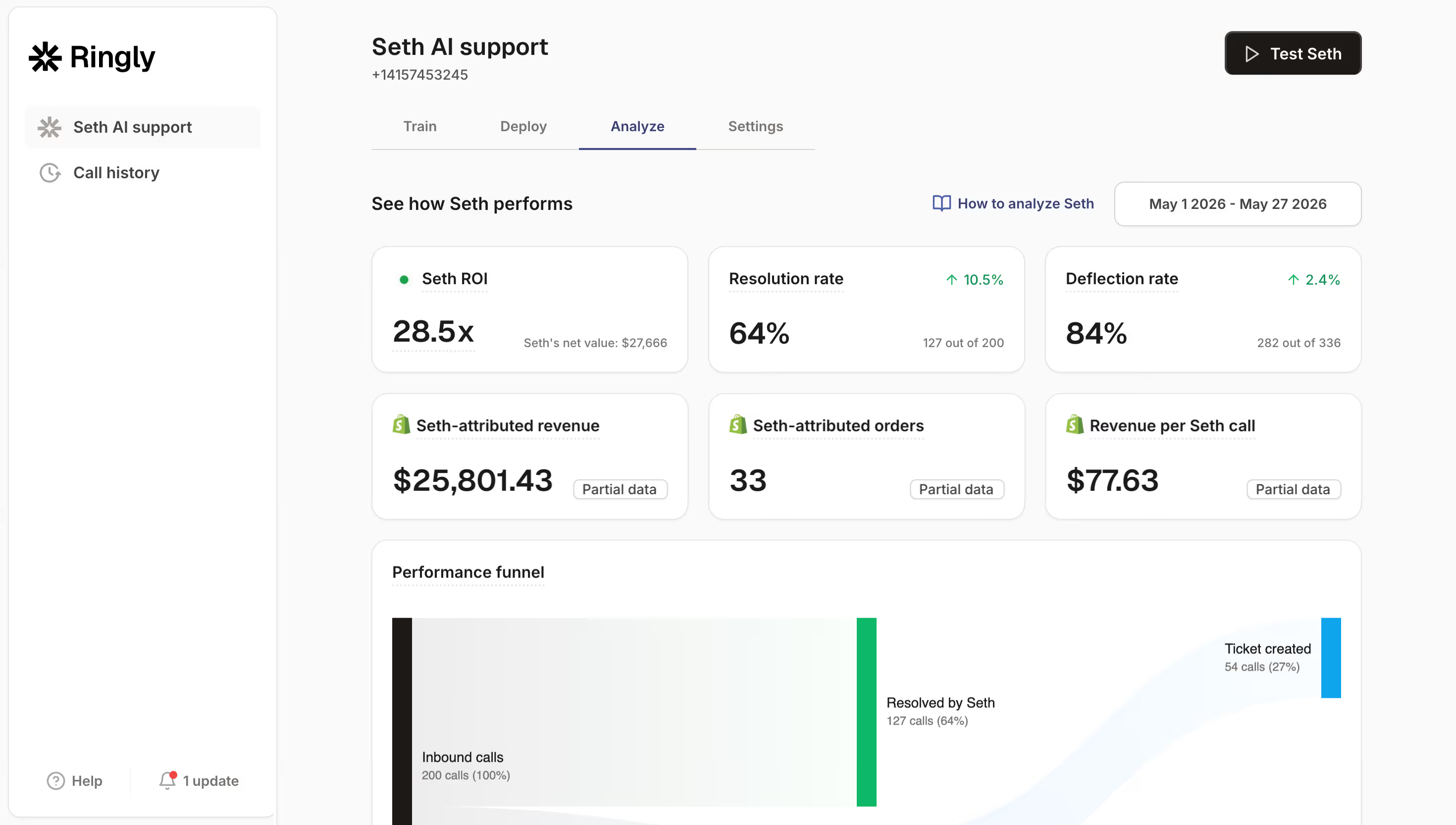
- Voice AI has finally crossed the quality bar. Across the 50+ Shopify brands running Ringly, the AI resolves 73% of inbound calls autonomously. Five years ago this number was 20% and customers hated it. Today the AI sounds and behaves enough like a competent human that most callers don't realize they're talking to one.
- The cost gap is massive. A human phone interaction costs $7-$16 in-house, $10-$15 with a BPO. An AI-resolved call costs roughly $0.42. That's a 20-30x cost reduction on the most expensive channel in your stack.
The strategic move in 2026 is to staff your phone line with AI for the routine 70% and route the rest to your best human reps. You get 24/7 coverage, you stop losing high-intent calls to voicemail, and you free your team for the calls that actually need a human.
Most DTC brands haven't made this move yet because the previous generation of voice tech wasn't good enough. That window has closed. The voice AI for customer service guide and the ecommerce phone support overview have more on the underlying tech and the specific Shopify use cases.
Ringly.io: AI phone support for Shopify brands
Ringly is AI phone support for Shopify brands. Hiring a phone team scales linearly with call volume. The AI doesn't. Instead of growing your support headcount every time call volume goes up, the AI takes the routine inbound calls so your team can focus on the work that actually moves revenue.
The AI answers inbound calls 24/7 in 40 languages. It finds orders in your Shopify store, processes returns and exchanges, answers product questions from your knowledge base, and rescues abandoned carts via outbound follow-up. Across 50+ brands, the AI resolves 73% of calls autonomously at roughly $0.42 per resolved call. Calls that need a human escalate cleanly to Gorgias, Richpanel, Reamaze, or whatever helpdesk you already run.
Plans: Grow $349/mo (1,000 minutes), Pro $799/mo (2,500 minutes), Enterprise custom. 14-day free trial on Pro. Live in under an hour. 65% resolution guarantee: if the AI resolves under 65% of your calls in 90 days, we refund the last 3 months. Full breakdown on the Ringly pricing page.
Try Ringly free for 14 days and get your phone line answered in under three minutes of setup.
The 3 strategic mistakes most DTC teams make
I've reviewed enough support strategies to spot the same three holes in almost every one. Here they are, with the fix.
Mistake 1: Under-staffing phone
Symptom: Calls go to voicemail, or to a 9-5 line that misses 60% of consumer activity. Voicemails get answered the next day via email. Customers churn before you respond.
Why it happens: Hiring phone reps feels expensive and "old". Most founders mentally classify phone as a legacy channel and quietly let it rot.
Fix: Add an AI line for 24/7 coverage on the routine calls. Keep your humans for what actually needs them. Even a basic deployment closes the coverage gap immediately.
Mistake 2: No SLAs (or unmeasured ones)
Symptom: When you ask the support lead "what's our first response time target on chat?", you get a shrug or a vague answer like "we try to respond fast".
Why it happens: Writing SLAs feels like corporate bureaucracy until the day you have a queue backing up and no agreed standard to staff against.
Fix: Write down four numbers (FRT for email, chat, phone, social). Put them on a dashboard your support lead reviews every Monday. Two weeks of missing target = staff up or move the target. The ecommerce customer service SLA post has a template you can crib.
Mistake 3: No proactive notifications
Symptom: 15-25% of your tickets are some version of "where is my order". You answer every single one reactively.
Why it happens: Proactive triggers from Shopify (order placed, in transit, delivery delay, delivered) feel like a "phase 2" project that never ships.
Fix: Set up shipping status SMS + email triggers from Shopify. One afternoon of setup, removes 15-20% of inbound ticket volume permanently. The WISMO calls breakdown and WISMO automation for Shopify guide walk through the specifics.
A 30/60/90 to roll this out
If you read this post and want to actually use it, here's the rollout I'd run:
Day 0-30: write it down
- Audit your current state. Where are tickets going? Who's answering? What's the FRT?
- Write the 5-component strategy doc. One page, not ten.
- Set realistic SLAs for the channels you actually staff.
- Pick deflection-first or human-first as your default philosophy.
Day 30-60: instrument and fix the worst gap
- Stand up a dashboard with the 5 KPIs.
- Fix your biggest gap. In 8 out of 10 DTC strategies I review, the biggest gap is phone.
- Ship one proactive trigger from Shopify (start with shipping status).
- Update your help center: top 10 most common ticket reasons each get a self-service page.
Day 60-90: review, cut, lock
- Look at the dashboard. Which channels are earning their cost? Which aren't?
- Cut or downscale the weakest channel. (Social DM staffing is usually first to go for sub-$10M brands.)
- Lock the playbook. Quarterly review only, no constant tinkering.
By day 90, you should know your cost per resolved ticket on every channel and be able to answer "what would happen if volume 2x'd next week" without guessing.
For training-side material on how to actually run the playbook day to day, see ecommerce customer service training and customer service scripts for ecommerce. On the escalation side, how to handle customer complaints in ecommerce covers the awkward calls.
FAQ
What is a customer support strategy?
A documented set of decisions about which channels you support, to what SLAs, with which team, measured against which KPIs, and which problems you deflect before a human gets involved. Five components, one page.
How is a customer support strategy different from a customer service strategy?
In practice, they're used interchangeably. If you want to draw a line: "support" is reactive (responding to problems), "service" is the broader experience including proactive moments. The same 5-component framework applies to both.
How many people do I need on my support team?
At $1M ARR, usually 1 founder-as-support plus a part-time helper. At $5M, 3-5 agents plus a lead. At $10M, 5-10 plus a lead and a workforce manager. AI deflection on phone and chat compresses these numbers by 30-50%.
Should a Shopify brand offer phone support?
Yes. Phone is the highest-intent channel and the one your competitors are quietly under-investing in. The cost objection is solvable with AI voice. Voicemail-only is the worst possible option because it sets an expectation you don't meet.
What KPIs should I track first?
Start with five: First Contact Resolution, First Response Time, CSAT, cost per resolved ticket, and repeat contact rate. Don't add a sixth until you're hitting target on all five.
How much should I budget for customer support?
Industry rule of thumb: 3-7% of revenue. DTC brands using AI deflection on the most expensive channels often run below 3% without losing CSAT. Track cost per resolved ticket, not total spend, to know if you're efficient.
The summary
A customer support strategy is a small number of decisions, written down, measured against. Five components. Five KPIs. Three mistakes to avoid.
If you only fix one thing this quarter, fix phone. It's the biggest cost line, the highest-intent channel, and the one where the gap between "good" and "bad" execution costs you repeat revenue.
If you're on Shopify and want to see what AI phone support could do for your store, try Ringly free for 14 days. Setup takes about three minutes and you'll hear a sample call answered in your brand voice within 20 seconds.
Article by Ruben Boonzaaijer. Co-founder of Ringly.io. We build AI phone support for Shopify brands so they can scale support without hiring a phone team.