

Every helpdesk listicle pretends ticketing is the same across vendors. It isn't.
The real differentiators are boring and specific: ticket routing depth, SLA management and reporting, multi-channel intake (with voice actually counted), and Shopify integration depth if you sell direct-to-consumer. Get those four right and you'll save your team hours every day. Get them wrong and you'll be migrating again in 18 months.
We tested and reviewed 10 help desk ticketing systems used by real DTC and SaaS support teams. We ranked them on routing depth, SLA management, multi-channel intake, Shopify integration, real cost at scale, and time to live. Then we called out the one channel almost every tool on this list gets wrong: the phone.
Hear what AI support calls sound like for your store. Just paste your Shopify URL and get sample calls in under 20 seconds, no email required. Listen to demo calls for my store.
How we evaluated these help desk ticketing systems
We didn't rank on "AI features" or marketing taglines. Vendors are flooding those. We ranked on what actually shapes daily work and renewal decisions.
- Ticket routing depth: round-robin, skill-based, AI-based, or just a single queue? Routing is where bad helpdesks waste agent time.
- SLA management and reporting: do they actually track first-response and resolution SLA per channel and per priority, or is "SLA" just a checkbox on the feature page?
- Multi-channel intake: email plus chat plus social, and crucially, phone. Voice is 18% of support interactions in ecommerce (source), and 67% of customers say they prefer phone for support (source).
- Shopify integration depth: native two-way (refunds and order edits from the ticket), read-only sidebar, or nothing? This is binary, and most buyers don't realize until week three.
- Real cost at scale: not the $19 starting price. What does a 5-agent team with 1,000 tickets actually pay all in?
- Time to live: are you up in a day or three weeks deep in onboarding?
We pulled pricing direct from vendor pages on May 23, 2026. G2 and Capterra scores reflect the latest available counts.
Quick comparison: the 10 tools at a glance
| Tool | Best for | Starting price | Shopify integration | Voice channel | G2 score |
|---|---|---|---|---|---|
| Zendesk | Enterprise, all channels | $19/agent/mo | Read-only sidebar | Forwarded only | 4.3 |
| Freshdesk | Mid-size, Zendesk-lite | Free / $19 | Read-only sidebar | Forwarded only | 4.4 |
| Gorgias | Shopify under 50K tickets/mo | $10/mo | Native two-way | None native | 4.6 |
| Re:amaze | Small Shopify/BC/Woo brands | $29/agent/mo | Native two-way | Voicemail + click-to-call | 4.6 |
| Help Scout | Email-first SaaS, under 30 agents | Free / $25/user | Via Zapier | None | 4.4 |
| HappyFox | Mid-market with workflow needs | $24/agent/mo | Via Zapier | None | 4.5 |
| Zoho Desk | Teams already in Zoho | Free / ~$7/user | Via marketplace | Forwarded via Zoho Voice | 4.4 |
| ProProfs | Tiny teams, no ads, free tier | Free / $19.99/user | Limited | None | 4.6 |
| Spiceworks | Free IT helpdesk | Free | None | None | 4.3 |
| HESK | Self-hosted free option | Free / $24.91/mo | None | None | 4.4 |
Notice the right two columns. Every single tool above either has no real voice channel or forwards calls into a queue or voicemail. We'll come back to this.
The 10 best help desk ticketing systems
1. Zendesk
Best for: large enterprise teams that need every channel and can afford every tier. Zendesk is the legacy giant. It has the deepest omnichannel coverage, the biggest app marketplace (1,000+ apps), and the most mature AI of anyone on this list.
If your support org is 50+ agents and you handle email, chat, social, voice, and self-service in one workspace, Zendesk does it. The Suite Enterprise + Copilot tier is genuinely powerful. But the pricing is brutal, and the Shopify integration is the same read-only sidebar it's been for years.
Pricing
| Plan | Price (per agent/month, annual) | Includes |
|---|---|---|
| Support Team | $19 | Email + ticketing only |
| Suite Team | $55 | AI agents, knowledge base, messaging, live chat |
| Suite Professional | $115 | App builder, IVR, advanced reporting, skill-based routing |
| Suite Enterprise + Copilot | Custom | AI triage, generative voice AI, sandbox |
14-day free trial of Suite Professional included.
What works
- Channel depth: Email, chat, voice, messaging, social, self-service all in one workspace
- App marketplace: 1,000+ integrations, the widest in the category
- AI maturity: Copilot, AI agents, automatic triage on Enterprise tier
- Reporting: Explore is the most flexible BI layer in any helpdesk
What doesn't
- Per-agent cost spirals fast: one Reddit user reported $5,000/month for 24 users not on the top plan
- Feature gating across tiers: SLA, skill-based routing, IVR, and reporting are split across $19, $55, and $115 plans
- Shopify integration is read-only: agents see order data in the sidebar but have to open Shopify to actually process refunds. See our Zendesk Shopify integration breakdown for the full picture
- Voice is forwarded: Zendesk Talk routes calls to humans or voicemail, no autonomous handling
Why it ranks first
Zendesk is still the depth king if you have budget and complexity. Nobody covers more channels with more polish. Most teams just don't need this much tool. If you're considering it, also check our Zendesk alternatives roundup.
2. Freshdesk
Best for: mid-size teams that want most of Zendesk at half the bill. Freshdesk has been the smart middle-ground pick for five years running. Freddy AI is genuinely useful for deflection, the free tier is real, and the platform is mature.
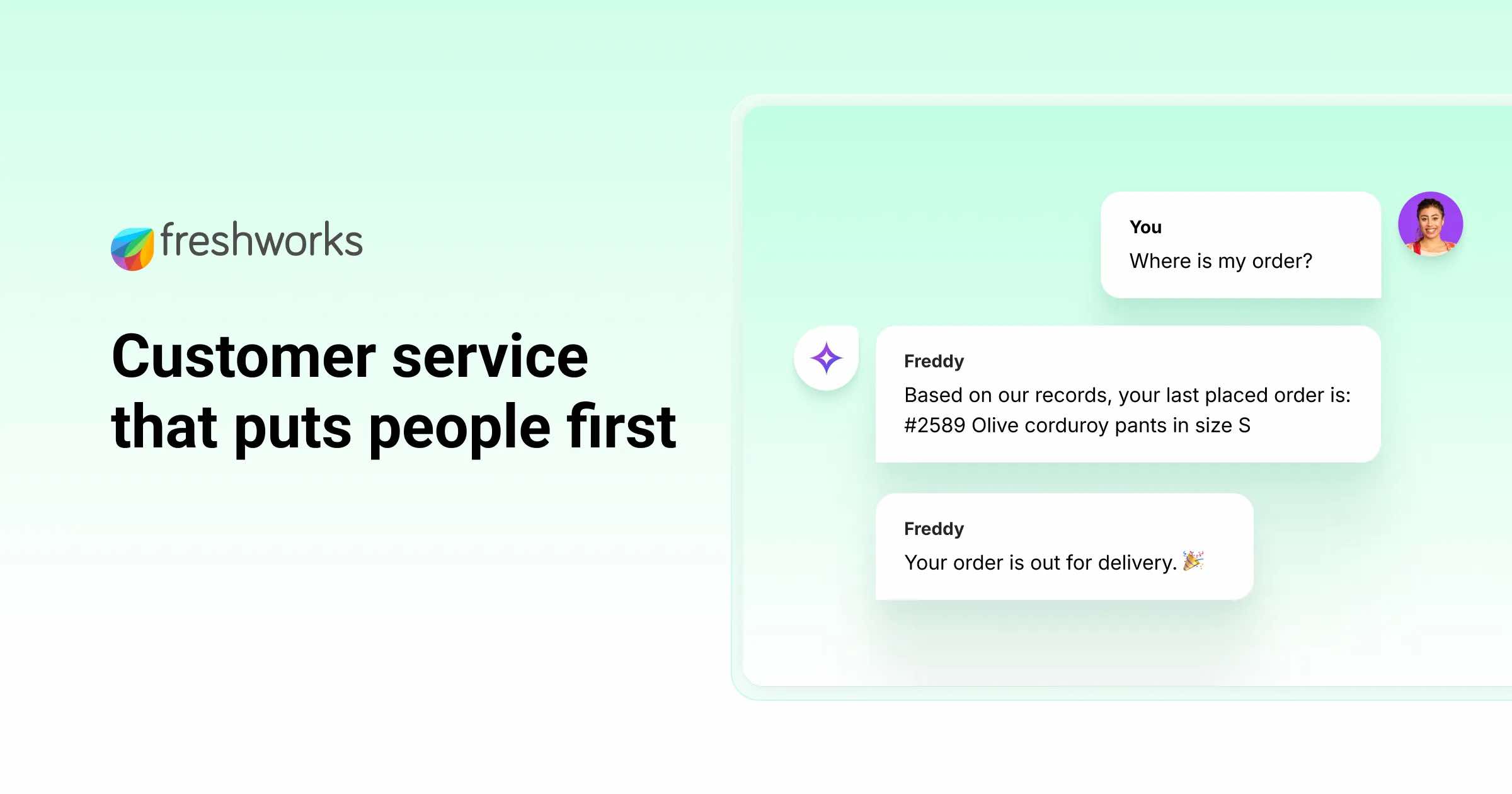
You get most of what makes Zendesk work, minus the polish and minus the worst of the pricing. If you have 5-30 agents and don't need IVR depth, Freshdesk is the obvious pick.
Pricing
| Plan | Price (per agent/month, annual) | Includes |
|---|---|---|
| Free | $0 (up to 2 agents, 6 months) | Basic ticketing, KB, reports |
| Growth | $19 | Ticketing, portal, basic reports |
| Pro | $55 | Custom objects, advanced ticketing, custom reporting |
| Enterprise | $89 | Skills routing, approval workflows, audit logs |
14-day Enterprise trial. Pro and Enterprise include 500 free Freddy AI Agent sessions per month.
What works
- Real free tier: 2 agents for 6 months at $0, no credit card
- Freddy AI deflection: actually deflects FAQ and routine tickets, not just summarizes
- Mature omnichannel: email, chat, social, phone (forwarded) in one inbox
- Predictable pricing: $19/$55/$89 is the published price, fewer hidden add-ons than Zendesk
What doesn't
- Reporting is shallow: fine for ticket counts, weak when you need to find why volume is climbing
- Lag complaints persist: multiple Reddit users report platform slowdowns leading to missed tickets
- Freshworks stack disconnects: four-product suite that doesn't always talk to itself well
- Shopify is read-only sidebar: see our Freshdesk Shopify integration guide
Why it ranks second
Best value-for-depth in the category. If you've outgrown Help Scout but Zendesk feels like overkill, Freshdesk is the answer. Comparison shoppers should also see Freshdesk alternatives.
3. Gorgias
Best for: Shopify brands under 50,000 tickets per month. Gorgias is the only helpdesk on this list with truly native two-way Shopify integration. Agents process refunds, edit orders, and trigger subscription changes without leaving the ticket.
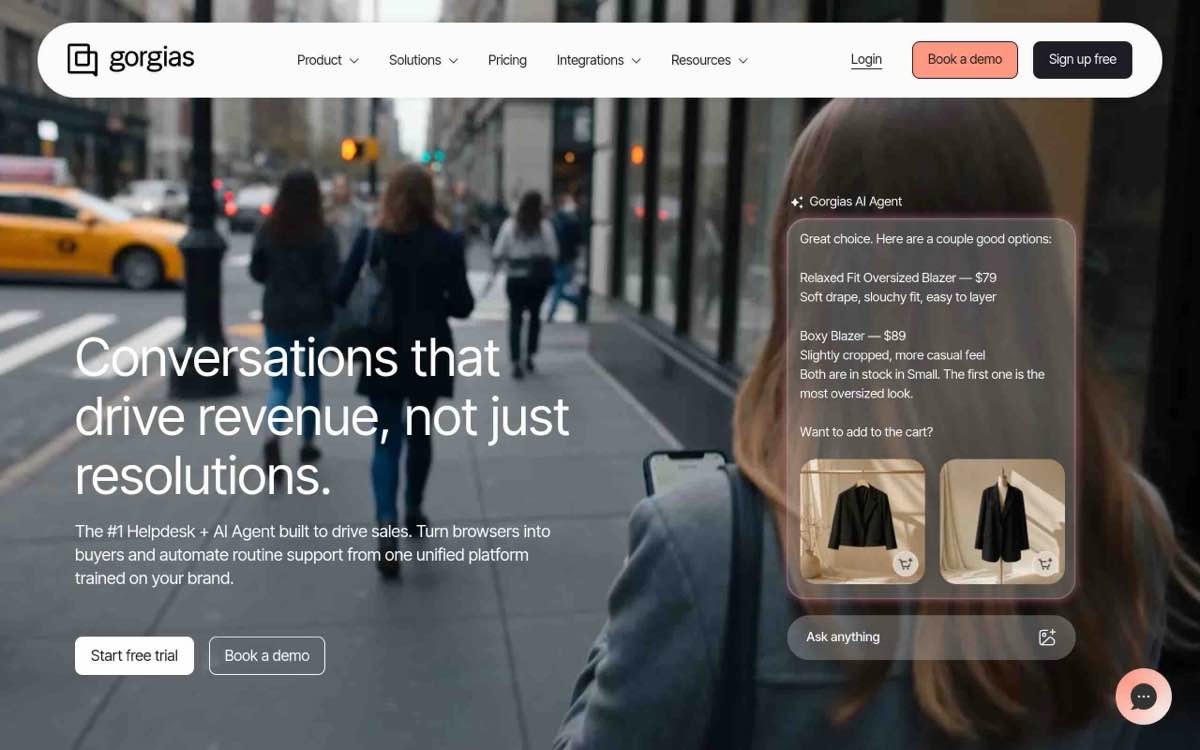
If you sell on Shopify and your ticket volume is predictable, this is the obvious pick. Gorgias is rated 4.6/5 on G2 with 700+ reviews. The per-ticket pricing model also means you can add unlimited agents at every tier, which is nice when your team grows.
Pricing
| Plan | Monthly price | Tickets/month | Overage |
|---|---|---|---|
| Starter | $10 | 50 | $0.40/ticket |
| Basic | $60 | 300 | $40 per 100 |
| Pro | $360 | 2,000 | $36 per 100 |
| Advanced | $900 | 5,000 | $36 per 100 |
| Enterprise | Custom | 5,000+ | $32 per 100 |
AI Agent add-on: $0.90 to $1.00 per resolved conversation.
What works
- Best Shopify integration on market: refunds, order edits, subscription changes from the ticket view (not a sidebar)
- Unlimited agents on every tier: pricing scales with tickets, not seats
- AI Automate: real deflection on FAQ, returns, order edits, product recommendations
- Multi-channel intake: email, chat, Instagram, TikTok, WhatsApp, Facebook all in one inbox
What doesn't
- Per-ticket pricing punishes seasonal spikes: Black Friday can double your bill
- Weak outside ecommerce: built for DTC, not service businesses or B2B SaaS
- No real voice channel: phone calls forward to humans, no autonomous handling
- AI Agent overage adds up fast: at $1/resolution, 1,000 deflections is another $1,000/month
Why it ranks third
If you're on Shopify, this is the helpdesk. The only reason it's not #1 is the long list of teams that don't sell on Shopify. See our Gorgias alternatives for the full breakdown.
4. Re:amaze
Best for: small-to-mid Shopify, BigCommerce, and WooCommerce brands that want flat pricing. Re:amaze does most of what Gorgias does, with transparent flat per-agent pricing instead of per-ticket. For brands worried about seasonal spike billing, that math wins.

It also handles multi-brand support cleanly, which Gorgias makes harder. On the Shopify App Store, Re:amaze has 4.5/5 stars across 174 reviews.
Pricing
| Plan | Price (per team member/month) | Includes |
|---|---|---|
| Basic | $29 | Email, chat, social, chatbots, 20 AI resolutions |
| Pro | $49 | Multi-brand, advanced reporting, SMS + voice |
| Plus | $69 | Live screensharing, scheduling, 100 AI resolutions |
| Starter (flat) | $59/mo total | Unlimited users, 500 conversations |
14-day free trial, no credit card required.
What works
- Native two-way Shopify/BigCommerce/WooCommerce: see and edit order data from the ticket
- Flat pricing: no per-ticket surprise on Black Friday
- Multi-brand support: route inboxes to teams cleanly without separate workspaces
- Decent AI deflection: 20 to 100 resolutions/month included on paid tiers
What doesn't
- Search has stop-words you can't disable: common complaint on Capterra
- AI feels dated vs Gorgias Automate: smaller training set, fewer ecommerce-specific actions
- "Voice channel" in Pro = voicemail and click-to-call: not AI handling actual calls
- Per-agent pricing climbs with team growth: if you grow to 10 agents on Plus, that's $690/month
Why it ranks fourth
Best Gorgias alternative for small Shopify brands worried about per-ticket pricing. Worth a free trial if your volume is unpredictable.
5. Help Scout
Best for: email-first SaaS and service teams under 30 agents. Help Scout is the cleanest UI in the category. It does email-based ticketing better than anyone, includes a real knowledge base (Docs), and onboarding takes hours, not weeks.
It's intentionally simpler than Zendesk. If you don't need IVR or skill-based routing, that simplicity is the feature.
Pricing
| Plan | Price (per user/month, annual) | Includes |
|---|---|---|
| Free | $0 (up to 5 users) | 1 inbox, 1 Docs site, 100 contacts/mo |
| Standard | $25 (up to 25 users) | Multiple inboxes, live chat, AI inbox assistant |
| Plus | $45 (up to 50 users) | WhatsApp, 2 SLA policies, round-robin, advanced workflows |
| Pro | $75 (min 10 users) | Unlimited SLA, SSO, HIPAA, dedicated CSM |
AI Answers add-on: $0.75 per resolution, 3-month free trial.
What works
- Cleanest UI in the category: agents are productive on day one
- Real knowledge base included: Docs is built in, not a $50/month add-on
- Generous free tier: up to 5 users, 1 inbox, 1 Docs site at $0
- Capterra 4.6/5: consistent praise for simplicity and onboarding speed
What doesn't
- SLA tracking is shallow: only Pro tier gets unlimited SLA policies, others get 2 or none
- Reporting weak at scale: G2 reviewers note difficulty getting volume-per-account insight as the team grows
- Recent UI updates hid keyboard shortcuts: frustrated power users
- No voice channel: Help Scout doesn't try to do phone
Why it ranks fifth
If your support is email-first and your team is under 30 agents, Help Scout is the right answer most of the time. See Help Scout alternatives and our Gorgias vs Help Scout comparison for context.
6. HappyFox
Best for: mid-market teams that want workflow depth without Zendesk complexity. HappyFox has been PC Mag's "Best Help Desk" seven years running. The smart-rules engine is genuinely powerful, and the interface is intuitive once you're past the initial setup.
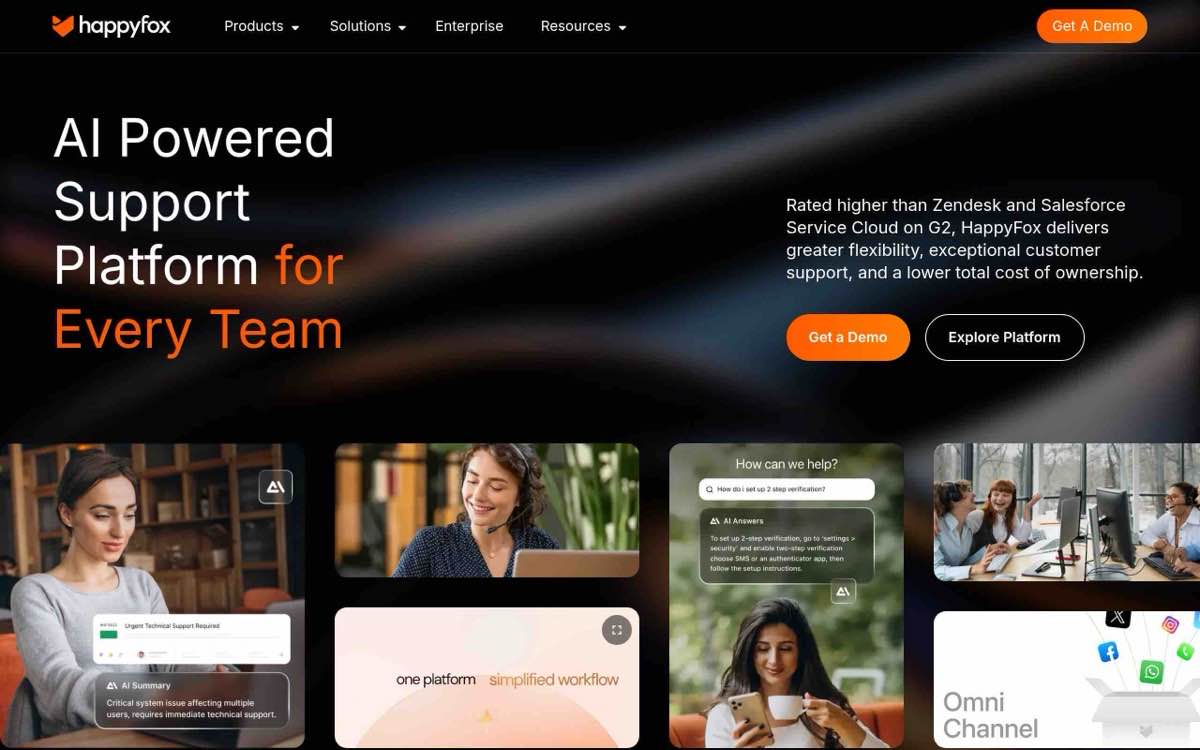
It scores 9.2/10 on G2 for ease of use. The catch: HappyFox restructured pricing in June 2025 and the Pro plan jumped 43%, from $69 to $99 per agent monthly.
Pricing
| Plan | Price (per agent/month) | Notes |
|---|---|---|
| Basic | $24 annual | Max 5 agents |
| Team | $29 annual / $39 monthly | Multi-brand helpdesk |
| Pro | $59 annual / $99 monthly | Proactive collision, asset management |
| Enterprise Pro | Custom | Agent scripting, 2TB storage, phone support |
What works
- Smart-rules workflow engine: best-in-class automation depth for mid-market teams
- Intuitive interface: 9.2/10 G2 ease-of-use score
- PC Mag's Best Help Desk seven years running: track record matters
- SLA management on every tier: actual SLA policies and breach tracking baked in from Basic
What doesn't
- Pricing just hiked 43%: Pro went from $69 to $99/agent/month monthly billing
- Mobile app is weak: G2 reviewers consistently flag this
- Knowledge base requires publish-then-preview: small but irritating workflow gap
- No voice channel: phone isn't in HappyFox's vocabulary
Why it ranks sixth
Most underrated helpdesk in the category. The recent pricing hike hurts but the workflow depth still earns its spot.
7. Zoho Desk
Best for: budget-conscious teams already running Zoho One. Zoho Desk is the cheapest paid tier in the category, and if you already use Zoho CRM, the integration is real. The Zia AI assistant on Enterprise is decent.

The catch: bug and outage complaints are common on Reddit, and the UX feels a generation behind Zendesk or Freshdesk.
Pricing
| Plan | Price (per user/month, annual) | Includes |
|---|---|---|
| Free | $0 | 3 users, email tickets only |
| Express | ~$7 | Multi-channel, basic automation |
| Standard | ~$14 | WhatsApp/Telegram, gen-AI satisfaction, custom reports |
| Professional | ~$23 | Phone integration, round-robin, multilingual |
| Enterprise | ~$40 | Zia AI assistant, skill-based routing, multi-brand |
Annual billing saves up to 34%.
What works
- Cheapest paid plan in the category: ~$7/user starting price is real
- Deep Zoho One integration: if you're already on Zoho CRM and Books, this fits
- Free tier is usable: 3 users for $0, email-only but real
- Zia AI on Enterprise: decent satisfaction analysis and answer bot
What doesn't
- Bug + outage complaints are common: one Reddit pattern: "system doesn't show you new requests"
- UX feels dated: not the polish of Zendesk or Freshdesk
- Phone via Zoho Voice = forwarded call: not AI handling
- Enterprise features locked behind $40/user: round-robin, multi-brand, skill-based all gated
Why it ranks seventh
Best pick only if you're already in the Zoho ecosystem. Otherwise the bug noise probably outweighs the price savings. See our Zoho Desk alternatives for the full set.
8. ProProfs Help Desk
Best for: tiny teams that want a clean free tier without ads. ProProfs is the no-ads alternative to Spiceworks. Single-user free plan includes unlimited tickets, basic routing, and a mobile app.
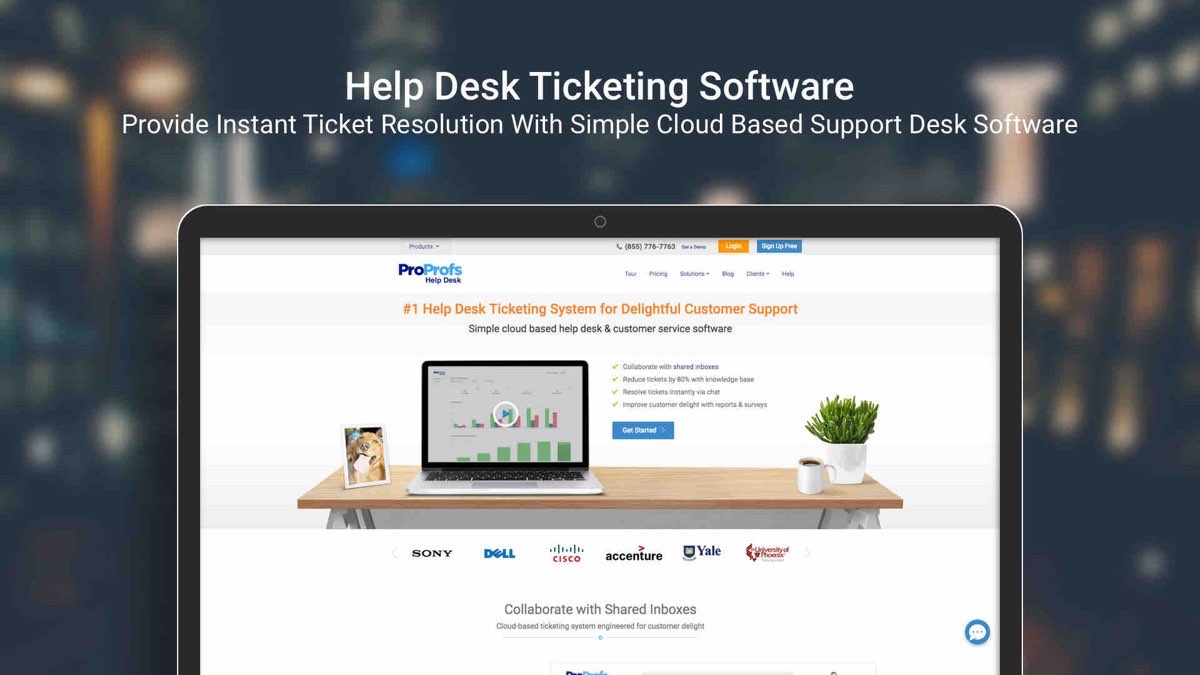
It scores 4.6/5 on G2 (small sample, ~40 reviews), and the UI is genuinely clean. Tradeoff: integrations are limited and reporting depth is light.
Pricing
| Plan | Price | Includes |
|---|---|---|
| Single User Free | $0 | Unlimited tickets, basic routing, mobile app |
| Team | $19.99/user/mo (2+ users) | Dedicated onboarding, 24/7 support, API + SSO |
| Enterprise | Custom (5+ users) | Custom |
White-label add-on: $300/year.
What works
- Clean free tier for single users: no ads, unlimited tickets
- Integrated knowledge base: built in, not an add-on
- Simple interface: low onboarding cost
- 24/7 support included on Team plan: most affordable plans skip this
What doesn't
- Reporting is light: ticket counts, not trend analysis
- Integration count is small: vs hundreds on Zendesk or Gorgias
- No voice channel: not in scope
- Niche feature depth: fine for tiny teams, falls apart at 10+
Why it ranks eighth
Best free tier if you're allergic to ads. Sits behind ProProfs for one reason: ecosystem size. The bigger tools have more integrations and more reviewers banking on them.
9. Spiceworks Cloud Help Desk
Best for: small IT teams with zero software budget. Spiceworks is genuinely free for the Core plan, no agent cap, ad-supported. It's been the default free pick for IT helpdesks for a decade.
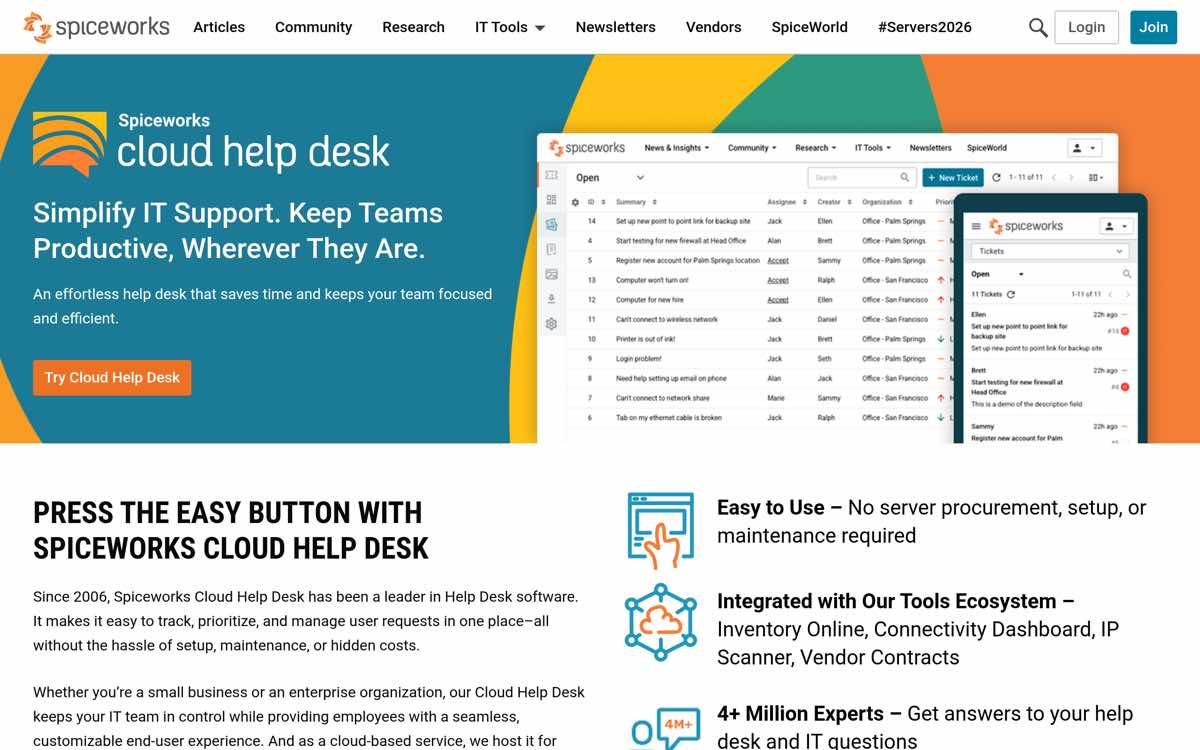
The UI is dated, the platform slows at high ticket volume, and ads are distracting. For sub-50-ticket IT teams, it still does the job.
Pricing
| Plan | Price |
|---|---|
| Core | Free, ad-supported, up to 5 seats |
| Premium | Paid (request pricing) |
What works
- Genuinely free: no agent cap on Premium, 5 seats on Core
- Active community: Spiceworks has the strongest community of any free helpdesk
- Decent IT ticketing: routing, assignment, internal notes, email intake
- Cloud-hosted: no server to maintain
What doesn't
- Ad-supported: ads are distracting and look unprofessional to end users
- Slow at high volume: lag and freezes reported as ticket count grows
- Dated UI: looks 2014
- Limited customization: workflow rules are basic
- No voice channel, no Shopify integration: built for internal IT, not ecommerce
Why it ranks ninth
The default free pick for tiny IT teams. Falls apart fast outside that use case.
10. HESK
Best for: one-person support shops that need self-hosted or want to avoid SaaS subscriptions. HESK is built by a single developer and has been around for 20 years. The self-hosted free version is genuinely free if you have a server.
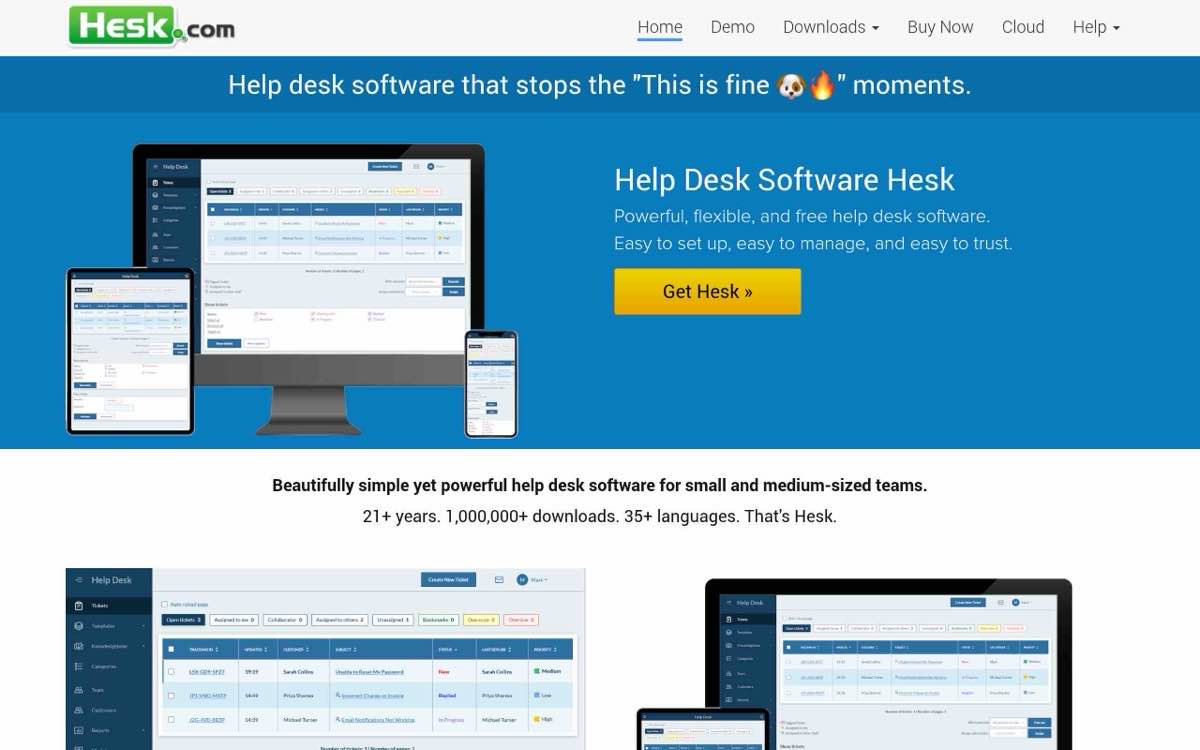
It's simple, customizable, and includes a knowledge base. Tradeoff: dated UI, no real multi-channel, and you maintain the install yourself unless you pay for cloud.
Pricing
| Plan | Price |
|---|---|
| Self-hosted free | $0 (with "Powered by HESK" branding) |
| Website License | $4,999 one-time (removes branding, 1yr support) |
| Advanced License | $19,999 one-time (5 installs, 5yr support) |
| HESK Cloud | $24.91/mo (10 agents, 10GB) |
| HESK Cloud Plus | $41.58/mo (unlimited agents, 50GB) |
90-day money-back guarantee on paid licenses.
What works
- Genuinely free if self-hosted: zero recurring cost
- Simple, customizable: built for the basics, does them well
- Built-in knowledge base: included, not an add-on
- HESK Cloud Plus is cheap for unlimited agents: $41.58/mo flat
What doesn't
- Dated UI: looks 2010
- No real multi-channel: email and web form only
- Manual updates if self-hosted: maintenance burden falls on you
- No voice channel: nothing close
Why it ranks tenth
Niche but real. If you need self-hosted ticketing for a single-person shop and you have a server, HESK is fine.
The channel every helpdesk treats as an afterthought: the phone
Look at the comparison table again. Voice channel column. Every tool on this list either has no real phone support or "voice" means forwarding the call to a human or sending it to voicemail.
Zendesk Talk routes calls. Freshdesk forwards them. Gorgias has no native phone. Re:amaze "voice channel" is voicemail and click-to-call. Help Scout, HappyFox, ProProfs, Spiceworks, HESK have nothing.
That's the gap. And it matters because 18% of customer support interactions in ecommerce happen via phone, and 67% of customers say they prefer phone for support when something has actually gone wrong (source). Voice isn't the most common channel. It's the channel customers default to when they're stressed, when chat didn't work, or when they want a human now.
The reason ticketing tools can't fix this is structural. Ticketing is async by design. The customer leaves a message, the agent picks it up. Phone is sync. Both sides have to be there. You can't queue a real-time conversation.
The honest take: if voice is in your channel mix, pair your ticketing tool with a real AI phone layer. Don't try to make a ticketing tool do the phone.
Ringly.io is AI phone support for Shopify brands. Phone support, without the payroll. The AI answers inbound calls 24/7. It finds orders in your Shopify store, processes returns and exchanges, answers product questions from your knowledge base, and rescues abandoned carts via outbound follow-up. Across 50+ brands, the AI resolves 73% of calls autonomously at roughly $0.42 per resolved call. Calls that need a human escalate to whatever helpdesk you already run.
Plans: Grow $349/mo (1,000 minutes), Pro $799/mo (2,500 minutes), Enterprise custom. 14-day free trial on Pro. Live in under an hour. 65% resolution guarantee: if the AI resolves under 65% of your calls in 90 days, we refund the last 3 months.
Want to hear what it sounds like for your store? Start your free trial. Setup takes about three minutes.
How to choose the right help desk ticketing system
Pick by your team size, channel mix, and whether you sell on Shopify. Not by the longest feature list.
Choose Zendesk if you:
- Run 50+ agents across multiple channels
- Need IVR, advanced routing, and the deepest reporting
- Have budget for $115/agent/month and up
Choose Freshdesk if you:
- Have 5-30 agents and want most of Zendesk at half the cost
- Need Freddy AI deflection on FAQ tickets
- Want a real free tier to start
Choose Gorgias if you:
- Sell on Shopify and need refunds/order edits from the ticket
- Have predictable ticket volume (per-ticket pricing burns on spikes)
- Run multi-channel (Instagram, TikTok, WhatsApp) ecommerce support
Choose Re:amaze if you:
- Run a small-to-mid Shopify/BigCommerce/WooCommerce brand
- Want flat per-agent pricing instead of per-ticket
- Need clean multi-brand support
Choose Help Scout if you:
- Run email-first SaaS or service support under 30 agents
- Want the cleanest UI and fastest onboarding
- Don't need IVR or skill-based routing
Choose HappyFox if you:
- Need deep workflow automation without Zendesk complexity
- Run a 10-100 agent mid-market support team
- Want SLA management baked in from day one
Choose Zoho Desk if you:
- Already use Zoho CRM, Books, or other Zoho products
- Need the cheapest paid plan in the category
- Can tolerate the occasional bug or outage
Choose ProProfs if you:
- Run a tiny team and want free without ads
- Don't need deep integrations
- Need a knowledge base included
Choose Spiceworks if you:
- Run an internal IT helpdesk under 50 tickets/day
- Have zero software budget
- Are okay with ads
Choose HESK if you:
- Need self-hosted ticketing
- Run a one-person support shop
- Want to own the install, not rent it
And whichever you pick, if voice is in your channel mix, add a real phone AI layer. None of these tools handle the actual phone conversation. See our guide on Shopify voice agents and our roundup of AI phone agents for Shopify for that side of the stack.
Frequently asked questions
What's the difference between help desk software and a ticketing system?
A ticketing system is the core function: turning every customer message into a tracked, assignable ticket. Help desk software is the broader category that wraps ticketing with channels, automation, knowledge base, and reporting. In practice, the terms are used interchangeably in 2026.
How much does help desk ticketing software actually cost at scale?
A 5-agent team with 1,000 tickets per month pays roughly: Zendesk Suite Pro $575, Freshdesk Pro $275, Gorgias Basic $60 (300 tickets) or Pro $360 (2,000), Help Scout Standard $125, Re:amaze Basic $145. AI add-ons typically run $0.50 to $1.00 per resolution on top.
Do I need a separate tool for phone support?
If voice is more than 5% of your support contacts, yes. Every helpdesk on this list either has no native voice channel or forwards calls to humans, which means you're paying full agent cost for every phone interaction. Pairing a real phone AI like Ringly.io with your ticketing tool is the standard 2026 stack.
Which help desk has the best Shopify integration?
Gorgias has the deepest native two-way Shopify integration (refunds, order edits, subscriptions directly in the ticket). Re:amaze is close behind. Zendesk, Freshdesk, and Help Scout all have read-only sidebars that require opening Shopify to take action. See our Shopify helpdesk app breakdown for the full comparison.
How long does it take to migrate to a new ticketing system?
Plan on 2 to 4 weeks for a 10-agent team. The work includes ticket history import, macro and automation rebuild, integration wiring, and agent training. Help Scout and Re:amaze typically come in fastest. Zendesk Enterprise migrations regularly run 6 weeks or more.
Are free help desk ticketing systems any good?
Spiceworks (free, ad-supported, IT-focused) and HESK self-hosted both work for small teams. Freshdesk Free (2 agents, 6 months) and Help Scout Free (5 users) are also solid starting points. The trap is hitting the limit and being forced into a paid plan after you've already built workflows around the tool.
What is SLA management in help desk software?
SLA (service level agreement) management tracks how fast tickets get a first response and final resolution, broken down by channel and priority. Done right, it surfaces breaches in real time so managers can reroute work. HappyFox and Zendesk have the deepest SLA tooling. Help Scout caps SLA policies on lower tiers.
The bottom line
Pick by channel mix and Shopify needs, not by AI feature list. Vendors are flooding "AI" but routing depth, SLA management, and integration depth are what shape daily work.
If you're DTC on Shopify, Gorgias or Re:amaze. If you're mid-market omnichannel, Freshdesk or HappyFox. If you're enterprise, Zendesk. If you're email-first SaaS, Help Scout. If you're broke, Spiceworks or HESK.
And whichever ticketing tool you pick, add a real phone AI layer. None of these handle the actual phone conversation. Try Ringly.io free for 14 days and have your AI phone agent live in under an hour.
Article by Ruben Boonzaaijer. Co-founder of Ringly.io. We build AI phone support for Shopify brands so they can scale support without hiring a phone team.