

You're tired of waking up to a broken plugin update. That's why you're reading this.
Most WooCommerce to Shopify migrations take 30 to 60 days end to end and cost anywhere from $500 to $75,000 depending on store size. The actual data movement is the easy part. What breaks is everything around it: customer logins, abandoned cart flows, ad tracking, support volume.
Every guide on Google walks you through the steps. Almost none of them tell you what actually breaks on launch day, what your support inbox looks like for the first 30 days after, or where the real cost shows up. This guide does.
If you're moving from WooCommerce to Shopify in 2026 (or you're trying to decide whether to), here's the real playbook. Step-by-step migration, current pricing and budget ranges, the 30-day post-launch reality, and the cost ranges nobody publishes.
Hear what AI support calls sound like for your store. Just paste your Shopify URL and get sample calls in under 20 seconds, no email required. Listen to demo calls for my store.
Why brands actually leave WooCommerce in 2026
The marketing version of this answer is "Shopify scales better." The real version has more layers.
The WordPress tax is real. Most WooCommerce stores running serious volume are paying for managed hosting (Cloudways, WP Engine, Kinsta), a security plugin, a backup plugin, a page builder, a caching layer, and a developer on retainer for when something breaks. That's $100 to $400 per month before you've sold anything, plus the dev hours.
Then there's the 2 AM problem. WordPress updates can break themes. Plugin conflicts can take down checkout. Most founders I talk to who left WooCommerce mention "I'm tired of being woken up by site issues" as the actual trigger, not feature parity.
Shopify takes that off your plate. PCI compliance, hosting, uptime, security patches: handled. You pay a flat monthly fee. The checkout is hardened. Conversion rates on the Shopify checkout average higher than custom WooCommerce builds, partly because the checkout flow has been optimized across hundreds of thousands of stores.
The honest counterpoint: WooCommerce still wins on raw customization. If you're running a setup that needs deep WordPress integration (membership site, complex content marketing, custom backend), Shopify will feel like a constraint, though Shopify Functions for checkout customization has closed a lot of that gap on the merchandising side. For most ecommerce-first brands, that's a constraint worth taking. For a few, it's a dealbreaker.
If you're not sure which side of that line you're on, the Shopify replatforming guide walks through the decision in more detail. The Shopify migration timeline has the calendar view.
What can and can't move from WooCommerce to Shopify
Most guides gloss this section. Here's what actually moves:
- Products: Yes, including variants. The catch: Shopify caps you at 3 options per product (size, color, material) and 100 variants total. WooCommerce variable products with more than 3 attributes will lose options unless you restructure them first.
- Customers: Yes, the records come over. The catch: passwords don't. Every returning customer will need to reset their password on first login after launch. Plan a comms email for this.
- Orders: Yes, but you need a third-party app like LitExtension or Matrixify. The Shopify Store Migration app doesn't handle orders directly.
- Product reviews: Not natively. You'll need a third-party review app on the Shopify side (Judge.me, Loox, Yotpo) and a CSV export from your WooCommerce reviews plugin. This is a manual step most guides under-cover.
- Blog posts: Yes, including categories and tags. Use the Store Migration app or Matrixify.
- Pages: Yes, but custom templates won't translate. You'll rebuild the design in your new Shopify theme.
- Subscriptions: This is its own project. WooCommerce Subscriptions doesn't map cleanly to Shopify. You'll be re-onboarding active subscribers through Recharge or Skio, which usually means a customer email and some manual cleanup.
- Custom WordPress plugin data: Anything custom built into a WordPress plugin probably stays in WooCommerce unless you pay a dev to extract it. Membership data, custom user fields, anything in a custom plugin table: case by case.
- SEO data: There's no native rank transfer. What you get is 301 redirects from old URLs to new URLs, which Google uses to pass authority. Skip the redirects and you'll lose 20-40% of organic traffic in the first 30 days.
If you're moving from a Shopify Plus competitor, the BigCommerce to Shopify migration guide and Magento to Shopify migration guide cover the same data-movement question for those platforms.
Ready to skip the homework and let an agent answer your phone instead? Try Ringly.io free for 14 days. Live in under an hour.
3 ways to migrate, ranked by store size
There's no single right approach. The right one depends on your catalog size, data complexity, and how much you want to do yourself.
Option 1: Manual CSV migration
Best for: Stores with under 500 products and no order history to preserve.
You export your products from WooCommerce as CSV (Tools > Export), reformat the columns to match Shopify's product template, and import. Free in dollars. Expensive in your weekend.
Pros: total control, no third-party data exposure, free.
Cons: tedious. Variant restructuring is manual. Images often need re-upload. Reviews and orders won't come over.
Option 2: Shopify Store Migration app
Best for: Most small and mid-sized stores moving products + blog posts.
Shopify's official migration app reads your WooCommerce CSV directly. No third-party tool needed. Free to use, you only pay for the Shopify plan you're moving to.
Pros: native, no third-party risk, free, supported by Shopify.
Cons: products and blog posts only. Doesn't migrate customers, orders, or reviews. Still in expanding rollout, may need access request.
Option 3: Third-party migration tools
Best for: Mid-sized stores that need customers, orders, and categories moved together.
The two most-used options:
- LitExtension ($59-$499 depending on volume): 4.8/5 on the Shopify App Store with 1,800+ reviews. Handles products, variants, customers, orders, categories. Manual-migration service add-on if you want them to babysit it.
- Matrixify ($20-$200/mo): Excel-based, the best tool if you need metafields, custom data, or complex product structures moved. 5.0/5 on the Shopify App Store with 700+ reviews.
Both have free demo migrations so you can preview before paying.
Pros: comprehensive, faster than manual, handles edge cases.
Cons: cost scales with data volume. HTML in product descriptions sometimes comes over broken (check every product after import).
Option 4: Hire a Shopify migration agency
Best for: Enterprise stores, Shopify Plus migrations, complex catalogs with custom B2B pricing or 5,000+ SKUs.
A done-for-you migration with an agency runs $5,000 for a mid-tier project up to $75,000 for a complex Plus migration with custom integrations. You get an account manager, QA, and someone to call when something breaks.
Worth it if your store does over $5M/year and you don't have an in-house team. Overkill for most smaller stores.
| Store size | Recommended approach | Cost range |
|---|---|---|
| Under 500 SKUs, no orders to migrate | Manual CSV or Store Migration app | $0-$500 |
| 500-5,000 SKUs, some orders | LitExtension or Matrixify | $59-$500 |
| 5,000+ SKUs, complex data | LitExtension Advanced + dev time | $1,000-$5,000 |
| Shopify Plus, custom integrations | Migration agency | $20,000-$75,000 |
The Shopify migration agency guide and Shopify migration partner posts dig into how to pick the right agency if you're going that route.
The 30-day migration timeline (week by week)
The "1-week migration" stories you see online assume you have nothing else going on. Real merchants juggle this with running the actual store. Here's a more honest 30-day version.
Week 1: Audit and plan
- Inventory your WooCommerce data: products count, customer count, order count, review count, custom data
- List every URL you need to redirect: product pages, category pages, blog posts, custom landing pages
- Pick your Shopify plan: Basic at $39/mo for new stores, Shopify at $105/mo for growing, Advanced at $399/mo for higher volume, Plus at $2,500/mo for enterprise (see Shopify Plus vs Advanced if you're stuck between the top two)
- Pick your theme: Dawn (free) or a premium Shopify theme. Avoid heavily customizing in week 1.
- List apps you'll need: review app (Judge.me, Loox), email (Klaviyo), shipping (ShipStation), helpdesk
- Brief your team and any contractors
Week 2: Build the Shopify store
- Set up the Shopify account and pick the plan
- Install and customize the theme (don't over-engineer this in week 2)
- Configure shipping zones and rates
- Configure tax settings (Shopify Tax can auto-handle most US states)
- Set up payment gateways (Shopify Payments is the default, plus Apple Pay, Google Pay, PayPal)
- Install core apps (reviews, email, support)
- Create one test product and run a test checkout end-to-end
Week 3: Migrate the data
- Migrate products first using your chosen method (Store Migration app, LitExtension, or Matrixify)
- Verify every product has correct pricing, weight, inventory, variants, images
- Migrate customers (passwords reset, plan the comms email)
- Migrate orders (if you need order history for support)
- Migrate reviews (export from WooCommerce, import to Judge.me or your chosen review app)
- Migrate blog posts and pages
Week 4: Go-live and redirects
- Build the 301 redirect map in a spreadsheet
- Import redirects into Shopify (Online Store > Navigation > URL redirects, or bulk via Matrixify)
- Point your domain DNS to Shopify (this is the actual cutover moment)
- Submit new sitemap to Google Search Console
- Reinstall tracking pixels (Google Analytics, Meta Pixel, conversion APIs)
- Reconnect email flows (Klaviyo, Mailchimp to new store)
- Send the customer comms email ("we've updated our site, please reset your password")
- Run smoke tests on checkout, account creation, search, blog
If you're a Shopify Plus migration, the Shopify Plus launch checklist and Shopify Plus implementation guide go deeper on the enterprise specifics.
SEO preservation: the 301 redirect playbook
Skip this section and you'll lose 20 to 40 percent of organic traffic in the first 30 days. Don't skip it.
The core problem: WooCommerce and Shopify use different URL structures. A typical WooCommerce product URL looks like /product/product-name/. The same product on Shopify lives at /products/product-name/. Different. Every product URL needs a 301 redirect.
Same goes for categories. WooCommerce uses /product-category/category-name/. Shopify uses /collections/category-name/. Different.
Here's the redirect priority:
- Product pages (highest priority): every URL needs a 1:1 redirect
- Category/collection pages: 1:1 redirects, sometimes with consolidation if you restructure categories
- Blog posts: 1:1 redirects, especially anything that ranks
- Custom landing pages: 1:1 redirects, manually
- Tag pages: lower priority but worth doing
- Author pages: usually safe to skip
Build the redirect map as a CSV with two columns: old_path and new_path. Import via Matrixify or Shopify's bulk redirect feature.
After the cutover, submit the new sitemap to Google Search Console immediately (Settings > Apps and sales channels > Online Store > sitemap.xml). Recrawling takes 2 to 8 weeks. Expect a temporary traffic dip in weeks 2 to 6, then recovery by month 3.
If you want a deeper SEO breakdown post-migration, the Shopify SEO guide and ecommerce SEO guide cover what to focus on once you're live.
What actually breaks on launch day (and how to prepare)
This is the section most guides skip. Here's the honest list.
- Customer logins: Passwords don't transfer. About 40 percent of returning customers will hit the login page and need to reset. Send a heads-up email 24 hours before cutover.
- Saved payment methods: Gone. Customers will re-enter card details on first purchase. Apple Pay and Google Pay tokens reset too.
- Abandoned cart emails: Your WooCommerce flow stops working the moment you cut over. Your Shopify flow needs to be set up and tested before launch. Expect a 24 to 48 hour gap where some carts won't get an email.
- Google Ads and Meta Ads tracking: Pixels need to be re-installed on the Shopify side. Conversion API setup re-done. Your historical conversion data stays in Ads, but you're starting a new tracking stream.
- Wishlist data: Most wishlist plugins on WooCommerce don't have a clean export. Customers will rebuild wishlists from scratch.
- App-specific data: Anything custom built in a WooCommerce plugin (custom user fields, loyalty points, gift cards) probably won't migrate without manual extract. Gift card balances are the worst offender. Plan a manual transfer process.
- Email flows (Klaviyo, Mailchimp, Sender): Re-connect to the new Shopify store, re-map metrics (placed order, started checkout, viewed product), test every flow before launch.
- Custom shipping rules: WooCommerce shipping plugins often have complex conditional logic that doesn't translate. Test every shipping scenario manually.
- Tax setup: WooCommerce tax plugins (TaxJar, Avalara) integrate with Shopify too, but you'll re-configure.
The fix for each of these is the same: test before cutover, not after. Set up a Shopify development store mid-week 2, run every flow through it before week 4 go-live.
The 30-day post-launch support spike no one warns you about
This is the part that catches every founder off guard. Even the ones who planned the migration well.
Your support volume triples in the first 30 days post-launch. Not double, triple. WISMO ("where is my order") calls spike because customers can't find their old tracking pages. Login questions spike because passwords reset. Returns questions spike because the new returns flow is different. Tracking page confusion spikes.
I've watched this happen across dozens of Shopify brands. The pattern is identical: weeks 1 and 2 are flooded, weeks 3 and 4 are heavy, week 6 onward stabilizes. If you don't plan for the spike, you'll either burn out your support team or pay for it in lost reviews.
Here's the practical playbook:
- Bank 3 weeks of canned responses for the common questions: password reset, order tracking, returns, new account, payment failed. Pre-write them. Share with your team.
- Set up a launch-week FAQ page that goes live the day you cut over. Cover the password reset, the new tracking page, the new returns flow. Link it from your transactional emails.
- Brief your existing support team on the new order lookup. The Shopify admin order search works differently than the WooCommerce one. Get your team comfortable with it in week 3, not week 4.
- If you're solo, plan for 5-10 extra support hours per week during the spike. Block the time on your calendar before launch.
- Have a phone plan. Most stores get more inbound calls in the post-launch month than any other month of the year. If your only support channel is email, expect customers to find a phone number anyway (Google listing, old WooCommerce contact page).
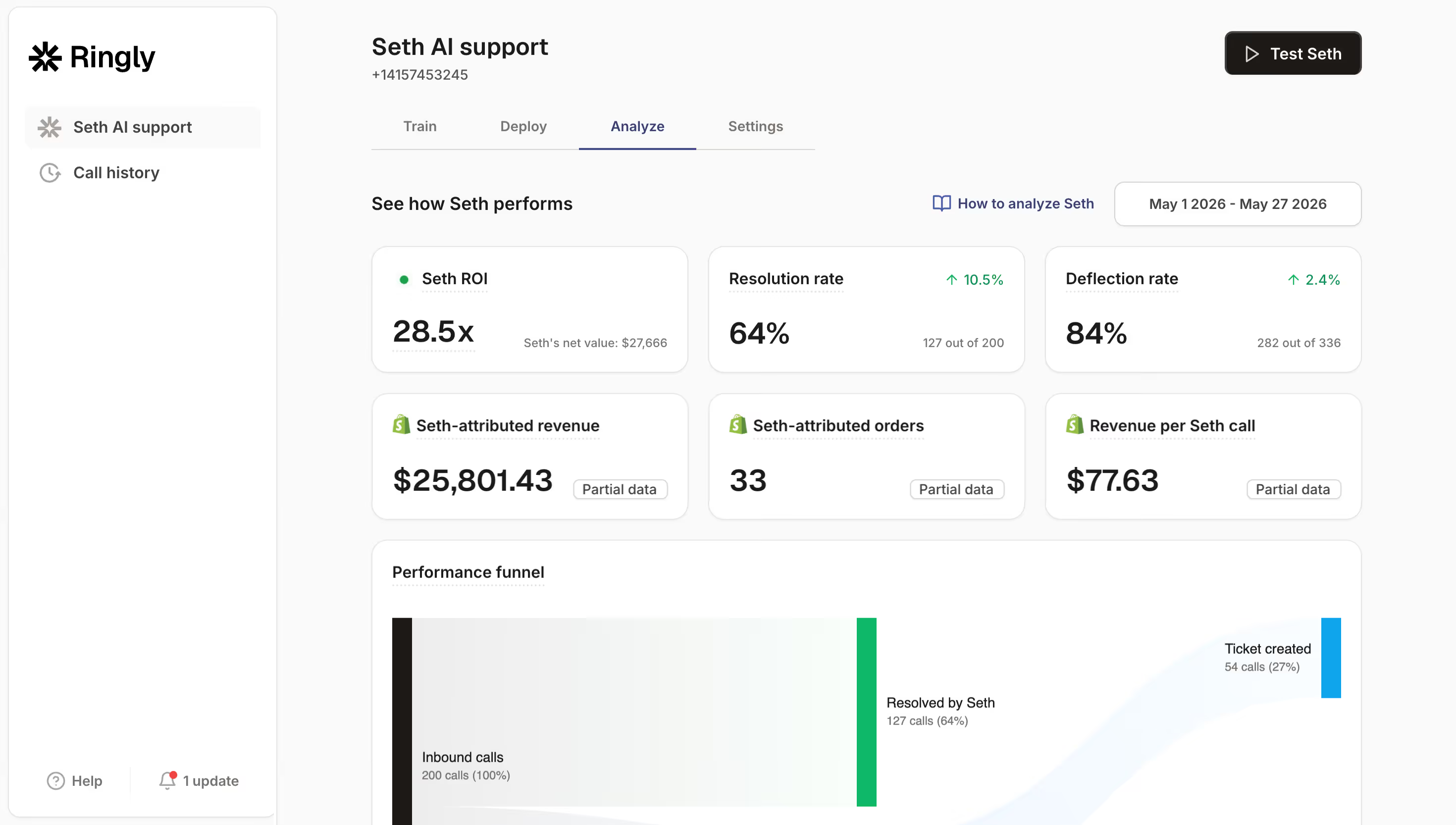
Ringly.io is AI phone support for Shopify brands. Instead of hiring and training a phone team during your migration month (the worst possible time to hire), the AI handles inbound calls 24/7: order status, returns, product questions, abandoned cart rescue. Across 50+ brands, the AI resolves 73% of calls autonomously at roughly $0.42 per resolved call. Plans start at $349/mo with a 65% resolution guarantee. Live in under an hour.
A few related reads if you want to dig deeper on the support side: ecommerce customer service, Shopify customer service apps, and the WISMO calls breakdown.
Try Ringly.io free for 14 days and get phone support live before you cut over.
How much does a WooCommerce to Shopify migration cost in 2026?
The honest answer: it depends, and most published numbers are stale. Here are current 2026 ranges based on the SERP plus what we've seen brands actually pay.
| Approach | Migration cost | Best for |
|---|---|---|
| DIY manual CSV | $0-$500 | Under 500 SKUs, no order history needed |
| Shopify Store Migration app | $0 (free tool) | Most small/mid stores, products + blog only |
| Third-party tool (LitExtension, Matrixify) | $59-$500 one-time | Mid-sized stores needing customers and orders |
| Mid-tier agency | $5,000-$15,000 | Stores with complex catalogs or custom needs |
| Enterprise / Shopify Plus migration | $20,000-$75,000 | Plus migrations, B2B, custom integrations |
Don't forget the ongoing Shopify costs:
- Shopify plan: $39 (Basic) to $399 (Advanced) to $2,500+ (Plus)
- Apps: budget $100-$400/mo extra in the first year as you discover which WooCommerce plugins need paid Shopify replacements
- Payment processing fees: 2.9% + 30¢ on Basic, dropping to 2.4% + 30¢ on Advanced and lower on Plus
- Theme: free (Dawn) or $180-$400 one-time for a premium theme
Calculate the cost of staying too. If you're paying $200/mo for managed WordPress hosting, $50/mo for security plugins, $30/mo for backups, $60/mo for a page builder, and $500/mo for a WordPress developer on retainer, that's $840/mo or $10,080/year. A Shopify Advanced plan at $399/mo plus $200 in apps is $7,188/year. The math gets compelling once you count the dev hours.
The Shopify store statistics and Shopify Plus benefits posts have more on the long-term economics.
Frequently asked questions
Will I lose my SEO during the migration? Short-term, yes. Most stores lose 20 to 40 percent of organic traffic in the first 30 days if 301 redirects are skipped or done poorly. With proper redirects and a quick Search Console resubmit, traffic typically recovers within 60 to 90 days.
Can I keep my customers' passwords? No. Shopify does not import password hashes from WooCommerce. Every returning customer needs to reset their password on first login. Send a comms email 24 hours before cutover so they're not surprised.
How long does a WooCommerce to Shopify migration actually take? Realistically, 30 to 60 days for small to mid-sized stores. Enterprise migrations with complex catalogs and custom integrations run 8 to 12 weeks. The "1-week migration" stories online assume nothing else is going on in your business.
Will my product reviews come over? Not natively. WooCommerce review data has to be exported separately and imported into your chosen Shopify review app (Judge.me, Loox, Yotpo). Plan this as a week 3 task, not an afterthought.
How do I migrate WooCommerce Subscriptions to Shopify? You'll re-onboard active subscribers into a Shopify subscription app like Recharge ($99/mo + transaction fee) or Skio (1% per transaction). Existing billing cycles need manual review and a customer comms email. Treat it as its own mini-project.
Does Shopify have a free migration tool? Yes. Shopify's official Store Migration app is free and handles products and blog posts from a WooCommerce CSV. It doesn't handle customers, orders, or reviews, so most stores still need a paid third-party tool for those.
What's the biggest mistake brands make during migration? Underestimating the post-launch support spike. Most founders plan the cutover well, then get blindsided by tripled support volume in weeks 1 and 2. Build the FAQ page, bank the canned responses, and have a phone-support plan before you go live.
The takeaway
Migrating from WooCommerce to Shopify is doable. It's not the disaster Reddit makes it out to be, and it's not the weekend project the agency landing pages sell either.
Plan for 30 to 60 days. Budget $59 to $500 if you're doing it yourself with a tool, or $5,000 to $75,000 if you're hiring an agency. Get the 301 redirects right or your SEO will hurt for a quarter. And plan for the post-launch month, not just launch day.
If you're moving to Shopify in the next 90 days, the support spike is the part that's going to surprise you. Get phone coverage handled before you cut over, not after.
Ready to see what AI phone support looks like for your store? Start your free trial. Setup takes under an hour.